

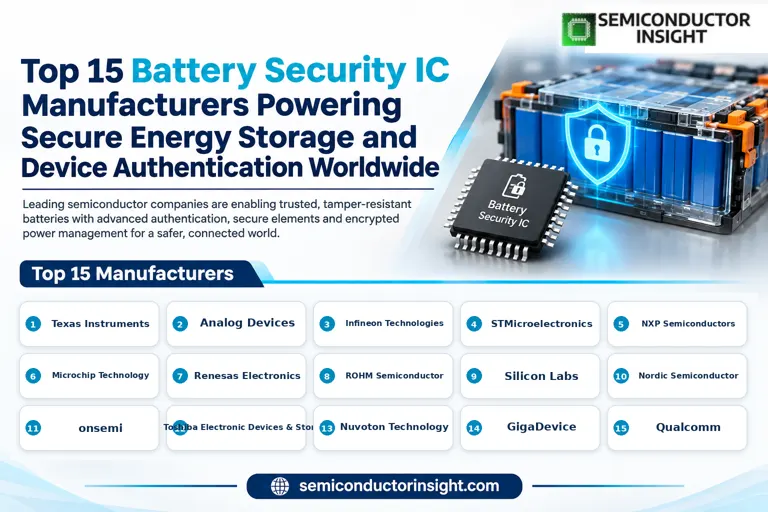
Top 15 Battery Security IC Manufacturers Powering Secure Energy Storage and Device Authentication Worldwide
Battery security ICs are becoming an increasingly important component of modern battery architecture as manufacturers move from conventional battery protection towards digitally authenticated, traceable and tamper-resistant power systems. These specialised integrated circuits help establish whether a battery pack is genuine, protect cryptographic keys, authenticate communication between a battery and its host device, and safeguard sensitive battery information against unauthorised modification.
The technology extends beyond conventional battery management ICs. It includes standalone SHA/HMAC authentication devices, ECDSA-based secure authenticators, embedded secure elements, cryptographic co-processors and integrated fuel-gauge solutions with authentication capabilities.
Texas Instruments – Advancing Battery Authentication through SHA/HMAC Security and Integrated Fuel Gauging
Texas Instruments has a particularly relevant position in battery security ICs because its portfolio includes devices developed specifically for battery-pack authentication rather than relying exclusively on general-purpose cybersecurity components. Its BQ26100 is a notable example, using SHA-1-based HMAC authentication to establish whether a battery pack originates from an authorised manufacturer.
The technical implementation is particularly relevant to compact battery applications. BQ26100 stores a unique 128-bit secret key, includes 160 bytes of one-time-programmable memory and 16 bytes of EEPROM, and communicates through a single-wire SDQ interface operating at 5 kbits per second. Its typical sleep current is just 8 µA. These specifications make it suitable for applications where authentication must operate without placing a substantial additional burden on the battery.
Another important development is TI’s newer TMF0020, TMF0064 and TMF0008 family, which combines FRAM storage with a 64-bit unique identification number and single-wire communication. The portfolio gives manufacturers additional options for battery identification and protected accessory communication.
Analog Devices – Extending Battery Identity Protection through ECDSA-Based Secure Authentication
Analog Devices has an established position in secure battery authentication through its former Maxim Integrated portfolio. Its DS28E30 1-Wire ECDSA Secure Authenticator is particularly relevant for applications requiring stronger asymmetric authentication than conventional identification-based systems.
The device combines an ECC P-256 cryptographic engine, a true random number generator, 3 Kbits of secure EEPROM and a unique 64-bit factory-programmed identification number. Its 17-bit decrement-only counter also enables authenticated tracking of usage or charge-related events. The single-contact 1-Wire interface is useful in battery designs where connector space and additional communication wiring are limited.
Its relevance extends to portable medical equipment, rechargeable accessories and consumer electronics, where unauthorised replacement batteries can create safety and reliability concerns. The DS28E30 remains listed as recommended for new designs, making it a relevant component for ongoing design evaluations.
Infineon Technologies – Building Battery Trust through the OPTIGA Authenticate Portfolio
Infineon Technologies has developed a focused authentication portfolio through its OPTIGA product family, with particular relevance to mobile device batteries and counterfeit prevention.
The OPTIGA Authenticate On is specifically designed for mobile battery authentication. It incorporates 2 Kbits of non-volatile memory, two lifecycle counters and a 500 kbps Single-Wire Interface. Its compact package measures approximately 1.5 × 1.2 × 0.4 mm, making it suitable for integration into space-constrained phone and tablet battery assemblies.
An important aspect of Infineon’s approach is its emphasis on product identity at the component level. A battery can carry its own protected identity rather than depending entirely on information stored by the host device. This is particularly relevant for smartphone manufacturers, repair ecosystems and authorised replacement battery suppliers.
STMicroelectronics – Strengthening Battery Brand Protection through STSAFE Secure Elements
STMicroelectronics has developed a dedicated solution for consumable and accessory authentication through its STSAFE-L010 secure element. The component is particularly relevant to branded batteries because it allows the host device to distinguish genuine battery products from third-party alternatives.
Its architecture uses certificate-based authentication and asymmetric Edwards-curve cryptography. The component also offers 32 Kbytes of secure non-volatile memory, secure counters and I²C or ST1Wire connectivity. Its compact DFN8 package measures 2 × 3 mm.
An important development is the wider STSAFE ecosystem, which includes solutions for connected accessories, industrial equipment and personal electronics. The availability of an expansion board compatible with STM32 and Arduino ecosystems also gives developers a practical route to prototype authentication systems before integrating them into commercial battery designs.
NXP Semiconductors – Connecting Battery Authentication with Digital Battery Passport Infrastructure
NXP Semiconductors is gaining strategic relevance through its approach to secure battery management, which combines battery-monitoring hardware, automotive microcontrollers and dedicated secure elements.
Its SecureBMS architecture incorporates the NCJ37-BMS secure element and supports cryptographic authentication, protected battery data storage and secure communication with cloud infrastructure. The secure element carries Common Criteria EAL6+ certification and automotive AEC-Q100 qualification. It also supports passive NFC access, allowing battery-related information to be retrieved even when the battery management system is disconnected from its 12 V supply.
A notable development is NXP’s collaboration with TNO on a secure battery passport demonstrator. The reference architecture incorporates an S32K358 microcontroller with three Arm Cortex-M7 cores, including two configured in lockstep, alongside the secure element. The demonstrator connects battery management hardware with cloud-based lifecycle information, addressing an increasingly important requirement for electric vehicles and stationary energy storage.
To Know More about the Report, You Can Freely Browse Our Latest Updated Report: https://semiconductorinsight.com/report/battery-security-ics-market/
Microchip Technology – Expanding Cryptographic Authentication through the ATECC608C Family
Microchip Technology is an important additional participant in the battery security IC ecosystem through its CryptoAuthentication portfolio. Although its ATECC608C is not exclusively marketed as a battery-authentication IC, its hardware security capabilities make it relevant to battery-powered connected devices and authenticated accessory systems.
The component supports ECDSA, ECDH, SHA-256, HMAC and AES-128 operations. It can securely manage up to 16 keys, certificates or data objects and incorporates two high-endurance monotonic counters. Its guaranteed unique 72-bit serial number provides an additional foundation for device identity verification.
Its significance lies in enabling battery manufacturers and equipment developers to create customised authentication architectures. Applications can include secure battery identification, firmware validation, authenticated communications and protection against unauthorised component substitution.
Renesas Electronics – Supporting Secure Battery Architectures through Integrated Battery Management
Renesas Electronics participates in the wider battery security ecosystem through its lithium-ion battery management portfolio, covering charging, protection, monitoring, balancing and fuel gauging.
Its solutions address rechargeable systems ranging from 2-, 3- and 4-cell portable battery configurations to automotive battery management applications. This broad coverage makes Renesas relevant to manufacturers developing connected power systems that require battery monitoring alongside secure host-device communication.
The company’s strategic relevance is its ability to support the battery-management layer into which secure authentication can be integrated. As battery systems become more connected, manufacturers increasingly need to combine accurate state-of-charge information, protection functions, firmware integrity and authenticated data exchange rather than treating these as independent design requirements.
ROHM Semiconductor – Developing Multi-Cell Battery Protection for Secure Power Systems
ROHM Semiconductor contributes to the battery security ecosystem through lithium-ion monitoring and protection components designed for rechargeable battery packs.
Its ML5262-102TBZ battery management LSI is particularly relevant to multi-cell applications, supporting battery packs containing 4 to 10 series-connected lithium-ion cells. The device monitors individual cell voltages, charge and discharge current, and temperature while supporting protection against overcharge, over-discharge and overcurrent conditions. Its typical operating current is 300 µA, while power-down consumption is approximately 1 µA.
Although this device is not a dedicated cryptographic authenticator, its monitoring architecture is relevant to secure battery platforms in which cell-level information must be protected and communicated reliably. ROHM’s position is therefore strongest in the complementary battery-management segment.
Silicon Labs – Bringing Hardware Root-of-Trust Capabilities to Connected Battery Systems
Silicon Labs is an important adjacent participant because its Secure Vault technology addresses several security requirements associated with connected battery-powered equipment.
Its security architecture incorporates true random number generation, cryptographic engines, secure application boot and protected key management, depending on the device and Secure Vault tier. Higher security configurations also provide anti-tamper capabilities, secure attestation and protected cryptographic key storage.
These capabilities are relevant to connected battery systems used in smart meters, wireless industrial sensors, monitoring equipment and other devices where the battery-powered electronics must maintain trusted communication throughout their operating life. Its role is primarily at the embedded security and system-controller level rather than dedicated battery-pack authentication.
Nordic Semiconductor – Securing Battery-Powered Wireless Devices Through Hardware-Protected Keys
Nordic Semiconductor has an important role in connected battery-powered products, particularly where wireless communication and long operating life must be combined with secure device identity.
Its nRF platform includes hardware-assisted cryptography, hardware unique keys and protected key-management capabilities. For example, the nRF52840 supports AES-128, SHA-1 and SHA-2 up to 256 bits, HMAC and hardware cryptographic acceleration. Its secure boot and access-port protection features also help protect embedded applications against unauthorised modification.
These technologies are relevant to battery-operated tracking devices, smart sensors, connected power equipment and wireless battery monitoring systems. Nordic’s contribution is strongest in protecting the electronics and communication layer surrounding the battery rather than providing a standalone battery authentication chip.
onsemi – Supporting Battery System Integrity Through Power and Monitoring Semiconductor Technologies
onsemi is a complementary semiconductor supplier in the battery security ecosystem, particularly through its involvement in power management, automotive electronics and battery-related system components.
Its relevance to this technology segment comes from the increasing need to connect battery monitoring and power-control hardware with secure automotive electronics. In electric vehicles, battery management is not limited to measuring cell voltage; it also involves reliable communication between battery controllers, vehicle control units and associated electronic subsystems.
The distinction is important for manufacturers evaluating suppliers. onsemi should be considered a broader battery and automotive semiconductor participant rather than a directly verified supplier of a dedicated battery-authentication IC comparable to TI’s BQ26100 or Infineon’s OPTIGA Authenticate On.
Toshiba Electronic Devices & Storage – Addressing Battery Protection and Power-System Reliability
Toshiba is relevant to the broader battery semiconductor landscape through its power-management, protection and electronic component technologies.
Battery-powered equipment requires reliable monitoring and protection circuits to manage voltage conditions, prevent electrical faults and maintain stable system operation. These functions become particularly important when battery packs are incorporated into industrial equipment, portable electronics and connected products.
For battery security applications, Toshiba’s potential relevance lies in the wider semiconductor architecture surrounding authentication. Dedicated cryptographic identity verification must be distinguished from conventional battery protection, and Toshiba’s inclusion here represents the adjacent battery electronics ecosystem rather than a confirmed standalone battery-authentication product portfolio.
Nuvoton Technology – Extending Embedded Security Into Battery-Controlled Electronics
Nuvoton Technology is an additional participant in the embedded security semiconductor ecosystem. Its relevance is associated with microcontrollers and hardware-level security functions used in connected electronic equipment.
As battery systems become increasingly software-controlled, secure boot, protected firmware execution and reliable communication between embedded controllers become important considerations. These capabilities can help prevent unauthorised changes to the software controlling battery-related functions.
Nuvoton’s potential application relevance includes battery-powered industrial controllers, smart electronics and equipment incorporating embedded monitoring. However, it should be classified as an adjacent embedded-security provider rather than a confirmed dedicated battery-authentication IC supplier.
GigaDevice – Supporting Secure Embedded Processing for Battery-Connected Applications
GigaDevice is another adjacent semiconductor participant worth tracking as embedded processing becomes more important in connected battery architectures.
Battery monitoring systems increasingly rely on microcontrollers to process sensor inputs, execute protection algorithms and communicate with external controllers. Secure firmware management and protected device identity are relevant to these architectures, particularly when battery information is transmitted to connected equipment or remote management platforms.
GigaDevice’s relevance to this landscape is therefore associated with the embedded processing layer. It should not be confused with suppliers that have explicitly documented standalone battery authentication products.
Qualcomm – Connecting Battery-Powered Electronics With Secure Device Ecosystems
Qualcomm represents a broader connected-device semiconductor participant rather than a specialist battery authentication IC supplier.
Its relevance comes from the integration of power management, application processing and connectivity in mobile electronics. In smartphones and other connected devices, battery identification and charging behaviour are closely connected with the host system’s power-management architecture.
As manufacturers strengthen protection against unauthorised replacement components, secure device identity and authenticated communication become increasingly relevant to the wider mobile electronics ecosystem. Qualcomm’s role in this assessment is therefore complementary, particularly in host-device architectures, rather than direct competition in standalone battery security ICs.

Comments (0)