

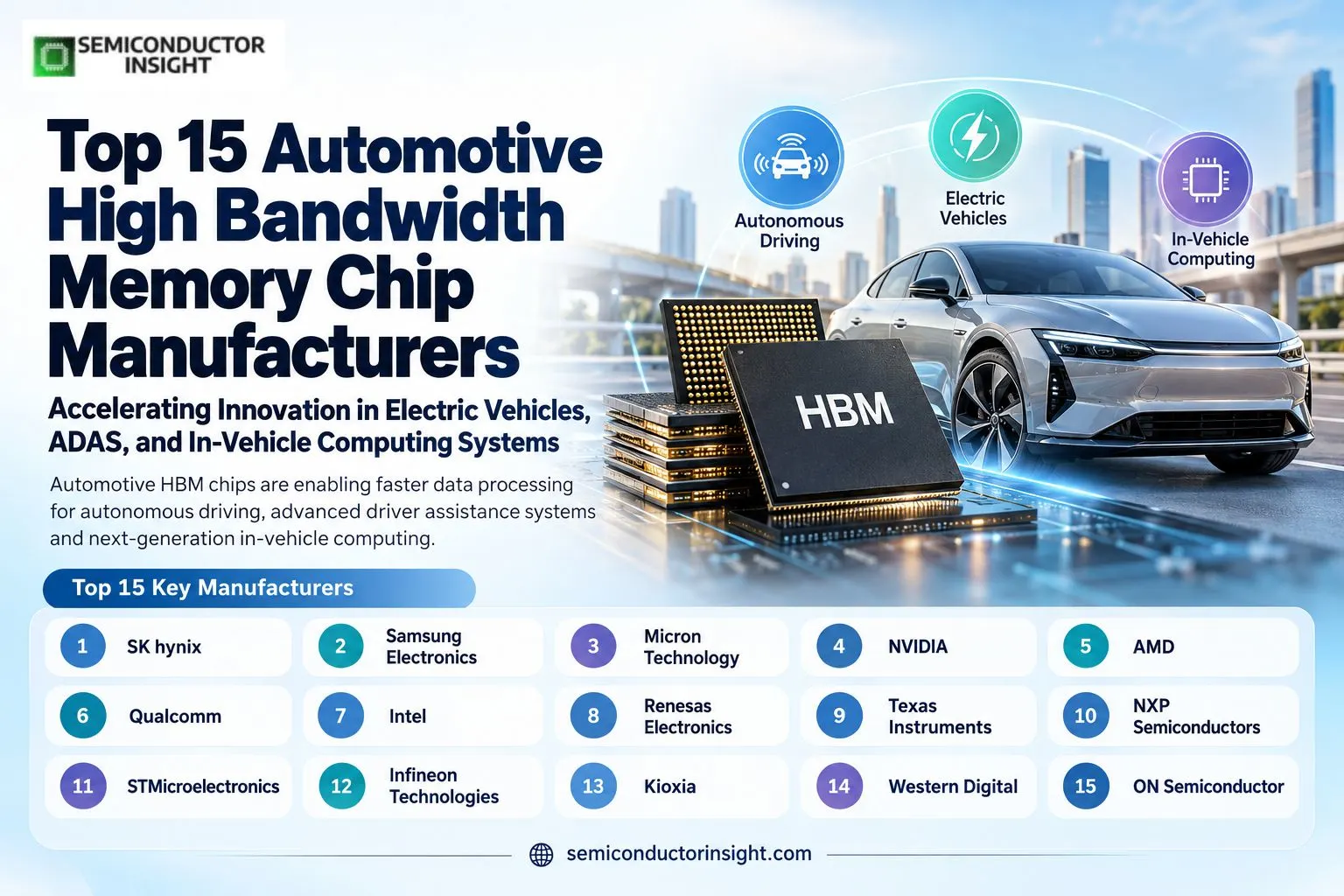
Top 15 Automotive High Bandwidth Memory Chip Manufacturers Accelerating Innovation in Electric Vehicles, ADAS, and In-Vehicle Computing Systems
Automotive HBM chip market sits at the intersection of high-bandwidth memory (HBM), automotive semiconductors and increasingly sophisticated in-vehicle computing. HBM is a vertically stacked DRAM technology that uses wide interfaces and advanced packaging to move large volumes of data between memory and processors.
It is particularly important in AI accelerators and high-performance computing systems, where conventional memory bandwidth can become a bottleneck.
SK hynix – Extending AI Memory Leadership towards Connected and Autonomous Vehicles
SK hynix is a central company in the HBM ecosystem because its stacked DRAM products serve compute-intensive AI workloads. Its automotive relevance is developing alongside its established HBM business, rather than through a confirmed mass-market automotive HBM product. At Mobile World Congress (MWC) 2026, the company showcased HBM4 alongside automotive LPDDR6, LPDDR5/5X, UFS storage and automotive SSDs, explicitly connecting its memory portfolio with autonomous driving and connected-car applications.
A particularly relevant development is its 16-gigabit LPDDR6, announced on 10 March 2026. SK hynix reported a data-transfer speed of 10.7 Gbps and improvements of 33% in speed and more than 20% in power efficiency compared with LPDDR5X. The company initially positioned this generation for on-device AI, but the underlying emphasis on bandwidth and energy efficiency is relevant to the broader automotive-computing transition. Its importance lies in developing complementary memory technologies for different workloads: HBM for demanding AI accelerators and low-power DRAM for embedded and vehicle applications.
Samsung Electronics – Bringing HBM4 Manufacturing Advances into the AI Compute Ecosystem
Samsung Electronics is an important HBM supplier because it combines DRAM manufacturing, advanced logic integration and semiconductor packaging expertise. On 12 February 2026, Samsung announced HBM4 mass production and commercial shipments, reporting a consistent transfer speed of 11.7 Gbps, with support for speeds up to 13 Gbps. Its implementation combines sixth-generation 10-nanometre-class DRAM with a 4-nanometre logic base die. These developments matter to the broader computing market because higher memory bandwidth can help processors handle increasingly complex AI workloads.
For automotive applications, however, Samsung’s HBM progress should not be confused with an established HBM-equipped vehicle platform. Its broader memory and semiconductor capabilities make it relevant to future automotive AI systems, where processors may need to manage sensor fusion, perception and increasingly sophisticated in-cabin computing. The commercial opportunity depends on whether automotive compute architectures adopt HBM and whether the resulting memory-and-processor combinations satisfy automotive reliability, thermal and qualification requirements.
Micron Technology – Connecting Automotive-Qualified DRAM with Growing Compute Requirements
Micron occupies two relevant positions in the automotive memory ecosystem: it manufactures HBM for AI and high-performance computing, and it supplies automotive-qualified DRAM and storage. Its automotive portfolio includes LPDDR5X, NAND, UFS and other memory products designed for applications such as advanced driver-assistance systems, digital cockpits and central vehicle computing.
In 2026, Micron reported HBM4 high-volume production, including a 36 GB 12-high configuration with bandwidth exceeding 2.8 TB/s. Separately, its automotive LPDDR5X catalogue includes 16-gigabit and 32-gigabit devices, with supported operating-temperature options extending to 125°C for certain products. These are distinct product categories, but together they demonstrate the company’s ability to address different memory requirements across the computing ecosystem.
Micron’s significance is particularly clear in the transition towards more capable vehicle computers. Its automotive memory qualifications and HBM development allow it to participate in both conventional in-vehicle memory demand and the broader AI infrastructure market that develops the technologies used by advanced processors.
AMD – A High-Performance Computing Player with Potential Automotive Relevance
AMD belongs in this analysis because of its processor, GPU and HBM-enabled computing expertise, although it is not a primary automotive HBM memory manufacturer. Its Instinct accelerator portfolio illustrates the relationship between compute performance and memory bandwidth: AMD’s data-centre accelerators use high-bandwidth memory to support demanding parallel workloads.
The distinction is important for automotive applications. HBM could become relevant where future vehicle-computing systems require substantially greater memory throughput for complex AI inference, simulation or centralised processing. However, AMD’s HBM-enabled data-centre products should not be treated as confirmed production automotive components.
AMD’s relevance to the automotive HBM ecosystem is therefore technological and potential rather than evidence of established automotive HBM shipments. The key developments to monitor are automotive-grade compute products, partnerships with vehicle-system suppliers and architectures that explicitly specify HBM instead of conventional external memory.
Our most recent updated related study is available for free at this link: https://semiconductorinsight.com/report/automotive-hbm-chip-market/
NVIDIA – Defining the Performance Requirements of AI-Centred Vehicles
NVIDIA is one of the most important automotive compute-platform suppliers because its DRIVE ecosystem targets advanced driver assistance, automated driving and centralised vehicle computing. Its DRIVE AGX Thor developer platform lists up to 1,000 INT8 TOPS of AI performance and 64 GB of LPDDR5X system memory, with memory bandwidth of up to 273 GB/s. The published configuration illustrates that high-performance automotive AI does not automatically require HBM.
This distinction makes NVIDIA particularly relevant to the market. Its computing platforms help establish the processing, memory-capacity and bandwidth requirements against which future vehicle architectures are evaluated. HBM could become attractive for more demanding automotive AI workloads, but adoption depends on system architecture, power consumption, cost, cooling and automotive qualification.
- For memory suppliers, NVIDIA’s automotive ecosystem is worth watching because its processor roadmaps can influence the requirements of Tier-1 suppliers and vehicle manufacturers.
- Its current published DRIVE AGX Thor specifications, however, identify LPDDR5X rather than HBM as the system memory.
Intel and Mobileye – Efficient Vision Processing for Advanced Driver Assistance
Intel’s automotive relevance is closely connected with Mobileye, whose EyeQ processors are designed for computer vision, driver assistance and autonomous-driving applications. Mobileye states that more than 27 vehicle manufacturers have selected EyeQ technology for assisted-driving systems. Its architecture uses specialised accelerators for vision processing, signal processing and machine learning rather than relying exclusively on general-purpose computing. Mobileye
This design philosophy matters to the automotive HBM discussion because the memory requirements of a vehicle processor depend on its architecture. Specialised vision accelerators can be designed around particular workloads and power budgets, while more generalised AI computing platforms may require greater memory bandwidth and capacity.
Mobileye’s position is therefore different from that of an HBM manufacturer. Its influence comes from defining the computing requirements of production-oriented ADAS systems. Any future shift towards HBM would need to be established through a specific product announcement or documented system architecture rather than inferred from the increasing complexity of autonomous-driving software.
Qualcomm Technologies – Combining Digital Cockpits and Automated Driving
Qualcomm is expanding the role of central vehicle computing through its Snapdragon Digital Chassis, which covers digital cockpit, connectivity and automated-driving platforms. At CES 2026, Qualcomm reported that its digital-cockpit technologies had powered more than 75 million vehicles. It also highlighted the adoption of Snapdragon Ride and Ride Flex platforms, including designs that combine cockpit and ADAS functions on shared hardware. Qualcomm
The company’s relevance to memory demand is strengthened by the integration of several workloads within a vehicle. Digital displays, voice interfaces, driver monitoring and ADAS may compete for system resources when consolidated into a central platform. Memory bandwidth, capacity and latency therefore become important architectural considerations.
- However, Qualcomm’s current automotive ecosystem also relies on memory technologies other than HBM.
- Micron previously qualified automotive-grade LPDDR5X, UFS 3.1, Xccela flash and SPI-NOR memory for Snapdragon automotive platforms, demonstrating the importance of a broader memory portfolio.
- Qualcomm is a key potential demand-shaping company, not a confirmed automotive HBM manufacturer.
Renesas Electronics – Designing AI Processing Around Automotive Safety
Renesas is strengthening its position in intelligent vehicle electronics through its R-Car automotive system-on-chip family and research into more advanced automotive computing architectures. Its R-Car portfolio supports applications ranging from ADAS and in-vehicle infotainment to cross-domain computing, with functional-safety capabilities extending up to ASIL-D for supported implementations.
A notable development arrived on 18 February 2026, when Renesas announced three system-on-chip technologies for next-generation automotive multi-domain electronic control units. The technologies address AI processing, chiplet integration, power management and functional safety. The company also announced a configurable ternary content-addressable memory design using a 3-nanometre process, intended to support automotive SoCs and other demanding applications.
These developments matter because future vehicle computers must balance processing density with deterministic operation and thermal constraints. Renesas’s contribution is primarily in automotive compute architecture and embedded memory technologies, rather than commercial HBM production. Its work could influence the types of memory interfaces and packaging configurations required by future central vehicle computers.
TSMC – The Manufacturing and Packaging Link between HBM and Processors
TSMC occupies a critical position in the HBM ecosystem through its semiconductor manufacturing and advanced-packaging capabilities. HBM systems depend not only on memory-stack production but also on the ability to integrate memory and processors within a package that maintains signal integrity, thermal performance and high-bandwidth connections.
Its CoWoS advanced-packaging family includes CoWoS-S, CoWoS-L and CoWoS-R. TSMC describes these approaches as enabling different integration arrangements for high-performance computing, including the incorporation of HBM alongside advanced logic dies. In its published technology roadmap, the company reported that a CoWoS solution supporting interposers 5.5 times the mask or reticle size completed certification in 2025, with volume production planned for 2026. TSMC
For automotive HBM, the important question is whether advanced packaging can be adapted to the thermal, reliability, supply-chain and cost requirements of automotive systems. TSMC is not an HBM memory-chip vendor, but its manufacturing and packaging technologies are relevant to any future processor architecture that combines HBM with automotive computing silicon.
NXP Semiconductors – Central Vehicle Computing Without an HBM Dependency
NXP is developing processors for software-defined vehicles, where multiple electronic control functions can be consolidated into fewer, more capable computing platforms. Its S32N5 family includes the S32N55, which combines 16 Arm Cortex-R52 cores with lockstep Cortex-M7 management and communication processors. The device also includes 48 MB of platform SRAM, networking interfaces and support for LPDDR4X, LPDDR5 and LPDDR5X external DRAM.
- In January 2026, NXP introduced the S32N7 processor series, designed to centralise core vehicle functions and support more integrated software-defined vehicle architectures.
- Bosch was identified as the first company to deploy the S32N7 in its vehicle integration platform.
- NXP stated that consolidation could reduce vehicle-system complexity and total cost of ownership by eliminating dozens of hardware modules.
NXP’s relevance lies in the architecture of the vehicle itself. Centralised computing can increase the need for fast memory access, but safety-critical control functions have different requirements from large-scale AI accelerators. Consequently, NXP’s published LPDDR interfaces illustrate why much of automotive computing can evolve without adopting HBM.
Texas Instruments – Supporting the Vehicle’s Real-Time Electronic Infrastructure
Texas Instruments is relevant to the automotive semiconductor ecosystem through processors, microcontrollers, analogue components, power-management devices and sensing technologies. Its automotive portfolio supports functions such as radar, vehicle networking, battery management and digital cockpit systems. These applications contribute to the growing number of electronic subsystems within modern vehicles.
The company’s relationship with automotive HBM is indirect. Rather than supplying HBM stacks, Texas Instruments provides components that help vehicle electronics operate reliably within constrained power, temperature and safety requirements. Its processing and sensing products are generally designed around application-specific memory and real-time system needs.
This distinction is commercially important. Even if HBM becomes more common in high-end autonomous-driving computers, most vehicle electronic functions will continue to require dedicated microcontrollers, analogue interfaces and power-management devices. Texas Instruments therefore represents the broad semiconductor infrastructure surrounding automotive AI rather than a direct HBM supplier.
Broadcom – Advanced Connectivity and Custom Silicon for Data-Intensive Systems
Broadcom’s relevance to the automotive HBM market is primarily connected with custom silicon, high-speed connectivity and advanced semiconductor integration. The company’s broader semiconductor portfolio includes networking and switching products designed to move large volumes of data between processors and connected systems.
In automotive computing, high-bandwidth memory is only one part of the performance equation. A central vehicle computer must also transfer data from cameras, radar, other sensors and vehicle networks. The ability to move information efficiently between compute units and communication interfaces can therefore be as important as the bandwidth available within the processor package.
Broadcom should not be presented as a confirmed automotive HBM supplier without a specific product announcement establishing that role. Its relevance is instead found in the connectivity and custom-chip technologies that could support future data-intensive vehicle architectures. Its automotive HBM significance will depend on demonstrable involvement in vehicle-specific compute platforms rather than its broader AI infrastructure activities alone.
Infineon Technologies – Automotive Memory Qualification for AI-Driven Cockpits
Infineon has a direct automotive memory role, although its published products are primarily embedded flash and other automotive memory technologies rather than HBM. Its importance is increasing as software-defined vehicles require larger firmware images, more sophisticated cockpit software and dependable storage for safety-related functions.
On 6 August 2026, Infineon announced that MediaTek had qualified its 512-megabit Quad SPI NOR Flash for the Dimensity Auto Cockpit C-X1 platform. The qualification gives automotive manufacturers and Tier-1 suppliers an approved memory option for next-generation cockpit systems.
The development highlights an important distinction within automotive memory procurement. HBM targets extremely high bandwidth, while NOR flash is particularly relevant to firmware and code storage. Both technologies may be present in the wider vehicle-computing ecosystem, but they perform different functions.
Infineon’s strength lies in automotive qualification, reliability and integration with established vehicle-electronics platforms. Its role is therefore more directly connected with embedded automotive memory than with HBM manufacturing itself.
STMicroelectronics – Integrating AI Acceleration into Automotive Control Systems
STMicroelectronics is broadening the processing capabilities available for automotive applications while retaining a strong focus on functional safety and long product lifecycles. On 10 February 2026, the company introduced the Stellar P3E automotive microcontroller, which incorporates AI acceleration for edge intelligence. ST positioned the device for software-defined vehicles, including hybrid and electric powertrains and zonal electronic architectures.
The importance of the development is that AI processing is increasingly moving into individual vehicle subsystems. Instead of sending every task to a single powerful central computer, manufacturers can distribute selected functions across controllers positioned closer to the relevant equipment.
This architecture creates a different memory profile from an HBM-based AI accelerator. Embedded controllers prioritise predictable response times, safety and efficient local processing, while HBM is designed for exceptionally high data throughput. STMicroelectronics is therefore relevant to the broader transition towards intelligent vehicles, even though its announced automotive microcontroller is not an HBM-based product.
Ambarella – Processing Multiple Camera Streams for Autonomous Driving
Ambarella is an important automotive AI processor supplier, particularly in computer vision, multi-camera processing, driver monitoring and autonomous-driving applications. Its CV3-AD family targets systems ranging from L2+ driver assistance to more advanced L3 and L4 applications, combining neural processing with conventional vision and radar-processing capabilities.
The company’s relevance to memory requirements is clear when considering the amount of information generated by a vehicle’s sensors. A system may need to process several camera feeds alongside radar data, identify objects, track their movement and combine the results into a representation of the surrounding environment. Ambarella’s processors are designed to execute these tasks within automotive power and safety constraints.
However, the company’s published automotive portfolio does not establish HBM as a standard memory configuration for its processors. Its significance is that it demonstrates the growing processing demands of automotive perception systems. As sensor counts and AI workloads increase, memory capacity and bandwidth will remain important design considerations, but the chosen technology will depend on the processor architecture and vehicle requirements.
What These Companies Reveal About the Automotive HBM Opportunity?
The 15 companies occupy different positions in the emerging automotive memory ecosystem. SK hynix, Samsung and Micron are the most direct HBM manufacturers in this group, while TSMC provides advanced manufacturing and packaging capabilities. NVIDIA, AMD, Qualcomm and Mobileye influence processor architectures and computing requirements, whereas Renesas, NXP, Texas Instruments, Broadcom, Infineon, STMicroelectronics and Ambarella address different parts of the automotive electronics stack.

Comments (0)