Automotive HBM Chip Market Insights
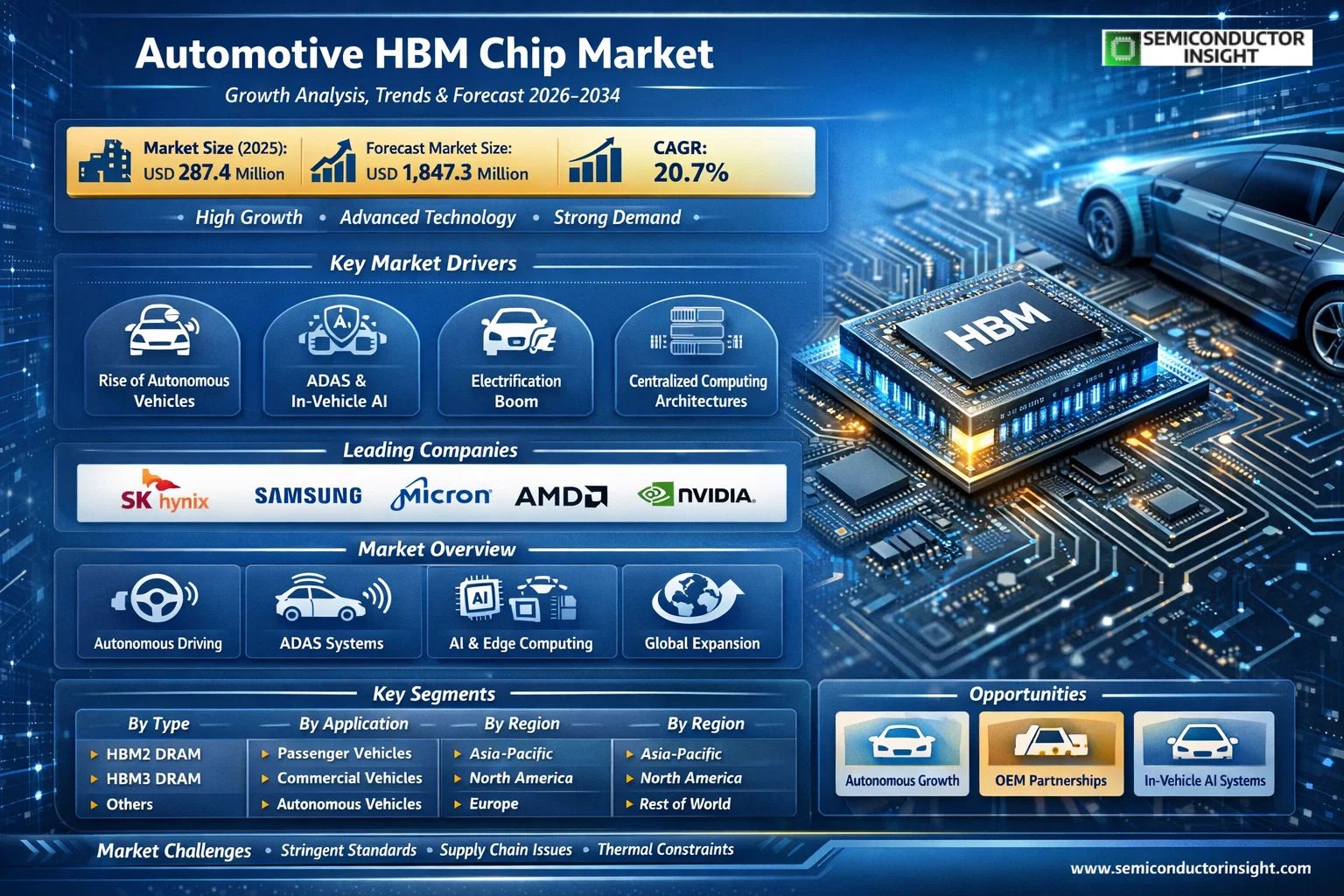
Global Automotive HBM Chip market size was valued at USD 287.4 million in 2025. The market is projected to grow from USD 334.6 million in 2026 to USD 1,847.3 million by 2034, exhibiting a CAGR of 20.7% during the forecast period.
High Bandwidth Memory (HBM) chips in automotive applications represent a specialized category of advanced semiconductor memory designed to deliver exceptional data throughput and energy efficiency within constrained thermal envelopes. Unlike conventional DRAM, HBM technology stacks multiple memory dies vertically using through-silicon via (TSV) interconnects, enabling significantly higher bandwidth at lower power consumption. In automotive contexts, these chips encompass variants such as HBM2 DRAM, HBM3 DRAM, and emerging iterations, each engineered to meet the stringent reliability and operating-temperature standards required by passenger vehicles and commercial vehicle platforms.
The market is experiencing accelerating momentum driven by the rapid proliferation of Advanced Driver Assistance Systems (ADAS), autonomous driving platforms, and in-vehicle artificial intelligence workloads that demand real-time, high-throughput data processing. Furthermore, the integration of centralized compute architectures by leading automakers , replacing distributed electronic control units with domain controllers and zonal architectures , is creating substantial demand for high-bandwidth memory solutions. SK Hynix, Samsung, and Micron are among the dominant global manufacturers actively advancing automotive-grade HBM portfolios to address these evolving system requirements.
MARKET DRIVERS
Rising Demand for High-Performance Computing in Next-Generation Vehicles
The automotive industry is undergoing a profound technological transformation, with advanced driver assistance systems (ADAS), autonomous driving platforms, and in-vehicle infotainment systems demanding unprecedented levels of data processing power. Automotive HBM Chip Market is experiencing accelerating growth as vehicle architectures increasingly rely on high-bandwidth memory to handle the massive data throughput required by AI inference engines and sensor fusion systems. High Bandwidth Memory chips are uniquely positioned to meet these requirements, offering significantly higher memory bandwidth per watt compared to conventional DRAM solutions, making them an ideal choice for power-constrained automotive environments.
Integration of AI and Machine Learning in Automotive Systems
Artificial intelligence and machine learning workloads embedded in modern vehicles are a primary catalyst propelling Automotive HBM Chip Market forward. Autonomous vehicle platforms require real-time processing of lidar, radar, and camera data streams simultaneously, placing extraordinary demands on memory bandwidth and latency. HBM chips provide the multi-terabyte-per-second bandwidth necessary to support these compute-intensive AI models without bottlenecking the system-on-chip processors. As OEMs and Tier-1 suppliers accelerate investments in Level 3 and Level 4 autonomous systems, the adoption of high-bandwidth memory solutions within automotive-grade SoCs is expected to deepen considerably over the forecast period.
➤ The transition toward software-defined vehicles is fundamentally restructuring automotive semiconductor architectures, with high-bandwidth memory emerging as a critical enabler of centralized computing platforms that consolidate multiple electronic control units into single, powerful domain controllers.
Electrification trends are also contributing to demand within Automotive HBM Chip Market, as battery management systems, powertrain control units, and energy optimization algorithms in electric vehicles increasingly leverage sophisticated computational hardware. The convergence of electrification and autonomy within a single vehicle platform creates compound demand for memory-intensive chips capable of operating reliably across wide automotive temperature ranges and stringent functional safety standards such as ISO 26262.
MARKET CHALLENGES
Stringent Automotive-Grade Qualification Requirements Pose Significant Barriers
One of the most significant challenges confronting Automotive HBM Chip Market is the rigorous qualification process that semiconductor components must undergo before they can be deployed in production vehicles. Unlike consumer electronics applications, automotive-grade components must comply with AEC-Q100 reliability standards and demonstrate long-term operational stability across extreme temperature ranges, typically from -40°C to 125°C or higher. The qualification timeline for a new memory component in an automotive application can span several years, creating extended go-to-market cycles for HBM chip manufacturers seeking entry into this segment. This prolonged validation process increases development costs and limits the pace at which cutting-edge memory technology can be transferred from data center applications into automotive environments.
Other Challenges
Supply Chain Complexity and Semiconductor Sourcing Risks
Automotive HBM Chip Market faces inherent supply chain vulnerabilities stemming from the highly concentrated nature of advanced memory chip manufacturing. HBM production relies on sophisticated 3D stacking processes, including through-silicon via technology, which are mastered by only a limited number of global semiconductor manufacturers. Automotive supply chains historically operate on long-term contracts with predictable volumes, creating friction when demand surges unexpectedly or when geopolitical disruptions affect wafer supply. The dependence on a narrow base of foundries and packaging specialists exposes automotive OEMs and Tier-1 suppliers to significant sourcing risk.
Thermal Management in Constrained Automotive Environments
High Bandwidth Memory chips generate considerable thermal output during sustained high-bandwidth operations, presenting thermal management challenges in the space-constrained and thermally demanding environment of an automotive platform. Engineers must develop sophisticated cooling solutions that maintain HBM junction temperatures within safe operating limits without adding excessive weight or cost to the vehicle. Balancing the performance advantages of automotive HBM chips against practical thermal and packaging constraints remains an ongoing engineering challenge that impacts the rate of broader market adoption.
MARKET RESTRAINTS
High Manufacturing Costs Limiting Widespread Adoption Across Vehicle Segments
The premium cost structure associated with High Bandwidth Memory technology represents a meaningful restraint on broader penetration across Automotive HBM Chip Market. HBM chips require advanced packaging techniques, including multi-die stacking with high-density interconnects, that are substantially more expensive to produce than conventional LPDDR or GDDR memory alternatives. This cost differential makes HBM solutions economically viable primarily for high-end autonomous driving compute platforms and premium vehicle segments, while volume mid-range and entry-level vehicles continue to rely on lower-cost memory architectures. Until manufacturing yields improve and economies of scale reduce per-unit costs, the addressable market for automotive HBM chips will remain concentrated among flagship and commercial autonomous vehicle platforms.
Regulatory Uncertainty and Evolving Functional Safety Standards
Evolving regulatory frameworks governing autonomous vehicle operation across major markets, including the United States, European Union, China, and Japan, introduce a layer of uncertainty that can delay automotive semiconductor procurement decisions. Automotive OEMs and Tier-1 suppliers may defer large-scale commitments to specific memory architectures, including HBM chip platforms, while awaiting clearer regulatory guidance on the permissible levels of vehicle automation in public road environments. Additionally, ongoing updates to functional safety standards and cybersecurity regulations such as UNECE WP.29 can require design revisions that extend product development timelines, indirectly restraining the pace of growth in Automotive HBM Chip Market in the near to medium term.
MARKET OPPORTUNITIES
Expansion of Autonomous Vehicle Programs Creating Substantial Long-Term Demand
The progressive scaling of autonomous vehicle development programs by both traditional automotive manufacturers and technology-focused mobility companies presents a substantial long-term growth opportunity for Automotive HBM Chip Market. As autonomous driving compute platforms evolve toward centralized zonal architectures requiring multi-hundred TOPS of AI inference capability, the demand for high-bandwidth, low-latency memory solutions is projected to intensify. HBM chips are uniquely suited to serve as the memory backbone for these next-generation central compute units, positioning established and emerging HBM suppliers to capture significant design wins as autonomous vehicle programs approach production readiness across the industry.
Partnerships Between Semiconductor Manufacturers and Automotive OEMs Accelerating Innovation
Strategic collaboration between leading semiconductor companies and automotive OEMs represents a compelling opportunity to accelerate the co-development of automotive-qualified HBM solutions tailored specifically for vehicular applications. Joint development agreements allow memory manufacturers to align product roadmaps with the long design cycles of the automotive industry while ensuring that automotive HBM chips meet platform-specific performance, reliability, and functional safety requirements from the outset. These partnerships also provide semiconductor companies with greater visibility into future vehicle program volumes, supporting more disciplined capacity planning and investment decisions that could ultimately help reduce unit costs and broaden the accessible market within Automotive HBM Chip Market.
Growth of In-Vehicle Data Centers and Edge AI Processing Architectures
The emerging concept of the vehicle as a mobile edge data center is creating new application opportunities for high-bandwidth memory within automotive platforms. As vehicles increasingly perform complex AI workloads locally rather than relying on cloud connectivity, the need for on-board memory solutions capable of supporting sustained high-throughput data transfer between processors and memory subsystems grows substantially. This trend toward in-vehicle edge AI processing is expected to drive incremental adoption of HBM chips in premium and commercial vehicle segments, opening new revenue streams for market participants and broadening the overall addressable opportunity within Automotive HBM Chip Market throughout the coming decade.
Trends
Rising Demand for High-Performance Computing Accelerates Automotive HBM Chip Adoption
Automotive HBM Chip Market is witnessing a significant transformation, driven by the rapid integration of high-performance computing capabilities within modern vehicles. High Bandwidth Memory chips are increasingly becoming a foundational technology in automotive systems, particularly as the industry shifts toward autonomous driving and advanced driver assistance systems. These chips deliver exceptional memory bandwidth combined with improved power efficiency, enabling vehicles to process complex, real-time data streams generated by sensors, cameras, and radar modules. As automakers and semiconductor firms intensify their collaboration on next-generation vehicle architectures, demand for automotive-grade HBM solutions continues to strengthen across both passenger and commercial vehicle segments.
Other Trends
HBM Integration in ADAS and In-Vehicle AI Platforms
One of the most defining trends shaping Automotive HBM Chip Market is the deepening integration of HBM technology into ADAS and in-vehicle artificial intelligence platforms. Modern ADAS applications require low-latency data processing and high throughput to support functions such as lane detection, collision avoidance, pedestrian recognition, and adaptive cruise control. HBM chips, with their stacked die architecture and wide memory bus, are well-positioned to meet these stringent computational demands. Leading chipmakers including SK Hynix, Samsung, and Micron are actively developing automotive-qualified HBM variants that comply with AEC-Q100 reliability standards, enabling broader deployment across vehicle safety-critical systems.
Transition from HBM2 to HBM3 DRAM in Automotive Platforms
Automotive HBM Chip Market is undergoing a generational shift as system designers begin evaluating HBM3 DRAM alongside the currently dominant HBM2 DRAM solutions. HBM3 offers substantially higher bandwidth and improved energy efficiency compared to its predecessor, making it attractive for next-generation autonomous driving compute platforms that require sustained high-performance operation over extended periods. While HBM2 DRAM continues to hold a significant share of the current market owing to its established supply chains and proven automotive qualifications, the migration toward HBM3 is expected to gain momentum as autonomous vehicle programs progress from pilot stages to broader commercial rollouts.
Regional Dynamics and Competitive Landscape Shaping Market Trajectory
From a regional perspective, North America and Asia remain at the forefront of automotive HBM chip adoption, with the United States and China representing key demand centers driven by strong investments in electric vehicles, autonomous mobility programs, and in-vehicle computing infrastructure. South Korea continues to play a pivotal role on the supply side, with major memory manufacturers headquartered there directing substantial research and development resources toward automotive HBM solutions. Europe is also gaining traction, particularly through automotive technology hubs in Germany and the broader push for software-defined vehicle architectures. The competitive landscape remains concentrated, with the top three global players , SK Hynix, Samsung, and Micron , collectively accounting for the majority of market revenue, underscoring the high barriers to entry associated with advanced HBM chip manufacturing and automotive-grade qualification processes.
COMPETITIVE LANDSCAPE
Key Industry Players
Automotive HBM Chip Market – Competitive Dynamics, Strategic Positioning, and Leading Manufacturer Profiles
Global Automotive High Bandwidth Memory (HBM) Chip market is characterized by a highly concentrated competitive structure, with a handful of technologically advanced semiconductor giants commanding a dominant share of global revenues. SK Hynix, Samsung Electronics, and Micron Technology collectively represent the most influential forces shaping the market’s trajectory. SK Hynix, in particular, has established itself as the foremost leader in HBM technology, holding a commanding position in the supply of HBM2 and HBM3 DRAM solutions tailored for automotive-grade applications. The company’s sustained investment in advanced packaging technologies and its close partnerships with automotive AI chip developers , including NVIDIA and AMD , have reinforced its competitive moat. Samsung Electronics follows as a formidable rival, leveraging its vertically integrated manufacturing capabilities and extensive R&D infrastructure to deliver high-performance, thermally optimized HBM solutions for ADAS, autonomous driving platforms, and in-vehicle AI computing systems. Micron Technology, the primary U.S.-based competitor, has been aggressively scaling its HBM3 production capacity and forging strategic collaborations with automotive OEMs and Tier-1 suppliers to capture a larger share of this rapidly evolving segment.
Beyond the top three memory giants, the automotive HBM chip ecosystem encompasses a broader set of significant participants, including specialized semiconductor design firms and automotive-grade chip solution providers. Companies such as AMD and NVIDIA, while primarily known as GPU and processor developers, are pivotal indirect players whose HBM-integrated products , including automotive SoCs and AI accelerators , are driving substantial HBM demand in next-generation vehicles. Firms like Mobileye (an Intel company), Qualcomm, and Renesas Electronics are actively integrating HBM-compatible memory architectures into their advanced automotive computing platforms. Additionally, TSMC and other foundry partners play a critical supporting role in enabling the fabrication of HBM-adjacent logic dies used in 2.5D and 3D chip stacking configurations. The competitive intensity in this market continues to escalate as automotive electrification, rising ADAS content per vehicle, and Global push toward Level 3 and Level 4 autonomous driving create sustained, long-term demand for high-bandwidth, low-latency memory solutions across both passenger and commercial vehicle segments.
List of Key Automotive HBM Chip Companies Profiled
- SK Hynix
- Samsung Electronics
- Micron Technology
- AMD (Advanced Micro Devices)
- NVIDIA Corporation
- Intel Corporation (Mobileye)
- Qualcomm Technologies
- Renesas Electronics
- TSMC (Taiwan Semiconductor Manufacturing Company)
- NXP Semiconductors
- Texas Instruments
- Broadcom Inc.
- Infineon Technologies
- STMicroelectronics
- Ambarella Inc.
Segment Analysis:
| Segment Category | Sub-Segments | Key Insights |
| By Type |
|
HBM2 DRAM currently holds a dominant position in Automotive HBM Chip Market, serving as the foundational memory technology adopted across early-generation autonomous and semi-autonomous vehicle platforms.
|
| By Application |
|
Passenger Vehicle represents the leading application segment for automotive HBM chips, propelled by the rapid proliferation of intelligent driver assistance features and in-cabin AI-driven experiences across premium and mid-range personal vehicle categories.
|
| By End User |
|
Original Equipment Manufacturers (OEMs) constitute the primary end-user category in Automotive HBM Chip Market, as they are responsible for defining the compute architecture requirements embedded within vehicle platforms from the earliest design stage.
|
| By Technology Integration |
|
ADAS & Autonomous Driving Systems represent the most strategically significant technology integration segment for automotive HBM chips, as the complexity of real-time perception, decision-making, and actuation in autonomous platforms creates an insatiable appetite for high-bandwidth, low-latency memory solutions.
|
| By Autonomy Level |
|
SAE Level 4 (High Automation) is anticipated to be the most transformative autonomy tier driving near-term and mid-term HBM chip demand in the automotive sector, as it demands robust, fail-operational compute platforms that can sustain complex AI workloads across extended operational periods without human intervention.
|
Regional Analysis: Automotive HBM Chip Market
Asia-Pacific
South Korea and Taiwan form the technological backbone of Automotive HBM Chip Market in Asia-Pacific. Leading memory manufacturers and advanced foundries in these countries supply high-performance, automotive-grade HBM chips to global OEMs. Their expertise in miniaturization, process node advancement, and automotive qualification standards gives Asia-Pacific a lasting competitive advantage in this high-growth semiconductor segment.
China’s position as the world’s largest electric vehicle market directly fuels demand for automotive HBM chips. The proliferation of advanced driver assistance systems, intelligent cockpit electronics, and autonomous driving platforms across Chinese EV brands creates sustained and growing requirements for high bandwidth memory solutions, making China a key growth engine within the regional automotive HBM chip ecosystem.
Japan brings unmatched depth in automotive electronics engineering to the regional automotive HBM chip market. Japanese Tier-1 suppliers and automakers have long prioritized reliability, safety compliance, and thermal performance in electronic components. This culture of engineering precision accelerates the adoption of automotive-grade HBM chips in safety-critical applications, reinforcing Japan’s strategic relevance in the regional market landscape.
Governments across Asia-Pacific have identified semiconductor self-sufficiency as a national priority, channeling significant resources into chip research, fabrication infrastructure, and talent development. These policy-driven investments directly benefit Automotive HBM Chip Market by reducing import dependency, accelerating domestic innovation, and creating a competitive environment that attracts global semiconductor industry players to establish regional design and manufacturing operations.
North America
North America represents a highly significant market for the automotive HBM chip industry, underpinned by the region’s leadership in autonomous vehicle development, artificial intelligence integration, and advanced computing architectures for next-generation mobility platforms. The United States, in particular, is home to pioneering technology companies and automotive OEMs that are at the forefront of deploying high bandwidth memory in vehicles designed for autonomous and semi-autonomous operation. The strong presence of fabless semiconductor design firms, coupled with substantial venture capital activity and federal support for domestic chip manufacturing, creates a favorable ecosystem for automotive HBM chip innovation. Canada also contributes meaningfully through its growing AI research community and automotive technology clusters. Regulatory frameworks promoting vehicle safety and electrification further stimulate demand for sophisticated memory solutions, positioning North America as a critical region in Global automotive HBM chip market value chain, particularly in the areas of chip architecture design and software-hardware co-development for intelligent vehicle systems.
Europe
Europe occupies a strategically important position in Automotive HBM Chip Market, shaped by the region’s world-renowned automotive manufacturing legacy, stringent safety and emissions regulations, and increasing commitment to vehicle electrification and digital transformation. Germany, Sweden, and France anchor the European market with their globally recognized automotive brands and robust supplier ecosystems that increasingly demand cutting-edge memory solutions for next-generation vehicle platforms. The European automotive HBM chip market benefits from the region’s strong emphasis on functional safety standards, which drives demand for high-reliability, automotive-qualified HBM components. The European Union’s ambitious industrial policy initiatives aimed at reducing semiconductor import dependency and building regional chip manufacturing capabilities are expected to meaningfully influence the long-term development of Automotive HBM Chip Market across the continent. The convergence of electrification mandates and autonomous driving research further amplifies the region’s strategic relevance.
South America
South America presents an emerging opportunity landscape within Global automotive HBM chip market, with growth prospects closely tied to the region’s gradual automotive industry modernization and the increasing penetration of technologically advanced vehicles in key markets such as Brazil and Argentina. While the region currently represents a smaller share of global automotive HBM chip demand compared to Asia-Pacific or North America, structural shifts in the automotive sector , including the growing adoption of connected vehicle technologies and the early stages of electric vehicle market development , are beginning to generate incremental demand for advanced memory solutions. The expansion of international automotive OEM operations in South America and the region’s improving semiconductor distribution infrastructure are expected to lay the groundwork for more meaningful participation in Automotive HBM Chip Market as the broader technology adoption curve accelerates across the region’s automotive landscape.
Middle East & Africa
The Middle East and Africa region is at a nascent but steadily evolving stage of participation in Global automotive HBM chip market. The Gulf Cooperation Council countries, particularly the United Arab Emirates and Saudi Arabia, are actively investing in smart mobility infrastructure, autonomous vehicle pilot programs, and technology-driven urban transportation ecosystems, creating early-stage demand signals for advanced automotive semiconductor solutions including HBM chips. Africa’s automotive market, while still predominantly focused on conventional vehicles, is gradually being exposed to connected and advanced driver assistance technologies through the entry of internationally manufactured vehicles equipped with sophisticated electronic architectures. The region’s long-term trajectory in Automotive HBM Chip Market will be shaped by the pace of smart city development, foreign automotive investment, and the broader rollout of digital infrastructure that enables intelligent transportation systems across the Middle East and African markets.
Report Scope
This market research report provides a comprehensive analysis of Automotive HBM Chip Market, covering the forecast period 2026–2034. It offers detailed insights into market dynamics, technological advancements, competitive landscape, and key trends shaping the industry.
Key focus areas of the report include:
- Market Overview: The report begins with an overview outlining its current market scenario, key growth indicators, and industry transformation drivers. It discusses macroeconomic factors, demand–supply balance, regulatory landscape, and the strategic role of semiconductors in powering advancements across industries such as automotive, telecommunications, consumer electronics, and industrial automation.
- Market Size & Forecast: Historical data and future projections for revenue, unit shipments, and market value across major regions and segments.
- Segmentation Analysis: Detailed breakdown by product type, technology, application, and end-user industry to identify high-growth segments and investment opportunities.
- Regional Insights: Insights into market performance across North America, Europe, Asia-Pacific, Latin America, and the Middle East & Africa, including country-level analysis where relevant.
- Competitive Landscape: Profiles of leading market participants, including their product offerings, R&D focus, manufacturing capacity, pricing strategies, and recent developments such as mergers, acquisitions, and partnerships.
- Technology Trends & Innovation: Assessment of emerging technologies, integration of AI/IoT, semiconductor design trends, fabrication techniques, and evolving industry standards.
- Market Drivers & Restraints: Evaluation of factors driving market growth along with challenges, supply chain constraints, regulatory issues, and market-entry barriers.
- Stakeholder Insights: Insights for component suppliers, OEMs, system integrators, investors, and policymakers regarding the evolving ecosystem and strategic opportunities.
Primary and secondary research methods are employed, including interviews with industry experts, data from verified sources, and real-time market intelligence to ensure the accuracy and reliability of the insights presented.
FREQUENTLY ASKED QUESTIONS:
What is the current market size of Automotive HBM Chip Market?
-> Global Automotive HBM Chip Market was valued at USD 287.4 million in 2025 and is projected to reach USD million by 2034, growing at a CAGR of 20.7%during the forecast period.
Which key companies operate in Automotive HBM Chip Market?
-> Key players include SK Hynix, Samsung, and Micron, among others. In 2025, Global top five players held a share of approximately % in terms of revenue.
What are the key growth drivers of Automotive HBM Chip Market?
-> Key growth drivers include increasing demand for high-performance computing (HPC) in autonomous driving, low-latency data processing in ADAS (Advanced Driver Assistance Systems), and the rapid adoption of in-vehicle AI applications. HBM chips deliver massive memory bandwidth and power efficiency critical for real-time processing of complex automotive data workloads.
Which region dominates Automotive HBM Chip Market?
-> Asia is a dominant region in Global Automotive HBM Chip Market. The U.S. market is estimated at USD million in 2025, while China is expected to reach USD million during the same period, reflecting strong regional demand across North America and Asia.
What are the emerging trends in Automotive HBM Chip Market?
-> Emerging trends include the accelerating integration of HBM chips in autonomous vehicle systems, growth of ADAS and in-vehicle AI workloads, and the expansion of HBM3 DRAM adoption. The HBM2 DRAM segment is projected to reach USD million by 2034, with a CAGR of % over the next six years, signaling continued innovation in automotive memory architecture.

Get Sample Report PDF for Exclusive Insights
Report Sample Includes
- Table of Contents
- List of Tables & Figures
- Charts, Research Methodology, and more...
 Download Sample Report PDF