

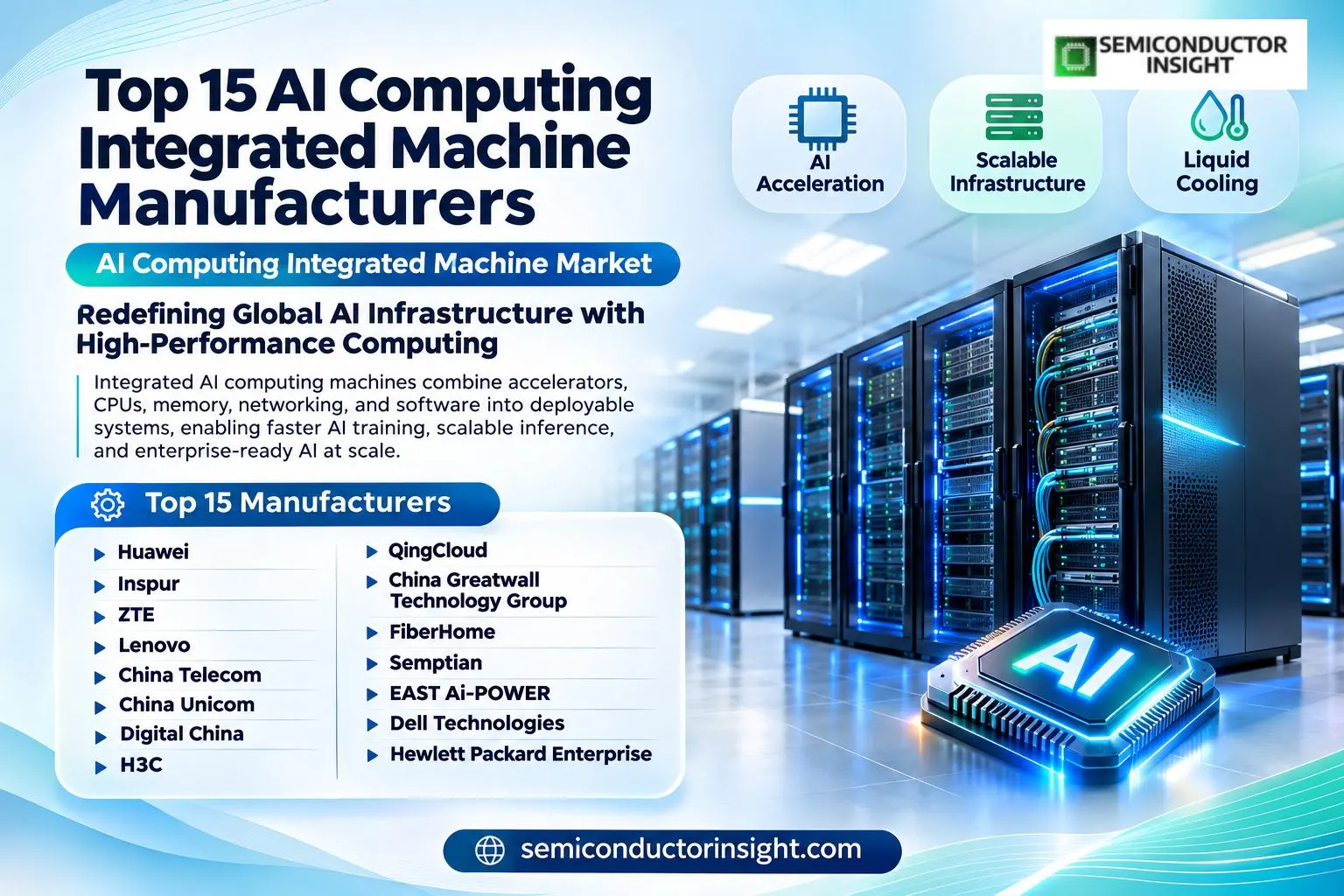
Top 15 AI Computing Integrated Machine Manufacturers Redefining Global AI Infrastructure through High-Performance Computing, Integrated AI Acceleration, and Scalable Enterprise AI Platforms
AI Computing Integrated Machine Market covers pre-integrated computing systems that combine AI accelerators, CPUs, high-bandwidth memory, storage, high-speed networking, software frameworks, and centralized management into deployable infrastructure. These systems are designed to simplify the development, training, deployment, and inference of artificial intelligence models.
Integrated AI computing machines combine various hardware and software components in a coordinated architecture, in contrast to traditional servers that necessitate substantial individual configuration. They can be used in private AI infrastructure, government computing facilities, corporate data centers, telecommunications networks, academic institutions, and industrial settings.
The market is increasingly moving beyond individual GPU servers toward rack-scale systems, liquid-cooled AI clusters, inference appliances, and SuperPod architectures. This shift is particularly relevant as enterprises adopt agentic AI, large language models, computer vision, industrial automation, and domain-specific AI applications.
Huawei – Scaling AI Computing Through UnifiedBus and Ascend SuperPoD Architecture
Huawei is increasingly positioning integrated AI computing around the ability to operate multiple accelerator-equipped nodes as a unified computing environment. Its Atlas and TaiShan product families address AI training, inference, general-purpose computing, and large-scale enterprise deployments. The September 2026 launch of the Atlas 960E SuperPoD introduced a particularly important development: a single system can accommodate up to 4,096 NPUs, deliver 8 EFLOPS of FP8 computing performance, and support up to 1 petabyte of HBM capacity. Its optical interconnect approach also reduces the complexity associated with conventional rack-scale networking.
The company’s UnifiedBus architecture is especially relevant for organizations developing large language models and agentic AI applications, where communication between computing nodes can become a major performance constraint. Huawei also reported that more than 1,000 Atlas 900 A3 SuperPoDs had been deployed, indicating an established deployment base for its integrated computing approach.
Inspur – Integrating High-Density AI Servers with Prefabricated Data Center Infrastructure
Inspur’s importance in the AI computing integrated machine market extends beyond individual server configurations to the engineering of complete computing environments. Its approach combines AI servers, liquid cooling, power distribution, storage, and prefabricated infrastructure to reduce the time required to establish large computing facilities.
A notable 2026 implementation is the Ningxia prefabricated AI data center developed for a 60 MW IT load. The project deployed 260 standardized prefabricated products comprising 342 containers, including liquid-cooled IT containers, air-cooled IT containers, battery containers, and power infrastructure. Inspur’s liquid-cooled racks support up to 83 kW, while the reported power usage effectiveness reached 1.159. This project demonstrates how integrated AI infrastructure increasingly depends on cooling and power engineering alongside processing capacity.
ZTE – Developing SuperPod Computing and Modular AI Data Center Systems
ZTE is expanding its position through the combination of intelligent computing servers, network infrastructure, and modular data center solutions. Its OEX-architecture SuperPod is particularly relevant because it uses a backplane-free design to support multi-chip collaboration and flexible computing configurations. The company’s reported configuration supports up to 128 GPUs in a single system, with larger clusters designed to scale to 100,000 GPUs.
Another important development came on October 20, 2026, when ZTE introduced its ZXEDC M8000 Intelligent Computing Micro-Module. The system integrates liquid-cooled racks, cold-plate cooling distribution, high-voltage DC power, monitoring, networking, and supporting infrastructure into a unified IT POD. This approach is relevant to customers that want to deploy high-density AI computing capacity without independently coordinating every data center subsystem.
Lenovo – Connecting Enterprise AI Servers with Rack-Scale Computing and Liquid Cooling
Lenovo is developing its AI infrastructure business around the integration of computing, storage, networking, and deployment services. Its ThinkSystem portfolio supports enterprise AI training and inference, while Lenovo Neptune liquid cooling addresses the thermal requirements of increasingly dense accelerator configurations.
A notable development announced on November 10, 2026, was the expansion of its AI and high-performance computing portfolio through new ThinkSystem servers powered by sixth-generation AMD EPYC 9006 processors, high-performance storage, and expanded hybrid AI services. This convergence is significant because organizations are increasingly using the same computing environments for AI development, scientific simulation, and engineering workloads.
Lenovo’s differentiation lies in its ability to connect enterprise server infrastructure with liquid cooling and lifecycle services rather than treating AI accelerators as standalone hardware purchases.
China Telecom – Building Large-Scale Integrated Computing Capacity through Xirang
China Telecom represents the infrastructure-operator segment of the AI computing market. Rather than competing only through individual appliance manufacturing, it develops computing centers and platforms that coordinate heterogeneous hardware across geographically distributed facilities.
Its 2026 interim reporting describes 16 data center campuses at the 100 MW level, with combined power capacity approaching 8 GW. Its Xirang 2.0 computing-power scheduling platform supports more than 20 types of heterogeneous chips, while the total proprietary and accessed intelligent computing capacity exceeded 118.8 EFLOPS.
Another important development is the deployment of four domestically developed liquid-cooled intelligent computing clusters, each equipped with 10,000 AI accelerator cards. These capabilities position China Telecom as an important infrastructure provider for enterprises requiring large-scale model training, distributed inference, and regional computing-resource allocation.
China Unicom – Combining AI Computing, Network Scheduling, and Edge Intelligence
China Unicom’s contribution is particularly relevant to integrated computing environments that require communication networks and processing resources to operate together. Its Unicom Cloud portfolio includes the AICC computing-power cluster, AICP computing-power platform, Xingluo scheduling platform, AI edge all-in-one server, and cloud GPU computing services.
A significant 2026 development is the documented China Unicom Shanghai use case involving a 10,000-GPU intelligent computing center. The project applies digital twins and intelligent agents to monitor computing-network topology, manage alarms, and support automated fault diagnosis across the infrastructure.
Its Wuzhen intelligent computing center also provides an important infrastructure example, with a planned capacity of 2,000 petaflops across three development phases. The first phase is designed for 320 petaflops. These developments demonstrate how computing integration is expanding from physical servers into network orchestration and intelligent operations.
Digital China – Building Heterogeneous AI Systems for Enterprise Inference
Digital China’s KunTai portfolio is relevant to enterprises that need AI infrastructure adapted to different deployment environments rather than a single standardized server configuration. Its product range includes heterogeneous computing, modular computing, edge systems, rack-scale infrastructure, and solution appliances.
The KunTai A722 is designed for AI inference using Kunpeng hardware and Ascend acceleration, with applications in image recognition, video analytics, transportation, and healthcare. Its R624 K2 model supports large-language-model training and inference with up to 10 full-height, full-length, double-width accelerator cards.
In February 2026, the company also introduced the KunTai A989 I3 supernode server and W916 AI inference workstation. These developments highlight its focus on extending AI computing from centralized data centers to enterprise and edge environments.
H3C – Engineering High-Density SuperPods for Agentic AI Workloads
H3C is strengthening its position through integrated computing systems that coordinate processors, accelerators, networking, and software optimization. Its UniPoD S80000 SuperPod, introduced in May 2026, is designed for trillion-parameter models and high-throughput AI training and inference.
Each computing node integrates one CPU and four AI accelerators with full liquid cooling. The architecture supports rack deployments exceeding 350 kW and uses 102.4 Tbps switching silicon. H3C also reports a fourfold cluster-bandwidth improvement for 256-card configurations and more than tenfold improvement for 1,024-card configurations compared with traditional architectures.
An especially relevant feature is its time-sharing approach, allowing infrastructure to support inference during the day and training during the night. H3C reports a threefold improvement in per-card inference efficiency through framework optimization. This approach addresses the commercial importance of keeping expensive AI hardware productive across different workloads.
QingCloud – Making Integrated AI Computing More Accessible to Enterprise Users
QingCloud occupies an interesting position because its AI infrastructure portfolio includes both cloud-based computing resources and deployable AI computing appliances. Its integrated approach connects hardware management, computing-resource scheduling, AI development environments, and application deployment.
The company’s AI Computing Appliance is positioned as an out-of-the-box development platform for enterprises and smaller research teams that do not want to assemble their entire AI infrastructure independently. Its AI computing platform also supports unified scheduling across heterogeneous computing resources, helping customers manage different accelerator types through a common operating environment.
In November 2026, QingCloud highlighted its participation in the Beijing-Tianjin-Hebei integrated circuit ecosystem through its subsidiary, Jishi Intelligent Computing. This development is relevant to domestic chip compatibility and heterogeneous computing deployment. Its differentiation is the attempt to make AI computing infrastructure manageable as a complete enterprise service rather than a collection of disconnected hardware components.
China Greatwall Technology Group – Advancing Secure Domestic AI Computing Systems
China Greatwall Technology Group is particularly relevant to organizations that require domestically developed computing platforms with hardware-level security and controlled technology ecosystems. Its AI infrastructure strategy connects processors, servers, network equipment, and application systems rather than focusing exclusively on accelerator performance.
Its 2025 annual report, published in April 2026, identifies the development of the GF7290V5 8U OAM AI server for domestically supported computing infrastructure and trillion-parameter model workloads. The company has also worked with Phytium on server platforms based on the Tengyun S5000C-E processor.
In June 2026, the two companies introduced a new 80-core Qingtian RF6260 V5 general-purpose server with 32 DDR5 memory slots and PCIe 5.0 connectivity. This is significant for enterprise AI deployments that require secure domestic computing foundations, high memory capacity, and expandable processing infrastructure.
A Brief Look at Our Detailed Analysis Related Report: https://semiconductorinsight.com/report/ai-computing-integrated-machine-market/
FiberHome Telecommunication Technologies – Strengthening the Optical Backbone of AI Computing
FiberHome’s importance in integrated AI computing is closely connected to the networking infrastructure that allows accelerator clusters to function efficiently. As AI systems expand from individual servers to hundreds or thousands of interconnected nodes, optical transmission becomes increasingly important for maintaining bandwidth, reducing signal loss, and supporting reliable data movement.
In June 2026, FiberHome introduced next-generation hollow-core fiber technology designed to improve optical transmission for AI computing interconnects. The company also presented OM4 PRO and OM5 multimode fiber products for high-speed data center applications.
One notable technical demonstration involved 400G eSR4 transmission over 150 metres and 400G eSR8 transmission over 200 metres using OM4 PRO fiber. These developments are relevant to AI infrastructure providers because network limitations can restrict the performance of otherwise powerful computing clusters. FiberHome therefore contributes to the integrated system through its optical connectivity expertise.
Semptian – Integrating CPU, GPU, and DPU Technologies into AI Computing Appliances
Semptian, also known as Hengyang Data, is particularly relevant to the integrated AI appliance segment because its product development combines processing, networking, and data acceleration within compact server architectures.
Its SK90 DeepSeek AI computing appliance provides an interesting example. The system was introduced with Huawei Kunpeng processors in 32-core, 48-core, and 64-core configurations, together with two Ascend Atlas 300I Duo accelerator cards, each specified with 96 GB of memory. The compact 1U platform is designed for local deployment of distilled large-language models and supports OpenEuler alongside other operating-system environments.
The company’s broader product strategy includes AI cluster DPUs, intelligent computing appliances, and programmable switching products. Its multi-chip architecture addresses GPU-to-GPU communication, RDMA networking, and data processing requirements, making it relevant to telecom, security, and enterprise inference applications.
EAST Ai-POWER – Connecting AI Computing Facilities with Power and Liquid-Cooling Infrastructure
EAST Ai-POWER, associated with East Group, occupies an adjacent but important position in the integrated AI computing ecosystem. Its contribution is primarily in the power, cooling, and data center infrastructure required to operate high-density computing equipment reliably.
The company’s MC6000 modular data center solution combines enclosed cold-aisle architecture, monitoring, cooling, and power management. In August 2026, East Group reported the deployment of an MC6000 system alongside EA66300 UPS equipment in a smart-city infrastructure project in Yiyang County, supporting police cloud services, AI analysis, and video platforms. The upgraded facility reported operational stability of 99.99%.
This is an important distinction for evaluating the market: EAST is better classified as an AI computing infrastructure integration and power-management provider than as a primary AI accelerator-server manufacturer. Its solutions address the operational foundation required for uninterrupted AI workloads.
Dell Technologies – Delivering Enterprise AI Factories from Individual Servers to Full Racks
Dell Technologies is becoming increasingly relevant to enterprises that want prevalidated AI infrastructure rather than separately sourced servers, networking, storage, and accelerator components. Its Dell AI Factory architecture brings together PowerEdge servers, NVIDIA GPUs, PowerScale storage, networking, and AI software to support model training, fine-tuning, and inference.
A significant November 16, 2026 development was the expansion of its AI Factory portfolio through the PowerEdge M8825, AMD-based modular AI configurations, and the AMD Helios rack-scale solution. The Helios configuration is specified with 72 AMD Instinct MI455X GPUs and up to 2.9 exaflops of computing performance. This expansion is important because it gives enterprises a deployment path ranging from individual computing nodes to large integrated AI environments without rebuilding their infrastructure at every stage.
Hewlett Packard Enterprise – Advancing Liquid-Cooled AI Rack Systems for Large Models
Hewlett Packard Enterprise (HPE) is building its AI infrastructure business around rack-scale integration, high-density accelerator deployment, and liquid-cooling technologies. Its portfolio includes NVIDIA GB200 and GB300 NVL72 systems, AMD Helios AI Rack, and next-generation NVIDIA Vera Rubin infrastructure.
The HPE NVIDIA Vera Rubin NVL72 configuration combines 72 Rubin GPUs with 36 Vera CPUs, alongside high-speed networking and liquid-cooling integration. HPE has also introduced the Compute XD700, an AI server based on NVIDIA HGX Rubin NVL8. Each rack can accommodate up to 128 Rubin GPUs.
These configurations are particularly relevant for AI factories handling trillion-parameter models, reinforcement learning, and high-volume inference. HPE’s competitive distinction is its integration of hardware, cooling, networking, deployment expertise, and infrastructure management into a coordinated rack-scale solution.
Supermicro – Accelerating Modular AI Rack Deployment and Liquid-Cooled Computing
Supermicro is an important provider of integrated AI computing infrastructure because its Data Center Building Block Solutions (DCBBS) approach combines servers, rack systems, power infrastructure, cooling, and networking into deployable configurations.
In July 2026, the company introduced an expanded AI rack portfolio comprising 10 rack models across 44OU, 48U, 48OU, and 52U configurations. The racks were designed to simplify factory pre-assembly and liquid-cooling integration, with certified static load capacity exceeding 2,500 kg.
Another important October 2026 development was the introduction of its 256-CPU NVIDIA Vera rack-scale solution for agentic AI workloads. The architecture integrates liquid cooling, NVIDIA Vera CPUs, BlueField-4 DPUs, and AI orchestration technologies. This positions Supermicro strongly in deployments where computing density, rapid installation, and infrastructure scalability are major purchasing considerations.
xFusion – Connecting Enterprise AI Appliances with High-Performance Computing
xFusion is developing an integrated computing portfolio that addresses the convergence of AI workloads and high-performance computing. Its FusionServer systems, liquid-cooled platforms, and enterprise AI appliances are designed for organizations that need scalable infrastructure without the complexity of independently assembling every hardware and software component.
At ISC 2026 in June, xFusion showcased its FusionPoD rack-scale liquid-cooled server, supporting cabinet power density of up to 240 kW and a reported pPUE as low as 1.06. The company also reported more than 100,000 liquid-cooled nodes deployed in production environments worldwide.
Its TokenBox enterprise AI platform was another notable introduction, designed to support local deployment of large models up to 1.6 trillion parameters in a single appliance. The product direction is significant for enterprises seeking private AI deployment, particularly where data governance, model ownership, and controlled inference environments are important.
Sugon – Turning Liquid-Cooling Standards into an AI Infrastructure Advantage
Sugon, also known as Dawning Information Industry, has an important position in China’s high-performance computing and intelligent computing infrastructure ecosystem. Its expertise extends across AI computing systems, data center infrastructure, and liquid-cooling technologies.
An important 2026 development was the release of China’s first national standard for cold-plate liquid-cooling systems in data centers, GB/T 48023-2026. Sugon DataEnergy led the compilation of this standard, which was approved and released in July 2026 and is scheduled to take effect on February 1, 2027.
The standard addresses system design, component requirements, hydraulic calculations, testing, validation, and deployment operations. This is particularly important as AI rack power density moves beyond conventional air-cooling capabilities. Sugon’s role in standardization strengthens its relevance to integrated AI infrastructure because cooling compatibility and operational reliability are becoming essential considerations when selecting large computing systems.
NVIDIA – Establishing the Reference Architecture for Full-Stack AI Computing
NVIDIA occupies a distinctive position in this market because it supplies not only the accelerators powering AI systems but also integrated computing platforms, interconnect technologies, networking, and enterprise AI software.
Its DGX GB200 platform combines 36 Grace CPUs and 72 Blackwell GPUs within a liquid-cooled rack-scale architecture. The system offers up to 13.4 TB of HBM3e GPU memory and 130 TB/s of NVLink switching bandwidth. NVIDIA also supports multi-rack DGX SuperPOD deployments for large-scale model training and inference.
The 2026 Vera Rubin generation extends this direction with 72 Rubin GPUs, 36 Vera CPUs, and next-generation NVLink and networking technologies. Its integrated architecture is particularly relevant to organizations developing advanced reasoning models and agentic AI applications. NVIDIA’s influence therefore extends throughout the integrated computing ecosystem, including server manufacturers, system integrators, software developers, and data center operators.
Alibaba Cloud – Bringing Proprietary AI Chips and Supernodes into Commercial Cloud Infrastructure
Alibaba Cloud is expanding integrated AI computing through a combination of proprietary chip development, AI supernodes, cloud infrastructure, and large-model deployment platforms. Its strategy is particularly relevant because it connects semiconductor development directly with the computing environments required to train and operate AI models.
At the September 2026 Apsara Conference, Alibaba introduced its Zhenwu V900 AI processor, which the company says delivers three times the performance of its predecessor, the Zhenwu M890. The processor features 216 GB of memory and 1,200 GB/s of inter-chip bandwidth, with mass production and commercial release scheduled for the first quarter of 2027.
Alibaba also announced an upgraded AI supernode architecture incorporating its Zhenwu processor, ICN switch, Panmai SmartNIC, and Zhenyue SSD controller. Its planned cluster architecture supports up to 500,000 accelerator cards. Additionally, Alibaba Cloud has established a target of exceeding 20 GW of global data center capacity by 2032. This combination of proprietary silicon, integrated systems, and cloud-scale deployment makes the company a significant participant in the evolving AI computing infrastructure ecosystem.

Comments (0)