
Top 5 Strategic Regions Accelerating Adoption of Biometric Smart Cards across Industries
Biometric Smart Cards Market refers to the global industry focused on smart cards that combine embedded biometric authentication technology with integrated electronic chips to verify an individual’s identity. Biometric smart cards can employ features like fingerprints, face recognition, iris patterns, or other biometric identifiers to give an extra layer of identity verification, in contrast to traditional smart cards that mainly rely on passwords, PINs, or card-based authentication.
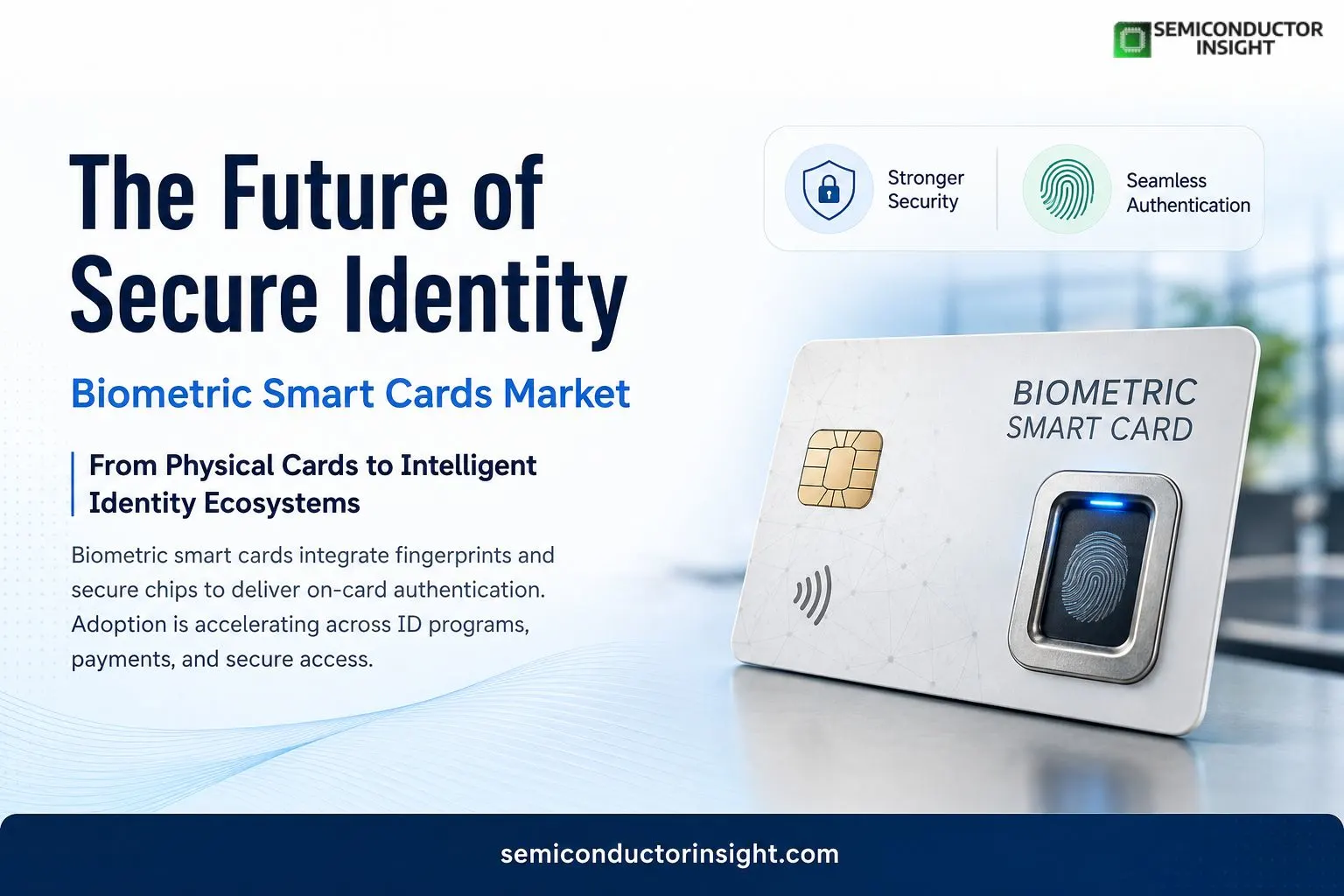
Biometric smart cards place a complete authentication system inside the familiar ID-1 form factor of 85.60 by 53.98 by 0.76 mm. The card body now houses a capacitive or thermal fingerprint sensor, a secure element, and matching logic that runs entirely on-card so the biometric template never leaves the plastic. This arrangement removes the need for a separate PIN pad or network round-trip while still meeting EMV and national-ID security rules.
Take a Quick Glance at Our In-Depth Analysis Report: https://semiconductorinsight.com/report/biometric-smart-cards-market/
Europe – The Identity Infrastructure Leader
Europe takes the #1 position because biometric credentials are increasingly connected with regulated digital identity systems, passports, national identity cards and cross-border authentication.
The European Union’s revised eIDAS 2.0 framework provides for a European Digital Identity Wallet, with EU member states required to make wallets available by 2026. The framework is particularly relevant to biometric smart-card technologies because secure identity credentials increasingly need to connect physical and digital authentication.
Europe also has a highly mature payment-card ecosystem. According to the European Central Bank, consumers made approximately 71.4 billion non-cash payment transactions in the euro area during the first half of 2025, demonstrating the scale of the infrastructure into which stronger card authentication can be integrated.
National ID cards → passports → payment authentication → border control → secure enterprise access.
Asia Pacific – Massive Digital Identity Deployment
- Asia Pacific ranks #2 because of its enormous population base and large-scale government identity programs.
- India is a particularly important example. The Aadhaar system had generated more than 1.4 billion Aadhaar numbers by 2025, making it one of the world’s largest biometric identity infrastructures. The program uses biometric information including fingerprints and iris data for identity verification.
- The region also contains highly developed smart-card ecosystems in countries such as Japan, South Korea, Singapore and China.
- Rising digital payments, government authentication and secure access requirements provide multiple application pathways.
- Japan’s My Number Card system is another significant example. By 2025, more than 100 million My Number Cards had been issued, illustrating the scale at which physical identity credentials can be connected with digital government services.
North America – Strongest Commercial Security Potential
North America ranks #3, supported by sophisticated payment infrastructure, corporate security requirements, government identity programs and increasing interest in biometric payment cards.
The United States has more than 5 billion payment cards in circulation, according to Federal Reserve payment data and industry estimates, creating an enormous installed infrastructure for next-generation card authentication.
The U.S. government’s REAL ID program is also relevant. From May 7, 2025, federal agencies began requiring REAL ID-compliant identification for access to certain federal facilities and federally regulated air travel.
For biometric smart cards, North America’s opportunity extends beyond conventional payment cards into employee identification, government credentials, physical access and high-security authentication.
Latin America – Financial Inclusion Creates a Strong Use Case
Latin America ranks #4, with biometric smart cards gaining relevance as governments and financial institutions seek stronger identity verification while expanding digital financial services.
- Brazil provides an important example. Its Cadastro de Pessoas Físicas (CPF) covers hundreds of millions of registrations and is increasingly connected with digital government authentication.
- Brazil’s banking ecosystem is also highly digitized, with Pix processing billions of transactions annually, demonstrating the region’s rapid movement toward digital financial infrastructure.
- Mexico, Colombia, Argentina and Chile are similarly investing in digital identity, biometric verification and secure payment ecosystems.
The opportunity here is particularly interesting because biometric smart cards can potentially combine physical credentials with biometric authentication, reducing dependence on passwords and PIN-based verification.
Middle East & Africa – High-Security Identity Programs Drive Adoption
The Middle East & Africa region occupies the #5 position, with particularly strong opportunities in government identification, border management, banking and workforce authentication.
The Gulf States have invested heavily in digital government infrastructure. The UAE, for example, has built extensive digital identity infrastructure around UAE Pass, while Saudi Arabia has expanded digital government services through its national digital transformation programs.
Africa represents a different opportunity. Several countries are expanding biometric national-ID systems to improve identity management and financial inclusion. Nigeria’s National Identity Management Commission reported that the country’s National Identification Number database had surpassed 100 million enrollments, representing a major biometric identity infrastructure.
The combination of large populations, financial inclusion initiatives and government digitization creates a substantial long-term addressable environment for secure smart credentials.

Comments (0)