
Biometric Smart Cards Market Insights
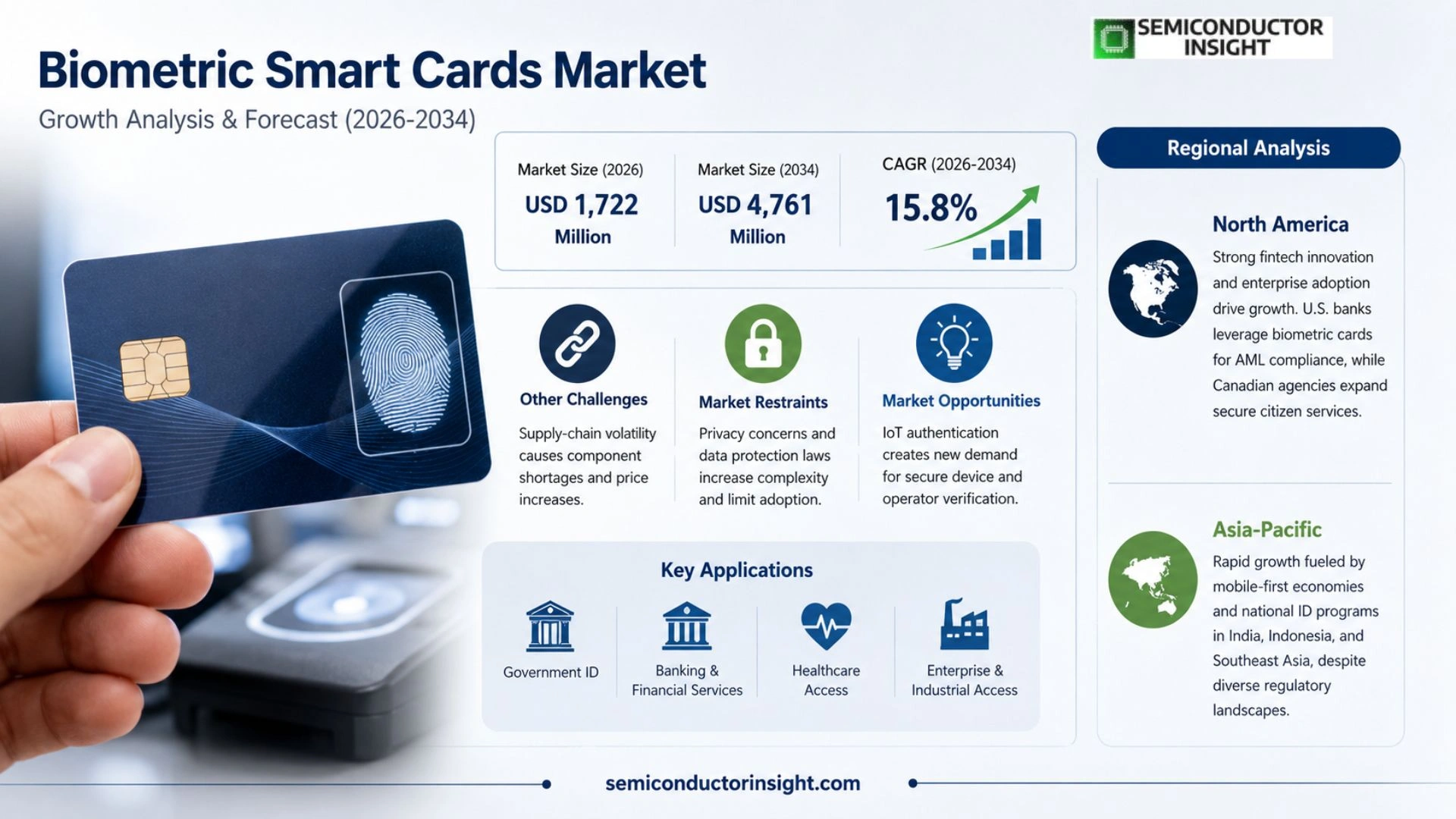
Global Biometric Smart Cards market is projected to grow from USD 1,722 million in 2026 to USD 4,761 million by 2034, exhibiting a CAGR of 15.8% during the forecast period.
Biometric smart card is a new type of security identity authentication carrier which combines biometric technology with a traditional smart‑card chip. It embeds a miniature fingerprint sensor (or other biometric modality) and a dedicated security processing unit alongside the conventional contact or contactless interface. When a user presents the card for payment or access control, live biometric data are captured on‑board, compared instantly with an encrypted template stored inside an isolated secure element, and only upon successful verification does the chip release the cryptographic key or authorization data.
The market is experiencing rapid growth due to several factors, including heightened demand for fraud‑resistant payment solutions, expanding government initiatives for secure identity verification, and continuous improvements in low‑power sensor integration that lower production costs. Moreover, collaborations among leading manufacturers such as IDEMIA, Thales Group and FEITIAN Technologies are accelerating deployment across financial services, transportation and healthcare sectors.
MARKET DRIVERS
Enhanced Security Requirements Across Sectors
Enterprises are increasingly replacing legacy password‑based controls with biometric authentication embedded in smart cards. The move reduces credential theft and aligns with compliance frameworks that demand multi‑factor verification. As data breaches continue to erode trust, organizations view these cards as a tangible way to safeguard sensitive transactions.
Government Mandates for Digital Identity
National identity programs are integrating fingerprint or iris templates directly onto smart cards, creating a unified credential for travel, voting, and social services. This policy direction pushes public‑sector budgets toward large‑scale procurement, prompting vendors to scale production capacities.
➤ “Deploying biometric smart cards cuts fraudulent access incidents by up to 60 % in pilot studies, delivering measurable cost savings for financial institutions.”
Corporate travel managers are also adopting the technology to streamline boarding processes while ensuring that only authorized personnel access secure areas. The operational efficiency gains, combined with reduced reliance on manual checks, make the solution attractive for global supply‑chain operators.
MARKET CHALLENGES
Complex Integration with Legacy Infrastructure
Many organizations operate on aging IT ecosystems that lack native support for biometric data exchange. Retrofitting these environments demands custom middleware, extending deployment timelines and inflating total cost of ownership. Vendors that cannot offer seamless integration risk losing contracts to more adaptable competitors.
Other Challenges
Supply‑Chain Volatility
Component shortages, particularly for secure microcontrollers, create bottlenecks that delay shipments and force buyers to accept higher unit prices. The uncertainty forces procurement teams to hold larger safety stocks, which impacts cash flow.
MARKET RESTRAINTS
Privacy Concerns and Data Protection Laws
Storing immutable biometric templates on a portable medium raises legal questions about consent and data residency. Jurisdictions with stringent privacy statutes require on‑card encryption and strict access controls, increasing development complexity and limiting market entry for newcomers.
MARKET OPPORTUNITIES
Emerging Use Cases in IoT Authentication
As the Internet of Things expands, device authentication becomes a critical hurdle. Embedding biometric smart cards into industrial controllers offers a hardware‑rooted trust anchor that can verify operator identity before executing high‑risk commands. Early adopters in the energy and manufacturing sectors are piloting such solutions, signalling a nascent revenue stream for card manufacturers willing to tailor firmware for machine‑level integration.
Biometric Smart Cards Market Trends
Integration of Sensor‑Chip Packaging Drives Adoption
The latest production run of roughly 126 million units in 2025 reflects how manufacturers have mastered the convergence of micro‑electronic packaging, thin‑film sensors and card lamination. By embedding ultra‑thin capacitance fingerprint modules directly into the card’s substrate, suppliers have cut the sensor’s power draw to a few milliwatts. This engineering breakthrough eliminates the need for bulky internal batteries, allowing cards to harvest energy from contactless readers. The resulting cost‑per‑unit decline,now near US$15,has opened the technology to midsize banks and municipal ID programs that previously could not justify the expense.
Other Trends
Shift from Pilot Projects to Full‑Scale Deployments
Early field trials in Europe and North America demonstrated the security advantage of binding “who you are” to “what you have.” Operators quickly recognized that the live‑fingerprint check prevents fraud scenarios that traditional chip‑and‑PIN cards cannot address. Consequently, government agencies have begun issuing biometric cards for driver’s licenses and social‑security credentials, while retail payment networks are rolling them out across nationwide point‑of‑sale terminals. This transition expands the addressable market beyond niche use cases, creating a steady pipeline of orders that sustains production volumes through 2034.
Standardisation and Ecosystem Expansion
Industry consortia are converging on common communication protocols and data‑format specifications, which reduces integration friction for card readers and back‑office systems. At the same time, manufacturers are experimenting with multimodal sensors,adding palm‑print or vein patterns to future generations of cards. Although the added modalities increase design complexity, they also broaden the cards’ applicability in high‑security environments such as data‑centers and hospitals. The emerging ecosystem, supported by vendors like IDEMIA, Thales, and TrustSec, is reshaping procurement strategies; buyers now evaluate not only price but also the robustness of the partner’s software stack and firmware upgrade path.
COMPETITIVE LANDSCAPE
Key Industry Players
Biometric Smart Cards Market Competitive Overview
The market is dominated by a handful of multinational firms that have mastered the integration of biometric sensors with secure chip technology. IDEMIA, headquartered in France, commands a sizeable share thanks to its extensive portfolio of fingerprint‑enabled cards and deep relationships with financial institutions across Europe and North America. Thales Group leverages its defense‑grade security heritage to supply government‑level authentication solutions, while Giesecke+Devrient pairs its long‑standing card‑issuing expertise with advanced sensor modules to address high‑volume payment applications. These leaders benefit from economies of scale in wafer‑level packaging and from established global distribution networks that make it difficult for newcomers to achieve comparable market penetration.
Beyond the tier‑one manufacturers, a vibrant ecosystem of specialized players fuels innovation in niche segments. FEITIAN Technologies and TrustSec focus on low‑cost, contactless fingerprint cards for emerging markets, emphasizing streamlined production workflows to keep unit prices competitive. Kona I and Cardlab differentiate themselves through modular designs that allow quick adaptation to palm‑print or multimodal biometric solutions. Companies such as Goldpac Group, Excelsecu, SmartMetric and TOPPAN Security invest heavily in algorithmic optimization to reduce power draw, thereby extending the usable life of embedded energy sources. This diversity of approaches creates a fragmented yet dynamic competitive field where agile firms can capture growth by tailoring solutions to sector‑specific security requirements.
List of Key Biometric Smart Cards Companies Profiled
- IDEMIA
- Thales Group
- FEITIAN Technologies
- Giesecke+Devrient
- Identita
- Kona I
- Cardlab
- Goldpac Group
- Excelsecu
- TrustSec
- SmartMetric
- TOPPAN Security
- Guangzhou Yema Electronic Technology
- Shenzhen United Smart Card
Segment Analysis:
| Segment Category | Sub-Segments | Key Insights |
| By Type |
|
Fingerprint cards dominate due to mature sensor technology and ease of integration.
|
| By Application |
|
Financial payments remain the core driver, with expanding adoption in ancillary sectors.
|
| By End User |
|
Government agencies lead adoption because of stringent security mandates.
|
| By Technology |
|
Capacitive sensors are favored for their reliability and low power profile.
|
| By Region |
|
Europe shows strong ecosystem collaboration driving innovation.
|
Regional Analysis: Biometric Smart Cards Market
Europe
The EU’s e‑IDAS framework mandates biometric verification for high‑value transactions, prompting banks to adopt smart cards that meet EU‑wide certification. This regulatory push accelerates product rollouts and forces vendors to maintain compliance across borders, creating a unified market thrust.
Rising fraud incidents in contactless payments and a growing appetite for frictionless user experiences reinforce demand for biometric cards. Large retailers are piloting fingerprint‑enabled loyalty cards to streamline checkout while preserving data integrity.
Established chip manufacturers partner with biometric sensor specialists, forming consortia that leverage economies of scale. New entrants focus on niche sectors such as transportation, where rapid issuance and on‑card verification are critical.
Anticipated convergence of biometric smart cards with emerging decentralized identity platforms could extend usage beyond payments, embedding identity verification into public services and enterprise access control.
North America
North America’s market momentum stems from aggressive fintech innovation and sizable enterprise procurement budgets. U.S. banks, pressured by evolving AML guidelines, are deploying biometric cards to enhance authentication without sacrificing transaction speed. Canadian government agencies, meanwhile, explore biometric credentials for secure citizen services, adding a public‑sector dimension to demand. Vendor alliances focus on integrating facial recognition modules, reflecting a broader trend toward multimodal biometrics that address diverse security scenarios.
Asia‑Pacific
The Asia‑Pacific region exhibits rapid scaling as mobile‑first economies transition to card‑based security. Nations such as India and Indonesia prioritize biometric solutions to bridge identity gaps in underserved populations, leveraging national ID programs as distribution channels. Manufacturers capitalize on lower production costs in Southeast Asia, yet must navigate heterogeneous regulatory environments that shape product specifications differently across jurisdictions.
South America
In South America, banks confront high incidences of card‑present fraud, prompting a shift toward biometric authentication to restore consumer confidence. Brazil’s open‑banking reforms stimulate collaborations between local card issuers and global sensor providers, while Argentina’s focus on fintech inclusivity drives pilot projects in urban centers. Supply‑chain constraints remain a challenge, but targeted investments in regional fabrication facilities aim to mitigate delays.
Middle East & Africa
The Middle East & Africa region balances emerging demand with infrastructural hurdles. Gulf Cooperation Council states adopt biometric smart cards for high‑value corporate transactions, leveraging substantial sovereign wealth to fund pilot deployments. Sub‑Saharan initiatives, often backed by development banks, emphasize biometric cards as a tool for financial inclusion, linking unbanked populations to formal payment networks while maintaining rigorous data‑protection standards.
Report Scope
This market research report provides a comprehensive analysis of the Biometric Smart Cards Market , covering the forecast period 2026–2034. It offers detailed insights into market dynamics, technological advancements, competitive landscape, and key trends shaping the industry.
Key focus areas of the report include:
- Market Overview: The report begins with an overview outlining its current market scenario, key growth indicators, and industry transformation drivers. It discusses macroeconomic factors, demand–supply balance, regulatory landscape, and the strategic role of semiconductors in powering advancements across industries such as automotive, telecommunications, consumer electronics, and industrial automation.
- Market Size & Forecast: Historical data and future projections for revenue, unit shipments, and market value across major regions and segments.
- Segmentation Analysis: Detailed breakdown by product type, technology, application, and end-user industry to identify high-growth segments and investment opportunities.
- Regional Insights: Insights into market performance across North America, Europe, Asia-Pacific, Latin America, and the Middle East & Africa, including country-level analysis where relevant.
- Competitive Landscape: Profiles of leading market participants, including their product offerings, R&D focus, manufacturing capacity, pricing strategies, and recent developments such as mergers, acquisitions, and partnerships.
- Technology Trends & Innovation: Assessment of emerging technologies, integration of AI/IoT, semiconductor design trends, fabrication techniques, and evolving industry standards.
- Market Drivers & Restraints: Evaluation of factors driving market growth along with challenges, supply chain constraints, regulatory issues, and market-entry barriers.
- Stakeholder Insights: Insights for component suppliers, OEMs, system integrators, investors, and policymakers regarding the evolving ecosystem and strategic opportunities.
Primary and secondary research methods are employed, including interviews with industry experts, data from verified sources, and real-time market intelligence to ensure the accuracy and reliability of the insights presented.
FREQUENTLY ASKED QUESTIONS:
What is the current market size of Biometric Smart Cards Market?
-> Biometric Smart Cards market is projected to grow from USD 1,722 million in 2026 to USD 4,761 million by 2034, exhibiting a CAGR of 15.8%
Which key companies operate in Biometric Smart Cards Market?
-> Key players include IDEMIA (France), TrustSec, Identita (Canada), Thales Group (France), FEITIAN Technologies (China), Giesecke+Devrient (Germany), Kona I (Korea), Cardlab (Denmark), Goldpac Group (China/Hong Kong), Excelsecu (China), Beautiful Card Corporation (Taiwan), Cellfie Global (Korea), CardLogix (USA), SmartMetric (USA), TOPPAN Security (Japan), Guangzhou Yema Electronic Technology (China), Shenzhen United Smart Card (China), Shenzhen Lassorfid Intelligent IoT (China), Guangdong Shengju Intelligent Technology (China).
What are the key growth drivers?
-> Key growth drivers include rising demand for high‑security authentication in financial payments, expanding government and enterprise access‑control applications, and the need to mitigate fraud through advanced biometric verification.
Which region dominates the market?
-> Europe and North America hold the largest market share, reflecting high concentration of manufacturers and early adoption of biometric smart card solutions.
What are the emerging trends?
-> Emerging trends include AI‑enhanced fingerprint algorithms, multi‑modal cards (e.g., palm‑print, iris), low‑power sensor designs powered by contactless readers, and the development of standardized biometric smart‑card protocols.
Get Sample Report PDF for Exclusive Insights
Report Sample Includes
- Table of Contents
- List of Tables & Figures
- Charts, Research Methodology, and more...
 Download Sample Report PDF