

Top 5 Regional Powerhouses Putting the Semiconductor Memory Market at the Center of the AI Hardware Race
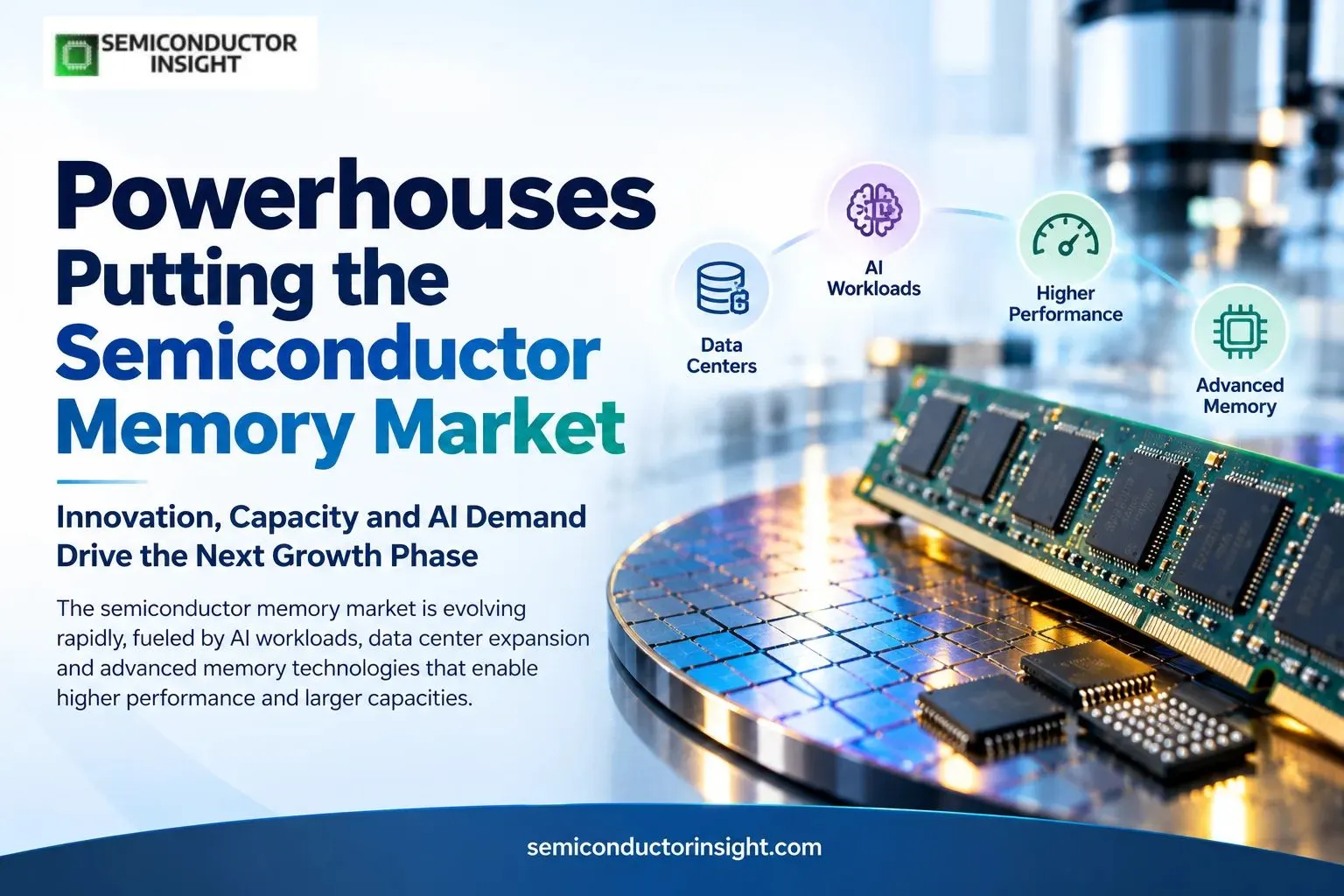
Memory has moved from being a background component inside electronics to becoming one of the most important performance elements in AI infrastructure. DRAM, NAND, HBM, LPDDR and enterprise SSDs now determine how quickly data can be moved, processed and stored.
SEMI’s latest 2026 outlook tracks 424 global 300mm fabs and production lines, while worldwide 300mm memory capacity is projected at about 4.1 million wafers per month in 2026. Memory equipment investment is also projected to rise 32% during 2026 as AI infrastructure accelerates demand.
Asia Pacific Sets the Pace for High-Bandwidth Memory
- Asia Pacific remains the clear center of semiconductor memory manufacturing, particularly through South Korea, Taiwan, Japan and China.
- Korea’s projected 23% share of global 300mm front-end capacity in 2026 and Taiwan’s 21% share demonstrate the region’s enormous manufacturing base.
- China is expected to reach 2.4 million 300mm wafers per month, equivalent to 25% of global capacity.
- The strongest current signal is HBM. Samsung began commercial HBM4 production in February 2026 with transfer speeds of 11.7Gbps, while SK hynix shipped 12-layer HBM4E samples in June at up to 16Gbps per pin.
- Kioxia is also targeting summer 2026 samples of its 10th-generation BiCS FLASH, with a 59% improvement in bit density over its eighth-generation technology.
North America Rebuilds Its Memory Manufacturing Footprint
North America is becoming strategically important because the United States is attempting to rebuild domestic memory production rather than rely almost entirely on East Asian supply.
The U.S. Department of Commerce says Micron’s expanded memory manufacturing and R&D program in Idaho, New York and Virginia could create about 90,000 jobs and includes advanced HBM packaging capabilities. Earlier CHIPS funding supported plans involving roughly 20,000 jobs by the end of the decade.
This makes North America particularly relevant to AI accelerators, high-performance computing, automotive electronics and defense systems. The region is shifting from memory consumption toward memory manufacturing, packaging and supply-chain localization.
Europe Builds Memory Demand through Automotive and Industrial Computing
Europe’s role is less concentrated in commodity DRAM and NAND production but increasingly important in memory-consuming applications. The European Commission notes that a modern vehicle can contain more than 1,000 chips, while a hybrid electric vehicle can contain up to 3,500. The EU’s Chips Act targets a 20% share of global semiconductor production by 2030, while the proposed Chips Act 2.0 announced in 2026 seeks to strengthen advanced semiconductor capacity and reduce strategic dependencies.
European demand therefore extends into automotive memory, industrial controllers, edge computing, medical electronics and connected infrastructure. Germany, France, Italy and the Netherlands remain important parts of the equipment, automotive and semiconductor ecosystem.
Latin America Turns Assembly and Electronics Growth into Memory Opportunity
Latin America is emerging through electronics manufacturing, semiconductor testing, design education and supply-chain diversification rather than large-scale leading-edge memory fabrication. Brazil’s 2026 Brasil Semicon program is designed to strengthen semiconductor production, research, innovation and employment, while Mexico is developing additional assembly, test and packaging capabilities. A Mexican government research initiative, KUTSARI, is specifically strengthening integrated-circuit testing and training semiconductor specialists.
This creates opportunities for memory modules, embedded storage, automotive electronics, industrial equipment and consumer-device assembly. Brazil’s CEITEC also develops RFID, smart-card and application-specific semiconductor solutions, giving the region an established semiconductor development base.
Middle East and Africa Establish a New Semiconductor Talent Layer
The Middle East and Africa remain smaller memory-manufacturing centers, but semiconductor capability is becoming a strategic technology priority. Saudi Arabia’s National Semiconductor Hub is designed to connect universities, research centers, startups and international companies across semiconductor design and manufacturing.
- In May 2026, Saudi Arabia’s second Chipathon selected 50 university students from more than 1,000 applicants and organized them into 15 teams working on AI-chip designs.
The region’s immediate opportunity is therefore less about mass DRAM or NAND fabrication and more about AI infrastructure, chip design, packaging, data centers and specialized memory-enabled systems.
To find out more, feel free to browse our latest updated report: https://semiconductorinsight.com/report/semiconductor-memory-market/
How Memory Moves Through the New AI Hardware Stack
AI workload → accelerator → HBM stack → high-speed interconnect → DDR5 system memory → enterprise SSD/NAND storage → edge device
The defining change in 2026 is that memory is no longer simply about storing information. It is increasingly about moving data fast enough to keep AI processors, autonomous systems, connected devices and high-performance computing platforms continuously productive.

Comments (0)