
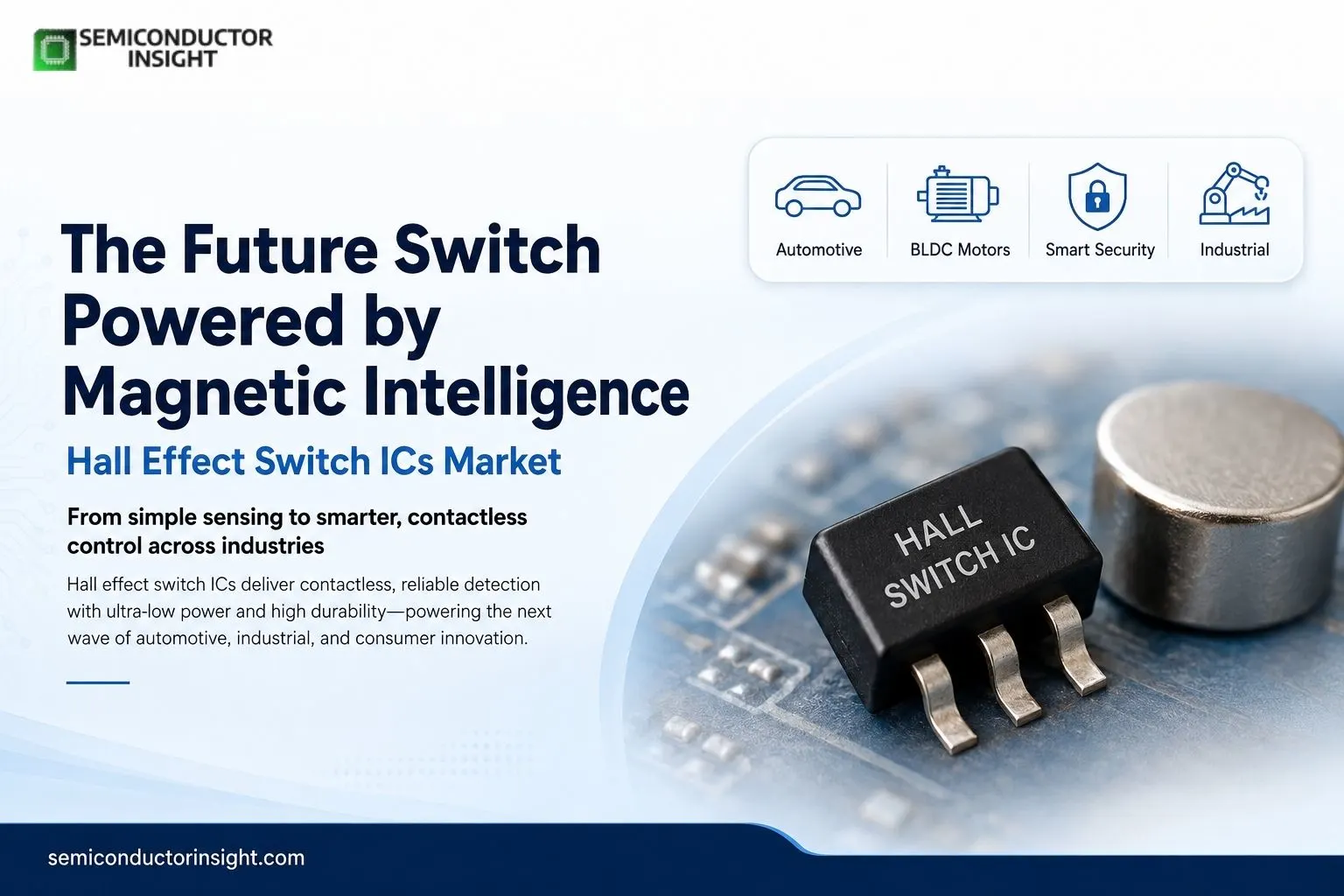
Top 5 Regional Growth Engines Supporting Hall Effect Switch ICs Expansion through Contact-Free Position and Motion Detection
Hall effect switch ICs are moving from being a niche magnetic-sensing component to an increasingly important building block for automotive electronics, BLDC motors, smart appliances, industrial automation, portable devices and access-control systems.
A Hall switch, in contrast to a traditional mechanical switch, senses the existence or lack of a magnetic field without making physical contact. This straightforward modification has significant effects on low-power operation, durability, contamination resistance, and miniaturisation.
The Hall Switch IC in One Simple Motion
- A Hall switch essentially converts magnetic proximity into a digital decision.
Magnet moves → Magnetic field crosses threshold → Hall element detects field → Signal conditioning processes it → Digital output changes state → Controller responds
- Texas Instruments describes switches as devices that toggle their output when magnetic flux passes a defined threshold. This makes them particularly suitable for binary position detection rather than continuous measurement.
- The technology is now available in extremely compact packages and across different voltage and power classes. TI’s current portfolio, for example, includes devices operating from 1.65-5.5 V, while high-voltage Hall devices can support systems up to 38 V. Some low-power devices consume less than 1 µA, opening opportunities in battery-operated locks, sensors and portable electronics.
Asia Pacific Turns High-Volume Electronics into a Major Hall-Sensing Opportunity
Asia Pacific is the strongest geographic ecosystem for Hall switch IC consumption because electronics manufacturing, automotive production, electric mobility and appliance manufacturing are concentrated across China, Japan, South Korea, Taiwan and Southeast Asia.
The wider semiconductor sector provides a useful indicator. Asia Pacific/All Others recorded 45.0% annual semiconductor sales growth in 2025, the strongest increase among the major geographic groupings reported by SIA.
China is particularly significant for automotive Hall sensing. The IEA reports that China produced approximately 16 million electric cars in 2025, representing nearly 75% of global electric-car production. More than 2.5 million Chinese electric cars were exported during the year.
Hall switches can support position and state detection across these vehicles, including steering controls, seat-belt mechanisms, switches, latches, actuators and motor-related systems.
North America Pushes Hall ICs into Automotive and Industrial Electronics
- North America’s strength comes from advanced automotive electronics, industrial automation, robotics, power tools, HVAC equipment and connected devices.
- The region’s semiconductor momentum was substantial in 2025, with Americas semiconductor sales increasing 5% year over year.
- S.-based semiconductor developers are also expanding the functional range of Hall switches.
- TI currently positions Hall-effect switches for applications including appliances, building automation, BLDC motor commutation, smart locks, power tools and vacuum robots.
- Its portfolio includes low-power switches operating below 1 µA and high-voltage solutions reaching 38 V.
- That combination makes North America particularly important for higher-value designs where engineers prioritize reliability, power efficiency and compact PCB architecture rather than simply replacing mechanical switches.
You can freely browse our most recent updated report to learn more about it before scrolling further: https://semiconductorinsight.com/report/hall-effect-switch-ics-markets/
Europe Builds Demand around Electrification and Precision Mobility
Europe’s Hall switch IC opportunity is increasingly linked with vehicle electrification, advanced industrial machinery and smart manufacturing.
The IEA reports that European electric-car sales increased 30% in 2025 to more than 4 million units, while electric cars represented around 28% of total European car sales.
For Hall switch suppliers, electrification expands the number of electronically monitored functions within vehicles. Position detection can be required around motors, actuators, access systems, seat mechanisms, steering-related controls and other electronically controlled subsystems.
Europe’s semiconductor sales also increased 6.3% in 2025, according to SIA.
Latin America Is Emerging Through Electric Mobility and Electronics Adoption
- Latin America’s Hall switch IC demand is smaller than Asia Pacific, North America and Europe, but its growth trajectory is becoming harder to ignore.
- The IEA reported that electric-car sales in Latin America increased 75% year over year in the first quarter of 2026. The same report identified strong expansion in emerging markets as lower-cost electric models became more widely available.
- This creates opportunities for Hall switches in electric cars, electric two-wheelers, charging equipment, industrial motors, appliances and security systems.
- Brazil also maintains a detailed automotive production and registration database covering assembled vehicles, CKD production, exports and employment, illustrating the scale of the country’s automotive manufacturing ecosystem.
Middle East & Africa Opens Smaller but Strategic Application Niches
Middle East and Africa represent a more application-specific opportunity. Instead of being driven primarily by enormous semiconductor manufacturing clusters, demand is connected with industrial automation, energy infrastructure, building security, vehicles, pumps and equipment operating in demanding environments.
Hall technology is particularly relevant where physical switches could suffer from dust, vibration or mechanical wear. TI highlights applications such as transformer tamper detection, door and window security, solenoid movement and industrial automation.
That makes contactless sensing attractive for infrastructure projects where long operating life and reduced maintenance can be more important than extremely high sensor volumes.

Comments (0)