

Top 5 Major Leading Regions Shaping the Artificial Meniscus Market through Advanced Knee Reconstruction in 2026
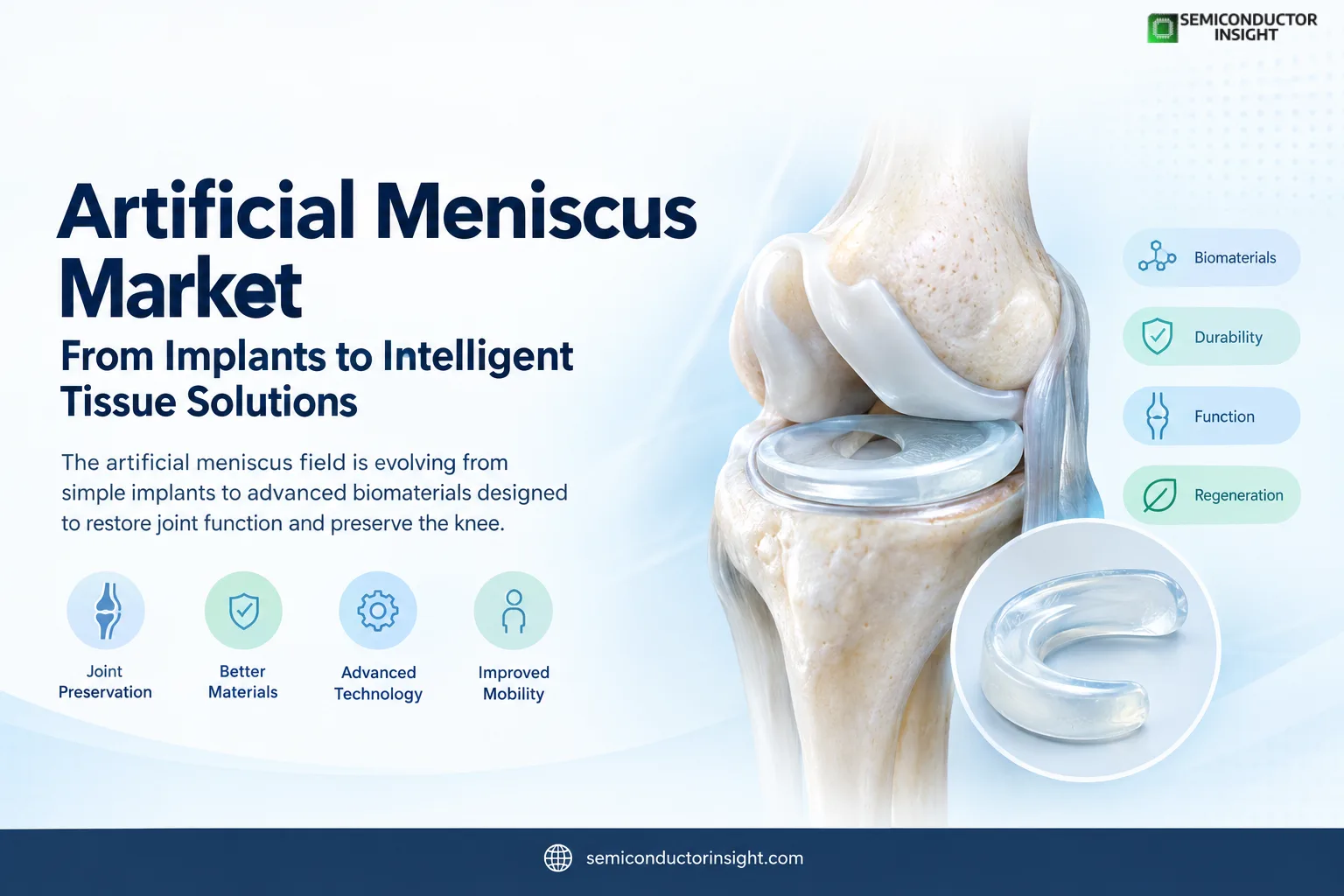
The artificial meniscus field is moving from simple implant concepts toward materials designed to behave more like native knee tissue. Meniscus replacement is being investigated as an option for patients with persistent symptoms and meniscal deficiency, particularly when preserving the joint remains clinically important. A 2024 review identified NUsurface and Artimis among the emerging total-meniscus technologies while noting that long-term evidence remains limited.
The clinical need is substantial. A JAMA review cited an estimated 500,000 meniscus procedures annually in U.S. patients older than 45 and more than 2 million procedures worldwide each year. JAMA Network
North America Builds the Clinical Evidence Base
North America is an important development center because artificial-meniscus technologies have progressed through formal clinical evaluation. The NUsurface implant, a polycarbonate-urethane device designed for medial meniscus replacement, received FDA Breakthrough Device Designation in 2019 and entered U.S. clinical investigations.
FDA documentation concerning NUsurface included data from the MERCURY program and other studies, with patient outcomes assessed through measures such as KOOS and imaging. Earlier pooled clinical results involved more than 175 patients across randomized and single-arm cohorts.
Europe Keeps Meniscus Scaffolds in the Clinical Conversation
Europe has played an important role in the development and clinical use of meniscal scaffolds. Actifit, a synthetic polyurethane-based scaffold, has been investigated for partial meniscal deficiency, while collagen-based implants represent another approach to tissue replacement.
Long-term evidence is beginning to add another dimension. A study of 32 knees receiving Actifit reported a mean follow-up of 11.4 years, with KOOS increasing from 47.75 before surgery to 78.62 at final follow-up. The researchers nevertheless emphasized that additional long-term research is required.
Asia-Pacific Pushes Materials Science Forward
Asia-Pacific is becoming particularly visible in artificial-meniscus biomaterials research. Chinese Academy of Sciences researchers have investigated sulfobetaine-modified polyurethane to address friction and mechanical requirements in artificial meniscus applications. Their work examined lubrication in simulated synovial environments, including mechanical and cytotoxicity characteristics.
A notable 2026 study from researchers in China developed a polyurethane elastomer with low-wear and self-recovery characteristics. Published in ACS Applied Materials & Interfaces, the material achieved an average coefficient of friction of 0.06578 in laboratory testing. This remains preclinical materials research rather than evidence of established clinical use.
You Can Freely Surf Our Latest Updated Report Here: https://semiconductorinsight.com/report/quantum-sensors-market/
Latin America Expands the Orthopedic Research Opportunity
Latin America’s opportunity is closely connected with its growing orthopedic research, sports medicine and joint-reconstruction ecosystem. Meniscal injuries are particularly relevant to active populations. Research involving football and kabaddi athletes, for example, found meniscal injuries in 364 of 517 patients undergoing primary ACL reconstruction, although this represents a selected surgical population and should not be interpreted as general population prevalence.
For the artificial meniscus field, this creates interest in technologies that can address segmental meniscal deficiency while supporting rehabilitation and preservation of the surrounding knee structures.
Middle East & Africa Connect Through Sports Medicine
Sports medicine provides an important clinical pathway for meniscus research in the Middle East and Africa. Pivoting, contact and landing sports generate substantial knee-injury workloads, while specialized orthopedic centers increasingly combine arthroscopy, imaging and rehabilitation services.
Evidence from U.S. high-school sports surveillance illustrates why this application matters internationally: 1,082 meniscal injuries were recorded over 21,088,365 athlete exposures, equivalent to 5.1 injuries per 100,000 exposures. The study also found that 54% had associated intra-articular knee pathology.
The Technology Pipeline Is Becoming More Sophisticated
Meniscal deficiency → Patient assessment → Implant/scaffold selection → Arthroscopic implantation → Tissue integration → Rehabilitation monitoring → MRI and clinical evaluation
The technology spectrum now ranges from collagen scaffolds and polyurethane implants to investigational total-meniscus devices and experimental self-healing polymers. A 2025 systematic review and meta-analysis covering 26 studies found improvements in several clinical outcome measures for collagen and polyurethane-based scaffolds, while also noting differences between materials and limitations in comparative evidence. PubMed
| 2026 Development Indicator | Reported Evidence |
| Estimated U.S. meniscus procedures annually in patients >45 | ~500,000 |
| Estimated global meniscus procedures annually | >2 million |
| Studies in recent artificial-meniscus meta-analysis | 26 |
| Knees in long-term Actifit study | 32 |
| Mean Actifit follow-up | 11.4 years |
| 2026 polyurethane material friction coefficient | 0.06578 |
Why Material Engineering Is Becoming Central
The next generation of artificial meniscus technology is increasingly being judged not simply by implant shape, but by friction, fatigue resistance, mechanical strength, tissue interaction, wear and long-term stability. The 2026 polyurethane research illustrates this shift toward materials capable of combining low wear with recovery after mechanical damage. ACS Publications
The field remains clinically evolving: some technologies have clinical experience, others remain investigational, and long-term comparative evidence is still developing. That distinction is important as orthopedic medicine moves toward joint-preserving solutions that aim to restore function while protecting the surrounding cartilage and bone.

Comments (0)