
Key Statistics
Key Takeaways
- NV-diamond sensors are moving fastest toward compact, room-temperature deployment because their solid-state sensing element can be integrated into instruments without the cryogenic infrastructure required by superconducting architectures.
- Navigation and aerospace is the clearest commercialization path as governments and suppliers invest in resilient positioning, navigation and timing systems that can operate when satellite signals are degraded, jammed or unavailable.
- North America is the largest 2025 market on the strength of federal quantum programs, defense-oriented sensing development, laboratory infrastructure and a deep supplier and university ecosystem.
- Field robustness, rather than laboratory sensitivity alone, is the principal engineering bottleneck; vibration, electromagnetic interference, thermal drift and calibration stability determine whether a quantum sensor can leave a controlled environment.
- Commercial value is shifting from isolated sensor physics toward integrated systems combining the quantum sensing element, lasers or microwave control, packaging, calibration, signal processing and application software.
Quantum Sensors Market Overview
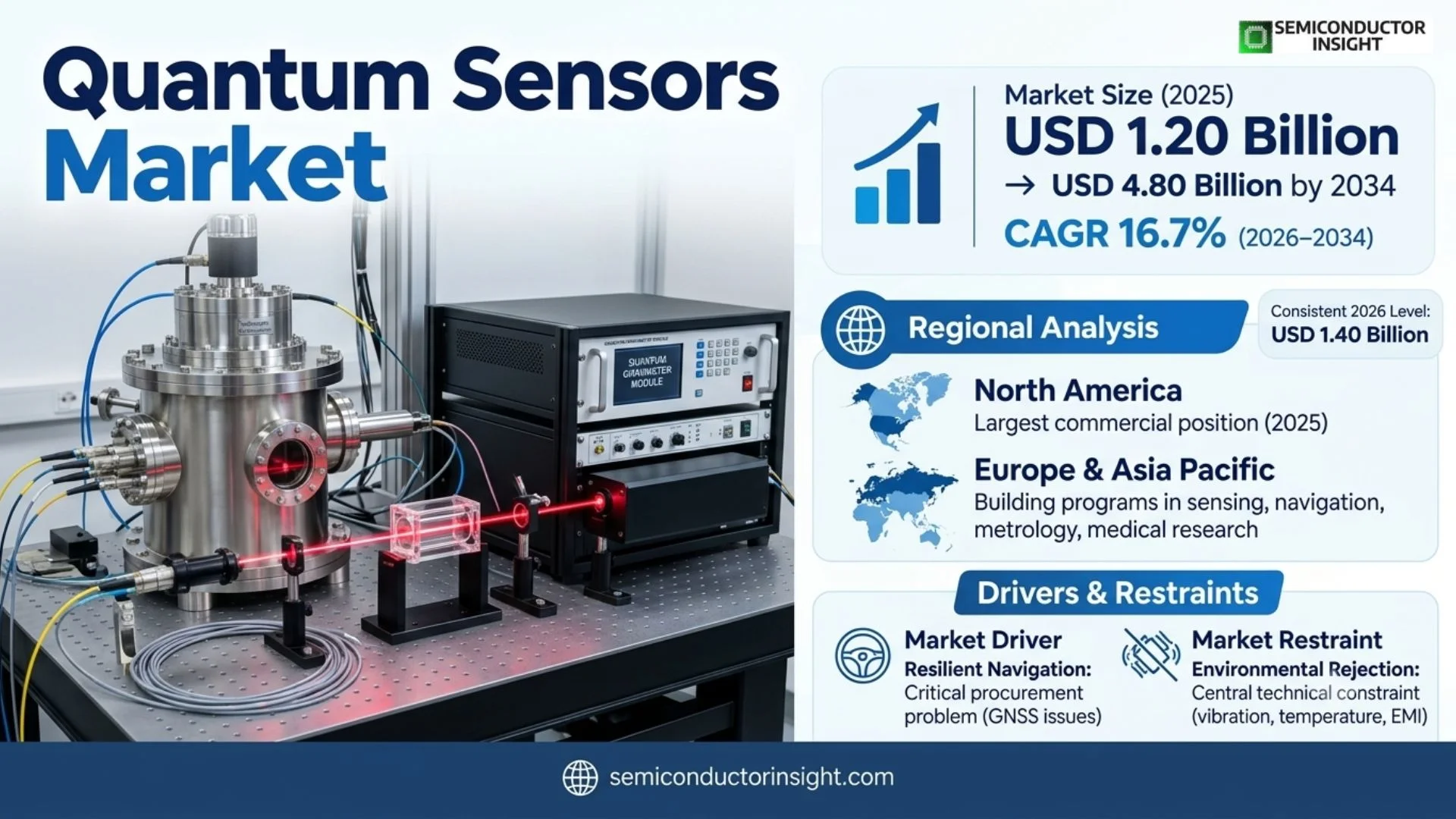
Quantum Sensors Market was valued at USD 1.20 billion in 2025 and is projected to reach USD 4.80 billion by 2034, representing a CAGR of 16.7% over the 2026–2034 forecast period. The consistent 2026 market level is USD 1.40 billion. North America held the largest commercial position in 2025, while Europe and Asia Pacific are building substantial application-specific programs in sensing, navigation, metrology and medical research.
Quantum sensors convert a physical quantity into a measurable signal by exploiting quantized atomic, spin, superconducting or matter-wave behavior. The market spans instruments that measure magnetic and electric fields, acceleration, rotation, gravity, time-linked quantities and temperature with sensitivities or stability that conventional technologies cannot readily provide. Commercial systems combine the quantum-active medium with control electronics, lasers or microwave sources, shielding or compensation, calibration routines and signal-processing software, so the addressable market extends well beyond the sensing element itself.
The market boundary includes superconducting sensors, nitrogen-vacancy diamond systems, atom-interferometry platforms, optomechanical and spin-based architectures when they are sold as quantum-enabled sensing systems. It excludes conventional MEMS, Hall-effect, fluxgate and optical sensors unless a product uses a genuinely quantum sensing mechanism. This distinction matters because many end applications remain hybrid: a quantum sensor is often fused with classical inertial units, GNSS receivers, imaging systems or semiconductor metrology platforms rather than replacing them outright.
Commercialization is accelerating because research programs are increasingly focused on deployment conditions rather than headline laboratory sensitivity. NIST describes atomic-vapor, NV-center and Rydberg-atom sensors as distinct real-world electromagnetic-field modalities, while DARPA’s Robust Quantum Sensors program explicitly targets operation under vibration, motion and electromagnetic interference. That shift changes supplier competition: packaging, control software, environmental rejection, calibration retention and application integration become as important as the underlying quantum state.
Segment Analysis: By Type
By type, the market is segmented into superconducting quantum sensors and NV-diamond based sensors. Superconducting devices remain important where extreme magnetic sensitivity justifies cryogenic support, including research and specialized biomagnetic measurement. NV-diamond sensors offer a contrasting path built around defects in diamond that can operate at room temperature, enabling compact magnetometry and temperature sensing. Their solid-state form factor makes them particularly relevant to semiconductor metrology, localized magnetic imaging and emerging navigation applications where size, weight and environmental tolerance matter.
| Type | Technical role | Market position |
|---|---|---|
| Superconducting quantum sensors | Ultra-sensitive magnetic-field measurement using superconducting quantum interference effects, normally requiring cryogenic operation. | Established in specialized scientific and biomagnetic systems where sensitivity is paramount. Adoption is constrained by cooling, shielding and system complexity, but performance keeps the architecture relevant in high-value measurement environments. |
| NV-diamond based sensors | Use nitrogen-vacancy defects in diamond whose spin states respond to magnetic field, temperature and related quantities and can be optically read. | Fast commercialization path because room-temperature operation, spatial resolution and solid-state packaging support compact instruments. NIST highlights their potential for magnetic navigation and localized field measurement. |
Additional segmentation: By End User
The report also segments demand by research institutions, manufacturing and fabrication users, and defense agencies. Research institutions remain essential early adopters because they validate sensor architectures and establish measurement protocols. Manufacturing and fabrication users prioritize repeatability, uptime and integration with existing tools rather than ultimate laboratory sensitivity. Defense agencies emphasize assured navigation, magnetic and gravity anomaly detection, platform ruggedization and operation in denied environments, which directs procurement toward complete fieldable systems rather than individual sensing components.
| End user | Purchasing logic |
|---|---|
| Research institutions | Access to frontier sensitivity, configurable instrumentation and experimental control; purchasing is grant- and program-driven and often tolerates larger systems. |
| Manufacturing & fabrication | Repeatability, calibration stability, throughput, service support and integration with metrology or process-control workflows. |
| Defense agencies | Ruggedness, low size-weight-power burden, GPS-independent operation, security, validated field performance and long support cycles. |
Additional segmentation: By Technology
Technology segmentation includes atom interferometry, optomechanical sensors and spintronic or spin-based sensors. Atom interferometers use matter-wave interference to measure acceleration, rotation and gravity and are central to quantum inertial and gravimetric systems. Spin-based architectures include atomic-vapor and NV-center magnetometers, while optomechanical approaches couple mechanical motion to optical readout. These platforms have different packaging and environmental-control requirements, so suppliers compete on application fit rather than one universal sensitivity metric.
| Technology | Commercial fit |
|---|---|
| Atom interferometry | Quantum gravimetry and inertial sensing for navigation, geophysics and space science; highest value where long-term drift and absolute references matter. |
| Optomechanical sensors | Precision displacement, force and acceleration measurement in laboratory and specialized instrumentation; integration depends on optical stability and packaging. |
| Spin-based sensors | Magnetometry and localized field sensing using atomic vapor, NV diamond or related spin systems; spans laboratory, biomedical, navigation and semiconductor use. |
Segment Analysis: By Application
By application, the market is segmented into navigation and aerospace, biomedical imaging, semiconductor metrology, and defense and security. Navigation and aerospace is the strongest near-term commercialization route because resilient positioning is a defined operational requirement and multiple programs are moving sensors onto aircraft, ships and other moving platforms. Biomedical imaging uses highly sensitive magnetic sensing to measure weak biological signals, while semiconductor metrology values nanoscale field mapping. Defense and security overlaps with navigation but also includes anomaly detection, timing and situational-awareness missions.
| Application | Demand characteristics |
|---|---|
| Navigation and aerospace | Demand is driven by the need for positioning and inertial references that remain usable when GNSS is degraded. Purchasers evaluate drift, field robustness, platform integration, size-weight-power, map quality and the ability to fuse quantum measurements with conventional inertial systems. |
| Biomedical imaging | Hospitals and research centers require non-invasive, low-noise sensing of weak biomagnetic signals. Adoption depends on clinical workflow, shielding requirements, regulatory validation, patient ergonomics and whether quantum sensors deliver actionable diagnostic improvement. |
| Semiconductor metrology | Chipmakers and tool vendors value local magnetic and electrical characterization at high spatial resolution. The commercial gate is compatibility with fab workflows, contamination control, repeatability, automation and throughput rather than record sensitivity in isolation. |
| Defense and security | Programs focus on assured PNT, magnetic and gravity anomaly detection, remote field sensing and operation on mobile platforms. Procurement is programmatic and validation-heavy, rewarding suppliers that can prove rugged operation and maintain calibration outside the laboratory. |
Regional Analysis
North America leads the 2025 commercial market because the United States combines defense procurement, national-laboratory expertise, quantum startups, aerospace users and university research. Europe has a coordinated public research base and explicit national missions for quantum sensing, while Asia Pacific combines advanced manufacturing, electronics integration and expanding national quantum programs. South America and the Middle East & Africa remain earlier-stage markets where adoption is concentrated in research, resource exploration, infrastructure monitoring and selected defense applications.
How does regional quantum-sensing demand differ?
Regional demand is shaped less by generic electronics consumption than by the institutions funding and validating the technology. North America emphasizes defense, navigation and high-end R&D; Europe combines public research with healthcare, infrastructure and navigation missions; Asia Pacific benefits from semiconductor manufacturing and national technology programs; South America has targeted geophysical and research demand; and the Middle East & Africa are building capability around defense, energy, mining and research. Supplier access therefore depends on program partnerships, local technical support and application-specific validation.
| Region | Position | Growth outlook | Demand profile | Market access gate |
|---|---|---|---|---|
| North America | Largest | High | Defense, navigation, R&D | Federal programs, platform validation and application partnerships |
| Europe | Major research-commercial cluster | High | Healthcare, navigation, infrastructure | EU/national program participation and industrial integration |
| Asia Pacific | Fast commercialization potential | High | Manufacturing, electronics, defense | Local ecosystem, manufacturing integration and national programs |
| South America | Emerging | Selective | Geophysics, mining, universities | Project economics, imported instrumentation and research funding |
| Middle East & Africa | Emerging | Selective to high in niches | Defense, energy, resource sensing | Program funding, local support and environmental validation |
Competitive Landscape
Competition is fragmented across physics platforms rather than dominated by one universal product class. Large technology companies contribute quantum research, control electronics, cryogenics or systems integration, while specialist suppliers commercialize NV-diamond microscopes, atomic gravimeters, magnetometers and control software. The value proposition increasingly depends on whether the supplier can deliver a complete measurement workflow, including calibration and application software, rather than simply a sensitive element.
The company list on the report page spans IBM, Honeywell, Qnami, Trimble, Bosch Sensortec, Quantum Diamond Technologies, Q-CTRL, ID Quantique, M Squared, Qblox, NVision, AOSense, Qontrol and Raytheon. These organizations do not occupy identical positions in the value chain. Some are direct sensing-system developers, some provide adjacent quantum control or photonics capability, and others are diversified technology companies. The competitive analysis therefore separates defensible sensor-system suppliers from adjacent ecosystem participants instead of treating every profiled organization as an interchangeable vendor.
Specialists gain traction when they solve a deployment bottleneck that larger research organizations do not address quickly: compact packaging, stable laser systems, environmental rejection, portable calibration, software-based error suppression, or application-specific data interpretation. Government programs further shape the field because early revenue can come from sponsored development and prototypes before recurring commercial volume develops. This favors suppliers able to work through multi-year engineering programs and document performance under operating conditions.
| Competitive tier | Representative organizations | Primary differentiation |
|---|---|---|
| Fieldable quantum sensing systems | Q-CTRL, AOSense, Qnami, M Squared | Navigation, gravimetry, magnetometry, diamond sensing, atom-based systems and application integration. |
| Quantum control / adjacent enabling technology | Qblox, Qontrol, ID Quantique | Control electronics, photonic or quantum subsystems that support sensing architectures but are not always sold as complete sensors. |
| Diversified technology and defense participants | IBM, Honeywell, Bosch Sensortec, Trimble, Raytheon | Large R&D resources, platform access, systems engineering and adjacent sensing or navigation capabilities. |
Key companies profiled
IBM, Honeywell, Qnami, Trimble, Bosch Sensortec, Quantum Diamond Technologies, Q-CTRL, ID Quantique, M Squared, Qblox, NVision, AOSense, Qontrol and Raytheon are profiled within the report scope. Their relevance differs by sensor modality and application, so supplier comparisons should be made by technology, field performance and system responsibility rather than by company size alone.
Production Capacity Analysis
Quantum-sensor capacity is not meaningfully described by a single global unit-output figure because production architectures differ radically. NV-diamond systems depend on high-purity diamond material, defect creation, optical components, microwave electronics and calibration; atom interferometers require vacuum systems, lasers, atomic sources and precision timing; superconducting sensors require specialized fabrication and cryogenic integration. Effective capacity is therefore constrained by qualified component supply, alignment and calibration labor, and application-specific test infrastructure more than by conventional assembly-line throughput.
The most scalable architectures are those that migrate critical functions toward semiconductor-style and photonic integration. Chip-scale optical packages, compact control electronics and repeatable diamond processing can lower system size and labor content, while software can reduce the burden of environmental compensation. However, high-performance systems still require calibration against traceable references and characterization across temperature, vibration and magnetic environments. Capacity expansion therefore involves both manufacturing equipment and metrology capability, creating a bottleneck that is less visible than component assembly.
Market Dynamics
The market is expanding because precision requirements and navigation resilience are improving at the same time that quantum hardware is becoming more fieldable. The strongest driver is demand for measurements that classical sensors cannot provide with the same stability or spatial resolution. The main restraint is that quantum advantage under controlled laboratory conditions does not automatically translate to moving platforms, factories or clinical environments. Commercial opportunities are strongest where a buyer can assign a clear economic or mission value to better sensing.
Market Drivers
| Driver | Impact | Time horizon | Evidence basis |
|---|---|---|---|
| Resilient navigation and PNT | High | Near to medium term | Government missions and field trials are moving quantum magnetometry and gravimetry toward GPS-independent navigation. |
| Government quantum investment | High | Multi-year | EU, UK, U.S. and Asia-Pacific programs fund sensing research, ruggedization and demonstrations. |
| Semiconductor and precision metrology needs | Medium-High | Medium term | NV-center and atomic sensors offer localized electromagnetic-field measurement beyond conventional approaches. |
| Healthcare and biomagnetic sensing | Medium | Medium to long term | Quantum magnetometers can measure weak biological magnetic signals, with adoption gated by workflow and clinical validation. |
Resilient navigation becomes an operational procurement problem
Navigation is moving from a research use case to an operational procurement problem because GNSS can be jammed, spoofed or unavailable. Quantum magnetometers and gravimeters offer passive measurements tied to Earth’s physical fields, while atom interferometers provide inertial and gravity references. The commercial implication is significant: buyers can justify higher sensor cost when the alternative is mission interruption, and suppliers can sell integrated navigation systems rather than laboratory instruments.
Public programs shorten the path from prototype to field trial
Public quantum programs finance the expensive engineering gap between a sensitive laboratory experiment and a rugged product. DARPA’s RoQS program is explicitly structured around operation in real-world defense environments, while the EU and UK programs set application missions around sensing, healthcare and navigation. These programs create test platforms, reference customers and technical milestones that private startups would struggle to fund independently, accelerating qualification of components and complete systems.
Semiconductor metrology rewards spatial resolution and non-contact measurement
Advanced semiconductor processes create demand for localized magnetic, current and defect characterization at dimensions where conventional probes face spatial-resolution limits or perturb the device being measured. NV-diamond sensing is especially relevant because the sensing center can be located close to a sample while operating at room temperature. Commercial success depends on integrating this sensitivity into automated, contamination-compatible tools that fit fab metrology workflows and deliver repeatable measurements at useful throughput.
Healthcare adds a high-value but validation-intensive application
Quantum magnetometers can detect biomagnetic fields associated with neural and cardiac activity, potentially enabling new imaging configurations with less reliance on cryogenic hardware. The market opportunity is high value but cannot be inferred from physics performance alone. Clinical adoption requires reproducible patient-level benefits, workflow compatibility, regulatory approval, safety documentation and serviceability. Suppliers that combine sensing hardware with reconstruction software and clinical partnerships are better positioned than standalone component vendors.
Market Restraints
| Restraint | Impact | Commercial consequence |
|---|---|---|
| Environmental sensitivity | High | Performance can degrade under vibration, field gradients, temperature change or motion, raising system-engineering cost. |
| Calibration and traceability burden | High | Field instruments need repeatable reference procedures and long-term stability, increasing qualification time. |
| System cost and complexity | Medium-High | Lasers, vacuum components, shielding, cryogenics or precision optics can make total ownership cost difficult for non-mission-critical applications. |
| Export and security controls | Medium | Some navigation and defense applications can face cross-border restrictions, limiting addressable customers and supply options. |
Environmental rejection remains the central technical constraint
Quantum sensors are sensitive by design, so the same physics that produces exceptional measurement capability can make them susceptible to unwanted motion, vibration, temperature drift and electromagnetic interference. DARPA identifies these effects as a primary barrier to field deployment. Suppliers therefore need active compensation, differential architectures, sensor fusion, packaging and software control. Each mitigation adds cost and engineering complexity, and performance must be demonstrated on the target platform rather than extrapolated from a quiet laboratory.
Calibration limits scale unless it becomes automated
A high-sensitivity instrument is commercially useful only if its calibration can be reproduced across units, maintained over time and checked without expert intervention. Quantum systems can require laser-frequency references, magnetic compensation, vacuum integrity, microwave control or spatial alignment. If those procedures remain manual, manufacturing throughput and field service scale poorly. Automated self-check routines and traceable calibration workflows are therefore as important to market expansion as improvements in raw sensitivity.
Total system cost narrows the first wave of applications
Many quantum-sensing architectures still rely on precision lasers, optical benches, vacuum packages, cryogenics or low-noise electronics. These subsystems raise acquisition and maintenance cost relative to mature classical sensors. Early adoption therefore concentrates where improved measurement has a clear mission, safety or productivity value. Cost reduction will depend on component integration, photonics, standardized packages and higher production volumes rather than simple price competition at the sensor-element level.
Market Opportunities
GPS-independent navigation systems
Air, maritime and defense operators need assured positioning when satellite navigation is unavailable. Quantum magnetometry, gravimetry and inertial sensing can be combined with classical INS and map matching, creating a systems-level market for sensors, control software, maps, integration and recurring support. Suppliers that demonstrate bounded navigation error on moving platforms can address a much larger market than those selling laboratory gravimeters alone.
Chip-scale NV-diamond metrology
Room-temperature NV centers offer a route to compact magnetic and electrical-field imaging close to semiconductor devices and materials. The opportunity is strongest in failure analysis, current mapping, advanced packaging and research tools where high spatial resolution has direct diagnostic value. Scale will come from repeatable diamond processing, compact optics and automated scan and reconstruction software.
Quantum-enabled biomedical instruments
Optically pumped and solid-state magnetometers can support new forms of magnetoencephalography, magnetocardiography and related biomagnetic measurement. The commercial opportunity lies in systems that reduce infrastructure burden or improve patient access while preserving diagnostic quality. Success requires clinical evidence and hospital workflow integration, creating room for partnerships between quantum-sensor developers and established medical-imaging companies.
Environmental and subsurface sensing
Quantum gravimeters and magnetometers can improve detection of underground structures, groundwater changes, mineral resources and infrastructure voids. These applications provide an economic link between improved measurement and reduced survey uncertainty. Field ruggedness, survey speed and interpretation software determine the commercial value, making integrated service models a practical route for early adoption.
Supply Chain Analysis
Quantum materials and atomic sources. Upstream value comes from high-purity diamond, alkali-vapor cells, superconducting materials, vacuum components and stable atomic sources. Specifications are unusually demanding because impurities, defects and thermal behavior directly affect coherence and measurement stability. Suppliers with process control and traceability can capture disproportionate value even when material volumes are modest.
Lasers, photonics and control electronics. Many quantum sensors depend on narrow-linewidth lasers, modulators, photodetectors, microwave electronics, frequency references and low-noise acquisition. These components often determine size, power and field reliability. Photonic integration and compact electronics are therefore major cost-down levers, and cross-supplier compatibility becomes important as the market moves away from laboratory optical benches.
Sensor assembly, packaging and calibration. Assembly converts delicate physics into a repeatable instrument. Vacuum sealing, optical alignment, magnetic shielding or compensation, thermal management and calibration must survive transport and field operation. The calibration stage is labor- and metrology-intensive, which can limit effective capacity. Manufacturers that automate alignment and self-test gain a structural advantage as volumes grow.
System integration, software and deployment. Downstream value is increasingly captured in sensor fusion, map matching, reconstruction algorithms, application software and service. Navigation buyers need a position solution rather than a raw gravity trace; medical users need interpretable images; semiconductor users need automated defect information. This shifts margin toward companies that own the complete application workflow and can support customers through qualification.
Recent Developments in the Quantum Sensors Market
Developments tracked to September 2026. Each item below is tied to an official agency, government program or company announcement and is included because it changes the commercialization path, field-readiness or addressable application set for quantum sensing.
- 27 August 2026
Q-CTRL reported a maritime field demonstration of GPS-free quantum gravimetric navigation in the Coral Sea. The system used a quantum gravimeter and gravity-map matching to provide positioning without satellite signals, extending commercial quantum navigation from laboratory and airborne demonstrations into maritime operation. Source - 19 December 2025
NIST published a review of atom-based electromagnetic-field sensing that covers atomic-vapor magnetometers, NV-center magnetometers and Rydberg-atom radio-frequency sensors. The work reinforces the market’s multi-architecture structure and the need to match sensor physics to frequency range, spatial resolution and application environment. Source - 27 August 2025
DARPA announced the first phase of the Robust Quantum Sensors program, focused on making quantum sensors resistant to interference, vibration and motion across ground, air, sea and space platforms. The program directly targets the ruggedization barrier that separates precision prototypes from deployable systems. Source - 6 May 2025
NASA detailed atom-interferometry work aboard the International Space Station, where the Cold Atom Lab has demonstrated matter-wave interferometry in microgravity. The program supports longer-term applications in gravity science, navigation and space-based precision measurement. Source
Report Scope & Segmentation
| Attribute | Scope |
|---|---|
| Report title | Quantum Sensors Market Size, Share & Industry Analysis, By Type (Superconducting Quantum Sensors, NV-Diamond Based Sensors), By Application (Navigation and Aerospace, Biomedical Imaging, Semiconductor Metrology, Defense and Security), and Regional Forecast, 2026-2034 |
| Base year | 2025 |
| Estimated year | 2026 |
| Forecast period | 2026–2034 |
| 2025 market size | USD 1.20 billion |
| 2026 estimated size | USD 1.40 billion |
| 2034 projected size | USD 4.80 billion |
| CAGR (2026–2034) | 16.7% |
| Largest market in 2025 | North America |
| By Type | Superconducting quantum sensors; NV-diamond based sensors |
| By Application | Navigation and aerospace; Biomedical imaging; Semiconductor metrology; Defense and security |
| By End User | Research institutions; Manufacturing & fabrication; Defense agencies |
| By Technology | Atom interferometry; Optomechanical sensors; Spintronic sensors |
| By Deployment Mode | Integrated chip-scale devices; Laboratory-scale systems; Hybrid cloud-connected platforms |
| Companies profiled | IBM; Honeywell; Qnami; Trimble; Bosch Sensortec; Quantum Diamond Technologies; Q-CTRL; ID Quantique; M Squared; Qblox; NVision; AOSense; Qontrol; Raytheon |
Frequently Asked Questions
What is the size of the quantum sensors market in 2025?
The global quantum sensors market is valued at USD 1.20 billion in 2025. The market scope covers quantum-enabled sensing systems across magnetic, inertial, gravimetric, temperature and related precision-measurement functions, including superconducting, NV-diamond and atom-based architectures where they are deployed as sensing products or integrated systems. This scope captures the principal commercial sensing platforms without treating conventional high-performance sensors as quantum products.
What is the quantum sensors market forecast for 2034?
The market is projected to reach USD 4.80 billion by 2034. Using the 2025 and 2034 size anchors, the consistent compound growth rate is 16.7% across the 2026–2034 forecast presentation, with a 2026 market level of USD 1.40 billion. The forecast therefore reflects the same global revenue scope and application boundary used for the 2025 base-year valuation.
Which region is the largest quantum sensors market?
North America is the largest 2025 market because the region combines U.S. federal quantum programs, national laboratories, defense demand, aerospace users, specialized startups and university research. Europe and Asia Pacific are also strategically important, but their commercialization mix is more closely tied to public missions, industrial integration and manufacturing ecosystems.
Which quantum sensor type has the strongest commercialization path?
NV-diamond sensors have a strong commercialization path where room-temperature operation, compact form factor and spatial resolution matter. Superconducting sensors remain important where extreme magnetic sensitivity justifies cryogenic infrastructure. The most suitable architecture depends on the application, so no single sensor type is optimal across navigation, medical, semiconductor and defense use cases.
What are the main applications for quantum sensors?
The report segments applications into navigation and aerospace, biomedical imaging, semiconductor metrology, and defense and security. Navigation is especially important because quantum magnetometers, gravimeters and atom-interferometry systems can support positioning and inertial measurement when satellite navigation is unreliable or unavailable. These applications differ in qualification burden, system integration and purchasing logic, so commercialization rates are not uniform across the portfolio.
What is the main barrier to quantum-sensor adoption?
The central barrier is translating laboratory sensitivity into stable operation under vibration, motion, temperature change and electromagnetic interference. Commercial systems also need reproducible calibration, manageable size-weight-power, application software and field service. These system-engineering requirements often determine adoption more strongly than a sensor’s best laboratory sensitivity. Suppliers must therefore prove stable field performance and calibration retention before laboratory sensitivity can translate into recurring commercial demand.
How are quantum sensors used in semiconductor metrology?
Quantum magnetometers, particularly NV-diamond architectures, can map local magnetic and electrical behavior near devices and materials. Their commercial value is strongest in failure analysis, current mapping and advanced research when high spatial resolution is paired with automated scanning, contamination-compatible packaging, repeatable calibration and integration with fab or laboratory workflows. Commercial tools also require repeatable scanning, calibration, software reconstruction and integration with established laboratory or fab workflows.
Why are governments investing in quantum sensing?
Governments support quantum sensing because it can provide strategic capabilities in resilient navigation, defense, healthcare, precision measurement and infrastructure monitoring. Programs from DARPA, the European Union and the United Kingdom explicitly target deployment or commercialization, helping fund the difficult engineering stage between a research demonstration and a robust product. Public programs also create reference customers and test environments that reduce the engineering risk of moving prototypes into operational settings.
Which companies are profiled in the quantum sensors market?
The report profiles IBM, Honeywell, Qnami, Trimble, Bosch Sensortec, Quantum Diamond Technologies, Q-CTRL, ID Quantique, M Squared, Qblox, NVision, AOSense, Qontrol and Raytheon. Their roles differ across direct sensors, control systems, photonics, navigation and broader quantum or defense ecosystems. The profiled set spans direct sensing specialists, quantum-control suppliers and diversified technology groups, so competitive roles differ materially by application.
What will determine market growth through 2034?
Growth will depend on ruggedization, automated calibration, component integration, lower size-weight-power, repeatable manufacturing and evidence that quantum sensing creates measurable mission or economic value. Navigation, semiconductor metrology, healthcare and geophysical sensing can scale when complete systems outperform classical alternatives under real operating conditions rather than only in controlled laboratories. The strongest growth will come from applications where those technical improvements can be tied to measurable mission, diagnostic or productivity value.
Research Sources & Evidence Base
View research sources used in this market overview
- DARPA – From fragile to field-ready: RoQS program launches first phase. Field ruggedization, environmental-interference and deployment evidence, 27 August 2025.
- NIST – Atom-Based Quantum Sensing of Electromagnetic Fields. Technical evidence on atomic-vapor, NV-center and Rydberg sensor modalities, published 19 December 2025.
- NIST – Nitrogen-Vacancy (NV) Center Magnetometry. Evidence on NV-diamond magnetometry and GPS-resilient navigation potential.
- NASA – Quantum Sensing via Matter-Wave Interferometry Aboard the International Space Station. Atom-interferometry evidence and space-sensing applications, 6 May 2025.
- European Commission – Quantum Technologies Flagship. European program scope, budget and quantum sensing/metrology application area.
- UK Government – National Quantum Strategy Missions. 2030 missions covering quantum healthcare sensing, aircraft navigation and mobile networked sensors.
- Q-CTRL – GPS-Free Quantum Gravimetric Navigation Demonstration. Maritime quantum-navigation field demonstration, 27 August 2026.
- AOSense – Sensors for a Quantum World. Commercial atom-based gravity and inertial sensing capability.
Get Sample Report PDF for Exclusive Insights
Report Sample Includes
- Table of Contents
- List of Tables & Figures
- Charts, Research Methodology, and more...
 Download Sample Report PDF


