
Top 5 Major Leading Regions Shaping Medical Grade EMI Filter Market through Safer and More Reliable Medical Electronics
Medical electronics are becoming more connected, compact and computationally intensive, making electromagnetic compatibility an increasingly important design requirement. Medical Grade EMI Filter Market sits quietly inside this transformation, protecting power lines and sensitive electronics from conducted electromagnetic interference while helping equipment meet safety and performance requirements. The scale of the opportunity is linked closely to the sheer diversity of healthcare equipment. The World Health Organization estimates that around 2 million different types of medical devices are available globally across more than 7,000 generic device groups.
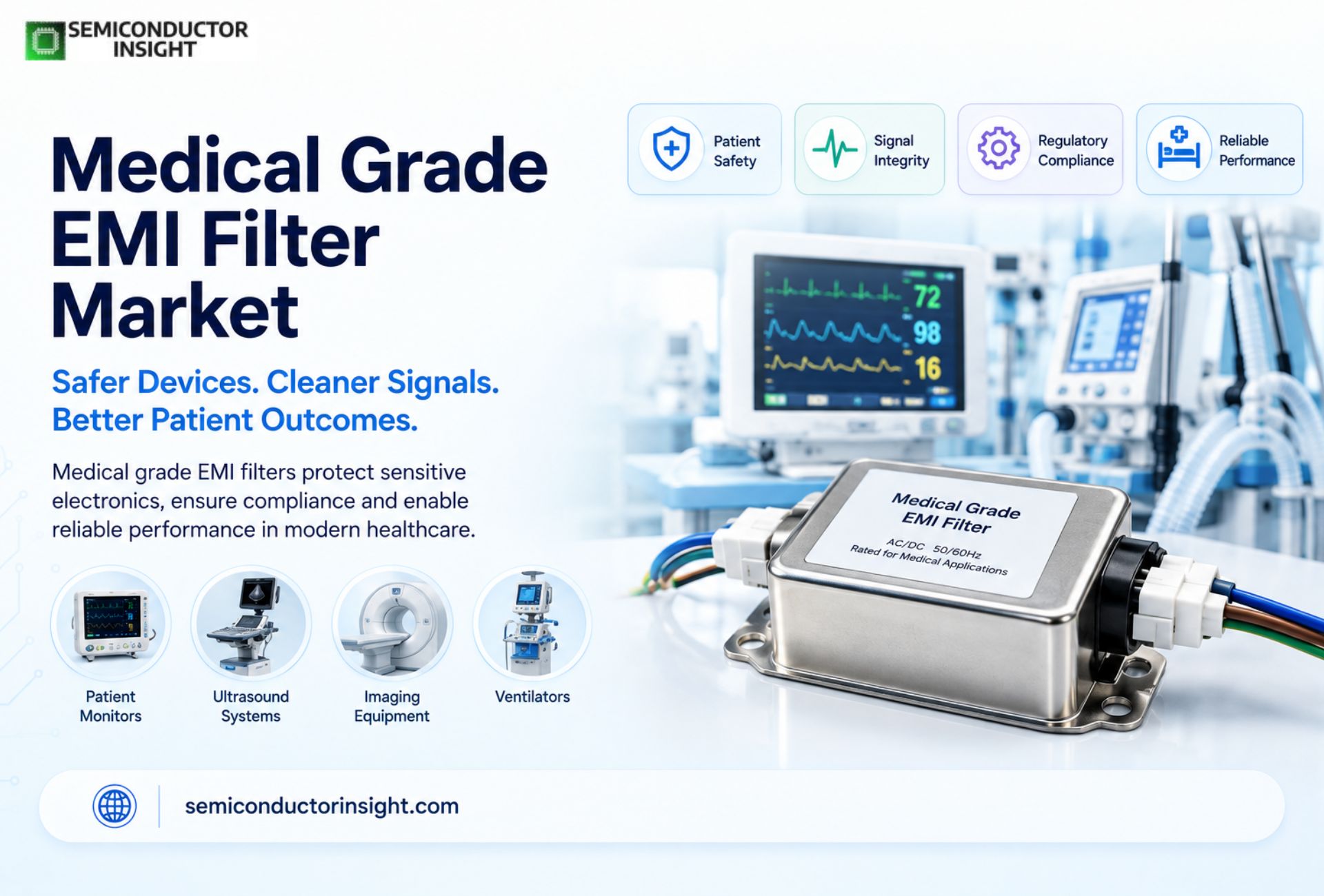
In 2026, EMI filtering is particularly relevant for patient monitors, ultrasound systems, imaging equipment, ventilators, laboratory instruments, surgical systems, dialysis equipment and electrically powered diagnostic platforms. IEC 60601-1-2 specifically addresses electromagnetic disturbances affecting the basic safety and essential performance of medical electrical equipment and systems.
The 2026 Application Chain behind Medical EMI Protection
AC/DC Power Input → Medical Grade EMI Filter → Power Conversion → Control Electronics → Sensors/Communication → Patient-Facing Function
This architecture explains why filters are increasingly treated as an integral part of equipment design rather than a final-stage accessory. The FDA also recognizes conducted, radiated and electrostatic electromagnetic interference as important considerations for medical devices and maintains specific EMC guidance for manufacturers.
For More Detailed Insights, You Can Surf Our Latest Report Here: https://semiconductorinsight.com/report/medical-grade-emi-filter-market/
North America Takes the Lead through High-Intensity Clinical Electronics
North America remains a highly influential region because of its concentration of advanced hospitals, medical-device manufacturers, diagnostic laboratories and connected clinical systems. In the United States, CDC reporting for 2024 included 3,410 general acute-care hospitals, alongside 1,294 critical-access hospitals, creating a large installed base of electrically powered healthcare equipment.
The region’s importance is not simply measured by hospital numbers. Imaging systems, intensive-care equipment, surgical electronics and wireless medical technologies require carefully controlled electromagnetic environments. FDA recommendations specifically identify areas such as ER, ICU, CCU and NICU as locations where electromagnetic environments should be assessed because critical equipment can be exposed to interference.
Europe Builds Demand around Dense Medical Technology Innovation
Europe represents another major center for medical-grade filtering because of its extensive medical-device ecosystem and demanding regulatory environment. The European Commission states that more than 500,000 types of medical devices and IVDs are available in the EU.
The region also has more than 38,000 medical technology companies, with approximately 90% classified as SMEs, while the sector directly employs more than 930,000 people. More than 15,700 medical-technology patent applications were filed with the European Patent Office in 2024.
For EMI filter manufacturers, this creates a broad design landscape spanning laboratory analyzers, imaging platforms, surgical equipment, patient monitoring and home-care electronics.
Asia Pacific Turns Manufacturing Scale into Filter Demand
Asia Pacific is particularly important because it combines enormous healthcare infrastructure with large-scale electronics manufacturing. China alone reported 1.107 million medical and health institutions at the end of 2025, including approximately 38,000 hospitals. Its healthcare institutions also handled billions of patient visits annually.
Japan adds another sophisticated market. Its government healthcare statistics track hospitals, clinics, beds, patient volumes and specialized medical services at national scale, providing a mature installed base for medical electronics.
The regional opportunity therefore extends from high-volume medical equipment manufacturing to premium imaging, robotics, monitoring and laboratory platforms where low-noise power architecture is critical.
Latin America Connects Healthcare Expansion with EMC Requirements
Latin America is developing into an important application region as hospitals, diagnostic centers and specialized healthcare networks modernize their electrical and electronic infrastructure. Brazil provides a useful indicator. Government healthcare data recorded approximately 425,000 healthcare establishments in 2024, including more than 7,300 hospitals and over 30,000 diagnostic-support establishments.
That breadth matters for EMI filters because modernization does not occur only inside large tertiary hospitals. Diagnostic imaging, laboratory systems, patient monitoring, dental electronics and outpatient equipment all introduce additional electronic loads requiring dependable electromagnetic protection.
Middle East & Africa Create a Different EMI Filtering Story
The Middle East and Africa present a more infrastructure-led opportunity. Advanced hospitals in Gulf markets increasingly incorporate connected monitoring, imaging, intensive-care and surgical technologies, while African healthcare systems continue working toward stronger electrification and equipment reliability.
The WHO estimates that nearly 1 billion people in low- and lower-middle-income countries are served by healthcare facilities without reliable electricity or without electricity access. In sub-Saharan Africa, only around half of hospitals have reliable electricity access.
This makes power quality, protection and equipment reliability especially important. In such environments, medical-grade filtering can become part of a broader electrical-design strategy rather than simply an EMC compliance component.

Comments (0)