
Top 5 Major Leading Regions for the Noninverting Buffer Market Shaping High-Speed Logic and Connected Electronics in 2026
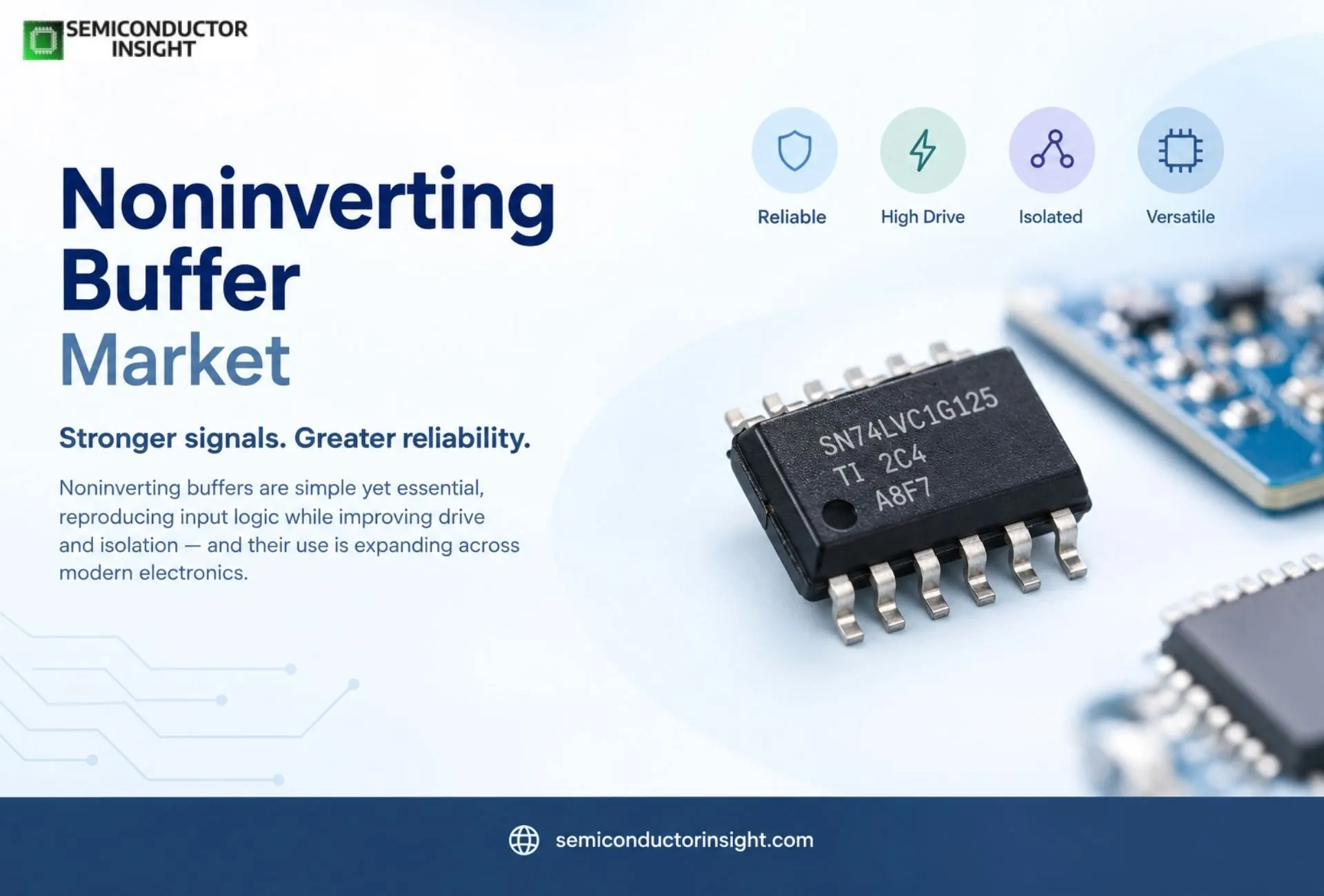
A noninverting buffer performs a deceptively simple task: it reproduces the input logic state while strengthening the signal, improving drive capability, isolating circuit sections, or enabling controlled bus connection. In practical designs, devices such as Texas Instruments’ SN74LVC1G125 provide a single-channel 3-state noninverting buffer across a 1.65 V–5.5 V supply range, with up to ±32 mA output drive and propagation delay as low as 3.7 ns at 3.3 V. Automotive versions extend the same concept into vehicle electronics operating from –40°C to 125°C.
This makes noninverting buffers relevant to much more than traditional logic boards. They appear in microcontroller interfaces, industrial controls, automotive electronics, communication equipment, storage systems, consumer devices, instrumentation, FPGA boards and power-management architectures.
2026 Signal Chain Snapshot
Controller / FPGA → Logic Buffer → Bus or Peripheral → Sensor / Memory / Actuator
The broader semiconductor environment is expanding rapidly. Global semiconductor sales reached $146.8 billion in July 2026, 6.4% above June, while year-to-date sales had already surpassed the previous annual record by July.
North America – Expanding Domestic Chip Capacity Creates More Interface-Level Demand
North America remains a major electronics and semiconductor design center, particularly for computing, automotive, industrial automation, aerospace and communications. The U.S. semiconductor ecosystem has more than 160 announced projects across 30 states, representing over $825.8 billion in announced private investment and more than 525,000 projected jobs supported or created, according to the Semiconductor Industry Association’s September 2026 industry update.
The manufacturing expansion is also moving into specialized semiconductor categories. In July 2026, the U.S. Department of Commerce announced up to $225 million in CHIPS funding for Bosch’s $2 billion silicon-carbide facility in California. Bosch says it has already produced and delivered more than 60 million SiC chips worldwide since its first-generation production began in 2021.
For the noninverting buffer market, this ecosystem matters because every new automotive, industrial or computing platform increases demand for signal-conditioning and interface components surrounding processors, sensors, power devices and controllers.
Europe – Automotive Electronics Gives Logic Buffers a Dense Application Base
Europe’s semiconductor opportunity is closely connected with automotive, industrial automation, energy systems and medical electronics. The European Commission notes that a modern car can contain more than 1,000 chips, while a hybrid electric vehicle can contain as many as 3,500 chips.
That chip density creates numerous locations where buffering, level compatibility, bus isolation and signal-drive functions become necessary. European semiconductor expansion is also targeting automotive and industrial production. TSMC’s 2025 annual report states that its planned Dresden facility is focused on automotive and industrial applications, complementing its manufacturing expansion in the United States and Japan.
The regional opportunity therefore extends from conventional logic boards into vehicle controllers, factory equipment, charging systems and intelligent industrial machinery.
You can freely browse our most recent updated report to learn more about it before scrolling further: https://semiconductorinsight.com/report/noninverting-buffer-market/
Asia-Pacific – The Highest-Volume Electronics Ecosystem
Asia-Pacific has an unusually deep connection to the noninverting buffer ecosystem because it combines semiconductor fabrication, assembly, packaging and massive electronics manufacturing.
China alone produced 484.3 billion integrated circuits during 2025, an increase of 10.9% year over year. It also produced 1.27 billion smartphones and 332 million microcomputer units during the year. In the first half of 2026, Chinese integrated-circuit production reached another 279.8 billion units, averaging more than 1.5 billion units per day.
Taiwan and Japan add advanced manufacturing depth. TSMC reported 15.0 million 12-inch-equivalent wafer shipments in 2025, 305 distinct process technologies and 12,682 products manufactured for 534 customers. Japan is simultaneously expanding advanced-node capability, with the Japanese government investing another ¥150 billion in Rapidus in June 2026 after an earlier ¥100 billion investment.
Regional flow: Wafer fabrication → Packaging → PCB assembly → Automotive / mobile / industrial equipment → Buffer and interface requirements
Latin America – Electronics Manufacturing Is Creating New Semiconductor Touchpoints
Latin America’s opportunity is developing through electronics manufacturing, automotive production, industrial systems and government-backed semiconductor programs. Brazil’s Brasil Semicon program was updated in 2026 to strengthen semiconductor production, research and innovation across the domestic electronics chain.
Brazil’s technology ecosystem also recorded R$267 million in strategic ICT project investment during 2025, representing a 116% increase in government-supported funding compared with 2024.
For noninverting buffers, the significance is not simply local chip fabrication. Increasing PCB assembly, embedded electronics, industrial automation and connected equipment creates more demand for compact logic devices that can isolate buses and deliver stable digital signals.
Middle East & Africa – Digital Infrastructure Opens Smaller but Strategic Niches
The Middle East and Africa represent an emerging application zone where semiconductor demand is increasingly connected with telecommunications, data infrastructure, energy systems, industrial automation and smart-city electronics. The importance of interface components rises as equipment becomes more connected and distributed.
The broader global semiconductor expansion provides the foundation: worldwide sales reached $403.3 billion in Q2 2026, up 35.1% from Q1, while June alone reached $134.5 billion.
In this region, noninverting buffers can support communication boards, embedded controllers, instrumentation, energy-management equipment and industrial gateways where reliable signal transfer is required without introducing complex logic transformation.
What the 2026 Regional Picture Reveals?
The noninverting buffer market is being shaped less by standalone buffer demand and more by the increasing number of digital connections inside every electronic system. Smaller packages, wider voltage compatibility, faster propagation, stronger output drive and automotive qualification are becoming important design attributes. TI’s current LVC portfolio, for example, includes devices with 1.45 mm² package footprints, up to 32 mA output drive, and operating ranges extending from 1.65 V to 5.5 V.
As semiconductor production expands across five major geographic clusters, every additional processor, sensor, controller, memory interface and communication channel creates another potential point where a noninverting buffer can improve signal integrity and system reliability.

Comments (0)