
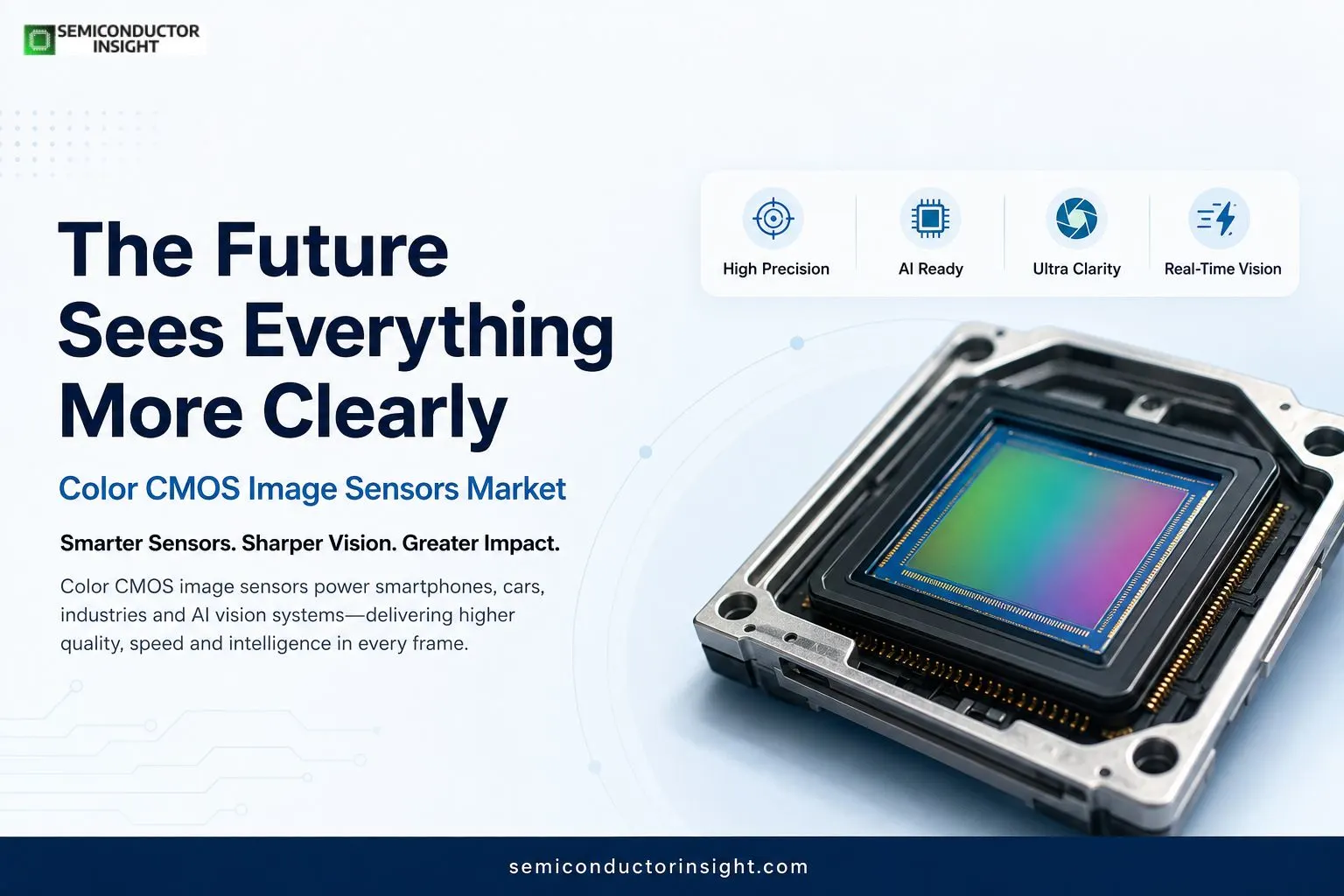
Top 5 Major Leading Regions for Color CMOS Image Sensors Market Powering the Next Wave of Digital Vision
Color CMOS image sensors are moving well beyond the traditional role of simply capturing photographs. They now sit at the heart of smartphones, automotive cameras, surveillance systems, industrial inspection equipment, medical imaging devices, drones and increasingly AI-enabled vision platforms.
The technology is also shifting toward larger pixels, stacked architectures, higher dynamic range, and global shutter operation and processing capabilities closer to the sensor. Sony Semiconductor Solutions, for example, announced its 50-effective-megapixel LYT-828 mobile sensor with more than 100 dB dynamic range and 4K video at up to 120 frames per second.
Sony also reported cumulative shipments of 20 billion image sensors by December 2024, showing the enormous installed base supporting the imaging semiconductor ecosystem.
Don’t Forget to Surf Our Updated Report for More Detailed Analysis: https://semiconductorinsight.com/report/color-cmos-image-sensors-market/
Asia Pacific Is Where Sensor Manufacturing Meets Massive Device Volume
- Asia Pacific remains the most influential regional ecosystem for color CMOS image sensors, combining semiconductor manufacturing, smartphone production, camera-module assembly and automotive electronics.
- Japan has an especially important position through Sony’s image-sensor manufacturing and technology base, while South Korea and China add major semiconductor, smartphone and camera-module capabilities. The region’s mobile ecosystem generated approximately $1 trillion in economic value during 2025, according to GSMA, while Asia Pacific is expected to reach 1.5 billion 5G connections by 2030.
- The opportunity is no longer limited to additional cameras. Smartphone manufacturers are increasingly demanding higher-resolution sensors and better computational imaging. In 2025, Sony introduced technologies aimed at improving HDR performance, low-light photography and high-speed video, reflecting this transition from camera quantity to image quality.
North America Is Turning Sensors into AI Vision Infrastructure
North America’s importance comes from the applications built around image data. Automotive perception, robotics, security, smart infrastructure, industrial automation and AI-enabled devices are creating demand for sensors capable of delivering reliable visual information under difficult lighting and motion conditions.
The region already has an advanced mobile ecosystem. GSMA reports that mobile technologies generated $1.6 trillion in economic value in North America during 2024, equivalent to 5% of regional GDP. The United States and Canada also reached 60% 5G share of mobile connections in 2024.
This connectivity matters because high-quality cameras increasingly work as part of connected AI systems rather than isolated components. A color CMOS sensor feeding an edge processor can support real-time object recognition, warehouse inspection, autonomous machines and driver-monitoring functions.
Europe Is Making Automotive Cameras a Safety Requirement
- Europe’s strength is particularly visible in automotive imaging. The European Union’s General Safety Regulation has made several driver-assistance technologies mandatory for new vehicles, including advanced emergency braking, lane-keeping assistance and reversing detection using cameras or sensors. These requirements began applying broadly to new vehicles from July 7, 2024, with additional measures being introduced through 2029.
- That creates a structural opportunity for CMOS image sensors because automotive systems increasingly depend on cameras for pedestrian detection, lane recognition, parking assistance and driver monitoring.
- Europe also has nearly half a billion people connected to mobile internet, while mobile data consumption increased from 3.8 GB per connection per month in 2019 to 15.3 GB in 2024. This expanding digital environment supports demand for cameras across consumer electronics, smart infrastructure and connected mobility.
Latin America Is Creating a Wider Consumer Imaging Base
Latin America’s opportunity is closely linked to smartphone adoption, connectivity expansion and the gradual arrival of 5G-enabled applications. GSMA recorded more than 450 million unique mobile subscribers in the region in 2024, while more than 30 operators across 13 countries had launched commercial 5G services by 2025.
For color CMOS sensor suppliers, this creates demand across smartphones, security cameras, retail systems, logistics and emerging smart-city applications. The regional mobile economy generated around $600 billion in economic value during 2025, illustrating the scale of the digital ecosystem in which camera-enabled devices operate.
Middle East and Africa Are Moving From Connectivity to Visual Intelligence
The Middle East and Africa represent an emerging application market where cameras are increasingly connected with smart-city platforms, security infrastructure, transportation systems, retail automation and industrial monitoring.
In MENA, 308 million people were using mobile internet in 2024, while mobile technologies generated approximately $350 billion in regional economic value. 4G represented 67% of connections, creating an established platform for connected imaging applications while 5G expansion opens opportunities for higher-bandwidth visual systems.
Across Africa, the opportunity is also expanding. GSMA estimates that 416 million people were using mobile internet in 2024, while AI and digital infrastructure investment are becoming increasingly important to regional technology strategies.
The Real Shift Is From More Cameras to Better Vision
One of the most interesting developments in 2026 is that sensor innovation is increasingly about quality rather than simply camera count. Smartphone designs are reducing redundant camera modules while adopting higher-resolution and more sophisticated sensors.
Recent industry data showed 50MP-class cameras accounted for 58% of smartphone shipments in Q2 2025, while sensors above 100MP reached 9%.
This shift gives color CMOS image sensors a broader role. The winning sensor is no longer simply the one with more pixels. It is the one capable of delivering better dynamic range, lower noise, faster readout and useful visual information for AI systems.

Comments (0)