
Top 5 Major Leading Regions for Buck-Boost Regulator Market Powering the Next Wave of Semiconductor Systems in 2026
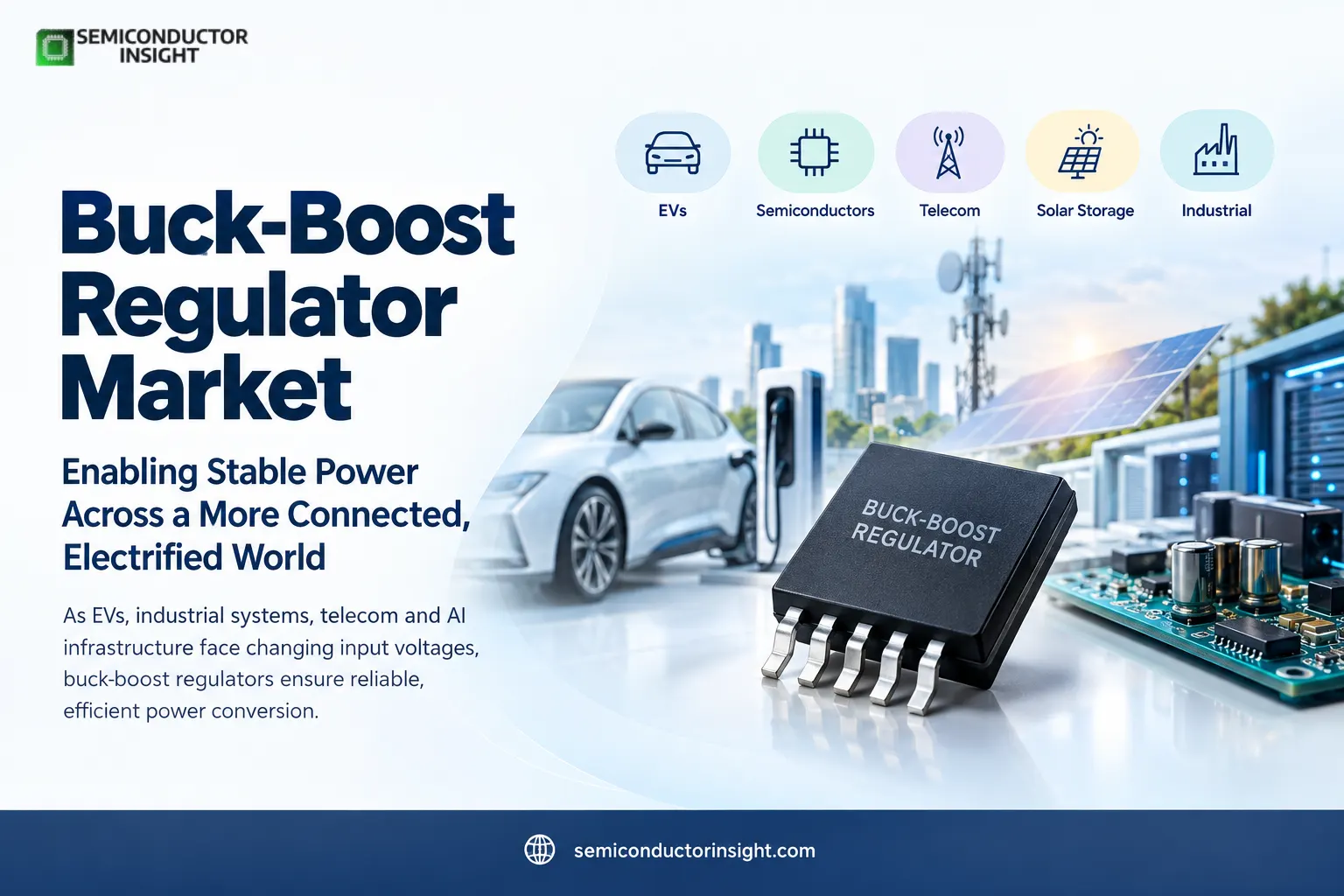
Buck-Boost Regulator Market is becoming increasingly important as electronic systems stop operating around a single predictable voltage. EV batteries, wearable devices, industrial controllers, telecom equipment, solar storage systems and AI infrastructure can experience substantial input-voltage variation, making regulated conversion essential. A buck-boost architecture can handle input situations that are higher or lower than the desired output, whereas a traditional buck regulator can only step down voltage.
The technology is particularly relevant to 48V vehicle architectures, battery-powered electronics and compact semiconductor systems. Texas Instruments, for example, identifies 48V-to-low-voltage conversion, 48V battery charging and USB-C power delivery among important automotive power-conversion applications, while its broader portfolio covers automotive, industrial, communications, data-center and portable-electronics applications.
The Global Application Map in 2026
The opportunity is no longer confined to one semiconductor application. The strongest regional demand is being shaped by a combination of vehicle electrification, semiconductor manufacturing, connected devices, industrial automation, AI computing and battery-powered systems.
Asia Pacific Takes the Lead through Electrification and Electronics Density
Asia Pacific stands out because several of the world’s largest electronics and electric-mobility ecosystems operate within the region. China remains particularly influential, while India and Southeast Asia are adding new demand. The IEA reports that Southeast Asian electric-car sales more than doubled in 2025, reaching almost 20% of new-car sales, led by Viet Nam, Indonesia and Thailand. India also reached a record 2.3 million EV sales across vehicle categories in 2025, with electric-car sales increasing by more than 75%.
This matters for buck-boost regulators because EVs and battery-powered electronics require multiple voltage rails rather than a single supply. India’s PM E-DRIVE dashboard recorded more than 30.3 lakh e-2W registrations cumulatively by September 2026, alongside almost 2.88 lakh L5 e-3W registrations, illustrating the enormous volume of battery-powered platforms requiring power-management electronics.
North America Builds Demand around AI Infrastructure and Semiconductor Capacity
North America occupies a powerful position because power management is becoming integral to new semiconductor and computing infrastructure. U.S.-headquartered semiconductor companies generated $425 billion in semiconductor sales in 2025, representing 53.4% of worldwide semiconductor sales, according to the Semiconductor Industry Association. U.S. semiconductor companies also invested $76.8 billion in R&D during the year.
The manufacturing pipeline is equally significant. More than 160 semiconductor-related projects across 30 U.S. states represented over $825.8 billion in announced private investment by September 2026, with projects expected to create or support more than 525,000 jobs.
For buck-boost regulators, this translates into opportunities around processor power delivery, network equipment, automotive electronics and industrial systems. TI specifically lists data-center compute, networking, automotive and industrial automation among its power-management application areas.
Europe Converts Automotive Electrification into Power-Management Demand
Europe’s importance comes from the rapid electrification of its vehicle fleet combined with semiconductor localization initiatives. In the first half of 2026, battery-electric vehicles represented 20.7% of EU new-car registrations, compared with 15.6% a year earlier.
The semiconductor ecosystem is also being reinforced through the EU Chips Act, under which multiple projects received Integrated Production Facility or Open EU Foundry status.
This creates a particularly strong environment for regulators used in EV battery systems, infotainment, ADAS, sensors, industrial controls and factory equipment. The attraction is straightforward: systems increasingly need compact power stages capable of maintaining stable rails despite fluctuating battery or upstream supply conditions.
For More Detailed Insights, You Can Surf Our Latest Report Here: https://semiconductorinsight.com/report/buck-boost-regulator-marketsize-share-trends-market/
Latin America Emerges as a Fast-Moving Electrification Market
Latin America is moving from an emerging opportunity toward a meaningful application market. The IEA recorded more than 350,000 electric-car sales in the region during 2025, representing approximately 75% growth from the previous year. Brazil and Mexico generated more than three-quarters of that growth.
Brazil alone reached 223,912 electrified light-vehicle sales in 2025, up 26% year over year. By January–July 2026, Brazilian electrified-vehicle sales had already reached 271,091 units, while the country’s charging infrastructure had expanded to at least 25,429 charging points.
That expanding installed base creates demand for efficient conversion inside vehicles, chargers, battery systems, dashboards and connected automotive electronics.
Middle East & Africa Turn Connectivity into a Power-Electronics Opportunity
The Middle East and Africa represent a different kind of growth story, centred on telecom infrastructure, connected devices, distributed power and increasingly digital services. Globally, cellular low-power wide-area IoT connections passed 1 billion by the end of 2025, creating an enormous installed base of devices requiring efficient voltage regulation.
Africa’s digital infrastructure is also expanding. GSMA reports that mobile technologies contributed $240 billion to Africa’s economy in 2025 and supported approximately 13 million jobs. Mobile operators are expected to invest more than $76 billion in network infrastructure between 2024 and 2030.
For buck-boost regulators, this creates practical applications in telecom equipment, remote sensors, battery-backed infrastructure, smart meters and off-grid systems where input voltage can fluctuate considerably.
Why Voltage Flexibility Is Becoming the Real Differentiator?
The market’s evolution can be visualized as:
Variable Battery / DC Input → Buck-Boost Conversion → Stable Voltage Rail → Processor / Sensor / Communication IC → Connected or Electrified System
The key change in 2026 is that regulators are increasingly expected to do more than convert voltage. They must operate efficiently within constrained board space, respond quickly to load changes, control EMI and support increasingly sophisticated automotive, industrial and computing architectures. TI’s current DC/DC portfolio, for example, emphasizes high efficiency, thermal performance, transient response and power-density requirements for data-center and automotive designs.

Comments (0)