
Top 5 Leading Regions Accelerating Filter Power Supply Market Adoption in Semiconductor Manufacturing
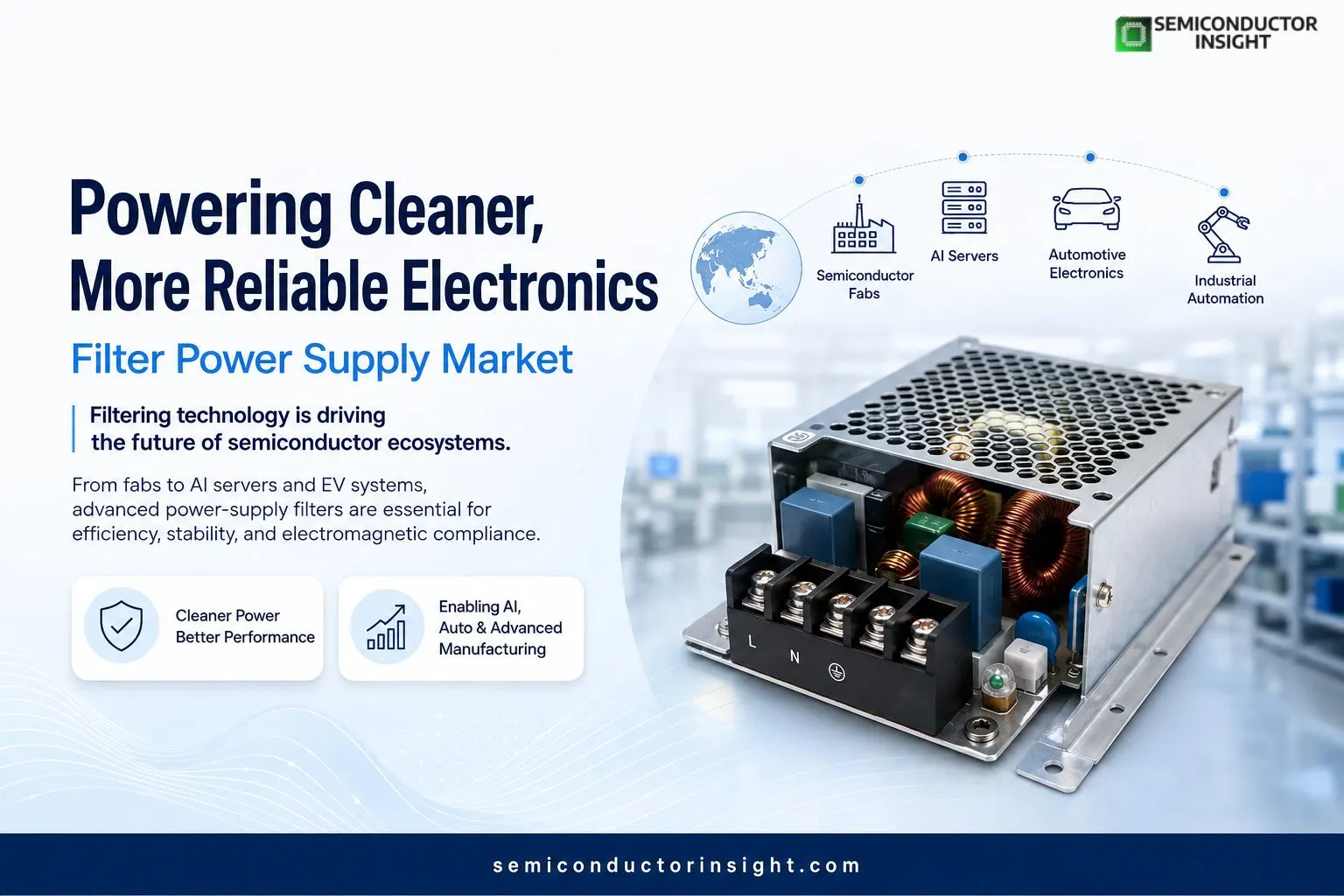
Filter Power Supply Market is becoming increasingly important as semiconductor manufacturing moves toward higher switching frequencies, denser electronics, AI servers, advanced packaging and electrically demanding industrial systems. Power-supply filters are used to control conducted electromagnetic interference, suppress common-mode and differential-mode noise, stabilize sensitive voltage rails and help electronic equipment meet electromagnetic-compatibility requirements.
Texas Instruments notes that active EMI-filter technology is already being applied to automotive onboard chargers, factory automation, grid infrastructure, server power supplies and telecommunications equipment ranging from several hundred watts to about 30 kW.
A useful way to understand the market is to follow the equipment chain rather than simply looking at component sales.
Electricity → Power Conversion → EMI Filtering → Voltage Conditioning → Semiconductor Equipment → Chip Fabrication → Packaging and Testing → AI, Automotive, Industrial and Consumer Electronics
This chain is expanding particularly quickly in regions adding semiconductor fabs, wafer capacity, advanced packaging lines and AI-computing infrastructure.
North America Turns Semiconductor Expansion into a High-Performance Filtering Opportunity
- North America remains one of the most technically important regions because semiconductor investment is spreading across wafer manufacturing, advanced packaging, materials and research infrastructure.
- The U.S. National Institute of Standards and Technology identifies new 300-mm wafer and fabrication projects in states including Texas, Missouri, Utah and New York.
- One GlobalWafers project alone is expected to create approximately 1,700 construction jobs and 880 manufacturing jobs, while its Texas facility is designed for 300-mm silicon wafers.
- Texas Instruments is also developing two large 300-mm fabs in Sherman, Texas, with anticipated output reaching tens of millions of chips per day.
- Such facilities require stable electrical environments for process equipment, controls, metrology and automated handling systems, creating demand for increasingly compact power filtering.
- The U.S. is also investing in semiconductor R&D. A planned Arizona facility is designed to provide at least one 300-mm full-flow CMOS prototyping capability, linking research directly with manufacturing-scale processes.
Asia-Pacific Maintains the Deepest Manufacturing Pull
Asia-Pacific is the most extensive semiconductor production ecosystem among the five regions, combining Taiwan, China, Japan, South Korea and emerging manufacturing locations such as India. That concentration directly supports power-filter demand because every additional wafer-processing, packaging or testing line introduces more power-conversion equipment and sensitive electronic controls.
Taiwan illustrates the intensity of this activity. Taiwan’s Ministry of Economic Affairs reported that its investment programs had attracted 1,694 companies, more than NT$25.872 trillion in cumulative investment and an estimated 162,239 domestic jobs by December 2025. Taiwan is simultaneously developing advanced semiconductor R&D infrastructure, including a planned 12-inch pilot production line supporting AI chips, silicon photonics and quantum technologies.
China adds enormous electronics volume to the regional equation. In 2025, China’s large-scale electronic-information manufacturing sector produced 484.3 billion integrated circuits, up 10.9%, while smartphone production reached 1.54 billion units. This enormous installed electronics base creates applications for EMI and power filtering from industrial equipment to consumer electronics.
Japan is also strengthening semiconductor and energy-efficient semiconductor technologies through its AI and semiconductor industrial framework, while its advanced-electronics supply chain includes dedicated government-backed programs for critical components.
Europe Builds Demand around Automotive and Power Semiconductors
Europe’s opportunity is closely connected with automotive electronics, industrial automation, and renewable-energy equipment and power semiconductors. The European Commission’s semiconductor initiatives are now targeting both advanced and mainstream manufacturing, with new facilities covering heterogeneous technologies, power devices, analog/mixed-signal chips and silicon-carbide production.
One particularly important development is the Infineon Dresden project, which focuses on discrete power and analog/mixed-signal integrated circuits. Meanwhile, the STMicroelectronics Catania project is designed to establish integrated 8-inch silicon-carbide production. These applications are especially relevant to filter technologies because power-conversion systems must manage switching noise and electromagnetic compatibility.
The EU’s Chips Act has already helped generate an estimated 46,000 direct and indirect jobs, while the proposed Chips Act 2.0 is pushing further into AI, cloud infrastructure, connected vehicles and industrial robotics.
Latin America Develops a More Specialized Semiconductor Footprint
Latin America is not yet comparable with Asia-Pacific in wafer fabrication, but Brazil is creating a more structured semiconductor ecosystem. The federal Brasil Semicon program was established to strengthen research, development, innovation, design, production and applications of semiconductor components.
Brazil’s industrial strategy also targets digital transformation, with a stated goal of digitally transforming 25% of companies by 2026 and 50% by 2033. As industrial electronics, automation, energy systems and connected equipment expand, demand for filtered power architectures can move beyond semiconductor fabs into the broader electronics-manufacturing base.
Our most recent updated related study is available for free at this link: https://semiconductorinsight.com/report/filter-power-supply-market/
Middle East & Africa Connect Semiconductor Filtering With AI Infrastructure
Despite having a lesser base for semiconductor production, the Middle East and Africa area is becoming more significant thanks to AI infrastructure, chip design, research, and high-performance computing. Researchers and students from four Saudi universities worked together to fabricate 25 cutting-edge electronic chips in 2025, according to Saudi Arabia’s KACST. For its semiconductor-design Chipathon, almost 700 students from 31 Saudi colleges submitted applications.
The infrastructure side is expanding rapidly as well. Saudi Arabia had more than 60 operational data centers developed by over 20 companies by 2025, with operational capacity exceeding 440 MW, compared with 68 MW in past year. Abu Dhabi is simultaneously developing a semiconductor cluster and R&D ecosystem, supported by partnerships involving universities and technology organizations.
For high-density AI servers, telecom equipment and data-center power systems, filtering becomes increasingly important because switching power electronics operate alongside highly sensitive processors and communications hardware.

Comments (0)