

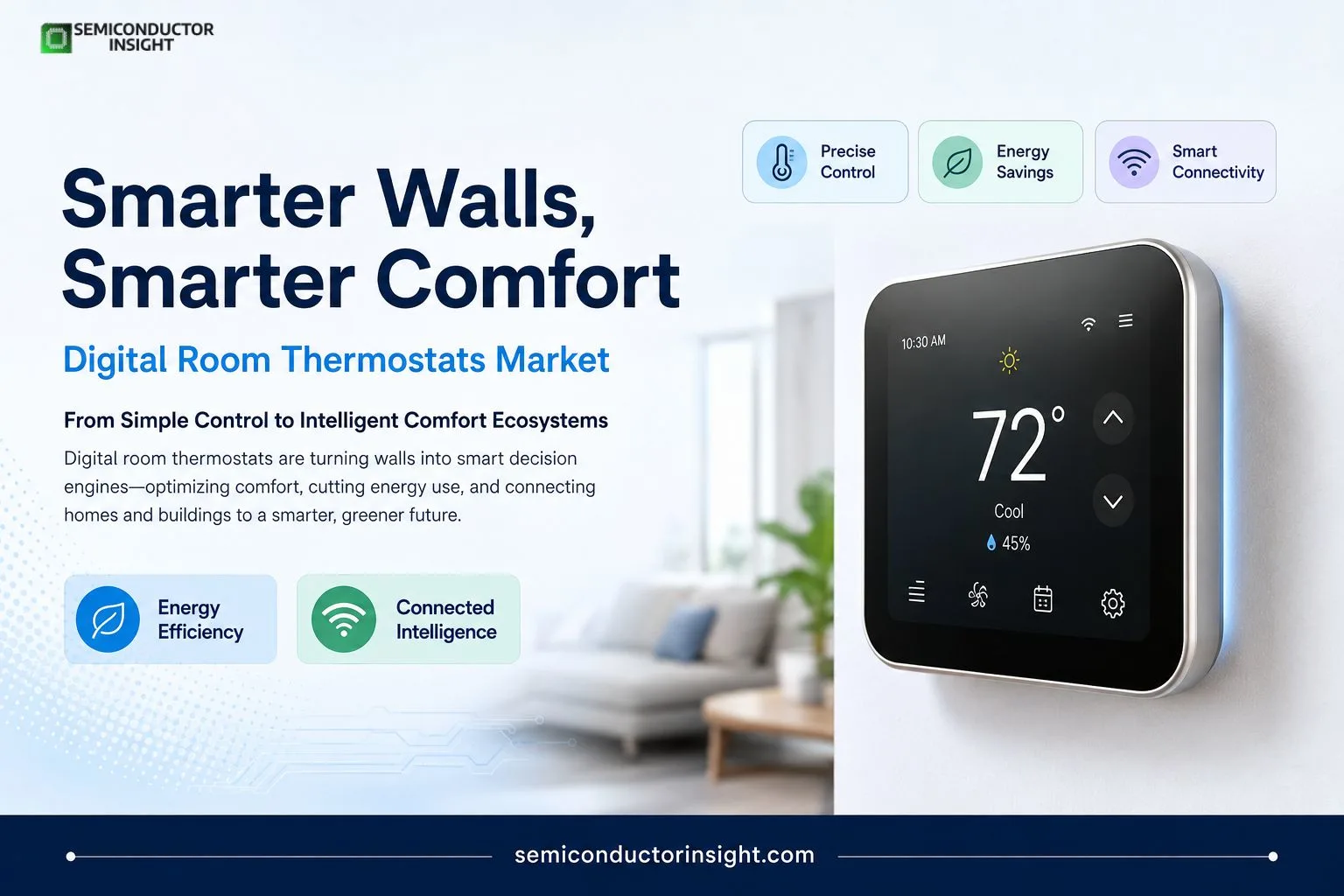
Top 15 Leading Digital Room Thermostats Companies Shaping Next-Generation Heating and Cooling Control
Silicon heartbeats inside digital room thermostats turn everyday walls into quiet decision engines. A typical unit samples temperature and humidity every 10 to 30 seconds through a 12-bit sensor, runs a PID loop on a low-cost microcontroller, and switches HVAC relays while staying under 3 W active draw.
ARM Cortex-M4 parts clocked near 100 µW per MHz handle the math with hardware floating-point support, while ESP32-C6 variants add native Thread and Wi-Fi 6 without a separate radio module. Component bills of materials often land between 25 and 40 dollars before enclosure and display, supporting retail prices that remain accessible for both new builds and retrofits.
Honeywell (via Resideo)
In the world of digital room thermostats, Honeywell Home stands out as a long-trusted name that keeps reinventing the everyday wall device. Late in 2025 the company rolled out the X8S model featuring a five-inch touchscreen, Matter compatibility, indoor air-quality tracking, radar presence sensing, and live video streaming from Ring or First Alert doorbells so homeowners can answer the door right from the thermostat.
The unit launched at around $220 and works with major voice platforms. Building Automation leadership updates continued into August 2026 as the broader Honeywell Technologies focused more tightly on connected buildings after its aerospace spin-off. These thermostats support multiple HVAC configurations, optional room sensors, and contractor tools that streamline installation across residential and light-commercial spaces.
Siemens
Siemens brings engineering depth to digital room thermostats with lines that serve everything from simple residential setups to BACnet-linked commercial buildings. In late 2025 the firm introduced the RDL series of standalone thermostats available in portrait and landscape orientations, offering e-paper displays, touch controls, OpenTherm readiness, and wireless options for heating, cooling, heat pumps, and radiant systems.
Models such as the RDG200 series integrate KNX or Modbus communication, air-quality sensing, and smartphone commissioning apps. A five-year warranty backs many units, and the devices appear in both new construction and retrofit projects across offices, hotels, and public buildings where precise zone control and energy efficiency matter.
Johnson Controls
Johnson Controls focuses on networked intelligence with its TEC3000 Series smart thermostats that combine full-color touchscreens, occupancy sensing, and advanced ventilation features designed to help manage airborne particles and CO2 levels. The controllers support BACnet, wireless, or standalone modes and integrate with Metasys or Facility Explorer systems.
Programmable scheduling and built-in occupancy detection can cut energy use significantly in hotels, multi-unit residences, and commercial spaces. Additional T9100 and T9180 models add high-resolution color screens, Wi-Fi, humidity control, and seven-day occupancy schedules, making them suitable for both residential and light-commercial applications that demand remote monitoring and compliance with energy codes.
Ecobee
Ecobee has built one of the largest voluntary data communities around smart thermostats. By the end of 2024 more than 238,000 devices had contributed to its Donate Your Data program, covering climate zones across the United States and Canada. Models such as the Smart Thermostat Premium and Enhanced continue to rank highly in 2026 reviews for their color touchscreens, air-quality monitoring, occupancy sensing, multi-platform support (Alexa, Google, HomeKit, SmartThings), and longer warranties. Users can mix different Ecobee generations in the same home and control them from a single app. The company emphasizes whole-home comfort, utility rebate programs, and features that automatically adjust setpoints based on occupancy and energy events.
Schneider Electric
Schneider Electric advances room-level intelligence with its SpaceLogic Touchscreen Room Controller and Wiser connected thermostats. Field trials of edge-AI-equipped controllers in Canadian facilities demonstrated energy reductions of up to 15% under specific conditions while maintaining comfort more than 85% of the time.
The all-in-one SpaceLogic unit can integrate HVAC, lighting, and blinds, potentially delivering energy savings of up to 35% in hotel guest rooms and similar spaces. Zigbee-certified Exxact and Wiser models support floor and room sensing, motorized valves, and multi-room scheduling. These devices target both new builds and retrofits where local processing and open protocols improve reliability and scalability.
For More Detailed Insights, You Can Surf Our Latest Report Here: https://semiconductorinsight.com/report/digital-room-thermostats-market-size-share-trends-market/
Emerson (Sensi)
Emerson’s Sensi line delivers practical, widely compatible digital thermostats that work with a broad range of conventional, multi-stage, and heat-pump systems. Models such as the Sensi Touch 2 feature a large color touchscreen, dual-band Wi-Fi, room-sensor support, energy-usage reports, and voice-assistant integration. The Sensi Smart Thermostat ST55 remains popular for its Apple HomeKit compatibility at an accessible price point. Cross-reference guides show these units can replace numerous legacy Honeywell and other models, simplifying upgrades for contractors. Emerson continues to expand geofencing, multi-thermostat management, and OEM partnerships that help homeowners and service technicians keep systems running efficiently.
Carrier
Carrier integrates digital thermostats tightly with its Infinity and related HVAC platforms. The Infinity Zoning Panel allows precise temperature and humidity control across up to eight separate zones when paired with compatible sensors and dampers. Recent customer feedback from 2026 highlights its usefulness for multi-level homes where different floors require independent settings. Carrier also offers BACnet-capable ComfortVu controllers and communicating sensors that feed data into broader building-management systems. These solutions appear in both residential and light-commercial projects that prioritize zoning flexibility and remote diagnostics.
ABB
ABB contributes KNX-based digital room thermostats and building-automation suites that emphasize open protocols and occupancy-aware control. Its i-Bus portfolio supports precise sensing and integration into larger automation networks used in commercial and institutional buildings. ABB devices often appear alongside lighting and energy-management systems, enabling coordinated responses to occupancy and environmental conditions. The company’s long experience in industrial and building automation translates into reliable hardware that facility managers deploy across multiple floors or campuses.
Vimar
Vimar specializes in elegant, design-conscious digital thermostats and connected controls popular in European residential and hospitality markets. Its products support wired and wireless configurations, multi-zone scheduling, and integration with broader home-automation platforms. The Italian firm focuses on clean aesthetics and intuitive interfaces that fit modern interiors while delivering accurate temperature regulation. Installers appreciate the modular approach that allows expansion from single rooms to whole-building systems.
Sensirion
Sensirion supplies high-precision environmental sensors that form the sensing heart of many digital room thermostats and indoor-air-quality systems. Its temperature, humidity, and gas sensors enable accurate feedback loops used by thermostat manufacturers and building-automation providers. These components help devices maintain tight control bands and support features such as VOC or CO2 monitoring. Sensirion’s focus on long-term stability and compact form factors makes its sensors common in both consumer smart thermostats and commercial room controllers.
Belimo
Belimo, headquartered in Switzerland and employing more than 2,800 people across more than 80 countries, is best known for actuators, valves, and sensors that sit alongside or inside digital room-control systems. Its room sensors measure temperature, humidity, and air quality and communicate via BACnet, Modbus, or MP-Bus. Belimo invests over 7% of sales annually in research and development and supplies field devices used in air-handling units, VAV boxes, and energy-valve applications. These components give thermostats and controllers the precise data and actuation needed for efficient zone control.
Danfoss
Danfoss offers both traditional digital room thermostats and the Ally smart-heating ecosystem. The Ally radiator thermostats communicate via Zigbee, cover a 5-to-35 °C range, and run on two AA batteries for up to two years. Paired with Ally Room Sensors that measure temperature and humidity (battery life up to five years), the system enables room-by-room control through a dedicated app and voice assistants. Newer electronic ranges such as the RET and TP series provide programmable schedules, optimized start, and five-year warranties. Danfoss solutions are widely used in European hydronic and radiator-based heating systems.
Trane
In August 2026 Trane and sister brand American Standard introduced new 24 V Priority and Gold Smart Thermostats featuring glass LED touchscreens, remote app and voice control, humidity management, and optional remote temperature-humidity sensors. The devices work with nearly any 24 V HVAC system and supply contractors with diagnostic data that can reduce unnecessary service visits. Color-coded status indicators and modern interfaces help homeowners manage comfort while giving technicians proactive insights. These thermostats extend Trane’s connected-comfort strategy across residential installations.
Saginomiya Seisakusho
Saginomiya Seisakusho, a Japanese specialist in control devices, manufactures precision thermostats and related components used in HVAC and refrigeration systems. Its digital and electronic room thermostats serve both OEM equipment makers and aftermarket needs, emphasizing reliability and compact designs suited to residential and commercial climate-control applications. The company’s long experience in sensing and switching technology supports stable temperature regulation across a variety of system types.
Viessmann Climate Solutions
Viessmann integrates digital room thermostats and controls with its boiler and heat-pump platforms. Compatible smart controls and Vitoconnect modules allow app-based monitoring, weather compensation, and multi-zone management for residential heating systems. These solutions appear frequently in European homes and light-commercial projects where precise modulation of heat sources improves efficiency. Viessmann continues to expand connected features that link room-level sensing with central plant equipment.

Comments (0)