Digital Room Thermostats Market Insights
Digital Room Thermostats market was valued at USD 3.55 billion by 2034, exhibiting a CAGR of approximately 7% during the forecast period.
Digital room thermostats are electronic control terminals installed on residential, commercial or industrial HVAC zones such as split‑type air conditioners, VRF indoor units, fan‑coil units or heat‑pump terminals. They acquire ambient temperature via NTC or digital sensors and execute set‑point adjustments, heating/cooling/dehumidification modes, fan speed control, scheduling and optional occupancy detection through an MCU that drives relays, proportional (0‑10 V/PWM) outputs or communication buses toward indoor units or valves.
MARKET DRIVERS
Energy‑efficiency mandates boost adoption
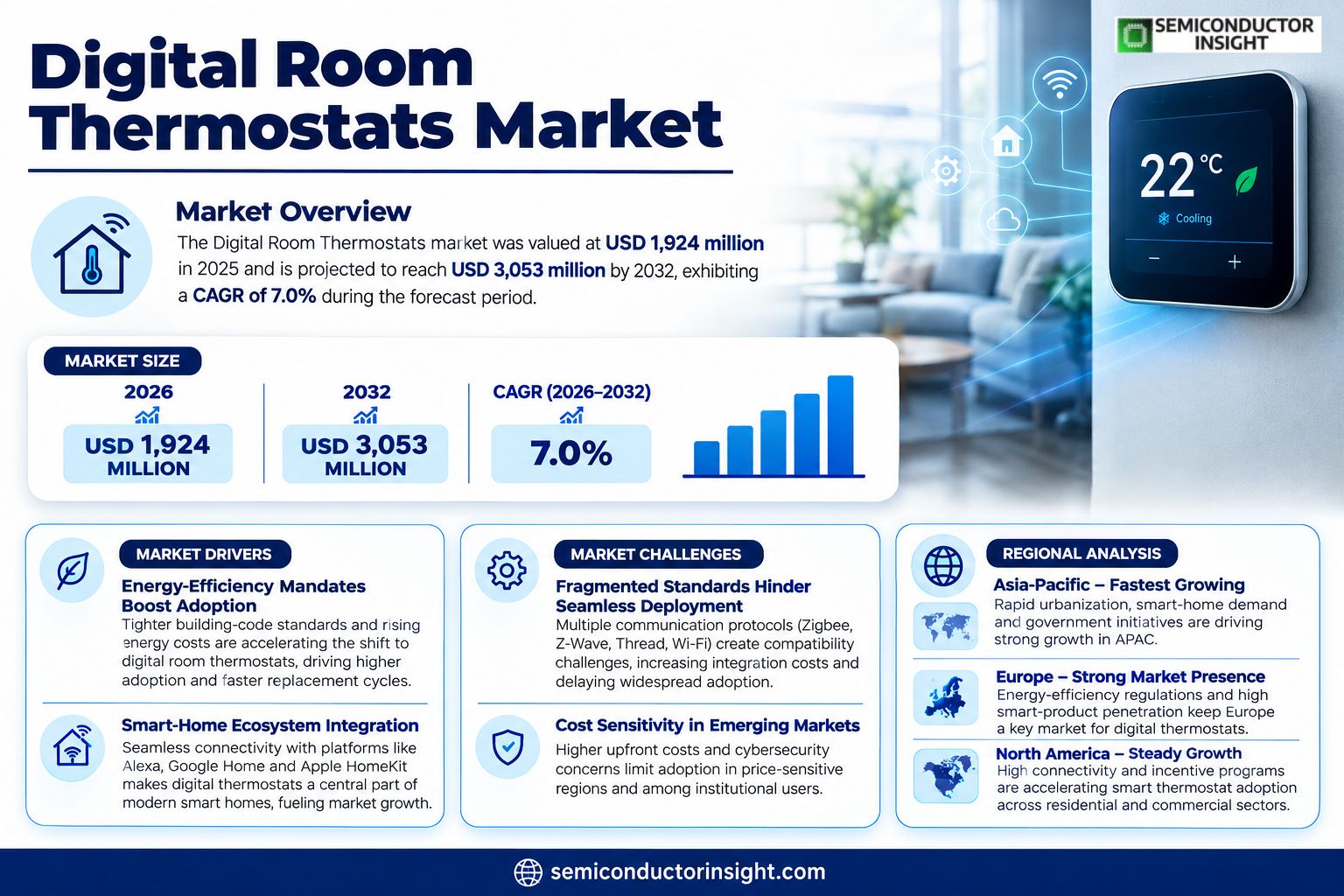
The tightening of building‑code standards across North America and Europe mandates lower heating‑energy consumption. Digital Room Thermostats Market participants that embed adaptive algorithms can demonstrate compliance while offering owners measurable utility savings. This regulatory pressure translates into faster replacement cycles for legacy programmable units.
Smart‑home ecosystem integration
Home‑automation platforms such as Amazon Alexa, Google Home and Apple HomeKit now expose thermostatic controls as first‑class services. Manufacturers that expose open APIs reap the advantage of cross‑device orchestration, prompting homeowners to upgrade from basic wired models to network‑enabled versions. The resulting upgrade momentum lifts the market beyond mere replacement demand.
➤ Analytics‑driven scheduling, paired with real‑time occupancy sensing, cuts heating load by up to 15 % in midsize apartments.
Beyond regulation and connectivity, the rising cost of natural gas and electricity fuels consumer willingness to invest in devices that promise lower bills. Companies that bundle remote diagnostics with subscription‑based energy‑insight services are positioning themselves to capture recurring revenue streams, reshaping Digital Room Thermostats Market from a one‑off purchase model to a services‑oriented landscape.
MARKET CHALLENGES
Fragmented standards hinder seamless deployment
Multiple communication protocols (Zigbee, Z‑Wave, Thread, Wi‑Fi) coexist in the smart‑home arena. Installers often confront incompatibility between a thermostat and the existing hub, leading to higher integration costs and delayed rollout. This technical diversity raises the barrier for small‑scale retrofits, especially in multi‑unit residential buildings.
Other Challenges
Cost sensitivity in emerging markets
Price points for feature‑rich digital thermostats remain above the median income in many fast‑growing regions. While the technology offers long‑term savings, upfront capital outlay deters widespread penetration, limiting the market’s reach outside mature economies.Additionally, cybersecurity concerns surrounding cloud‑connected devices have prompted procurement officers to demand rigorous data‑privacy certifications. Vendors lacking certified security frameworks risk exclusion from corporate and institutional procurement lists.
MARKET RESTRAINTS
Legacy infrastructure resistance
Older building stock often relies on centralized heating control panels that cannot be easily bypassed for zone‑level digital thermostats. Retrofit projects require substantial wiring and conduit work, inflating installation budgets and discouraging property owners from pursuing upgrades.The lack of skilled technicians familiar with both HVAC fundamentals and IoT configuration creates a talent bottleneck. Contractors hesitant to invest in specialized training may opt for conventional mechanical solutions, perpetuating reliance on dated controls.Lastly, intermittent internet reliability in rural areas reduces the perceived value of cloud‑enabled features. When connectivity cannot be guaranteed, the incentive to adopt networked thermostats diminishes sharply.
MARKET OPPORTUNITIES
AI‑enhanced predictive heating
Advances in machine‑learning models allow thermostats to anticipate occupancy patterns based on historical behavior, weather forecasts, and calendar data. Vendors that integrate such predictive engines can offer a differentiated value proposition, enabling users to enjoy comfort while shaving energy consumption without manual intervention.Regulatory incentives for low‑carbon buildings present a lucrative channel for manufacturers. By aligning product roadmaps with upcoming net‑zero building certifications, companies can secure government subsidies and preferential procurement status, accelerating market share gains.The rise of subscription‑based home‑service bundles (e.g., energy‑monitoring plus maintenance contracts) opens a recurring‑revenue stream. Providers that couple hardware sales with analytics‑as‑a‑service stand to benefit from higher customer lifetime value and deeper data insights for future product refinement.
Digital Room Thermostats Market Trends
Shift Toward Proportional Control and Node‑Based Management
The latest generation of digital room thermostats is moving away from simple on/off logic to proportional output that mirrors the variable‑speed operation of modern HVAC fans and valves. By modulating 0‑10 V or PWM signals, devices can fine‑tune temperature and humidity set‑points, delivering smoother occupant comfort while shaving energy consumption. This technical evolution is reinforced by the growing prevalence of temperature‑humidity‑occupancy sensor nodes that feed richer data into building‑automation algorithms. Manufacturers that integrate these capabilities are seeing higher adoption rates in commercial and industrial installations, where energy‑cost savings directly affect operating margins.
Other Trends
Wireless Connectivity and Upgrade Paths
Wireless mesh and gateway‑centric architectures are redefining retrofit projects for hotels and office blocks. Eliminating hard‑wired links reduces installation labor and permits rapid deployment of additional zones during building expansions. Moreover, OTA firmware updates now allow vendors to roll out security patches and feature enhancements without site visits, extending device lifecycles and improving after‑sales service profitability. The net effect is a more attractive value proposition for property owners who must balance capital expenditure against long‑term operational resilience.
Standardisation and User‑Interface Evolution
Interoperability standards such as Matter and Thread are gaining traction alongside legacy building‑control protocols, fostering a more open ecosystem where third‑party applications can interact with thermostats. Concurrently, UI design is transitioning from basic digit‑display panels to high‑resolution touchscreens that support graphical schedules, remote diagnostics, and integration with mobile apps. These enhancements not only simplify occupant interaction but also generate actionable data streams for analytics platforms, enabling facility managers to benchmark performance across sites and identify anomalies before they translate into costly failures. Digital Room Thermostats Market therefore benefits from a feedback loop where better interfaces drive richer data, which in turn fuels smarter control strategies.
COMPETITIVE LANDSCAPE
Key Industry Players
Digital Room Thermostats – Competitive Overview
The market is anchored by multinational system integrators that combine deep HVAC expertise with extensive building‑automation portfolios. Siemens, Honeywell, and Johnson Controls dominate high‑value contracts in commercial skyscrapers, data centres, and large‑scale hotel chains, leveraging proprietary communication protocols and long‑standing service networks. Their pricing power and global service footprints create a tiered structure in which mid‑range manufacturers must differentiate through modular designs or niche compliance certifications. The profit margins of 15‑30 % reflect a balance between sophisticated hardware, firmware updates, and the recurring revenue from software licences for remote diagnostics and energy‑management dashboards.Regional champions and specialist firms fill the remaining space, especially in the fast‑growing Asia‑Pacific residential segment. Companies such as Ecobee, Schneider Electric, and Vimar have accelerated product cycles by bundling low‑cost LCD touch modules with cloud‑enabled APIs, targeting cost‑conscious homeowners and small‑office retrofits. Smaller innovatorsincluding Sensirion, Belimo, Danfoss, and Saginomiya Seisakushofocus on sensor accuracy, proportional valve control, and wireless mesh connectivity, enabling OEMs to embed advanced functionality without extensive R&D spend. This diversification creates a dynamic competitive fabric where alliances, OEM‑ODM arrangements, and open‑standard adoption increasingly dictate market share.
List of Key Digital Room Thermostats Companies Profiled
- Honeywell
- Siemens
- Johnson Controls
- Ecobee
- Schneider Electric
- Emerson
- Carrier
- ABB
- Vimar
- Sensirion
- Belimo
- Danfoss
- Trane
- Saginomiya Seisakusho
- Viessmann Climate Solutions
Segment Analysis:
| Segment Category | Sub-Segments | Key Insights |
| By Type |
|
Smart Networked Type
|
| By Application |
|
Commercial
|
| By End User |
|
Facility Managers
|
| By Control Output |
|
Proportional Adjustment Type
|
| By Interaction |
|
Graphic LCD and Touchscreen
|
Regional Analysis: Digital Room Thermostat Market
North America
Homeowners are increasingly treating thermostats as the central node of an interconnected living space. Voice‑assistant compatibility and seamless integration with lighting and security platforms raise the perceived utility of each device, prompting upgrades even among consumers with functional legacy units.
State‑level efficiency standards and utility rebate schemes accelerate the displacement of analog controls. Compliance incentives are particularly pronounced in jurisdictions that have adopted net‑zero building mandates, compelling developers to embed digital thermostats early in construction cycles.
The market bifurcates between residential units emphasizing user‑friendly interfaces and commercial solutions that prioritize granular zoning capabilities. The latter benefit from enterprise‑grade analytics platforms that translate temperature data into actionable energy‑saving recommendations.
Established HVAC firms are bolstering their portfolios through acquisitions of software startups, while pure‑play technology companies leverage cloud ecosystems to differentiate their offerings with advanced learning algorithms and over‑the‑air updates.
Europe
European consumers display a pronounced appetite for sustainability, translating into early adoption of digital temperature controls that reduce building emissions. Across the EU, energy‑performance directives encourage retrofits in both residential and office blocks, prompting manufacturers to tailor firmware to local heating patterns and climatic nuances. In Germany, for instance, the integration of thermostatic controls with district‑heating networks creates a distinctive use case where precision scheduling directly influences large‑scale fuel consumption. Meanwhile, the United Kingdom’s burgeoning smart‑home market establishes a fertile testing ground for AI‑driven comfort algorithms, compelling vendors to refine user interfaces for multilingual households.
Asia‑Pacific
The Asia‑Pacific region presents a paradox of rapid urbanization juxtaposed with heterogeneous infrastructure maturity. In China and India, rising middle‑class incomes stimulate demand for connected appliances, yet legacy construction practices often lack the wiring backbone required for seamless cloud connectivity. Companies therefore focus on hybrid solutions that pair battery‑backed modules with cellular backhaul, ensuring reliability across both new builds and retrofitted apartments. Southeast Asian markets, especially Singapore and Australia, benefit from government‑sponsored smart‑city initiatives that embed digital thermostats within broader energy‑management dashboards, fostering a data‑centric approach to residential comfort.
South America
South America’s market dynamics are shaped by fluctuating energy costs and climatic diversity. In Brazil, electrical tariffs incentivize households to adopt programmable thermostats that curb peak‑load consumption. Argentina’s regulatory environment, while less prescriptive, still sees utilities offering limited rebates for energy‑efficient upgrades, nudging consumers toward digital alternatives. The region’s manufacturers often prioritize rugged hardware designs to withstand high humidity and temperature extremes, differentiating their products from those tailored for temperate zones.
Middle East & Africa
In the Middle East, extreme heat drives a pragmatic focus on thermostat reliability and integration with advanced HVAC systems that can handle high‑capacity cooling. Wealthier Gulf Cooperation Council states invest heavily in luxury smart‑home installations, where temperature control intertwines with sophisticated lighting and security ecosystems. Conversely, sub‑Saharan Africa’s market remains nascent, constrained by limited broadband penetration. Here, solar‑powered thermostats with offline scheduling capabilities are emerging as a viable pathway, aligning energy autonomy with the region’s infrastructural realities.
Report Scope
This market research report provides a comprehensive analysis of the Digital Room Thermostats Market , covering the forecast period 2026–2034. It offers detailed insights into market dynamics, technological advancements, competitive landscape, and key trends shaping the industry.
Key focus areas of the report include:
- Market Overview: The report begins with an overview outlining its current market scenario, key growth indicators, and industry transformation drivers. It discusses macroeconomic factors, demand–supply balance, regulatory landscape, and the strategic role of semiconductors in powering advancements across industries such as automotive, telecommunications, consumer electronics, and industrial automation.
- Market Size & Forecast: Historical data and future projections for revenue, unit shipments, and market value across major regions and segments.
- Segmentation Analysis: Detailed breakdown by product type, technology, application, and end-user industry to identify high-growth segments and investment opportunities.
- Regional Insights: Insights into market performance across North America, Europe, Asia-Pacific, Latin America, and the Middle East & Africa, including country-level analysis where relevant.
- Competitive Landscape: Profiles of leading market participants, including their product offerings, R&D focus, manufacturing capacity, pricing strategies, and recent developments such as mergers, acquisitions, and partnerships.
- Technology Trends & Innovation: Assessment of emerging technologies, integration of AI/IoT, semiconductor design trends, fabrication techniques, and evolving industry standards.
- Market Drivers & Restraints: Evaluation of factors driving market growth along with challenges, supply chain constraints, regulatory issues, and market-entry barriers.
- Stakeholder Insights: Insights for component suppliers, OEMs, system integrators, investors, and policymakers regarding the evolving ecosystem and strategic opportunities.
Primary and secondary research methods are employed, including interviews with industry experts, data from verified sources, and real-time market intelligence to ensure the accuracy and reliability of the insights presented.
FREQUENTLY ASKED QUESTIONS:
What is the current market size of Digital Room Thermostats Market?
-> Digital Room Thermostats Market was valued at USD 1,924 million in 2025 and is expected to reach USD 3,053 million by 2032, growing at a CAGR of 7.0% during the forecast period.
Which key companies operate in Digital Room Thermostats Market?
-> Key players include Honeywell, ABB, Siemens, Ecobee, Schneider Electric, Emerson, Carrier, Centrica, Vimar, Sensirion, Saginomiya Seisakusho, Belimo, Cyrus Controls, Viessmann Climate Solutions, ITAP SpA, Rinnai, Johnston Controls, Danfoss, Trane, Saswell, Computime, Shenzhen Topband, Beijing Hailin Control Technology Inc..
What are the key growth drivers?
-> Key growth drivers include rapid urbanization, consumption upgrades, energy‑conservation and emission‑reduction policies, and the widespread adoption of smart‑home solutions that demand advanced HVAC control.
Which region dominates the market?
-> Asia-Pacific is the fastest‑growing region, while Europe remains a dominant market due to mature technologies and high smart‑product penetration.
What are the emerging trends?
-> Emerging trends include the shift from single‑point temperature control to integrated room‑environment nodes, adoption of proportional control, wireless connectivity for rapid upgrades, development of interconnection standards and ecosystem compatibility, and enhanced UI/UX with full device lifecycle management (remote configuration, fault diagnosis, OTA).

Get Sample Report PDF for Exclusive Insights
Report Sample Includes
- Table of Contents
- List of Tables & Figures
- Charts, Research Methodology, and more...
 Download Sample Report PDF