

Top 15 Key Players in the Global Industrial Tilt Sensors Market Powering Advanced Motion Control Solutions
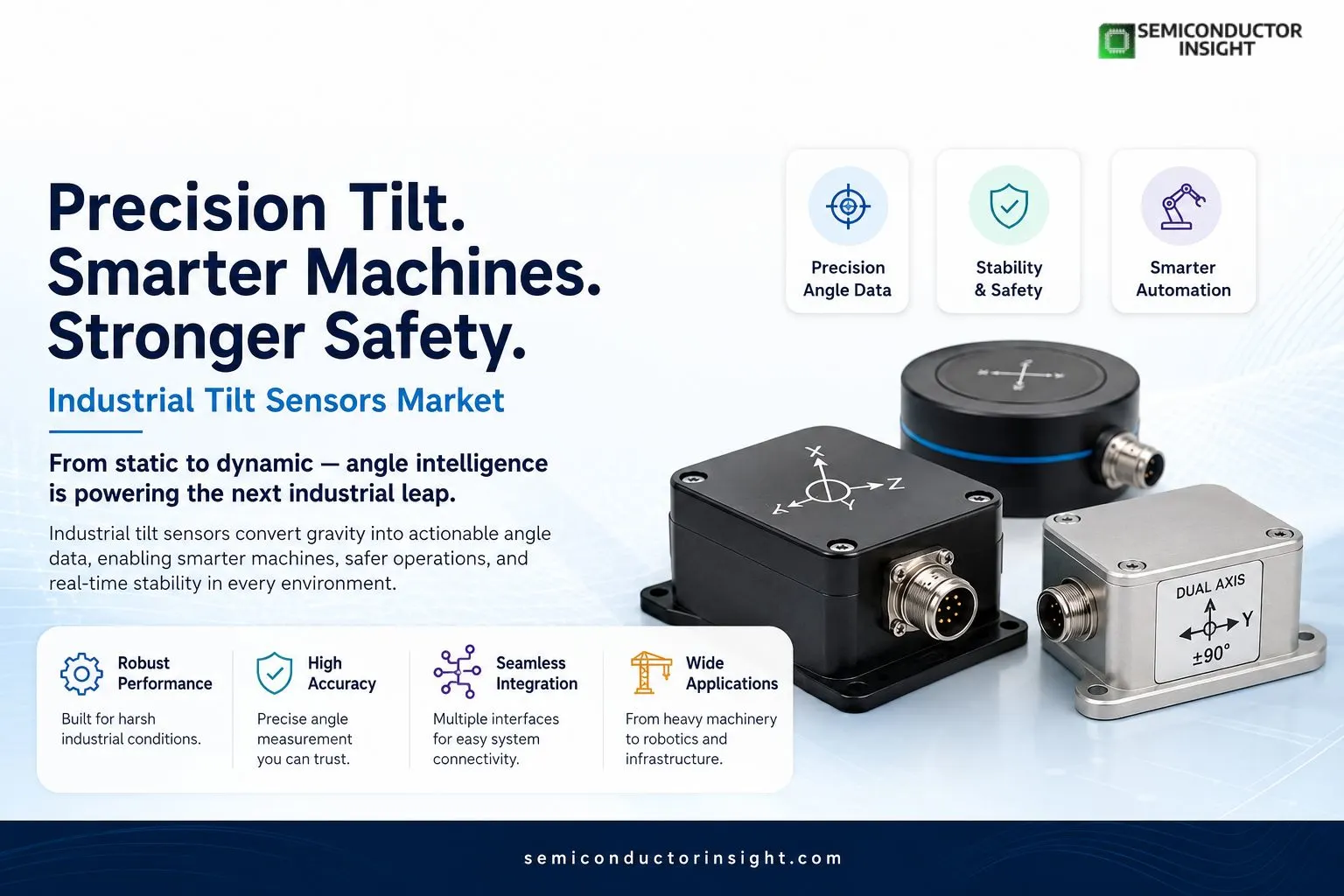
Industrial tilt sensors measure inclination relative to gravity and deliver angle data that machines and structures rely on for stability, positioning, and safety. Most modern units use MEMS accelerometers that sense the gravitational component along one or two axes and convert it into a usable angle.
Ranges commonly span from a few degrees for high-precision structural work up to ±180 degrees for full orientation tracking. Resolution can reach 0.001 degrees in specialized units while everyday industrial models hold accuracy near ±0.1 degrees across temperature swings.
Sensata Technologies – The Quiet Backbone of Motion Awareness
- Sensata sits at the heart of industrial sensing with more than 16,000 people spread across operations in 13 countries. Its teams turn physical tilt, pressure, and position into clean electronic signals that keep machines safe and efficient.
- In 2025-2026 the company opened a multi-million-pound R&D hub in Newtownabbey, Northern Ireland, bringing roughly 360 engineers under one roof while another 250 continue manufacturing nearby in Antrim.
- Recent work includes sensors for data-center power systems and humanoid-robot prototypes, plus a new Chennai plant investment of about $30 million to serve the Indian market.
- Tilt and inclination products feed into heavy vehicles, industrial equipment, and aerospace platforms, giving operators real-time awareness of platform angle across thousands of deployed units every year.
Balluff – Four Generations of Sensor Craft
Founded in 1921 as a small repair shop, Balluff now runs seven production sites and 38 subsidiaries while employing around 3,600-3,700 people worldwide. The family-owned group posted group revenue near 501-502 million euros in the latest full year. Inclination and tilt sensors sit alongside inductive, capacitive, and RFID lines, serving factories, mobile machinery, and automation cells in roughly 60-68 countries.
A smart factory opened in Aguascalientes, Mexico, strengthens supply chains, and the headquarters in Neuhausen still houses about 900 specialists focused on software, IIoT, and optical sensing. Balluff’s dual-axis and single-axis tilt units appear in packaging lines, semiconductor tools, and outdoor equipment where vibration and weather demand rugged performance.
TE Connectivity – Connecting the Angle to Everything Else
TE Connectivity’s sensor portfolio feeds into transportation, industrial automation, and data networks. Recent quarters showed net sales climbing past $5 billion in a single period, with the Sensors line contributing hundreds of millions across automotive and commercial segments. In 2026 the company announced acquisitions including Astrodyne TDI for roughly $1.4 billion and a fluid-connection unit from HENN to expand thermal and power solutions that often work alongside tilt sensing. Inclination devices support mobile equipment, autonomous platforms, and factory systems, delivering continuous angle data that integrates with connectors and power modules. Teams across multiple continents keep refining MEMS-based designs for harsh environments.
Murata Manufacturing – MEMS Precision in a Tiny Package
Murata’s SCL3300 and SCL3400 inclinometers pack three-axis or two-axis measurement into packages measuring just 7.6 × 8.6 × 3.3 mm or similar. These capacitive MEMS devices offer noise densities down to 0.001°/√Hz and operate from -40 °C to +125 °C, with selectable ranges such as ±10°, ±30°, or ±90°.
They serve structural-health monitoring, platform leveling, heavy machinery, humanoid robots, and urban-air-mobility platforms. Proven 3D-MEMS technology delivers lifetime stability and shock resistance that suits construction equipment and drones. Evaluation boards and SPI digital interfaces make integration straightforward for engineers designing the next generation of tilt-aware systems.
For More Detailed Insights, You Can Surf Our Latest Report Here: https://semiconductorinsight.com/report/industrial-tilt-sensors-market/
Baumer – Swiss Accuracy for Outdoor and Mobile Work
Baumer Group employs roughly 2,800 people across 39 sites in 19 countries and generates about 500 million euros in annual activity. Its GIM500R and GIM600R inclination sensors deliver accuracy to ±0.1°, IP69K protection, and corrosion resistance rated CX (C5-M). One- and two-dimensional versions support CANopen and SAE J1939 interfaces, with redundant options reaching performance level d under ISO 13849.
Applications stretch from forklifts and solar trackers to construction machines and process plants. More than 15 percent of the workforce focuses on innovation, keeping the family-owned Swiss firm close to customers who need reliable tilt data in wet, dusty, or vibrating conditions.
Pepperl+Fuchs – Rugged Two-Piece Design for Dynamic Tilt
Pepperl+Fuchs’ F99 series inclination and acceleration sensors use a metal mounting bracket that stays in place while the sensor module can be swapped without recalibration. Accuracy reaches ±0.15°, and the units carry IP68/69K ratings plus E1 approval for road vehicles. The IMU F99 inertial measurement unit fuses gyroscope, inclination, and acceleration data to compensate for external motion, enabling reliable readings on moving cranes, agricultural booms, and mobile platforms.
Software filters and parameter settings let users tune the devices for specific vibration patterns. These sensors appear daily on construction sites, elevators, and renewable-energy installations where continuous tilt monitoring prevents tip-overs and improves safety.
SICK – Trusted Angle Feedback across Factory Floors
SICK supplies tilt and angle sensors such as the TMM88B series with analog outputs and ranges up to ±90°. The devices integrate into packaging, logistics, and machine-tool environments where precise inclination data supports automated guidance and safety interlocks.
SICK’s broader industrial-sensor portfolio includes thousands of product variants used by manufacturers worldwide. Field engineers rely on the company’s local support networks to configure and maintain tilt units that must withstand continuous production cycles and occasional shocks. Recent deployments continue to appear in material-handling systems and mobile platforms that demand both static and dynamic angle measurement.
Turck – MEMS Inclination for Flexible Industrial Networks
Turck’s inclination sensors measure single-axis angles up to 360° or dual-axis ranges from a few degrees to ±85°. Output options include analog voltage, current, PNP, IO-Link, and CANopen, giving designers freedom to match existing control architectures. Compact rectangular housings and robust sealing suit machine builders who need reliable tilt feedback without complex wiring.
Turck units support conveyor systems, mobile equipment, and process plants where angle data feeds directly into PLCs. The company’s global sales and technical teams help customers select and commission the right combination of range, interface, and protection for each application.
Aeron Systems – Specialized Sensing for Demanding Environments
Aeron Systems focuses on industrial sensors that capture tilt and related physical parameters for automation and monitoring tasks. Its devices support applications ranging from platform leveling to equipment protection in harsh conditions. Engineers value the company’s ability to deliver consistent performance across temperature swings and vibration.
Aeron products appear in installations that require long-term stability and straightforward integration with existing control systems. Current projects emphasize reliability for outdoor and mobile machinery where continuous angle awareness reduces downtime.
PM Instrumentation – Precision Instruments for Critical Measurement
PM Instrumentation supplies tilt and inclination solutions tailored to industrial and laboratory-grade needs. Its sensors serve applications that demand accurate angular data for calibration, alignment, and structural monitoring. The company maintains a portfolio of units covering different measurement ranges and output formats.
Users in manufacturing and infrastructure projects rely on these instruments for repeatable results over extended operating periods. Recent activity continues to support both static and dynamic tilt measurement in specialized equipment.
Piher Sensing Systems – Harsh-Environment Position and Tilt Experts
Founded in 1950 in Barcelona, Piher develops contactless and MEMS-based sensors for heavy equipment, construction, agriculture, and marine use. Its TSDA dual-axis inclinometers offer ranges of ±25°, ±45°, or ±90° with accuracy better than 0.5° and IP69K sealing. Operating temperatures span -40 °C to +85 °C, and outputs include analog and CAN. Applications cover crane load monitoring, tip-over protection, solar-tracker angle control, and wind-turbine rotor positioning. In-house manufacturing and short prototype lead times allow custom mechanical and electrical designs that match exact customer requirements.
Senther – Industrial Tilt for Platforms and Robots
Senther’s T211 series single-axis and dual-axis inclinometers cover ranges from ±5° to ±180° or ±360° with resolutions of 0.05° and operating temperatures from -40 °C to +85 °C. Output choices include RS232, RS485, CAN, voltage, and current. Aluminum housings resist oils and fuels, making the sensors suitable for outdoor and mobile platforms. Typical uses include platform calibration, robot control, tip-over alarms, and machine-status monitoring. Full-process calibration and optional digital filtering help maintain signal quality in vibrating environments. Custom cable and connector options further adapt the devices to installation constraints.
BWSENSING – High-Resolution Chinese MEMS Innovation
BWSENSING develops dual-axis inclinometers such as the BWS5000 and BWS5500 series that reach accuracies of 0.001° and temperature drifts of 0.0003°/°C. Measurement ranges include ±5° and ±15°, with outputs via CAN, RS485, or other digital protocols and protection up to IP67. Wireless models support long-term structural monitoring with multi-year battery life on a single charge. Applications span bridge deflection, building health, wind-turbine towers, tunnel monitoring, and precision platform leveling. The company holds more than 100 intellectual-property rights and serves thousands of customers in intelligent driving, IoT structural monitoring, and automation. Recent work supports low-altitude aircraft and geological-disaster early-warning systems.
ASC Holdings – Specialized Sensor Solutions for Industry
ASC Holdings supplies industrial sensing products that include tilt and inclination capabilities for automation and monitoring tasks. Its devices support applications requiring reliable angular feedback in manufacturing and mobile equipment. The company focuses on robust designs that maintain performance under temperature variation and mechanical stress. Users integrate ASC units into systems where continuous tilt data improves safety and process control. Ongoing development keeps the portfolio aligned with current industrial requirements for accuracy and durability.
Nano Sensors – Compact Sensing for Modern Platforms
Nano Sensors concentrates on compact industrial sensors capable of capturing tilt and related motion parameters. Its products serve applications in automation, robotics, and equipment monitoring where space is limited yet reliable angle data remains essential. The sensors support integration into larger control systems and operate across typical industrial temperature and vibration ranges. Current offerings help engineers add tilt awareness to machines without adding significant bulk or power demand.

Comments (0)