

Top 15 High-Impact Companies Expanding Opportunities in the Standard Digital Isolator Space
Standard Digital Isolator refers to a general-purpose integrated circuit (IC) semiconductor device designed to transfer digital signals across a galvanic isolation barrier while preventing the flow of direct current or unwanted alternating currents between two circuits.
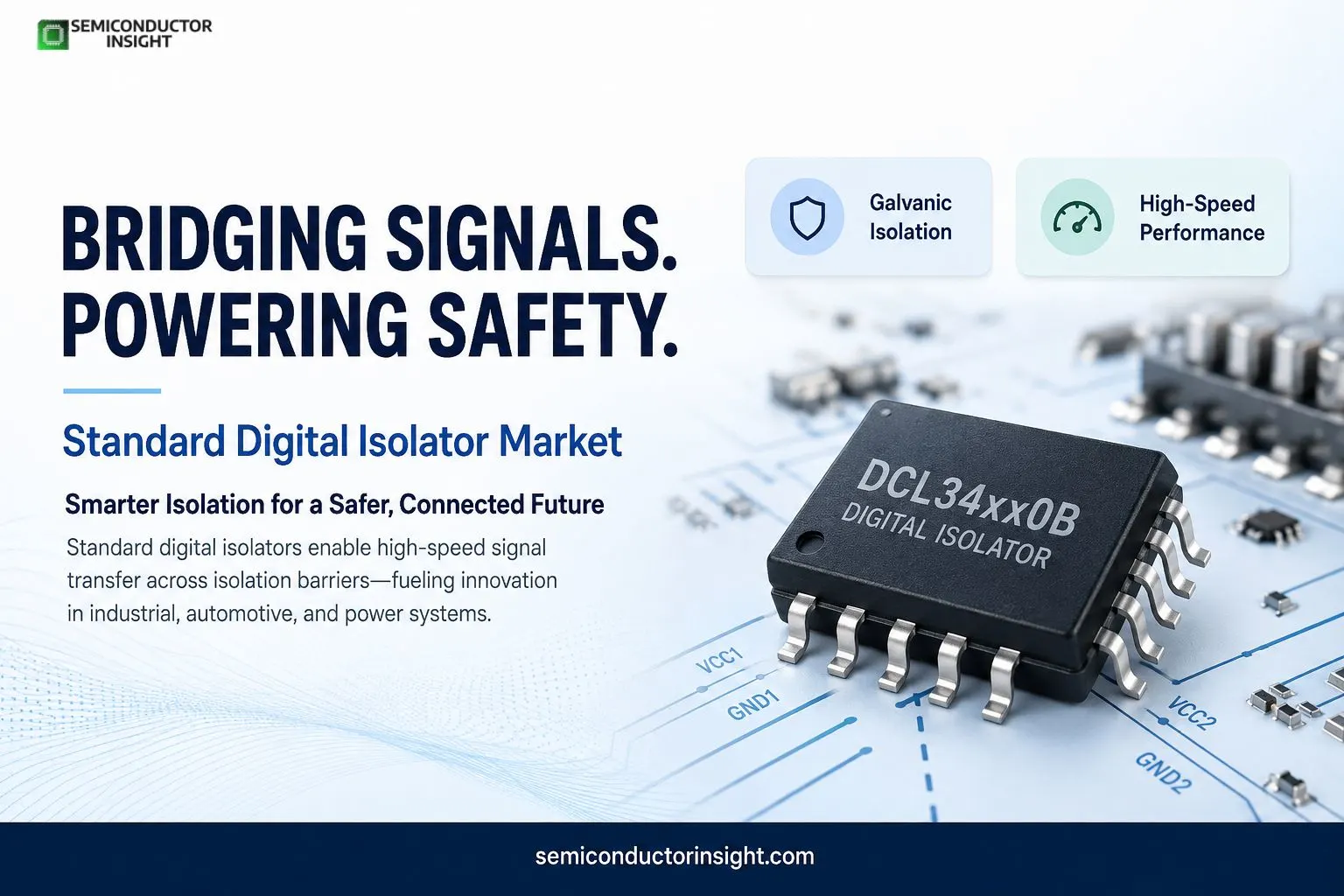
Toshiba recently expanded its DCL34xx0B series of standard digital isolators with four new quad-channel devices aimed at industrial automation. These parts draw a typical 0.2 mA per channel while supporting data rates up to 25 Mbps and deliver a minimum isolation voltage of 3000 Vrms.
Texas Instruments – The Capacity Builder
Texas Instruments anchors the digital isolator space with a deep portfolio of reinforced and functional isolators, including the ISO77xx, ISO64xx, and newer six-channel families rated up to 5000 Vrms isolation. The company runs 15 manufacturing sites worldwide and recently brought its newest 300 mm wafer fab in Sherman, Texas, into production in late 2025, with a second fab already largely built.
That Sherman campus is projected to support thousands of local jobs over time and can eventually process more than 100 million chips daily once fully ramped. TI’s Freising, Germany site alone has grown from a handful of early staff to roughly 1,500 people. In March 2026 the firm showcased new isolated power modules using its IsoShield technology at APEC, targeting data centers and electric vehicles. These moves keep TI’s isolators flowing into industrial drives, automotive systems, and power-conversion designs that demand high CMTI and low emissions.
Analog Devices – Two Decades of Magnetic Isolation
· Analog Devices, which folded Maxim Integrated into its fold, has shipped more than 6 billion unique isolation channels through its iCoupler technology.
· The portfolio spans standard multi-channel digital isolators, isolated interfaces for RS-485, CAN, SPI and I2C, plus µModule solutions that need almost no external components.
· ADI’s industrial segment delivered strong sequential growth through mid-2026, supporting applications from factory automation and motor drives to medical equipment and renewable-energy inverters.
· The company employs tens of thousands globally and continues to expand design-in activity across data-center power and electrification projects.
· Its devices routinely appear in systems that must survive high common-mode transients while maintaining data integrity across isolation barriers.
NXP Semiconductors – Hybrid Manufacturing Strength
NXP operates with roughly 32,000 employees across more than 30 countries and maintains a hybrid model that combines internal fabs with joint ventures. One Dutch wafer facility alone turns out around 15 billion chips a year after wafers travel through hundreds of process steps lasting up to seven months.
The company holds equity stakes in new 300 mm fabs planned for Dresden and Singapore that will secure future capacity. NXP’s isolation and interface products serve automotive safety systems, industrial connectivity, and secure communications. Recent focus on consolidating older lines into larger 300 mm sites aims to keep supply steady for customers building next-generation vehicles and smart-factory equipment.
Infineon Technologies – Power and Isolation Scale
Infineon opened its Smart Power Fab in Dresden months ahead of schedule in 2026 after a five-billion-euro investment that creates about 1,000 direct jobs and doubles local capacity for power and analog mixed-signal devices. The company employs around 57,000 people worldwide.
In July 2026 it began shipping a new solid-state isolator family (ISSI20BxxF) in a compact DSO-8 package aimed at high-volume industrial and building-automation sockets that once relied on photovoltaic or electromechanical relays. These devices deliver 3 kVrms isolation and integrated drive capability. Infineon’s backlog and automotive segment remain key supports as demand rises for isolators in EV powertrains, AI data-center supplies, and industrial automation.
STMicroelectronics – Integrated Device Reach
STMicroelectronics employs about 49,000 people, of whom roughly 9,500 work in R&D, and operates 14 main manufacturing sites spanning Italy, France, Asia and North Africa. The group serves more than 200,000 customers and invests heavily in power, analog and isolation technologies used in automotive, industrial and energy systems.
Italian operations alone account for more than 12,000 staff, including thousands in production and research. ST’s isolators and related interface products help protect signal integrity in motor-control, power-conversion and sensor applications. In 2026 the company continued pushing toward 100 % renewable electricity by the end of 2027 while expanding capacity for devices that sit at the boundary between high-voltage power stages and sensitive digital logic.
onsemi – Focused Power and Sensing Footprint
onsemi has been streamlining its manufacturing base, agreeing in 2026 to divest two older wafer fabs while raising overall utilization toward the low-80 % range. The company is seeing AI data-center revenue more than double year-over-year as its power devices and related isolation solutions win sockets across high-, medium- and low-voltage rails.
Collaborations with EV makers such as Geely expand silicon-carbide and supporting isolation content outside traditional markets. onsemi’s product set supports solid-state relays, industrial I/O and power-conversion designs where galvanic isolation is mandatory. The ongoing “fab-right” approach keeps capital focused on higher-return lines that feed growing electrification and data-center demand.
Take a Quick Glance at Our In-Depth Analysis Report: https://semiconductorinsight.com/report/standard-digital-isolator-markets/
Microchip Technology – Embedded Control Backbone
· Microchip employs approximately 17,900 people and serves more than 125,000 customers with microcontrollers, analog and interface products that frequently incorporate or pair with digital isolation.
· The company maintains a broad portfolio of interface and protection devices used in industrial, automotive and communications designs. Its culture of continuous improvement and long employee tenure supports reliable delivery of components that sit between noisy power stages and quiet digital domains.
· Microchip’s development tools and application support help designers integrate isolation into motor drives, power supplies and sensor interfaces without lengthy redesign cycles. In 2026 the firm continues to emphasize secure, connected embedded solutions that rely on robust signal isolation.
Silan Microelectronics – China’s IDM Contender
Silan, founded in 1997 and headquartered in Hangzhou, operates as one of China’s larger integrated device manufacturers with several thousand employees and a substantial R&D force that includes hundreds of advanced-degree holders. The company runs 8-inch and 12-inch wafer capacity and produces power devices, drivers, isolation circuits and interface products for industrial, automotive and consumer applications.
Its isolation and gate-driver offerings sit alongside IPMs and discrete power components used in motor control and power conversion. Silan has steadily expanded process capability and now supplies both domestic and export markets that need cost-effective, high-volume isolation solutions. Recent revenue growth reflects rising demand for these devices inside China’s electrification and automation push.
Taiyo Yuden – Component Ecosystem Partner
Taiyo Yuden maintains a global network of manufacturing and sales sites focused on passive and related electronic components that frequently appear alongside digital isolators in power and signal chains. The group operates multiple plants in Japan and overseas, supporting high-volume production of multilayer ceramic capacitors and other parts used in automotive, industrial and AI-server designs. Individual high-end systems can contain thousands of such components, making reliable isolation and filtering essential.
Taiyo Yuden’s engineering and operations teams work closely with customers to ensure supply continuity for boards that combine isolators with dense passive networks. In 2026 the company continues capacity adjustments to match demand from electrification and high-performance computing platforms.
ROHM Semiconductor – Precision Isolation Drivers
ROHM operates dozens of bases worldwide, including multiple manufacturing sites in Japan and Europe, and offers a focused lineup of isolated gate drivers with isolation ratings of 2500 Vrms or 3750 Vrms. These devices incorporate protection features such as undervoltage lockout, thermal shutdown and short-circuit detection, targeting automotive and industrial power stages that drive SiC MOSFETs and IGBTs. Proprietary on-chip transformer technology enables compact, efficient designs. ROHM’s isolation products appear in EV traction inverters, industrial motor drives and renewable-energy converters. The company’s long-standing quality systems and expanding SiC capacity keep its isolation solutions relevant as system voltages and switching speeds continue to rise.

Comments (0)