

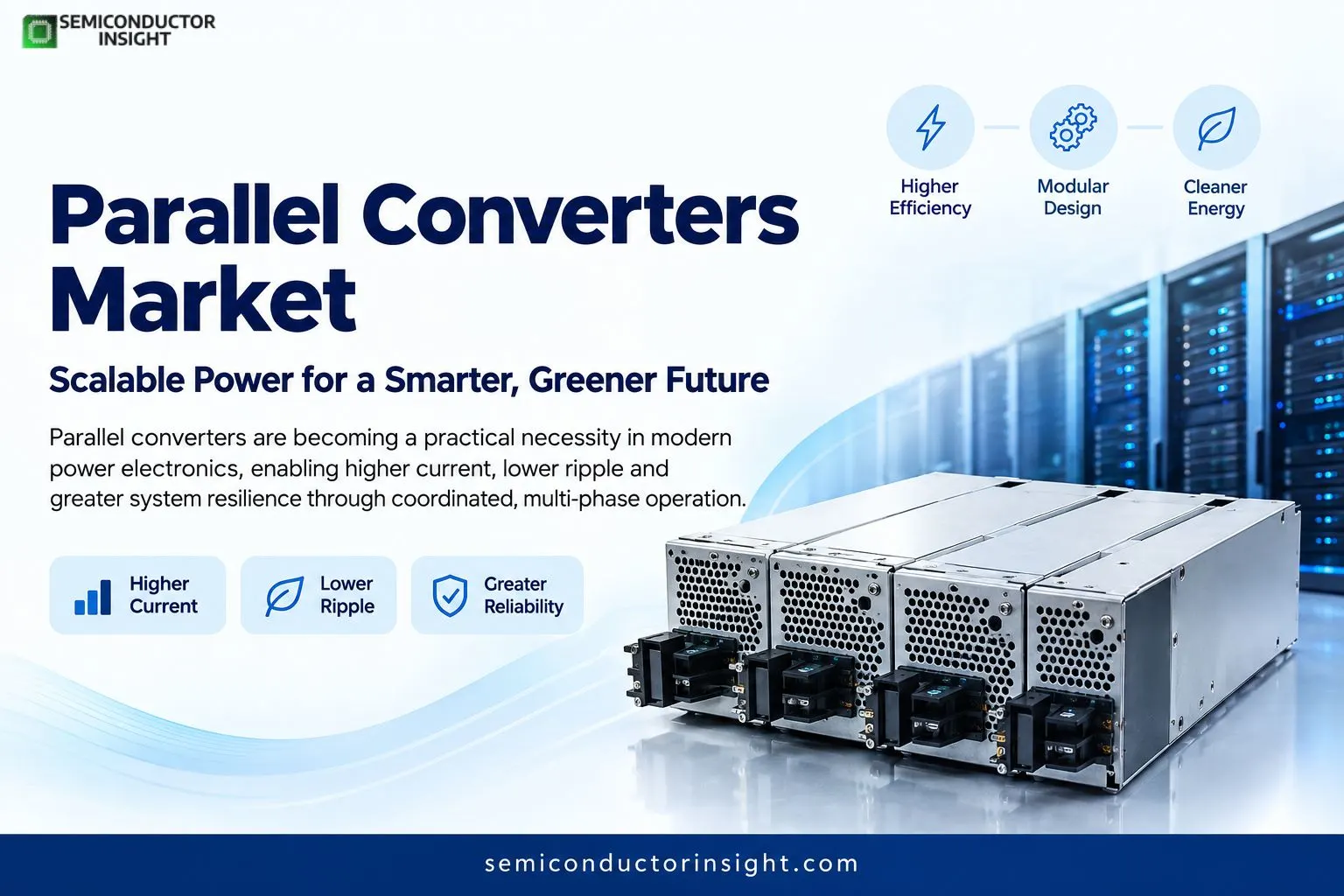
Top 15 Global Parallel Converter Leaders Enhancing Efficiency across Electric Vehicles, Renewables, and Data Centers
Parallel converters have become a practical necessity wherever a single power stage cannot deliver the required current without excessive heat or size. In semiconductor power electronics the term describes multiple identical converter phases connected so their outputs combine while their switching instants are deliberately staggered. The result is lower ripple, smaller magnetics and the ability to scale current simply by adding phases.
Delta Electronics – The AI Power Architect Building Tomorrow’s Racks
Delta has become one of the most visible forces behind high-density power conversion for AI factories.
- With more than 85,000 people working across nearly 200 locations on five continents, the company runs dozens of manufacturing sites that turn out DC-DC converters, server power shelves, and modular racks capable of parallel operation.
- In 2025 its Krishnagiri campus in India alone employed over 3,800 people across four factory buildings on 95 acres, and expansion continued into 2026. Recent shipments of ±400 VDC and 800 VDC systems began in the third quarter of 2026 to support Nvidia platforms.
- Engineers have developed 19-inch 90 kW DC-DC shelves and 1.1 MW-scale in-row power racks that can be paralleled for higher capacity and redundancy.
- Active current-sharing designs in the new PMS series allow multiple units to balance load without overloading any single module.
- Delta’s Dongguan site achieved 100 % renewable electricity in 2025 and cut carbon emissions by more than 388 tons annually through rooftop solar and storage.
- These moves keep Delta central to the shift toward high-voltage parallel architectures in data centers and industrial automation.
Schneider Electric – Edge-to-Megawatt Resilience with Multi-Chemistry Flexibility
Schneider Electric continues to shape parallel UPS and conversion systems for both distributed edge sites and large data halls. Its Galaxy VXL modular three-phase UPS supports up to four units in parallel for a combined 5 MW capacity while occupying a compact 1.2 m² footprint. In August 2026 the company launched the next-generation APC Smart-UPS platform that accepts VRLA or lithium-ion batteries and is engineered for future chemistries, so operators can upgrade energy storage without replacing the entire unit.
The SRTD series starts at 2.2 kVA and 3 kVA and is aimed at medical, light-industrial, and IT white-space applications. EcoCare services expanded to 3-phase UPS in mid-2026, combining 24/7 remote monitoring with AI-driven condition-based maintenance. A fleet of 78 EcoStruxure modular data centers demonstrated measurable operational savings after shifting from calendar-based to condition-based service. Schneider is also collaborating on 800 VDC sidecar solutions capable of feeding racks up to 1.2 MW, reinforcing its role in scalable, parallelable power protection.
ABB – Grid-Forming Conversion for Data Centers and Critical Industry
ABB’s strength lies in modular power conversion that can be paralleled for both capacity and grid support. In 2026 the company introduced an ultracapacitor energy-storage platform paired with grid-forming converters specifically to help Irish data centers meet new EirGrid rules requiring facilities to stay connected during faults and restore 90 % of pre-fault demand within 500 milliseconds. ABB continues to expand medium-voltage manufacturing capacity across European plants with roughly $200 million planned over three years. In the United States additional investments of $110 million are creating nearly 200 jobs at facilities in Mississippi, North Carolina, Virginia, and Puerto Rico.
Parallel-connected variable-frequency converters and power modules appear in microgrid and industrial projects, while the company’s Motion and Automation businesses supply synchronized condensers and eHouse packages that stabilize high-power AI loads. These systems illustrate ABB’s ability to deliver both high-power parallel conversion and real-time grid interaction.
For additional report info, feel free to view our most recent edition: https://semiconductorinsight.com/report/parallel-converter-market/
Siemens – Chassis-Scale Parallelism for Industrial Drives
- Siemens SINAMICS S120 systems allow up to six Motor Modules-2 and multiple Infeed Modules to operate in parallel under a single Control Unit, increasing total converter power while maintaining coordinated control.
- Parallel connections of Chassis-2 and Cabinet Modules-2 formats support vector control and are used in demanding industrial applications.
- The Sitras SFC plus static frequency converters can be paralleled in blocks of 12-120 MW to reach total ratings of up to 600 MW for traction power-supply networks.
- Siemens has deployed these converters in Germany, Austria, Switzerland, and Sweden since the mid-1990s.
- SITOP modular power-supply systems can expand to 36 selectively monitored outputs and support parallel operation for higher current or redundancy.
- The combination of chassis-level parallelism and high-power block designs keeps Siemens relevant for heavy industry and large infrastructure projects that require scalable, coordinated conversion.
Eaton – Hot-Sync Parallel UPS for Mission-Critical Continuity
Eaton employs approximately 97,000 people worldwide, with substantial teams dedicated to electrical and power-management products. Its Hot Sync technology enables true parallel redundant N+1 configurations without communication wiring between modules, eliminating single points of failure. The 9395XR UPS delivers 1.5 MW in a footprint under 1.5 m² and supports modular scaling. In Finland the Vantaa UPS plant grew from roughly 350 to about 500 employees after relocating and expanding. Eaton’s Puducherry facility in India now exceeds 260,000 square feet after successive additions. In August 2026 the company signed an MoU with Singapore Polytechnic focused on 800 VDC talent development for next-generation data-center power. These moves position Eaton’s parallel UPS and solid-state transformer technologies at the center of high-availability power systems.
Vertiv – Sidecar Architectures Moving Power outside the Rack
Vertiv is driving the practical transition from rack-level to pod-level DC power. Its PowerDirect 5000 800 VDC sidecar delivers 400-900 kW directly into GPU racks via busbar and is undergoing customer validation in 2026 with commercial launch targeted for early 2027. The PowerUPS 9000 reaches 1.8 MW and is designed for AI-ready high-density workloads. Vertiv is collaborating with NVIDIA and VisionBay AI on Taiwan’s first AI data center adopting 800 VDC architectures at rack and pod level. Partnerships with Caterpillar and Solar Turbines integrate modular power blocks with on-site generation for faster deployment. By relocating conversion outside the IT rack, Vertiv frees space and reduces conversion stages while enabling megawatt-class densities through parallelable modular units.
Huawei Digital Power – Modular UPS Dominance with Grid-Forming Ambition
Huawei’s modular UPS lines have led the Chinese market for multiple consecutive years in overall, modular, and high-power segments. The UPS5000-H series uses 100 kVA / 3U hot-swappable modules, enabling one megawatt per cabinet and reducing recovery time from hours to minutes. Efficiency reaches 97 % in double-conversion mode and up to 99.1 % in S-ECO mode. In 2026 Huawei launched the Taishan UPS with grid-forming capability and 0.5-second active-power recovery. A new 430 kW smart-string grid-forming PCS supports six grid-support functions and achieves 99.35 % converter efficiency. These modular, parallelable platforms serve medium-to-large data centers and industrial sites while expanding into renewable-energy and storage applications.
Advanced Energy – Configurable PowerMods for Parallel Current Sharing
- Advanced Energy’s Xgen and Ultimod platforms use droop current-share methods so identical powerMods can be paralleled to increase output current.
- DIP-switch or link configurations enable I-Share mode, ensuring balanced loading across modules.
- The modular architecture allows system designers to scale power while maintaining voltage regulation under varying loads.
- These solutions appear in industrial, medical, and semiconductor equipment where parallel redundancy and precise current sharing are required.
- Continuous refinement of the powerMod family keeps Advanced Energy relevant for applications demanding flexible, paralleled high-reliability conversion.
TDK-Lambda – Power Modules Built for Parallel and N+1 Redundancy
TDK-Lambda power modules support both power-up parallel operation and N+1 redundant configurations through active current-share terminals. Connecting PC pins allows even current distribution; adding an extra module provides redundancy so that failure of one unit does not interrupt the load. Application notes detail wiring practices and thermal considerations for multi-module arrays. These capabilities serve industrial controls, medical systems, and test equipment where scalable, fault-tolerant DC power is essential. TDK-Lambda’s modular approach continues to support designers who need to expand capacity without redesigning entire power stages.
MEAN WELL – High-Power Units Ready for Multi-Unit Parallel Arrays
MEAN WELL offers multiple series RSP, RST, SDR, TDR with explicit current-sharing functions that permit two or more identical units to operate in parallel. Models such as the RST-10000 can be paralleled to reach 20 kW total output. Recommended practice limits arrays to four-to-six units and requires matched output voltages and short, low-impedance wiring. These power supplies find use in industrial machinery, telecom centers, and large-scale installations where higher current is achieved by paralleling standard modules rather than specifying custom high-power units. The breadth of parallel-capable models makes MEAN WELL a practical choice for scalable industrial power.
Vicor – High-Density Modules Engineered for Easy Parallel Arrays
Vicor’s DCM and related families support passive paralleling for higher current delivery in 48 V and intermediate-bus architectures. Modules in package sizes such as 4623 and 3623 deliver kilowatt-class power with efficiencies in the mid-to-high 90s and can be paralleled without complex external circuitry. Peak currents reach tens of amperes per module, allowing arrays to feed high-current point-of-load stages. These solutions appear in data-center, telecom, and AI acceleration systems where space and efficiency constraints favor dense, paralleled conversion. Vicor’s focus on modular, shareable designs continues to address rising current demands inside modern racks.
Murata Power Solutions – Compact Converters Supporting Parallel Expansion
Murata Power Solutions supplies board-mounted and chassis DC-DC converters used in telecom, industrial, and computing applications. Many models are designed so that multiple units can share load current, enabling system designers to scale power without oversized single converters. Parallel configurations improve thermal distribution and provide paths for N+1 redundancy. Murata’s portfolio of isolated and non-isolated modules supports a wide range of input voltages and output rails, giving engineers flexibility when building paralleled power stages for space-constrained equipment.
Bel Power Solutions – Reliability-Focused Parallel and Redundant Architectures
- Bel Power Solutions emphasizes both parallel load-sharing and true redundant configurations.
- Technical guidance highlights how paralleled supplies can improve or degrade system reliability depending on operating density, while N+1 arrangements add standby capacity.
- Bel’s modules and supplies serve industrial, medical, and data-center environments where current sharing and fault tolerance are critical.
- Designers use Bel’s documentation to implement balanced parallel arrays that maintain performance even when individual units are stressed or fail.
XP Power – Configurable Supplies for Parallel Current Delivery
XP Power manufactures AC-DC and DC-DC converters used across industrial, medical, and technology sectors. Selected families support parallel operation through current-share mechanisms, allowing multiple units to feed a common load. This capability helps engineers meet higher current requirements while retaining the thermal and reliability benefits of distributed conversion. XP Power’s modular approach continues to serve applications that need scalable, paralleled power without custom high-power designs.
Flex Power Modules – Board-Mounted Converters Optimized for Parallel Use
Flex Power Modules has more than 45 years of experience delivering high-efficiency DC-DC converters for data centers, AI, telecom, industrial automation, and railway systems. Many families support droop load sharing or active current sharing, enabling parallel arrays for higher output current. Newer modules target 800 VDC and ±400 VDC systems with peak powers reaching the multi-kilowatt range. Vertical power-delivery solutions and intermediate-bus converters can be paralleled to feed high-current loads while maintaining efficiency and thermal balance. Flex’s design notes guide engineers on proper parallel and series configurations, reinforcing its role in dense, scalable power architectures.

Comments (0)