
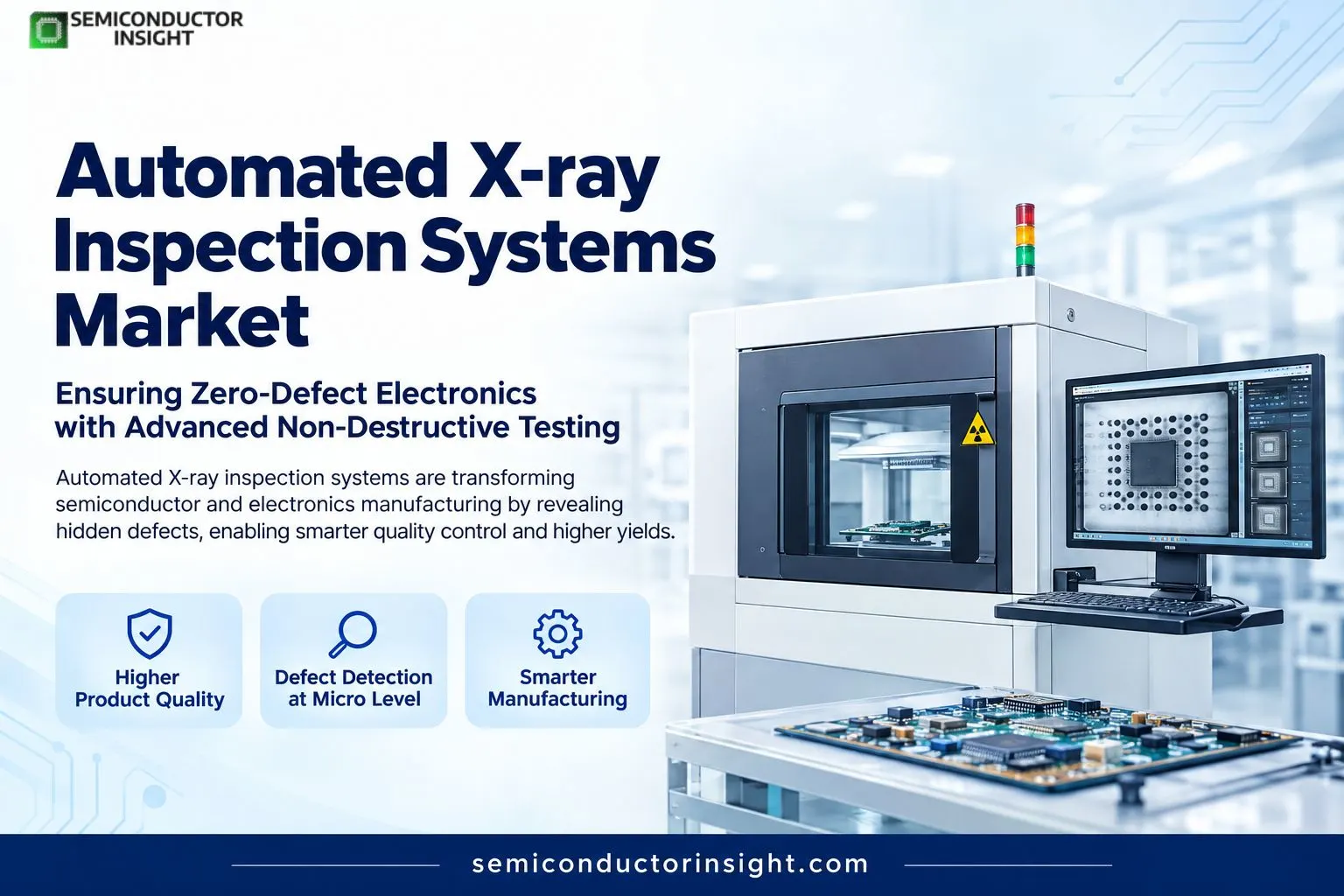
Top 15 Established and Emerging Players in the Automated X-ray Inspection Systems Market Fueling Demand Growth
Automated X-ray inspection systems operate on the principle of penetrating radiation that reveals internal structures invisible to optical cameras. In semiconductor packaging the connections under ball grid arrays flip chips and stacked dies remain completely hidden yet must be verified for voids bridges insufficient solder and head-in-pillow defects. Wikipedia describes AXI as the technology that extends automated optical inspection principles into the X-ray domain so that anomaly detection and process feedback can occur without destroying the part.
ViTrox
Penang-based ViTrox, founded in 2000, has grown into a powerhouse for automated vision and X-ray inspection in semiconductors and electronics packaging.
- In 2025 the company delivered revenue of 843 million ringgit with net profit of 133 million ringgit, then powered into 2026 with record quarterly results driven by AI-chip and high-bandwidth memory demand.
- Its V810Ai QX1 Smart 3D AXI system, launched with ultra-high-resolution imaging down to 2 µm and AI-driven programming, won the 2026 Circuits Assembly NPI Award.
- The machine handles flip-chip, SiP and miniature SMT components while supporting dual-sided PCB inspection via planar CT.
- With more than one thousand employees, mostly in Malaysia, and a new European foothold, ViTrox links wafer-level AOI through board-level AXI into its V-ONE manufacturing intelligence platform, giving factories closed-loop control from NPI to high-volume runs.
Nordson
Nordson’s Test & Inspection division, part of a company employing roughly 8,200 people across more than 35 countries, supplies automated X-ray systems alongside acoustic microscopy and optical tools for semiconductors, advanced packaging and PCB assemblies. Fiscal 2025 revenue reached about 2.8 billion dollars, with Advanced Technology Solutions contributing a meaningful share through bond testers, X-ray and metrology platforms.
In early 2026 the X-ray segment recovered strongly after a softer prior year, helped by demand for complex stacked logic-and-memory packages where yield is everything. Sealed QuadraNT tubes and high-resolution detectors let the systems inspect BGAs, TSVs and micro-bumps at production speeds. Nordson’s global footprint and long patent portfolio (over 2,200 active patents) keep it embedded in AI, automotive, aerospace and medical lines that cannot afford hidden solder voids or internal cracks.
Take a Quick Glance at Our In-Depth Analysis Report: https://semiconductorinsight.com/report/automated-x-ray-inspection-systems-market/
Omron
Japanese automation specialist Omron has refined its CT-based AXI lineup over successive generations, culminating in the VT-X750-V3 and heavier-duty VT-X850. The V3 model delivers 1.5 times the inspection speed of its predecessor through continuous-motion CT scanning, slicing each solder joint into hundreds of cross-sections for precise void and head-in-pillow measurement.
The VT-X850 handles samples up to 40 kg and thick power modules used in EV inverters and e-axles, while the clean-room-ready VT-X950 targets mid-process semiconductor wafer-to-wafer bonding. These systems integrate with Omron’s broader SPI and AOI platforms and feed data into process-monitoring software, giving automotive and 5G manufacturers real-time feedback on hidden joints that optical tools simply cannot see.
Nikon
Nikon Metrology’s industrial X-ray portfolio centers on proprietary micro-focus sources reaching 450 kV and systems such as the XT V series for electronics and the VOXLS 30 Series for larger parts. The XT V machines inspect PCBs, BGAs and semiconductors with low-dose collimators and ESD-safe options, while VOXLS units scan everything from lithium-ion cells to aerospace castings and additive-manufactured metals.
Automation-ready designs support both lab failure analysis and production-line 100 % inspection. High-contrast filters and multi-mode CT (Panel Shift, Tilted CT) reveal voids, cracks and internal dimensions without destructive sectioning, serving automotive battery packs, medical devices and turbine blades with the same high-resolution imaging chain.
Viscom
Hanover-based Viscom, founded in 1984 and employing around 456 people worldwide, builds both optical and X-ray inspection systems under one German roof, including its own micro-focus tubes up to 250 kV. The iX7059 family delivers inline 3D AXI with CT for power semiconductors and heavy PCBs, handling boards up to 1 000 mm × 660 mm and weights of 15 kg.
Resolution reaches 1 µm on the “One” model, and handling times can drop to four seconds per board. Viscom’s vertically integrated tube production and award-winning combo AOI-AXI platforms are widely used in automotive electronics, where zero-defect requirements drive demand for void analysis in IGBT modules and high-voltage assemblies. Recent expansions into battery-cell inspection via subsidiary Exacom further broaden its reach.
Unicomp Technology
Chinese firm Unicomp, established in 2002 and now employing more than 1 300 people across three manufacturing bases totaling over 60 000 m², develops both micro-focus X-ray sources and complete inspection systems. It holds more than 400 authorized patents and has delivered over 10 000 intelligent inspection units. Its portfolio covers offline and inline 2D/3D CT machines for SMT, semiconductors, lithium batteries, die castings and food foreign-object detection.
In 2026 the company opened a European demonstration center and celebrated the 10 000th equipment shipment; self-developed closed-tube sources (90-180 kV) now power many of its own systems with internal penetration rates above 95 %. Applications range from wafer-level nano-inspection to multi-ton automotive castings.
Innometry
- South Korean specialist Innometry focuses on non-destructive X-ray and CT inspection for secondary batteries and is expanding into advanced semiconductor packaging.
- Its inline systems examine electrode alignment, gaps and foreign particles in cylindrical, prismatic and pouch cells without disassembly, helping prevent EV thermal events.
- Recent government-backed projects target AI-driven inspection of glass-substrate through-glass vias (TGV), and the company has already supplied equipment to multiple TGV process specialists.
- Cumulative equipment sales have exceeded 239 million USD, with technology also applied to ammunition, military components and HBM packages.
- High-speed imaging combined with proprietary AI algorithms lets manufacturers catch micro-voids and plating defects that would otherwise reach the field.
Waygate Technologies (Baker Hughes)
Waygate Technologies, with more than 125 years of combined NDT heritage from brands such as phoenix|x-ray and Krautkrämer, supplies a full spectrum of industrial radiography and CT systems. It’s Phoenix Microme|x Neo and Nanome|x Neo platforms combine high-resolution 2D X-ray with optional 3D CT for semiconductors, PCBAs and lithium-ion batteries.
The Phoenix X|aminer offers an accessible entry point for electronic assemblies, while larger Power|scan and V|tome|x systems handle heavy, high-absorption parts. Flexible digital detectors such as the DXR Flex reduce the number of exposures needed for pipe and weld inspections by up to 65 %. Operating in more than 80 countries, Waygate supports aerospace, energy, automotive and electronics customers with both laboratory and production-floor solutions.
Seamark ZM
Chinese manufacturer Seamark ZM (Zhuomao Technology) has spent nearly two decades refining offline and inline X-ray systems for electronics and lithium-battery production. Its AXI9000 high-speed CT machine inspects BGAs, PoPs, QFNs, IGBTs and DIP components in as little as two seconds per field of view, using a three-layer linear-motor gantry and self-developed AI software that identifies more than thirty common solder defects.
Offline models such as the X6600B and X5600 serve R&D and low-volume lines with 5-130 kV sealed tubes and CNC multi-point scanning. Systems are deployed across SMT, semiconductor, automotive electronics and battery plants in more than 180 countries, giving mid-tier EMS and battery makers affordable access to 3D void and alignment analysis.
Comet Yxlon
Comet Yxlon, headquartered in Hamburg with about 400 employees and seven locations, designs high-end X-ray and CT systems for semiconductor, automotive and aerospace customers. Its CA20 platform delivers sub-micron 3D imaging for advanced packaging, including TSV voids and 3D-IC solder-bump metrology, now available in fully automated configurations.
Larger FF-series CT systems handle complete battery packs weighing up to 1 000 kg. Dragonfly AI software accelerates defect recognition and metrology, while computed laminography suits flat components such as PCBs and EV battery modules. In 2025-2026 the company expanded semiconductor coverage from wafer-level voids to full package inspection, reinforcing its role in both R&D labs and high-volume fabs.
Zhengye Technology
Guangdong Zhengye Technology supplies automatic and semi-automatic X-ray systems tailored to lithium batteries, semiconductors and PCB processes. Online models use multi-axis robots and matrix imaging to inspect entire trays of discrete components (7-, 11- or 13-inch) in roughly three minutes for 3 000 pieces, detecting foreign matter, wire defects and solder anomalies with near-zero miss rates.
Battery-focused lines check electrode alignment and winding integrity at rates above 24 parts per minute. Sealed micro-focus tubes, flat-panel detectors and MES connectivity make the machines suitable for high-volume Chinese and export-oriented factories that need rapid, non-destructive quality gates before packaging.
Test Research Inc. (TRI)
Taiwan’s TRI employs more than 1 000 people and maintains offices across Asia, Europe and the Americas. Its TR7600 series of inline 3D AXI systems, including the new SV line-scan models, deliver up to 20 % higher throughput than previous generations while maintaining resolutions from 5 µm to 25 µm. Boards up to 1 200 mm × 660 mm or even 2 100 mm long can be inspected for BGAs, THT fill, SiP packages and multi-layer PoPs.
XAVIS Co., Ltd.
Korean company XAVIS, founded in 2002 and listed on KOSDAQ, builds both industrial XSCAN systems for semiconductors, batteries and PCBs and FSCAN foreign-object detectors for food and pharmaceuticals. Its nano-level XSCAN-7120 and high-speed XSCAN-9860A deliver 0.25 µm resolution for wafer-level and advanced packaging inspection, while hybrid 2D/3D CT platforms handle large panels up to 515 mm × 510 mm for TGV glass substrates. AI-assisted algorithms reduce false calls below 0.05 % on some models. Export milestones include the 20-million-dollar tower in 2024, and the firm continues to expand paid imaging services that give smaller manufacturers access to 30 nm-class microscopy without capital investment.
ZEISS
ZEISS Industrial Quality Solutions offers both high-precision CT metrology systems (METROTOM series) and robust 2D production X-ray platforms under the BOSELLO and OMNIA brands. The OMNIA GC 220-180, introduced in 2025, inspects large aluminum castings such as battery trays with volumes up to 2 200 mm × 1 800 mm × 900 mm and cycle times of 3-3.5 seconds per view. Fully automated defect recognition software compliant with ASTM standards classifies porosity, inclusions and cracks.
Wheel-inspection systems clear light-alloy rims in under 2.5 seconds per part. Complementary Xradia microscopes and NLX wafer laminography tools extend the portfolio into semiconductor advanced packaging, giving automotive and aerospace lines a single-vendor path from lab metrology to 100 % inline inspection.
Saki Corporation
Tokyo-based Saki has built a reputation for ultra-fast planar-CT AXI systems that keep pace with high-volume SMT lines. The 3Xi-M110 series achieves industry-leading cycle times while generating dense 3D volume data for void, head-in-pillow and THT-fill analysis; the power-module-focused 3Xi-M200 handles multi-layer IGBT and SiC modules, including those with thick finned baseplates, thanks to high-power tubes and advanced noise-reduction filters.

Comments (0)