
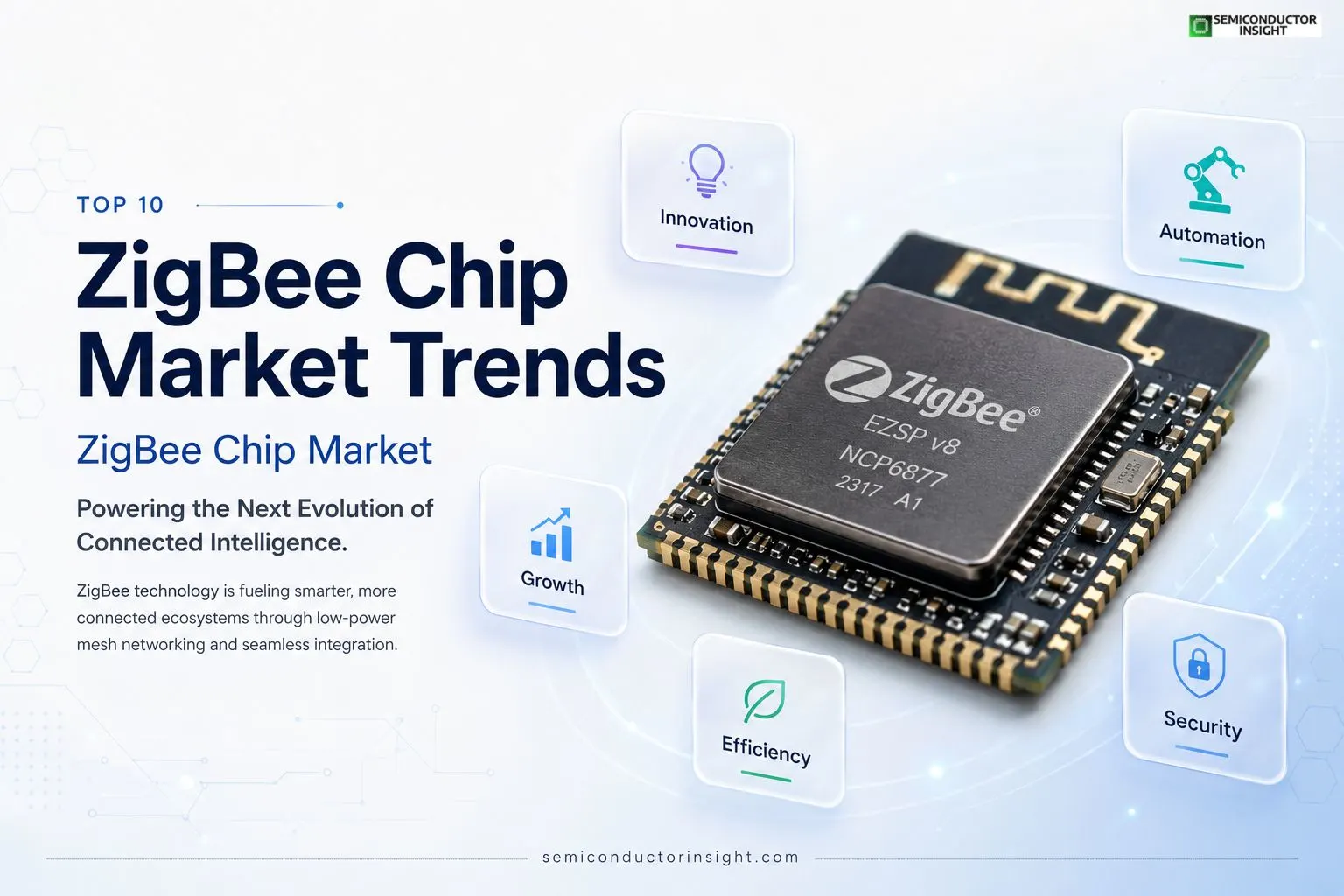
Top 10 ZigBee Chip Market Trends Driving Next Generation IoT Device Integration
ZigBee Chip Market remains closely tied to the rapid evolution of smart homes and connected living environments. As households increasingly adopt smart lighting, thermostats, sensors, security systems, and voice-controlled devices, demand for reliable low-power wireless communication continues to rise. ZigBee technology has established a strong presence because of its ability to support mesh networking, allowing devices to communicate efficiently over extended distances without placing heavy demands on battery life.
The growing number of connected devices inside residential environments has increased the need for protocols capable of maintaining stable communication across large networks. ZigBee chips enable hundreds of devices to operate within a single ecosystem, making them particularly valuable for expanding smart home deployments.
Matter Compatibility Creates New Opportunities
- One of the most significant developments influencing the ZigBee Chip Market is the emergence of the Matter interoperability standard.
- Developed through collaboration among major technology companies and industry organizations, Matter seeks to simplify communication between smart devices regardless of manufacturer.
- Several ZigBee-based ecosystems are adapting to coexist with Matter-supported platforms, creating opportunities for chip suppliers that can provide flexible connectivity solutions.
- Manufacturers are increasingly designing chips capable of supporting multiple wireless protocols, helping device makers maintain compatibility across diverse smart home environments while preserving existing ZigBee infrastructure investments.
Mesh Networking Becomes Essential for Large Scale Deployments
ZigBee uses a mesh networking architecture, in contrast to conventional point-to-point wireless communication, in which devices exchange data with one another. This method reduces signal interruptions while improving coverage and reliability.
According to technical documentation from the ZigBee Alliance and industry publications, ZigBee networks can support thousands of nodes within a single deployment, depending on network design and application requirements.
Such scalability has positioned ZigBee chips as a preferred option for large commercial buildings, industrial facilities, and smart city infrastructure where extensive device connectivity is required.
The ability to self-heal and reroute communications when individual nodes fail continues to strengthen ZigBee’s relevance in mission-critical environments.
To find out more, feel free to browse our latest updated report: https://semiconductorinsight.com/report/zigbee-chip-market/
Smart Metering Programs Strengthen Adoption
- Utility companies worldwide continue deploying smart electricity, gas, and water meters to improve monitoring accuracy and operational efficiency. ZigBee chips play an important role in enabling secure communication between meters, home energy management systems, and utility networks.
- In the United States alone, more than 120 million smart electric meters have been installed according to government and utility reports. Many of these systems utilize ZigBee-enabled communication technologies to provide consumers with real-time energy consumption data and demand response capabilities.
- As governments pursue energy efficiency objectives, smart metering initiatives continue generating demand for reliable low-power wireless semiconductor solutions.
Industrial Facilities Embrace Wireless Monitoring
Manufacturing plants, logistics centres, and industrial facilities increasingly rely on wireless sensor networks to improve operational visibility. ZigBee chips are enabling real-time monitoring of equipment performance, environmental conditions, inventory movement, and predictive maintenance activities.
For industrial users, the combination of low energy consumption and network scalability offers practical advantages over wired communication systems. Sensors can be installed in hard-to-reach locations while maintaining connectivity across expansive operational environments. This flexibility has expanded ZigBee’s role beyond consumer electronics into industrial digitalization strategies.
Semiconductor Innovation Focuses on Energy Efficiency
- Power consumption remains one of the most important considerations for connected devices. Semiconductor manufacturers continue introducing ZigBee chips designed to extend battery life while maintaining reliable performance.
- Modern ZigBee chipsets integrate advanced sleep modes, optimized radio architectures, and highly efficient microcontrollers.
- Many battery-powered sensors can now operate for several years without replacement, reducing maintenance costs and supporting large-scale deployments across residential, commercial, and industrial environments.
- This focus on energy efficiency aligns with broader sustainability initiatives that prioritize resource conservation and reduced electronic waste generation.
Security Enhancements Reinforce Long Term Relevance
As connected devices become more widespread, cyber security remains a priority for network operators and consumers alike. Modern ZigBee chip designs incorporate advanced encryption, authentication mechanisms, and secure key management capabilities that help protect sensitive communications.
The ongoing investment in secure wireless connectivity ensures ZigBee remains a trusted technology for applications ranging from smart homes and energy management to industrial automation and healthcare monitoring. With expanding device ecosystems, growing smart infrastructure investments, and continued semiconductor innovation, the ZigBee Chip Market is maintaining its position as a critical enabler of the connected world.

Comments (0)