
Top 10 Most Leading Companies in the Global Tech Dive Computer Industry 2026
In the high-stakes world of technical diving, where multi-gas mixes, rebreathers, and extreme depths demand absolute precision, dive computers have evolved from simple depth timers into sophisticated life-support systems. By mid-2026, the market favors units that handle multiple transmitters, offer transparent algorithms like Bühlmann ZHL-16C with gradient factors, support CCR modes, and deliver high-resolution displays readable in low visibility.
The following ranking draws from recent product launches, field use in technical training, and real-world deployments across expedition and cave diving communities. These ten companies stand out for their engineering focus, reliability under pressure, and continuous refinement of features that keep divers safe at depth.
Shearwater Research – The Technical Standard Bearer
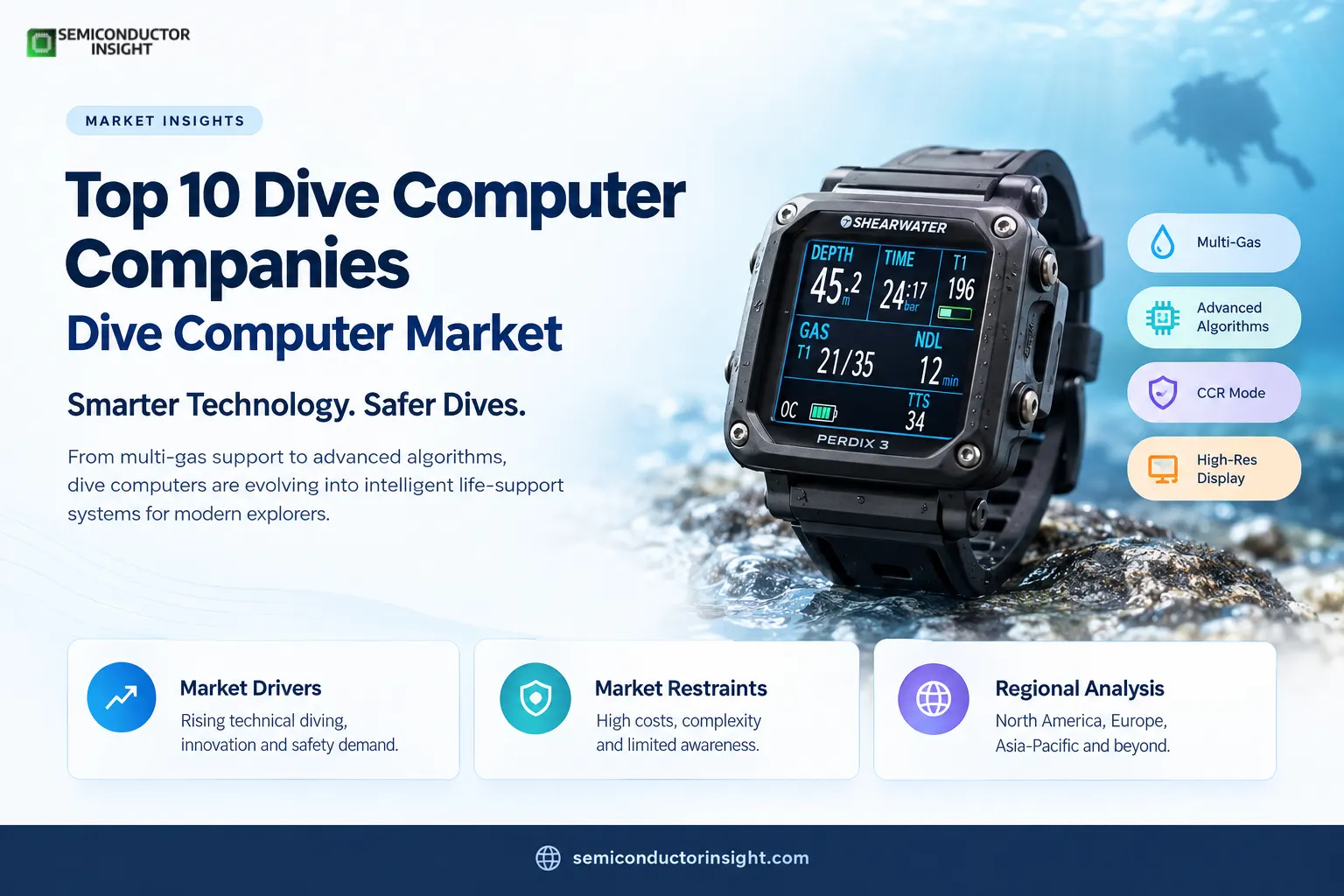
Shearwater continues to set the pace for serious technical divers with a lineup that now includes the Perdix 3, launched in May 2026. This full-size unit features a 2.4-inch (6.1 cm) ultra-bright AMOLED display running at 450 x 600 resolution four times higher than earlier models protected by toughened aluminosilicate glass and housed in titanium with an armored casing. It supports air integration with up to four SWIFT transmitters, open-circuit multi-gas, closed-circuit rebreather modes, and user-replaceable AA batteries.
The company operates from a 35,000-square-foot facility in Richmond, British Columbia, with roughly 82 people across multiple continents. Recent additions include the Swift GPS transmitter (available from December 2025) that pairs with existing computers such as the Teric, Perdix AI, Petrel 3, and Tern TX to log surface entry and exit points, plus a new Dive Shearwater app for interactive mapping. Shearwater’s transparent ZHL-16C gradient-factor algorithm and consistent firmware support make its computers the default choice for cave explorers, wreck specialists, and instructors running multi-day technical courses.
Suunto – Precision Meets Versatility
Finnish-rooted Suunto entered a new chapter in late 2025 with the Nautic and Nautic S series. The Nautic carries a 3.26-inch AMOLED panel at 720 x 382 resolution the largest of its kind in the current field and delivers claimed battery life of 120 hours in medium-brightness dive mode (chamber tests have shown longer endurance). It runs Bühlmann ZHL-16C with gradient factors, supports up to five gases with oxygen concentrations to 100 percent, and accepts multiple transmitters for dual-tank or sidemount monitoring. Depth capability reaches 200 meters.
The Nautic S offers a more compact alternative while retaining core technical features. Suunto’s long history of instrument design shows in the four-button interface, triaxial tilt-compensated compass, and upcoming CCR software support scheduled for mid-2026. These computers serve both advanced recreational divers progressing into technical territory and full technical teams who value clear data presentation across multi-gas profiles.
Ratio Computers – Italian Innovation for Multi-Gas and CCR
Ratio, based in Italy, has carved a distinct niche with the iX3M series, particularly the iX3M 2 and GPS-equipped variants. These units feature a large 2.8-inch full-color IPS display with highly customizable color schemes and support for up to ten gas mixes, including full Trimix and CCR modes on the Tech+ and Reb versions. Air integration handles multiple transmitters simultaneously, and the GPS models record surface positions via a dedicated float system. Depth ratings extend to 300 meters on certain configurations, with vibration, visual, and audible alarms.
Ratio emphasizes sustainability by eliminating single-use plastics from packaging and using recycled cardboard. The company’s focused range from the more accessible Deep model to full rebreather-capable unit’s appeals to European technical divers and instructors who want extensive gas management and a bright, information-dense screen for complex dives.
Divesoft – Rebreather and Cave Diving Specialist
Czech manufacturer Divesoft builds the Freedom series specifically for technical and CCR divers. The Freedom Full Trimix and related models support dual algorithms running in parallel, extensive gas lists, and robust construction suited to cave and expedition environments. Units are depth-rated for serious technical work and integrate closely with Divesoft’s own Liberty rebreather ecosystem. Firmware updates and companion software allow detailed log analysis and planning.
In 2026 field comparisons, the Freedom continues to earn praise for compact form factor and reliable information layout under high-workload conditions. Divesoft’s emphasis on military-grade reliability and direct support for closed-circuit systems positions it as a preferred tool for teams operating in overhead environments where redundant, high-fidelity data is non-negotiable.
For More Detailed Insights, You Can Surf Our Latest Report Here: https://semiconductorinsight.com/report/tech-dive-computer-market/
Heinrichs Weikamp – Open-Source Precision from Germany
Heinrichs Weikamp, founded in 2004 and based in Freiburg, produces the OSTC series entirely in-house. The OSTC 4 and newer OSTC 5 models offer switchable Bühlmann ZH-L16 with gradient factors and VPM-B algorithms, support for five or more gases, and open-source firmware that the technical community actively develops.
Depth capability reaches 200 meters, with Bluetooth connectivity for log downloads and inductive charging on flagship units. Companion tools include Subsurface software integration and dedicated ppO2 monitors for rebreathers. The company’s small, specialized team focuses on transparency and user-updatable software, making OSTC computers popular among technical divers who want full control over decompression parameters and the ability to fine-tune settings between dives.
Oceanic – Practical Innovation under Huish Outdoors
Oceanic, founded in 1972 and now part of Huish Outdoors, balances recreational accessibility with growing technical capability. Current models such as the ProPlus 4.0 and Geo Air offer Bluetooth connectivity, dual-algorithm options (including Pelagic variants), and optional air integration via transmitters. The Oceanic+ ecosystem extends functionality to Apple Watch Ultra and iPhone with dedicated dive housing rated to significant depths, allowing color-corrected imaging alongside computer data.
Oceanic computers typically support multiple gases and provide user-replaceable batteries for travel convenience. In 2026 the brand remains a practical choice for divers transitioning from recreational to light technical profiles, with straightforward interfaces and solid depth performance suitable for wreck and multi-level diving.
Mares – Connected Color Displays for Progressive Divers
Italian brand Mares updated its range in 2025–2026 with the Quad Ci, Sirius, and related models. The Quad Ci features a high-resolution multi-color MIP display, digital compass, and wireless air integration supporting multiple transmitters. The Sirius series combines watch-style aesthetics with stainless-steel cases, multi-gas capability including Trimix, and Bluetooth for log management.
Units commonly reach 150 meters displayed depth and incorporate customizable gradient factors on Bühlmann-based algorithms. Mares emphasizes safety features such as refined ascent guidance and integrates its computers into a broader ecosystem of regulators and buoyancy systems. These tools suit advanced recreational divers and those beginning technical training who value clear color data and seamless transmitter pairing.
Cressi – Accessible Color Computing with Solid Fundamentals
Cressi delivers practical color-screen options such as the Raffaello and Da Vinci. The Raffaello uses a large rectangular layout optimized for readability, while the Da Vinci offers a 1.54-inch full-color TFT display, Bühlmann ZHL-16C algorithm with three preset conservatism levels, digital compass, and support for up to four gases including pure oxygen.
Depth rating sits at 100 meters, with rechargeable lithium-ion power via USB-C. Two-button operation keeps the interface simple for divers moving beyond basic monochrome units. Cressi’s 2025–2026 models focus on clarity and essential multi-gas functionality without unnecessary complexity, making them popular among intermediate divers and training centers that need reliable, easy-to-teach computers.
Hollis – Technical Systems Orientation
Hollis, also under the Huish Outdoors umbrella and originally linked to Oceanic’s founding lineage, concentrates on gear that supports technical configurations. While its buoyancy systems (ST and DT series with stainless or aluminum backplates and various wing sizes) dominate current product focus, Hollis has long offered dive computers such as the DG series that integrate with technical harnesses and double-tank setups.
These units provide digital gauge modes extending depth display, nitrox capability, and log storage for multiple dives. In 2026 Hollis continues to serve technical divers who assemble modular kits, emphasizing compatibility between computers, transmitters, and harness systems for streamlined overhead and deep diving.
Aeris – Legacy Recreational Foundation with Residual Technical Reach
Aeris originated as a sister brand to Oceanic under American Underwater Products and later transitioned under Huish ownership. Although the brand presence has become more limited, its earlier computers (including air-integrated and console models) established features such as dual algorithms, user-replaceable batteries, and multi-mode operation that still influence the broader Huish lineup.
Surviving Aeris units and related Oceanic models continue to appear in the used and instructional markets, supporting nitrox and gauge modes with solid depth performance. In the current landscape Aeris represents the practical recreational-to-technical bridge that many divers first encounter before moving to higher-end multi-gas systems.

Comments (0)