
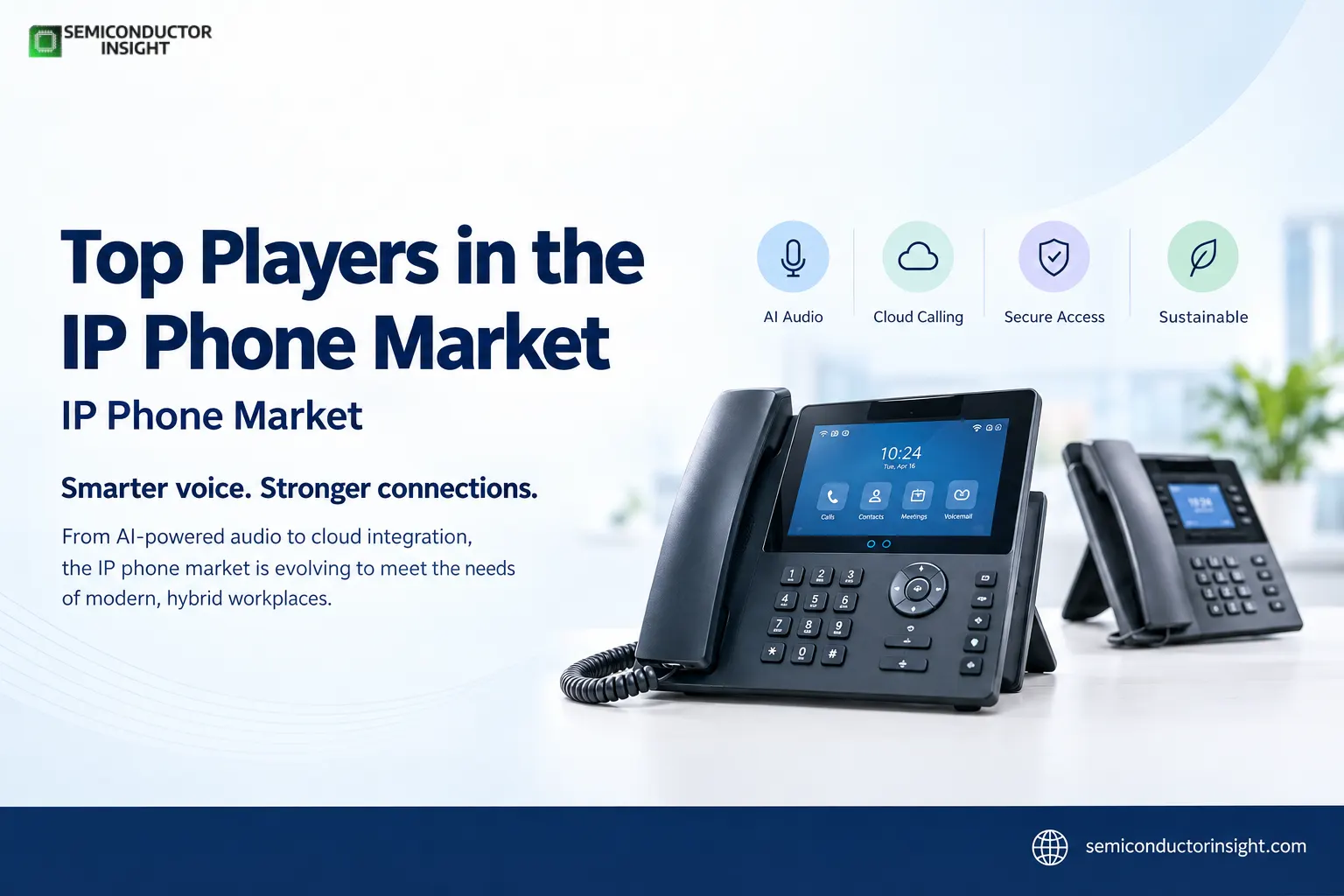
Top 10 Leading Manufacturers and Solution Providers in the IP Phone Market Worldwide
In today’s hybrid workplaces, IP phones remain central to reliable voice, seamless platform switching, and AI-enhanced audio experiences. Organizations continue to deploy desk sets that handle multi-line operations, secure remote access, and integration with cloud calling systems while meeting sustainability and manageability demands.
The following companies stand out through their active product development, large-scale deployments, and practical contributions to enterprise and mid-market voice environments as of 2026.
Cisco
Cisco’s Desk Phone 9800 Series, introduced with five models plus a key expansion module, brings AI-powered audio, desk reservation capabilities, and a configurable action button into everyday desk spaces. These phones run on PhoneOS, allowing a single device to connect to CUCM, Webex Calling, BroadWorks, or third-party cloud platforms without separate hardware. Built with more than 74% post-consumer recycled plastics and EnergyStar certification, the series supports energy-saving modes while serving the needs of IT and facilities teams.
Cisco reports more than 200,000 collaboration customers worldwide and notes that it has shipped 2.5 times more IP phones than its closest competitor, with over 95% of Fortune 500 companies using its collaboration solutions. Recent internal rollouts across roughly 90,000 employees illustrate how the company pairs these desk phones with broader AI agent and Wi-Fi 7 initiatives for campus-scale voice reliability.
Yealink
Yealink continues to expand its T-series and newer T7/T8 models, which remain preferred for auto-provisioning with platforms such as 3CX and support multi-line configurations suited to supervisors and high-volume users. First-half 2026 results showed desktop communication terminals generating 1.559 billion yuan while cloud office terminals grew more than 60%, reflecting strong demand for IP endpoints that bridge desk and meeting use cases.
Models such as the T54W and T57W deliver color displays, Wi-Fi options, and wideband audio that handle everyday SIP environments across offices, contact centers, and hybrid setups. The company maintains broad certification for Microsoft Teams and Zoom devices, enabling organizations to standardize on a single hardware family for both traditional SIP and collaboration platforms. In 2026 buying guides, Yealink devices frequently appear as the practical default for reliable firmware support and multi-account flexibility.
Take a Quick Glance at Our In-Depth Analysis Report: https://semiconductorinsight.com/report/global-ip-phone-market/
Avaya
Avaya’s Aura platform continues to power large enterprise voice environments, with version 10.3 delivering RHEL 9.6 support, FIPS 140-3 updates, and JITC certification for government and military-grade deployments. The platform scales to 300,000 users and one million devices per instance, supporting complex multi-site configurations that many organizations still rely on for mission-critical calling. In 2026 roadshows, Avaya demonstrated Nexus environments that moved from order to working system in roughly 3.5 hours and highlighted total-cost reductions of approximately 45 to 50% over five years for a 5,000-user setup when shifting toward managed services.
The company also advances Next Generation 911 capabilities that deliver richer location and multimedia data to public-safety responders. These developments keep Avaya relevant for regulated sectors that require long-term support and hybrid modernization paths rather than full rip-and-replace projects.
Mitel
Mitel’s 2026 portfolio centers on Mitel WX for workforce communications and Mitel Edge for AI-enabled, resilient control in mission-critical settings. The company introduced vertical solutions packages that combine calling, meetings, messaging, and industry-specific workflows, while its H60 DECT AI-activated headset earned recognition for frontline mobility and secure connectivity. Security advisories throughout 2025 and 2026 address issues across SIP phone series and collaboration platforms, demonstrating ongoing attention to firmware integrity for deployed devices.
Partner program updates emphasize hybrid UC systems and outcome-based incentives as organizations refresh infrastructure for AI readiness. Mitel’s focus on continuity and control supports environments where downtime carries high operational cost, from healthcare to manufacturing floors that still depend on reliable desk and cordless IP endpoints.
Poly (HP Poly)
HP unveiled the Poly Edge V Series in 2026, offering models from the V200 to V850 that support between 16 and 60 lines depending on configuration, with expansion modules, integrated Wi-Fi and Bluetooth on higher models, and AI-powered audio features. The series incorporates at least 35% recycled plastics, carries Energy Star and TCO certifications, and targets hybrid desks with noise-block technology and accessibility options such as text-to-speech.
Earlier Edge E models continue to serve executive and high-volume users with up to 48 lines, surround light status indicators, and Microban antimicrobial protection. These phones appear in certified configurations for Zoom and other platforms, addressing the ongoing preference among many IT teams to maintain physical desk endpoints alongside soft clients. Pricing starts around the mid-tier range, making the line accessible for both refresh projects and new hybrid office builds.
Alcatel-Lucent Enterprise (ALE)
ALE’s DeskPhone and Myriad S series deliver SIP and proprietary protocol support with dual Gigabit Ethernet, USB-C ports, and optional Bluetooth/Wi-Fi modules. Models such as the ALE-500 feature a 5.5-inch touch screen and three microphones, while the Myriad S range (M3s through M7s Pro) supports up to 20 SIP accounts, 6-way local conferencing, and AES-256 encryption.
Expansion modules and alphabetic keyboards extend key capacity, and VPN clients enable secure work-from-home use on the same hardware. The company emphasizes 3D Symphonic HD audio and hot-desking modes that fit frontline and office environments. Recent updates to OmniPCX Enterprise Purple continue to extend the life of existing deployments while adding SIP hunting groups and alarm features for specialized use cases.
Grandstream
Grandstream’s GRP series professional carrier-grade IP phones support up to 14 lines and 16 SIP accounts, with dual LCD options, Wi-Fi 6 on newer hardware revisions, and centralized management through GDMS. Models such as the GRP2670 and GRP2650 deliver 7-inch capacitive touchscreens, full-duplex HD speakerphones, and 5-way conferencing, while hotel-focused GHP series units provide compact designs with programmable keys and PoE.
The company regularly releases firmware and new devices, including smart IP video door stations and outdoor Wi-Fi 7 access points that complement its voice portfolio. These phones target mass deployment scenarios where cost-effective multi-account support and interoperability with open SIP systems matter most. Grandstream’s approach keeps it active in SMB, hospitality, and multi-tenant environments that still rely on physical endpoints.
NEC
NEC’s UNIVERGE portfolio includes the Aspire 6 key telephone system launched in 2025 and SIP multi-line phones in the DX700 series, alongside digital multi-function models in the DX300 series. The company completed a large internal migration of roughly 110,000 group employees to Zoom Phone, achieving approximately 70% reduction in telephone-related costs while enabling smartphone answering of traditional fixed lines.
Although NEC has wound down certain older DT and SV series products, with technical support transitions underway through 2026, the remaining UNIVERGE lines continue to serve Japanese and regional offices that require hybrid digital-IP continuity. These developments illustrate how legacy PBX providers adapt by pairing remaining hardware with cloud services for large user bases.
D-Link
D-Link’s contributions to the IP voice space appear primarily through 4G/5G routers and gateways that incorporate VoLTE support, enabling failover and mobile voice connectivity for small offices and remote sites. Catalog offerings for 2026 include multi-gig models with dual Ethernet ports and Wi-Fi 7 capabilities that can anchor basic SIP environments where dedicated desk phones connect via the network.
While the company focuses more heavily on connectivity infrastructure, these devices support practical IP telephony deployments in locations lacking traditional wired infrastructure. Organizations use them to extend voice reach into temporary or underserved sites without requiring full PBX hardware refreshes.
Escene
Escene specializes in SIP-compliant IP phones designed for broad interoperability with systems such as Asterisk, Broadsoft, and various IMS platforms. Models range from compact hotel sets such as the HS118 to standard desk units like the ES220 with HD voice, dual VoIP accounts, PoE, and XML-based information access, as well as wireless options such as the WS620 featuring a 4.3-inch color display, dual-band Wi-Fi, and support for six SIP accounts.
These phones emphasize clear audio codecs, headset ports, and auto-provisioning features that suit cost-sensitive deployments in hospitality, small offices, and emerging markets. Escene’s catalog continues to offer multiple form factors that address everyday SIP needs where specialized enterprise features are secondary to reliable basic calling and multi-account flexibility.

Comments (0)