
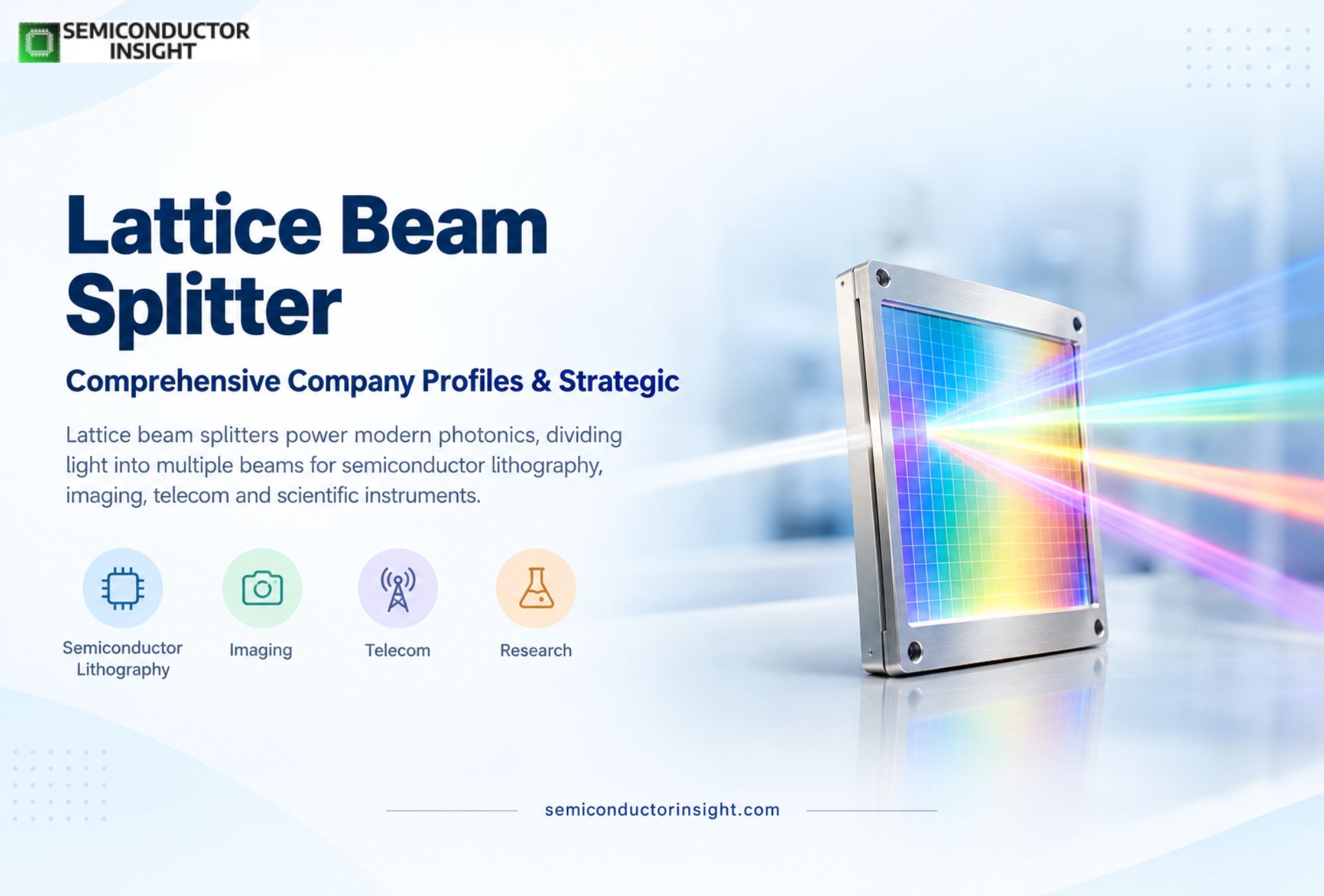
Top 10 Key Players Dominating the Lattice Beam Splitter Market Worldwide: Comprehensive Company Profiles & Strategic Insights
Lattice beam splitters sit at the heart of modern photonics. These precision diffractive components divide incoming light into multiple controlled beams or lattice patterns, powering everything from semiconductor lithography and laser pulse compression to hyperspectral imaging, telecom wavelength management, and advanced scientific instruments.
As demand rises for higher diffraction efficiency, lower scatter, and larger-aperture designs, a select group of specialists has risen to the forefront through decades of grating mastery, proprietary fabrication methods, and deep application expertise.
Jenoptik – The Photonics Powerhouse Driving Semiconductor Optics
Jenoptik has built a commanding position through its Semiconductor & Advanced Manufacturing unit, delivering micro-optics, diffraction gratings, and beam-shaping modules used in high-end lithography and laser processing tools. The German group employs roughly 4,450 people worldwide (about 4,068 full-time equivalents at the end of 2025), maintains a direct presence in 18 countries, and runs major production sites in Germany, the United States, Switzerland, and Asia. In 2025 the company operated with around 670 researchers and development specialists and opened a new LEED-certified micro-optics cleanroom fab in Dresden that effectively doubles relevant production capacity. Its portfolio includes efficiency-enhanced transmission gratings and diffractive optical elements that handle demanding semiconductor and industrial laser applications. Continuous investment in nano-structured optics keeps Jenoptik central to next-generation fab equipment.
LightSmyth Technologies – Lithographic Precision for High-Efficiency Gratings
Based in Eugene, Oregon, LightSmyth specializes in ultra-high-efficiency transmission and reflection gratings fabricated with deep-ultraviolet projection lithography methods adapted from semiconductor manufacturing. The company offers more than 100 optimized grating designs covering telecom wavelength-selective switches, pulse compression, high-power beam combining, and spectroscopy. Substrates reach up to 12-inch diameters, with line densities as high as 7,200 lines per millimeter and feature sizes down to 125 nanometers. Its ripple-free transmission gratings and coherent grating arrays deliver low polarization-dependent loss and purely inorganic construction suitable for Telcordia-qualified systems. LightSmyth’s focus on volume lithographic production has made its components a staple in laser systems and optical communications hardware worldwide.
Optometrics – Master Grating House with Massive Replication Capacity
Optometrics (part of the Omega Optical platform) stands out as one of the few producers that designs and manufactures both ruled and holographic diffraction grating masters in-house. The Massachusetts facility maintains an inventory of more than 400 standard master gratings plus a deeper archive of thousands, enabling annual production of over 500,000 precision replicated optical components. Groove densities and blaze wavelengths are tailored for UV-VIS-NIR spectroscopy, with additional capabilities in echelle, filtered, and transmission formats. The ISO 9001- and ITAR-certified operation supports OEM instrument builders across life sciences, environmental monitoring, aerospace, and semiconductor markets. Its combination of original mastering and high-volume replication keeps delivery times short for both catalog and custom lattice and beam-splitting elements.
Kaiser Optical Systems – Volume-Phase Holographic Expertise for Spectroscopy
Founded in 1979 and now part of Endress+Hauser, Kaiser Optical Systems in Ann Arbor, Michigan, pioneered volume-phase holographic (VPH) transmission gratings and notch filters that remain industry standards for Raman spectroscopy and high-efficiency beam management. The company supplies original VPH gratings used in major astronomical instruments (including recent Keck Planet Finder cross-dispersion grisms with 450 and 800 lines per millimeter) and process Raman systems deployed in chemical, pharmaceutical, and biopharmaceutical plants. Its HoloSpec spectrographs and modular analyzers incorporate these gratings to deliver high light throughput at f/1.8. With decades of holographic process know-how and a focused team of specialists, Kaiser continues to set performance benchmarks for low-stray-light, high-efficiency lattice and spectroscopic beam splitters.
SUSS MicroTec – Enabling Micro-Optics at Semiconductor Scale
SUSS MicroTec brings mask-aligner, bonding, and coating platforms that support the fabrication of advanced micro-optics and diffractive structures used in lattice beam splitters. Headquartered in Germany with key sites in Garching, Sternenfels, and Taiwan (Hsinchu/Zhubei), the company employed approximately 1,528 people as of late 2025 and reported an order book of €276 million, including tools scheduled for 2026 delivery. Its imaging and coating systems enable high-precision patterning essential for wafer-level micro-optic arrays and beam-splitting elements. Recent capacity expansions in Taiwan and continued focus on advanced packaging and photomask solutions position SUSS as a critical enabler for companies scaling diffractive optics into high-volume semiconductor and photonics production.
Photop Technologies – Integrated Optics for Beam Management
Photop Technologies supplies precision optical components, including diffraction-based elements and beam-handling assemblies used across laser and imaging systems. The company supports OEM customers with custom and standard solutions that integrate gratings, coatings, and mechanical packaging for reliable multi-beam performance. Its capabilities span multiple wavelength bands and application environments, from industrial laser processing to scientific instrumentation. Photop’s emphasis on complete optical sub-assemblies helps system builders reduce alignment complexity when incorporating lattice beam splitters into larger platforms.
For additional report info, feel free to view our most recent edition: https://semiconductorinsight.com/report/lattice-beam-splitter-market/
Headwall Photonics – Master Holographic Gratings for Hyperspectral Imaging
Headwall manufactures original master-quality holographic diffraction gratings that form the core of its hyperspectral imaging sensors and OEM spectral engines. Typical grating dimensions range from 10–90 mm diameter or rectangular formats up to 75 × 40 mm, with groove frequencies from 50 to more than 3,600 lines per millimeter covering spectral ranges from 160 nm to 10,000 nm. These aberration-corrected planar, concave, and convex designs power airborne, ground-based, and machine-vision systems used in agriculture, environmental monitoring, and industrial inspection. Because every grating is an original rather than a replica, Headwall sensors deliver consistent spectral and spatial resolution across production lots, making the company a preferred source for high-performance lattice and dispersive elements.
Plymouth Grating Laboratory – Large-Aperture Laser Gratings via Nanoruler Technology
Plymouth Grating Laboratory (PGL) in Carver, Massachusetts, occupies a dedicated 20,000-square-foot facility focused exclusively on high-performance diffraction gratings for lasers and laser systems. Founded in 2004, the company commercialized MIT’s Scanning Beam Interference Lithography (Nanoruler) technology to produce meter-class multilayer dielectric (MLD), gold, transmission, and two-dimensional gratings. PGL supplies the UV focusing gratings for France’s 176-beam Laser Megajoule facility and serves commercial high-energy and ultrafast laser manufacturers. Its exclusive Nanoruler process delivers exceptional diffraction efficiency, laser-damage threshold, and wavefront uniformity over large areas—critical for pulse compression and spectral beam combining.
Spectrogon AB – Swedish Holographic Gratings and Thin-Film Precision
Spectrogon, headquartered and manufacturing in the Stockholm area of Sweden, produces custom holographic diffraction gratings covering 200–2,000 nm with high efficiency, low stray light, and high damage thresholds. Standard plane and Littrow formats are offered in sizes from 25 × 25 mm up to 120 × 140 mm, with groove densities routinely manufactured from 600 to 3,600 lines per millimeter. The company also supplies more than 1,000 optical filter designs and thin-film coatings spanning 400–20,000 nm. Applications include chirped-pulse compression, laser wavelength tuning, spectroscopy, and telecommunications. Spectrogon’s combination of grating and filter expertise allows customers to source matched components from a single specialized European source.
RPC Photonics – Engineered Diffusers and Diffractive Beam Control
RPC Photonics (now part of the VIAVI Solutions light-shaping portfolio) pioneered Engineered Diffuser technology that precisely controls intensity profiles and angular distributions for beam homogenization and multi-beam generation. Its refractive microlens-array designs deliver circular, square, rectangular, linear, or custom patterns with divergence angles ranging from fractions of a degree to more than 100 degrees. These components, available on polymer film or polymer-on-glass substrates, serve laser projection, illumination systems, and sensing applications where uniform lattice-like illumination is required. RPC’s proprietary design and fabrication methods give system engineers independent control over both the spatial pattern and the intensity profile within that pattern.

Comments (0)