

Top 10 Global Bio-FET Market Leaders Accelerating Growth in Wearable Health Monitoring and Real-Time Biomarker Detection
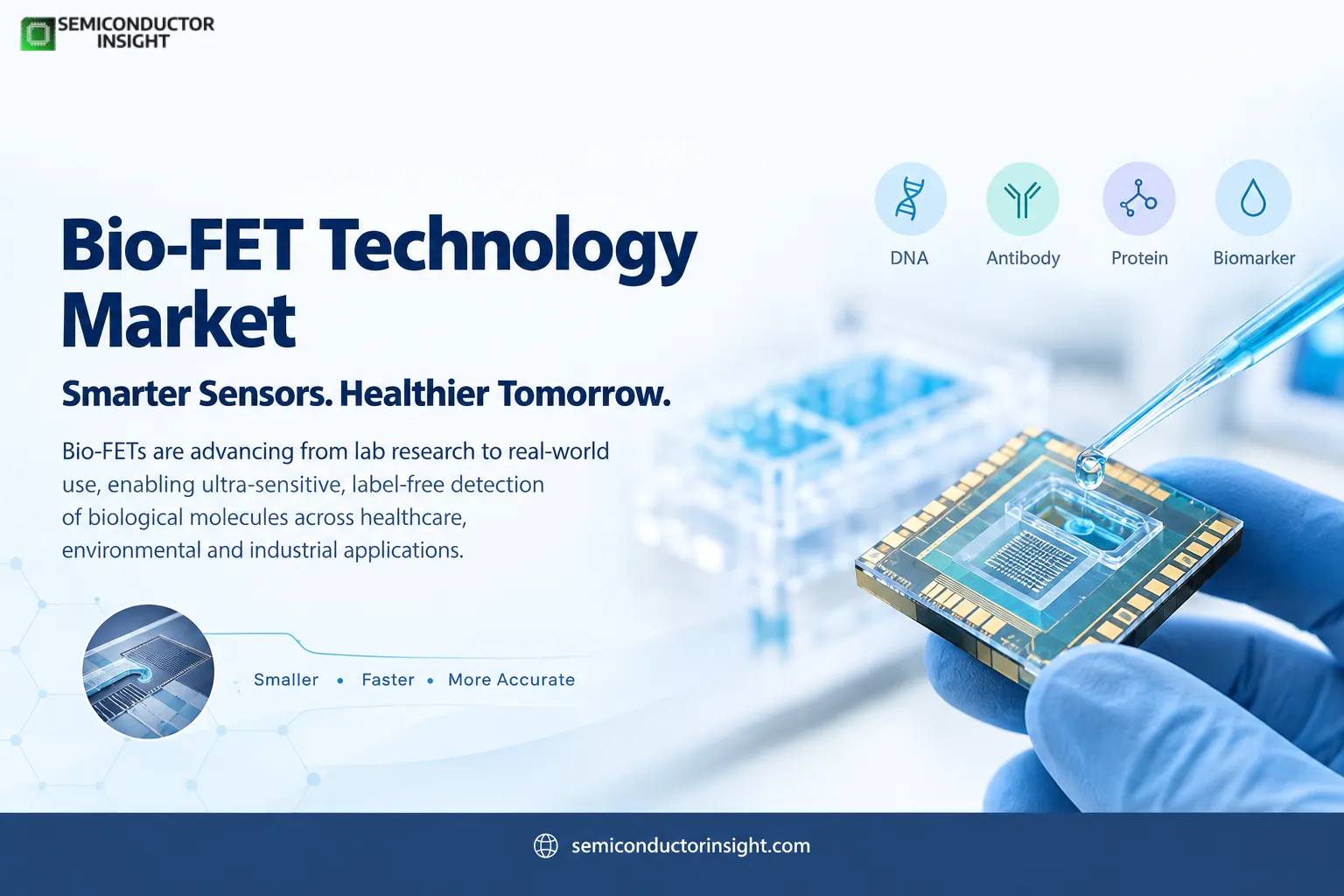
Bio-FET (Biological Field-Effect Transistor), also called BioFET, biosensor field-effect transistor, or field-effect biosensor, is a specialized type of field-effect transistor (based on the MOSFET structure) designed for label-free detection of biological molecules.
In a Bio-FET, the conventional metal gate of a standard FET is replaced or modified so that the gate region is exposed to an electrolyte solution containing the target analyte. A biological recognition element such as antibodies, enzymes, DNA probes, aptamers, or other receptor molecules is immobilized on the gate dielectric surface (often SiO₂, Ta₂O₅, or similar insulating layers).
Imec
Imec continues advancing silicon-based Bio-FET architectures that push molecular detection toward single-molecule resolution. Their nanowell FET design places a 25 nm sensing well inside a 35-40 nm wide FinFET channel, producing a 40 mV threshold shift from roughly ten short DNA strands double the response of earlier FinFET versions. Wafer-scale carbon nanotube array BioFETs demonstrated at the 2025 IEDM conference delivered real-time voltage shifts exceeding 20 mV upon DNA oligo binding while maintaining subthreshold swings below 80 mV per decade.
Parallel arrays of tens of thousands of these devices remain compatible with standard 300 mm CMOS flows, enabling high-throughput genomics and proteomics platforms that operate without optical labels or amplification steps.
Microsens
Microsens specializes in compact ISFET platforms that form the practical foundation for many Bio-FET ion and pH sensing applications. Their MSFET series uses Ta₂O₅ gate insulators functionalized with ion-selective membranes for simultaneous readout of potassium, sodium, ammonium and nitrate ions across concentration windows from 0.1 mM to 100 mM. Typical sensitivity reaches 50 mV per decade with response times measured in seconds, while the 5 mm by 50 mm module format supports dry storage and integration into portable water-quality or soil-nutrient systems. Multiple independent ISFET channels fabricated on a single chip allow parallel monitoring of several ionic species without separate reference electrodes for every analyte, a configuration increasingly adopted in environmental and agricultural Bio-FET prototypes.
Fraunhofer Institute
Fraunhofer IPMS has refined n-well isolation technology that packs several independently addressable ISFETs onto one 5 mm × 5 mm chip for multiparameter Bio-FET style measurements. The devices deliver 56-60 mV per pH unit sensitivity across pH 1-13, with drift held below 20 µV per hour and response times of 5-8 seconds for a 0.02 pH accuracy window.
Recent n-well integration enables concurrent tracking of pH, nitrate, phosphate and potassium on the same die, eliminating the need for discrete sensor modules. New metal-oxide sensing layers further reduce light sensitivity and hysteresis, supporting continuous unattended operation in water-management and indoor-farming setups where Bio-FET arrays must remain stable for weeks.
Micronit Microtechnologies
Micronit supplies precision microfluidic cartridges that house and fluidically address Bio-FET and ISFET sensor arrays for point-of-care diagnostics. Their platforms handle capillary blood volumes under 10 µL while maintaining controlled surface chemistry and optical or electrical pathways. Custom channel geometries and hydrophilic coatings ensure reproducible sample delivery to sensing surfaces, and rapid prototyping cycles (often completed within weeks) convert research Bio-FET layouts into manufacturable consumables. Integration projects have already linked microfluidic channels with FET sensor arrays capable of detecting multiple cardiovascular markers from clinical samples in under five minutes, demonstrating how fluidic packaging turns laboratory Bio-FET concepts into deployable diagnostic tools.
Biosurfit SA
Biosurfit’s centrifugal microfluidic discs create controlled microenvironments that can incorporate Bio-FET sensing elements for multiparameter blood analysis. A single disposable disc processes finger-prick volumes and simultaneously runs immunoassay, hematology and clinical-chemistry assays, and returning quantitative results in minutes. The platform’s preloaded reagent architecture and automated optical/electrical readout path reduce operator steps while maintaining laboratory-grade precision. Ongoing expansion into contract development services allows external Bio-FET developers to embed their transistor arrays into the same disc format, accelerating translation from research prototypes to CE-marked point-of-care systems used in pharmacy and clinic settings.
American Elements
American Elements supplies high-purity silicon wafers, graphene, carbon nanotubes and specialized gate-dielectric powders that serve as the foundational materials for experimental Bio-FET channels and sensing layers. Their catalog includes nanoparticle dispersions and thin-film precursors tailored for liquid-gate and extended-gate configurations, enabling researchers to deposit uniform recognition layers with controlled surface charge density. Consistent lot-to-lot purity supports reproducible threshold-voltage baselines across batches of nanowire or FinFET biosensors, while custom alloy and oxide formulations help tune Debye-length response for protein and nucleic-acid detection in high-ionic-strength media.
Our most recent updated related study is available for free at this link: https://semiconductorinsight.com/report/bio-fet-market/
Dart Sensors
Dart Sensors applies fuel-cell electrode chemistry and platinum-catalyzed membranes that complement enzymatic Bio-FET designs for metabolite monitoring. Their double-coated biporous electrode architecture maintains stable internal resistance even as electrolyte volume fluctuates with temperature and humidity, a practical advantage when Bio-FET gates are exposed to continuous biological fluids.
The same catalyst systems used for alcohol vapor detection have been adapted to glucose and lactate enzyme electrodes that feed extended-gate FET transducers, delivering measurable current changes over physiological concentration ranges without frequent recalibration.
Wellinq
Wellinq focuses on miniature pressure and flow sensors integrated into microcatheters, technology that increasingly intersects with Bio-FET platforms for simultaneous mechanical and biochemical readout inside blood vessels. Dual-sensor catheter designs place independent transducers a fixed distance apart, enabling differential pressure measurements across stenoses while leaving surface area available for future ion-selective or enzyme-modified FET coatings.
The resulting hybrid catheters support real-time hemodynamic and potential biomarker data streams during interventional procedures, expanding Bio-FET utility beyond benchtop diagnostics into intravascular environments.
Silicon Biosystems
Silicon Biosystems develops dielectrophoresis-based cell isolation chips that can be combined with Bio-FET arrays for downstream molecular analysis of rare cells. The platforms capture circulating tumor cells or fetal cells from blood volumes of a few milliliters, then transfer the isolated population onto sensing surfaces for label-free electrical interrogation.
Integration of FET sensors downstream of the isolation stage allows direct measurement of surface markers or secreted metabolites without intermediate labeling steps, creating closed-loop systems that move from cell sorting to molecular quantification on a single cartridge.
I-GEST
I-GEST contributes specialized sensor interface electronics and packaging solutions that stabilize the readout of high-impedance Bio-FET and ISFET devices in portable formats. Their circuitry compensates for drift and temperature effects while maintaining the low-noise amplification required to resolve millivolt-scale threshold shifts from sparse biomolecule binding events. Compact modules designed for field deployment support simultaneous acquisition from multi-channel Bio-FET arrays, enabling continuous environmental or clinical monitoring without laboratory-grade instrumentation.

Comments (0)