

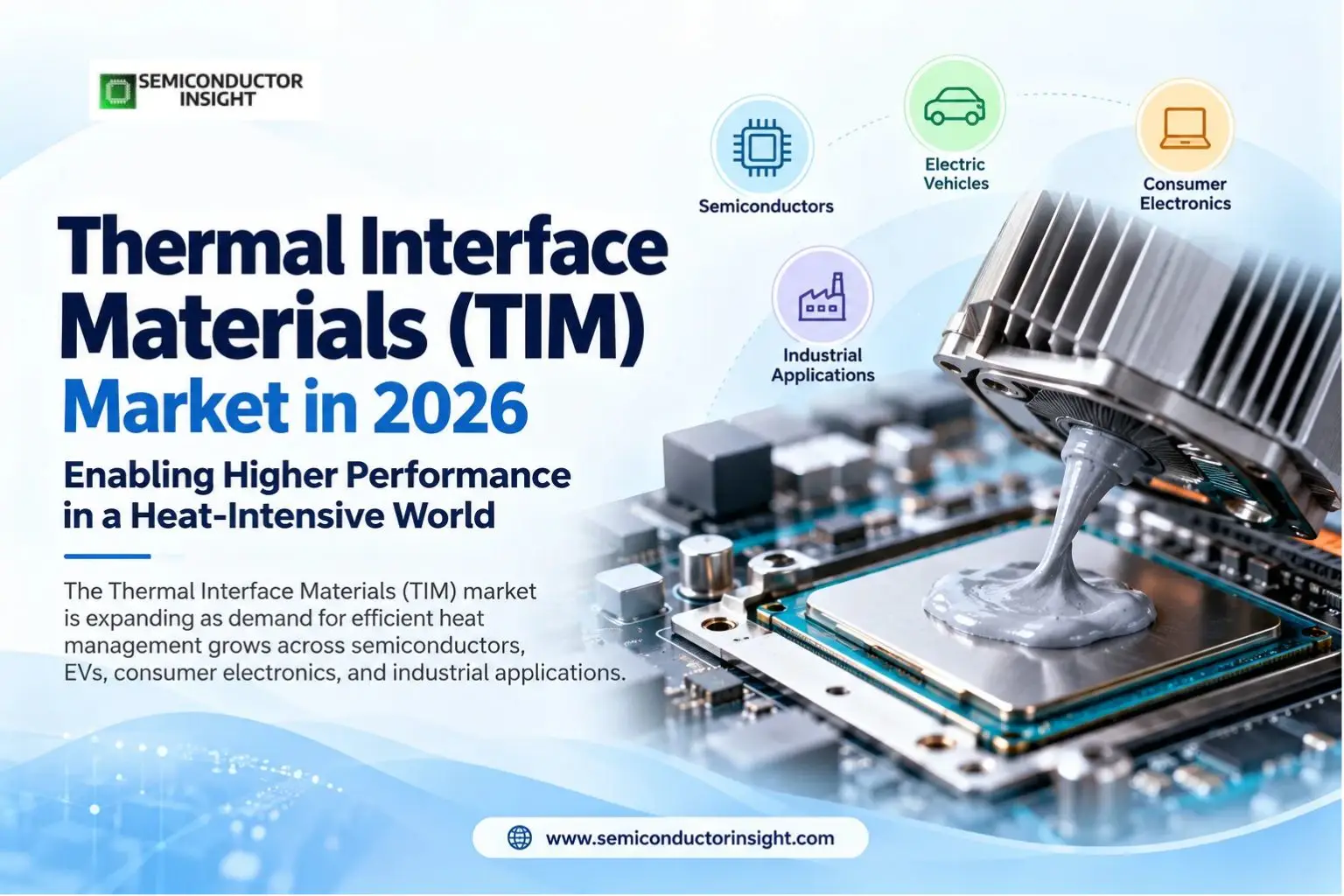
Thermal Interface Materials (TIM) Market in 2026 and the Race to Control Heat in AI Semiconductor Packages!
As semiconductor performance advances, controlling heat has become a materials-engineering problem as much as a cooling-system problem. AI accelerators, stacked memory and high-density computing packages generate concentrated heat that must travel through several interfaces before reaching a heat sink or liquid-cooling plate. Thermal interface materials (TIMs) help bridge these microscopic gaps, making their conductivity, contact quality and long-term stability increasingly important to semiconductor design.
The thermal interface materials market is evolving alongside advanced packaging, where even small thermal bottlenecks can affect operating temperatures, reliability and sustained computing performance.
The Hidden Resistance between a Chip and Its Cooler
- A semiconductor package may have a powerful cooling system and still struggle with heat transfer if the interfaces between components are inefficient.
- Microscopic surface irregularities trap air, which conducts heat poorly. TIMs fill these gaps and improve thermal contact between a chip, heat spreader or cooling assembly.
- Common formulations include silicone-based thermal greases, gap fillers, elastomeric pads, phase-change materials and thermally conductive adhesives.
- Their suitability depends on bond-line thickness, pressure, surface geometry, electrical insulation requirements and operating temperature.
- A higher advertised conductivity does not automatically guarantee better system performance if the material cannot establish a thin, uniform interface.
- A 2025 review in Microelectronics Reliability examined thermal management from the chip to the heat sink, covering TIMs, heat spreaders, substrates, thermal vias and methods for measuring thermal properties.
- Its central engineering lesson is that heat transfer must be evaluated across the complete package rather than through an individual material specification.
To find out more, feel free to browse our latest updated report: https://semiconductorinsight.com/report/thermal-interface-materials-tim-market/
AI Accelerators Are Changing the Material Selection Process
The expansion of AI computing is placing greater emphasis on sustained power delivery and heat removal. NVIDIA’s liquid-cooled server designs illustrate how thermal engineering is moving beyond conventional air-cooled configurations. However, liquid cooling does not eliminate the need for TIMs: heat must still cross interfaces between the processor, package components and cooling hardware. NVIDIA technical blog
For materials suppliers, this means developing formulations that remain stable under repeated thermal cycling, mechanical pressure and long operating periods. Pump-out, dry-out, void formation and changes in contact resistance can undermine performance even when the initial thermal conductivity looks promising.
SK hynix Takes Thermal Management inside the HBM Package
A notable development arrived on 26 May 2026, when SK hynix announced its integrated cooling-element solution for high-bandwidth memory, called iHBM. The company reported a 30% reduction in thermal resistance through cooling elements integrated within the HBM package.
The approach is significant because stacked memory creates complex heat-transfer paths in a compact footprint. Rather than relying exclusively on cooling hardware outside the package, the design incorporates thermal management into the package architecture itself. This is not simply a conventional TIM product, but it demonstrates the wider direction of semiconductor thermal engineering. SK hynix announcement
Henkel’s New Conductive Film Highlights the Importance of Interface Chemistry
- In August 2026, Henkel introduced its LOCTITE ABLESTIK CDF900 series of conductive die-attach films, reporting thermal conductivity exceeding 8 W/m·K.
- The films are intended for applications including AI, high-performance computing and advanced communications.
- Die-attach films are used to bond semiconductor components and are not interchangeable with every conventional TIM category.
- Nevertheless, this development illustrates how manufacturers are engineering materials to combine heat transfer, mechanical integrity and controlled assembly processes. Henkel announcement
Why Advanced Packaging Needs More Than a Conductivity Number?
Chiplets and three-dimensional integration bring processors, memory and other components closer together. Intel’s packaging research identifies thermal and mechanical technologies as important areas of heterogeneous integration, alongside interconnect design and power delivery.
For TIM developers, the implications extend beyond selecting conductive fillers. Dispensing precision, bond-line control, compatibility with package materials and resistance to thermal cycling can all influence manufacturing yield and service life. Materials must work within the actual assembly process, not just in laboratory testing.
The Next Competitive Edge Lies at the Interface
- The thermal interface materials market is increasingly connected to semiconductor architecture, package reliability and data-centre cooling strategy.
- As AI processors and stacked memory become more complex, suppliers will need to demonstrate repeatable performance under realistic operating conditions.
The most valuable innovations will not necessarily be the materials with the highest conductivity figures alone. They will be solutions that combine effective heat transfer, manufacturing consistency, mechanical stability and compatibility with increasingly dense semiconductor packages.

Comments (0)