
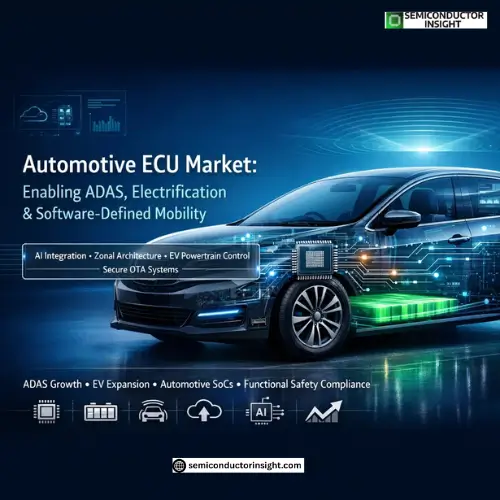
The Rise of Smart Vehicle Electronic Control Units (ECU) Market Speeds Semiconductor Evolution in Modern Automobiles
The automotive industry is no longer defined only by engines and mechanical precision. Today’s vehicles are intelligent machines, powered by embedded electronics and advanced semiconductor systems.
At the heart of this transformation lies the Electronic Control Unit (ECU) the decision-making module that manages everything from engine timing to
https://semiconductorinsight.com/report/global-adas-camera-modules-market/.
As vehicles evolve into software-defined platforms, the ECU market is experiencing unprecedented momentum driven by semiconductor innovation, electrification, and connectivity trends.
The Digital Nervous System of Modern Vehicles
An ECU is essentially a compact embedded system integrating microcontrollers, sensors, memory chips, power devices, and communication interfaces. Modern passenger vehicles can contain anywhere between 70 to over 150 ECUs depending on the level of automation and connectivity.
Engine control, transmission management, braking systems, infotainment, battery management, and autonomous driving functions are all governed by specialized ECUs. The increasing integration of AI processors, high-performance microcontrollers, and system-on-chips (SoCs) is transforming traditional ECUs into high-computing automotive nodes.
The shift toward software-defined vehicles is accelerating this evolution. Instead of numerous isolated ECUs, automakers are gradually adopting domain and zonal architectures to centralize computing power and reduce system complexity.
Semiconductor Innovation Reshaping ECU Architecture
The ECU market’s growth is deeply intertwined with semiconductor advancements. High-performance automotive-grade processors, advanced power management ICs, and wide-band gap semiconductors such as SiC and GaN are redefining efficiency standards.
With electric vehicles (EVs) gaining global traction, battery management ECUs and powertrain control modules require robust microcontrollers capable of handling real-time processing with high thermal stability. Semiconductor companies are focusing on:
- Enhanced functional safety compliance (ISO 26262)
- Cyber security integration at chip level
- Low-latency communication protocols
- Advanced packaging for thermal management
The growing demand for high-performance computing in vehicles is pushing chipmakers to develop automotive-specific AI accelerators and multicore processors.
ADAS, Electrification & Connectivity considered as the Growth Catalysts
Advanced Driver Assistance Systems (ADAS) remain one of the strongest growth drivers in the ECU ecosystem. Features such as adaptive cruise control, lane-keeping assistance, automatic emergency braking, and 360-degree sensing rely heavily on sensor fusion ECUs and high-bandwidth data processors.
Electric vehicle adoption further expands ECU complexity. Unlike conventional internal combustion engine vehicles, EVs require additional controllers for battery systems, regenerative braking, inverter management, and charging modules.
Connected vehicles introduce another dimension over-the-air (OTA) updates. This capability enables remote software upgrades, increasing reliance on secure communication protocols and centralized vehicle control systems.
As global vehicle production gradually shifts toward electrified and intelligent models, ECU content per vehicle continues to rise significantly.
Transition from Distributed to Zonal Architecture
Traditionally, vehicles used distributed ECU architectures where each function had a dedicated control module. However, this approach increases wiring complexity, weight, and system costs.
The industry is now transitioning toward domain and zonal computing architectures. In zonal systems, ECUs are grouped based on vehicle zones rather than functions. This reduces wiring harness requirements and enhances scalability.
Centralized vehicle controllers powered by high-end automotive SoCs are replacing multiple standalone ECUs. This transformation represents a critical semiconductor opportunity, particularly for suppliers specializing in automotive microprocessors and networking chips.
The emergence of centralized vehicle computing is expected to redefine supplier ecosystems and revenue streams across the semiconductor value chain.
Safety, Regulation & Functional Integrity
- Automotive ECUs must meet strict global safety and reliability standards. Functional safety compliance (ISO 26262), cybersecurity frameworks (UNECE WP.29), and automotive quality certifications (AEC-Q100) are mandatory in modern vehicle electronics.
- As vehicles become more autonomous, redundancy and fail-operational systems are gaining importance. Dual-core lockstep microcontrollers, hardware security modules (HSM), and secure boot mechanisms are increasingly integrated into ECU designs.
- The focus is not only on performance but also on functional safety compliance and long-term reliability under extreme temperature and vibration conditions.
Intelligent consolidation, AI integration, and safe software ecosystems are key factors in the future of the vehicle electronic control units market. Vehicles will move from control modules to high-performance computing hubs as ECUs advance toward Level 3 and Level 4 autonomy.
Electrification, digital cockpit integration, autonomous mobility, and smart infrastructure connectivity will continue to expand semiconductor requirements per vehicle.
In the coming years, the automotive industry will increasingly rely on intelligent semiconductor integration to deliver safer, smarter, and more sustainable mobility solutions.
The ECU is no longer just a control unit it is the silicon brain powering the mobility revolution.

Comments (0)