
The Hidden Semiconductor Layer Behind Every Click How Mouse Controller Market Supports Modern Human Interface Devices
The mouse controller is one of the least visible but most important semiconductor components inside a modern pointing device. It receives movement data from optical or laser sensors, interprets button inputs, manages communication with the host system and, in wireless models, coordinates power and radio-related functions. In advanced gaming products, the controller also supports extremely high polling rates, programmable inputs and real-time data processing.
The role is changing because the mouse is no longer simply a basic USB peripheral. It has become a compact embedded system combining sensing, processing, communication and power management within a small enclosure.
The Signal Path Is Becoming More Intelligent
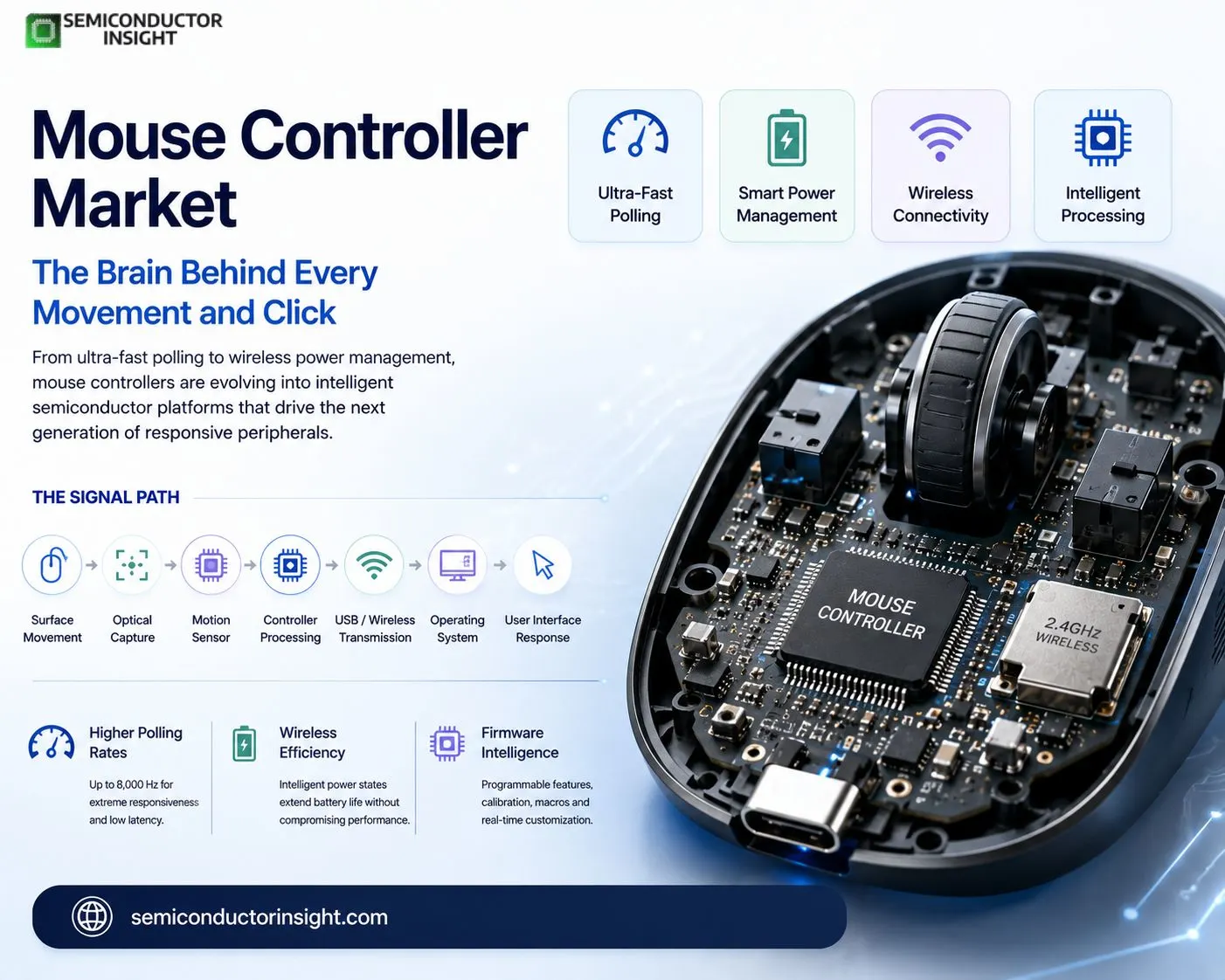
Surface movement → Optical image capture → Motion sensor → Controller processing → USB or wireless transmission → Operating system → User interface response
The controller sits at the centre of this chain. A sensor may capture thousands of images per second, but the controller determines how that information is converted into usable movement data. This is why controller architecture has a direct effect on responsiveness, compatibility and power consumption.
Modern mice increasingly combine dedicated motion sensors with microcontrollers rather than relying on a simple single-function logic chip. This creates opportunities for firmware-based customization and real-time processing.
Polling Rate Has Changed the Semiconductor Design Equation
- For years, 125 Hz USB polling was common in basic computer mice. Modern performance-focused devices can reach 1,000 Hz, 4,000 Hz and even 8,000 Hz polling rates, meaning the host computer can receive input reports up to 8,000 times per second.
- At 8,000 Hz, the theoretical interval between reports is only 0.125 milliseconds. The controller must therefore process and transmit data at much higher frequency than traditional office peripherals. This increases the importance of firmware optimization, USB handling and high-speed microcontroller performance.
- The trend is particularly visible in gaming peripherals. Companies such as Logitech have promoted high-polling-rate technologies, while Razer has introduced mice supporting 8,000 Hz polling through its HyperPolling ecosystem. These developments are pushing mouse controller designs toward lower latency and faster data handling.
Wireless Mice Are Turning Controllers into Power Managers
The wireless segment is adding another layer of semiconductor complexity. A wireless mouse controller may need to coordinate motion data, button signals, Bluetooth or proprietary 2.4 GHz connectivity, sleep modes and battery management.
Bluetooth SIG specifications support low-power Bluetooth operation designed for efficient wireless communication, while modern peripheral platforms increasingly combine high-speed wireless links with power-saving firmware.
This creates a design trade-off. A gaming mouse may require extremely low latency during active use but must consume minimal energy when idle. As a result, controller manufacturers are increasingly focusing on dynamic power states, rapid wake-up and efficient data transmission.
To find out more, feel free to browse our latest updated report: https://semiconductorinsight.com/report/mouse-controller-market/
USB-C and the Move toward More Flexible Peripheral Architectures
USB technology continues to influence the controller ecosystem. The USB Implementers Forum has developed standards covering USB Type-C connectivity and high-speed data transfer, creating a broader foundation for modern wired and rechargeable peripherals.
For mouse controllers, the shift is not only about the connector. It also involves firmware compatibility, charging management and the ability to support higher data throughput in advanced devices.
The Controller Is Becoming a Firmware Platform
- A modern mouse controller increasingly acts as a programmable platform rather than a passive signal bridge. Firmware can manage lift-off distance, debounce behaviour, sensor calibration, macro functions, lighting control and wireless power states.
- This development is changing product differentiation. Two mice can use similar optical sensors but deliver different performance because of differences in controller architecture, firmware and data processing.
Mouse Controller Market is therefore moving toward a more integrated semiconductor model where sensing, high-speed communication, power management motion and embedded software increasingly work as one system. As computing becomes more responsive and peripherals become more customizable, the controller is quietly becoming the component that determines how accurately physical movement is translated into digital action.

Comments (0)