

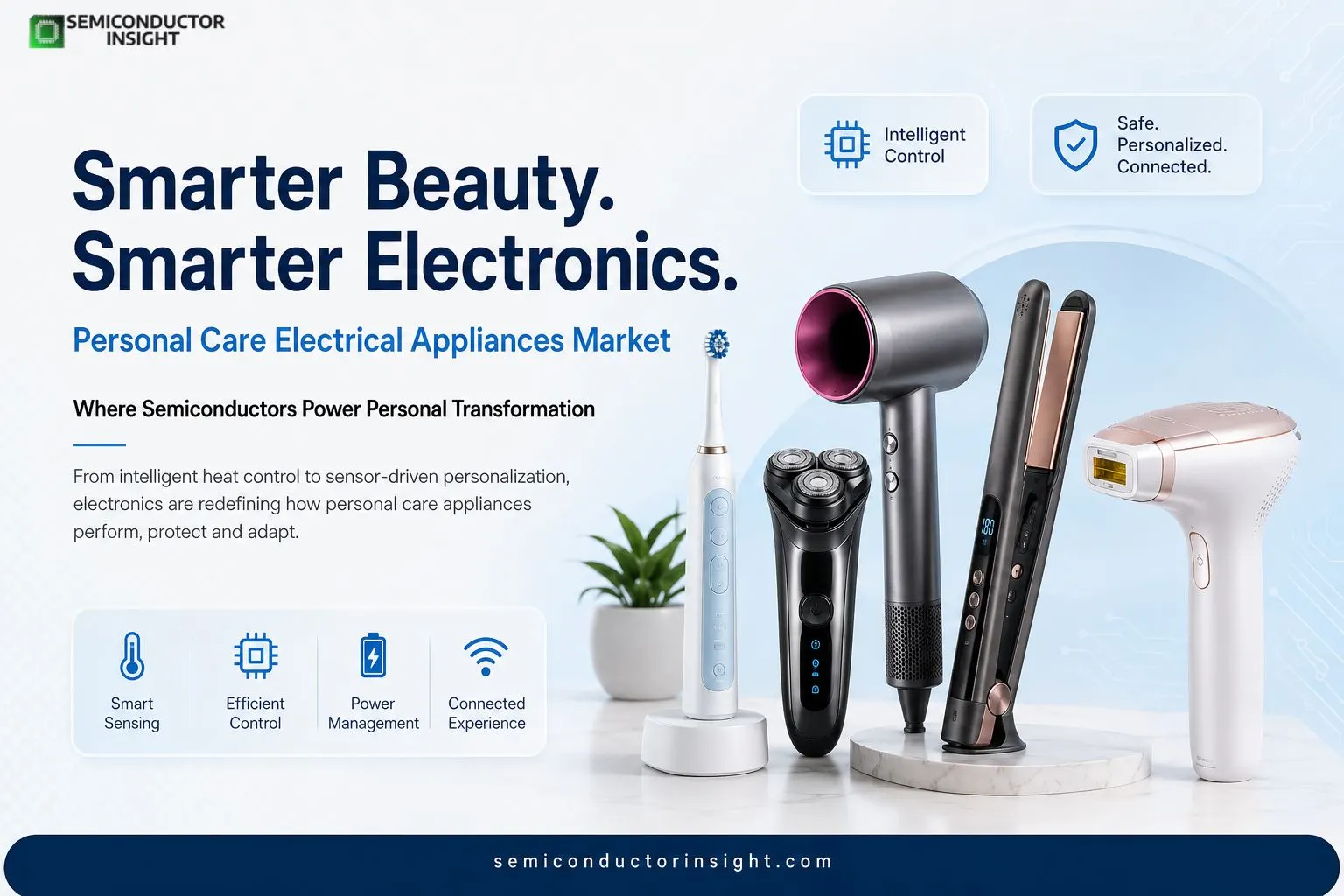
The Connected Beauty Revolution Transforming the Personal Care Electrical Appliances Market
The modern personal-care appliance is increasingly closer to a compact consumer-electronics product than a conventional electrical gadget. Hair dryers, straighteners, curling systems, electric toothbrushes, shavers, epilators, facial devices and home-use IPL systems now combine motors, heating elements, power-management components, sensors, microcontrollers and increasingly sophisticated software.
That shift is particularly relevant to the semiconductor industry because the performance of these appliances increasingly depends on how accurately electronics can monitor and control heat, speed, pressure, current and battery consumption.
The product architecture is changing from:
Power input → motor/heater → manual control
Toward:
Power management → sensors → microcontroller → real-time control → user feedback
The Temperature Chip Is Becoming as Important as the Heating Element
Heat-based products are one of the clearest examples. Straighteners, curling tools and hair dryers must balance high operating temperatures with protection against excessive heat exposure.
Instead of relying solely on fixed settings, newer designs can use temperature sensors and electronic feedback loops to adjust power repeatedly during operation. This creates opportunities for thermistors, temperature sensors, MOSFETs, microcontrollers and power-management ICs.
The semiconductor opportunity is therefore not simply about putting a chip into a beauty device. It is about making the appliance respond to changing conditions rather than operating at one fixed electrical level.
A Hair Dryer Can Now Behave Like a Controlled Computing System
Modern premium hair-styling systems increasingly combine high-speed motors with electronic control. Brushless motor architectures can provide precise speed regulation while reducing mechanical wear, and digital controls allow manufacturers to create multiple airflow and temperature modes.
This matters because the motor and power-management system must work together. A sudden change in airflow demand can require corresponding adjustments in electrical power, thermal protection and motor speed.
The result is a compact control ecosystem:
Sensor input → processor decision → power adjustment → motor response → thermal feedback
That architecture mirrors principles already familiar in industrial electronics, but in a much smaller consumer product.
Home Beauty Devices Are Moving Into Regulated Territory
- Another important development is the increasing sophistication of light-based personal-care equipment.
- Some home-use hair-removal devices use intense pulsed light technology, bringing optical components, power electronics, thermal management and safety controls together.
- The U.S. FDA classifies certain hair-removal products as medical devices depending on their intended function.
- Recent FDA records show multiple home-use IPL hair-removal devices receiving 510(k) clearance decisions, including products reviewed in 2025 and 2026.
- This creates a different electronics requirement from a conventional hair dryer. Light intensity, pulse timing, skin-contact detection and thermal protection can all become important parts of the device architecture.
Battery Design Is Creating a New Hardware Layer
Cordless personal-care appliances are also changing the semiconductor requirement. Rechargeable products need battery-management systems that monitor voltage, current and temperature while protecting cells during charging and discharge.
For manufacturers, the challenge is no longer simply providing a battery. The appliance must coordinate:
Battery → charging IC → protection circuit → power-management IC → motor/heater → sensor feedback
This architecture becomes particularly important in cordless shavers, toothbrushes, facial devices and portable styling products where users expect compact dimensions and repeated operation between charges.
The Numbers Show How Quickly Electronics Are Spreading
The broader consumer-electronics ecosystem is already moving toward more standardized and reusable charging infrastructure. The European Commission’s common-charger rules require USB-C charging for a growing range of portable electronic devices sold in the EU. The Commission estimates that discarded and unused chargers account for approximately 11,000 tonnes of e-waste annually.
For personal-care appliances, this creates an interesting design direction: charging compatibility, removable or replaceable power systems and reduced accessory duplication can become part of product engineering rather than merely packaging decisions.
Personalization Is Turning Sensors into Product Differentiators
- The next generation of appliances is increasingly designed around individual usage. A device can potentially detect temperature, contact, motion, pressure or operating duration and adjust its output accordingly.
- Academic research into connected beauty systems has already explored sensor-enabled ‘Internet of Mirrors’ concepts that combine visual systems, connectivity and personalized beauty recommendations.
- While such concepts remain emerging, the underlying electronics are becoming increasingly accessible through compact sensors, low-power processors and wireless connectivity.
2026 Product Blueprint
The most interesting transformation in the personal-care appliance category can be summarized through one evolving architecture:
Compact semiconductor → sensing → decision-making → controlled power → personalized output
You can freely browse our most recent updated report to learn more about it before scrolling further: https://semiconductorinsight.com/report/personal-care-electrical-appliances-market/
This explains why the personal care electrical appliances market is becoming increasingly relevant to semiconductor suppliers. The growth opportunity is moving beyond individual chips toward complete electronic subsystems involving microcontrollers, sensors, motor drivers, power-management ICs, connectivity modules and protection components.
At the same time, regulatory boundaries are becoming important. The FDA notes that certain products marketed for appearance can fall under medical-device rules when they are intended to affect body structure or function.
The result is a rapidly evolving category where beauty hardware, consumer electronics and semiconductor engineering increasingly overlap. In 2026, the competitive edge of a personal-care appliance is therefore increasingly determined not only by its physical design, but by how intelligently its electronics can control the experience.

Comments (0)