
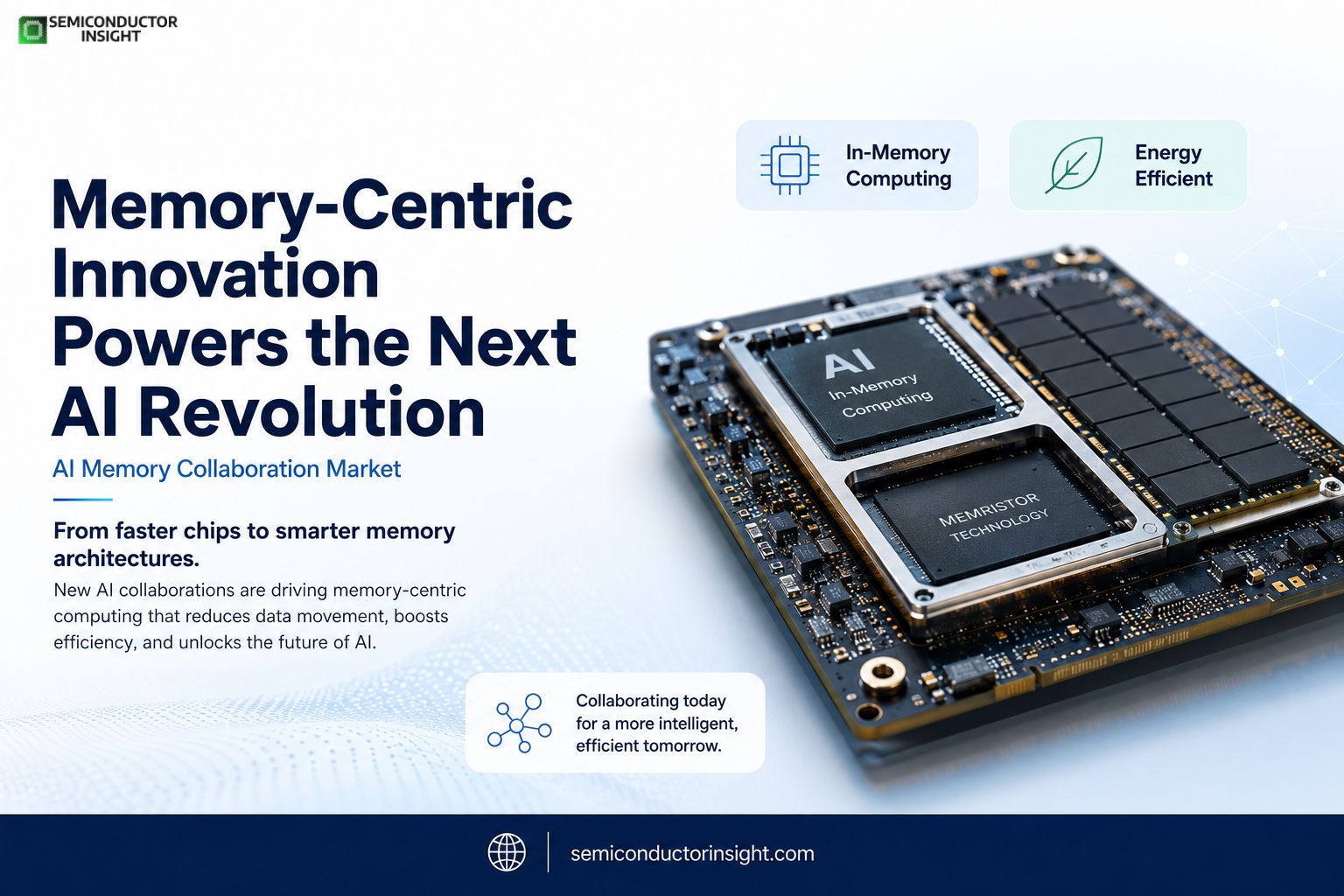
TetraMem and SK hynix Strengthen AI Semiconductor Innovation with Breakthrough Memory-Centric Computing Collaboration
As artificial intelligence models continue to grow in size and complexity, the semiconductor industry is increasingly shifting its focus from faster processors to smarter memory architectures. Reflecting this transition, TetraMem Inc. and SK hynix have announced the successful completion of a joint technology collaboration that advances the future of memory-centric AI computing.
The partnership has culminated in the publication of the research paper,
“A Memristor-based In-Memory Computing SoC with Efficient Depthwise Convolution,” in Advanced Intelligent Systems. The study was also selected as the journal’s cover feature, highlighting the growing significance of innovative memory architectures in addressing the next generation of AI computing challenges.
While AI hardware has traditionally focused on increasing computational performance, today’s foundation models often containing billions or even trillions of parameters are exposing a different limitation. A substantial portion of system energy is now consumed by transferring massive volumes of data between processors and memory, creating bottlenecks that impact performance, latency, power consumption, and thermal management.
To overcome these challenges, TetraMem and SK hynix are exploring Analog In-Memory Computing (A-IMC), an emerging computing paradigm that performs mathematical operations directly within memory rather than continuously moving data between separate computing and storage units.
By reducing unnecessary data movement, memory-centric architectures have the potential to significantly improve computational efficiency while lowering overall energy consumption an increasingly important objective as AI workloads continue expanding across cloud infrastructure, enterprise computing, autonomous systems, and edge devices.
- The collaboration successfully demonstrated a memristor-based AI System-on-Chip (SoC) capable of executing efficient depthwise convolution, a core operation widely used in modern AI inference models.
- Beyond validating the feasibility of Analog In-Memory Computing, the project integrated several advanced semiconductor disciplines into a unified platform, including emerging memory devices, circuit engineering, AI architecture, software optimization, and system-level design.
- This multidisciplinary approach illustrates how future semiconductor innovation will increasingly depend on close collaboration across the entire technology stack rather than isolated component development.
The achievement also highlights the growing role of ecosystem partnerships in accelerating semiconductor innovation. By combining TetraMem’s expertise in Analog In-Memory Computing with SK hynix’s leadership in advanced memory technologies, the companies have demonstrated how collaborative engineering can help solve some of AI’s most pressing infrastructure challenges.
Company executives noted that the project represents more than a research milestone it establishes a foundation for continued exploration of memory-centric computing technologies capable of supporting increasingly demanding AI applications.
As AI models continue to scale, future computing platforms will require balanced advances across processor design, memory technology, interconnects, and system architecture. Memory is rapidly evolving from a supporting component into a strategic enabler of AI performance.
Explore the Newest Research Insights Available: https://semiconductorinsight.com/report/ai-computing-modules-market/

Comments (0)