
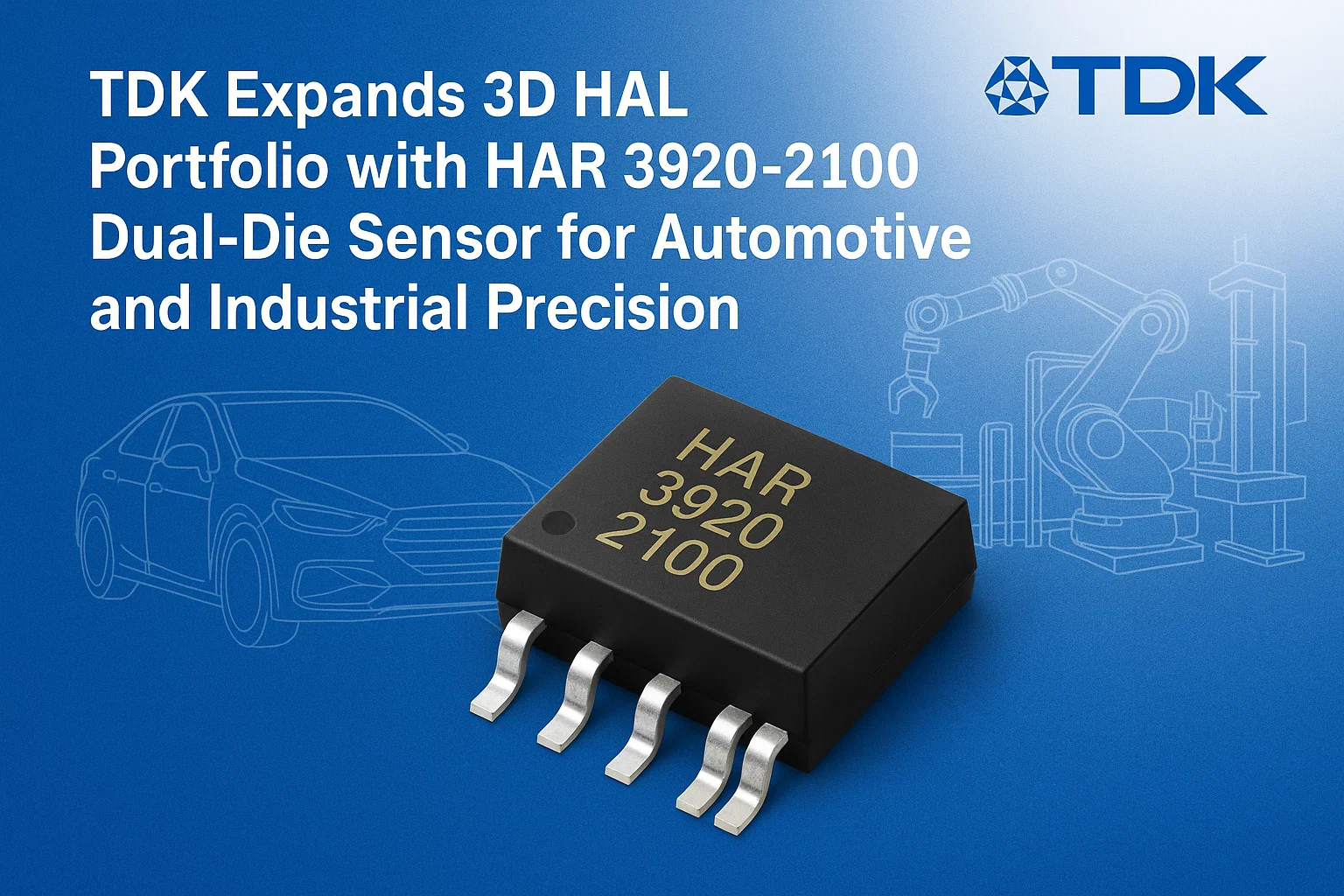
TDK Expands 3D HAL® Portfolio with HAR 3920-2100 Dual-Die Sensor for Automotive and Industrial Precision
In today’s hyper-connected world, machines are not just operating—they’re communicating, adjusting, and learning in real time. At the heart of this transformation are sensors, the unsung heroes that enable precision, safety, and automation. Among these, multi-axis linear and angular position sensors are some of the most crucial, quietly powering industries from autonomous vehicles and robotics to medical imaging systems and industrial automation.
In 2024, the global multi-axis linear and angular position sensors market was valued at US$ 1145 million, and it is projected to grow steadily, reaching US$ 1803 million by 2032. This trajectory reflects a compound annual growth rate (CAGR) of 7.4%, underscoring the increasing demand for highly accurate, durable, and smart sensing technologies.
But what’s fueling this surge? The answer lies in recent technological developments from industry leaders like TDK, CTS, and Interface, combined with groundbreaking academic research. Together, these innovations are reshaping what sensors can achieve—extending lifespans, increasing accuracy, resisting interference, and even enabling soft and flexible robotics.
Access Your Free Sample Report- Multi-axis Linear and Angular Position Sensors Market
Understanding Multi-Axis Position Sensors: A Quick Primer
Before diving into the recent news, it’s worth clarifying what makes multi-axis linear and angular position sensors so unique.
- Linear position sensors measure movement along a straight path (X, Y, or Z axes).
- Angular position sensors detect rotation around an axis, measuring angles with high precision.
- Multi-axis sensors combine both, enabling machines and systems to monitor movements across several directions simultaneously.
These sensors are vital in:
- Automotive systems (steering angle detection, throttle position, braking systems)
- Industrial automation (robotic arms, CNC machines, factory automation)
- Aerospace and defense (navigation, satellite positioning, missile guidance)
- Medical technology (robotic surgery, imaging systems, prosthetics)
- Consumer electronics (gaming controllers, smartphones, VR devices)
With applications expanding across so many sectors, it’s clear why the market is on a steady growth path. Now, let’s dive into the specific recent developments that are setting the tone for the next decade.
TDK/Micronas HAR 3920-2100: Resilience in Noisy Environments
One of the most exciting developments in 2024 came from TDK Micronas, a leading innovator in sensor technology. In March, the company announced the launch of the HAR 3920-2100, a dual-die 3D HAL® position sensor.
Key Features:
- Measures both linear and angular position simultaneously
- Built to remain accurate even in environments with strong magnetic stray fields
- Provides both analog and switch outputs, making it versatile for multiple use cases
Why It Matters:
One of the biggest challenges in sensor technology—especially in automotive and industrial environments—is magnetic interference. Electric motors, power electronics, and other components generate magnetic noise that can distort sensor readings. If sensors misread positions, it could mean anything from improper steering angle detection in a car to misaligned robotic arm movements in a factory.
TDK’s dual-die approach provides redundancy and reliability, ensuring the sensor continues to deliver accurate measurements even under harsh conditions. This is particularly crucial for electric vehicles (EVs), where electromagnetic interference is more intense compared to traditional combustion engines.
Applications:
- Automotive steering and throttle systems
- Electric motor position detection
- Industrial automation requiring high reliability
This development is a major step toward making autonomous driving and Industry 4.0 systems safer and more dependable.
CTS Series 286: Extending Beyond 360° with Multi-Turn Hall Sensors
Another breakthrough came from CTS Corporation, which introduced the Series 286 multi-turn Hall-effect rotary position sensor.
Key Features:
- Tracks rotation beyond 360°—up to 3600°
- Capable of withstanding up to 10 million rotational cycles
- Features internal EMI shielding and IP67 protection against dust and water
- Designed for non-contact operation, reducing wear and tear
Why It Matters:
Traditional rotary sensors typically track a single revolution, limiting their usefulness in applications requiring multi-turn monitoring. CTS’s innovation allows for precise measurement over multiple rotations, unlocking possibilities in robotics, heavy machinery, and advanced automation systems.
The durability—up to 10 million cycles—also means these sensors can thrive in demanding industrial and transportation environments, reducing maintenance costs and improving uptime.
Applications:
- Robotics (multi-axis robotic joints)
- Medical devices (robotic surgery arms, imaging systems)
- Heavy industrial machinery
- Aerospace and defense systems
With Industry 4.0 and the Internet of Things (IoT) becoming the backbone of modern production lines, sensors like the CTS 286 are critical enablers of smart factories.
Download Sample Report PDF- Multi-axis Linear and Angular Position Sensors Market
Interface Force Systems: Overload Protection and Robot Integration
Meanwhile, Interface Force Systems announced upgrades that directly address a common challenge in multi-axis sensing: overload protection.
Key Features:
- New sensors offer five times overload capacity
- Built-in mounting compatibility with ABB robots, in addition to Universal Robots and KUKA
- Designed for reliability in demanding robotic applications
Why It Matters:
In robotics and industrial automation, sensors are frequently exposed to unexpected forces. Overloads can damage sensors, leading to costly downtime. By increasing overload protection fivefold, Interface’s new designs greatly enhance durability and safety.
Moreover, direct compatibility with major robotics brands like ABB, UR, and KUKA means these sensors can be seamlessly integrated into global automation ecosystems. This saves manufacturers time and cost, accelerating adoption.
Applications:
- Collaborative robots (cobots) in manufacturing
- Automated assembly lines
- Precision machining
- Testing and measurement systems
This innovation reflects a growing industry trend: sensors are no longer just components—they’re plug-and-play solutions that can easily integrate into broader industrial systems.
Academic Innovations: Shaping the Next Generation of Sensors
While corporate advancements dominate headlines, academia is pushing the boundaries of what’s possible in multi-axis sensing. Several notable research breakthroughs are worth highlighting:
1. Inductive 6-Axis Force/Torque Sensor (2025)
- Developed a compact, non-contact inductive sensor with onboard CAN-FD processing
- Achieved high sensitivity (0.03 N resolution, 55k quantization steps)
- Low crosstalk, high accuracy, and real-time processing at 4 kHz
This could redefine robotic manipulation, making robots more dexterous and precise.
2. Self-Calibrating Hall Sensors (2025)
- Introduced data-driven, online calibration for Hall sensors
- Reduced measurement error by a factor of 6 without external encoders
This is significant because calibration has always been a time-consuming process. A self-calibrating sensor reduces downtime and ensures accuracy in real-world conditions.
3. Dielectric Elastomer 2-DOF Sensor (2024)
- Soft, flexible sensor for two-degree-of-freedom measurement
- Achieved 2 mm accuracy with only 0.7% error
- Tailor-made for soft robotics and medical applications
As robotics increasingly moves toward human-robot collaboration and wearable assistive devices, soft and flexible sensors will become essential.
Market Growth Drivers: Why Demand is Accelerating
The move from US$ 1145 million in 2024 to US$ 1803 million by 2032 is driven by several key factors:
- Automotive Electrification & ADAS
- EVs require precise motor and steering angle sensors.
- ADAS (Advanced Driver Assistance Systems) rely on redundant, highly accurate sensors.
- Industry 4.0 and Smart Manufacturing
- Multi-axis sensors power robotic arms, CNC machines, and smart factory systems.
- Demand for predictive maintenance boosts need for real-time sensing.
- Medical Robotics & Imaging
- Surgical robots demand ultra-precise multi-axis sensors.
- Imaging systems (MRI, CT) use sensors for accurate positioning.
- Aerospace & Defense
- Navigation, missile guidance, and drone stabilization all rely on angular and linear position sensing.
- Consumer Electronics & VR
- Immersive technologies like VR/AR and gaming demand accurate angular sensors.
Challenges Ahead
Despite growth, the industry faces hurdles:
- High development costs for advanced, multi-functional sensors
- Electromagnetic interference (EMI) in EVs and industrial setups
- Miniaturization demands in medical and wearable devices
- Supply chain disruptions for semiconductor components
Overcoming these challenges requires continuous R&D, collaborations between academia and industry, and advances in materials science.
Click Here To Download Full Sample Report- Multi-axis Linear and Angular Position Sensors Market
Future Outlook: Toward Smarter, More Flexible Sensors
Looking ahead, three trends stand out:
- Integration with AI and Edge Computing
Sensors will not just measure—they will process and interpret data locally, reducing latency. - Soft and Flexible Materials
Inspired by academic research, future sensors will integrate into wearables, prosthetics, and soft robots. - Sustainability and Energy Efficiency
Low-power and self-powered sensors will gain traction as industries aim for carbon neutrality.
The multi-axis linear and angular position sensor industry is on a clear growth trajectory, moving from US$ 1145 million in 2024 to US$ 1803 million by 2032. With a CAGR of 7.4%, this sector is powered by technological breakthroughs, surging demand across industries, and the relentless march toward automation and precision.

Comments (0)