

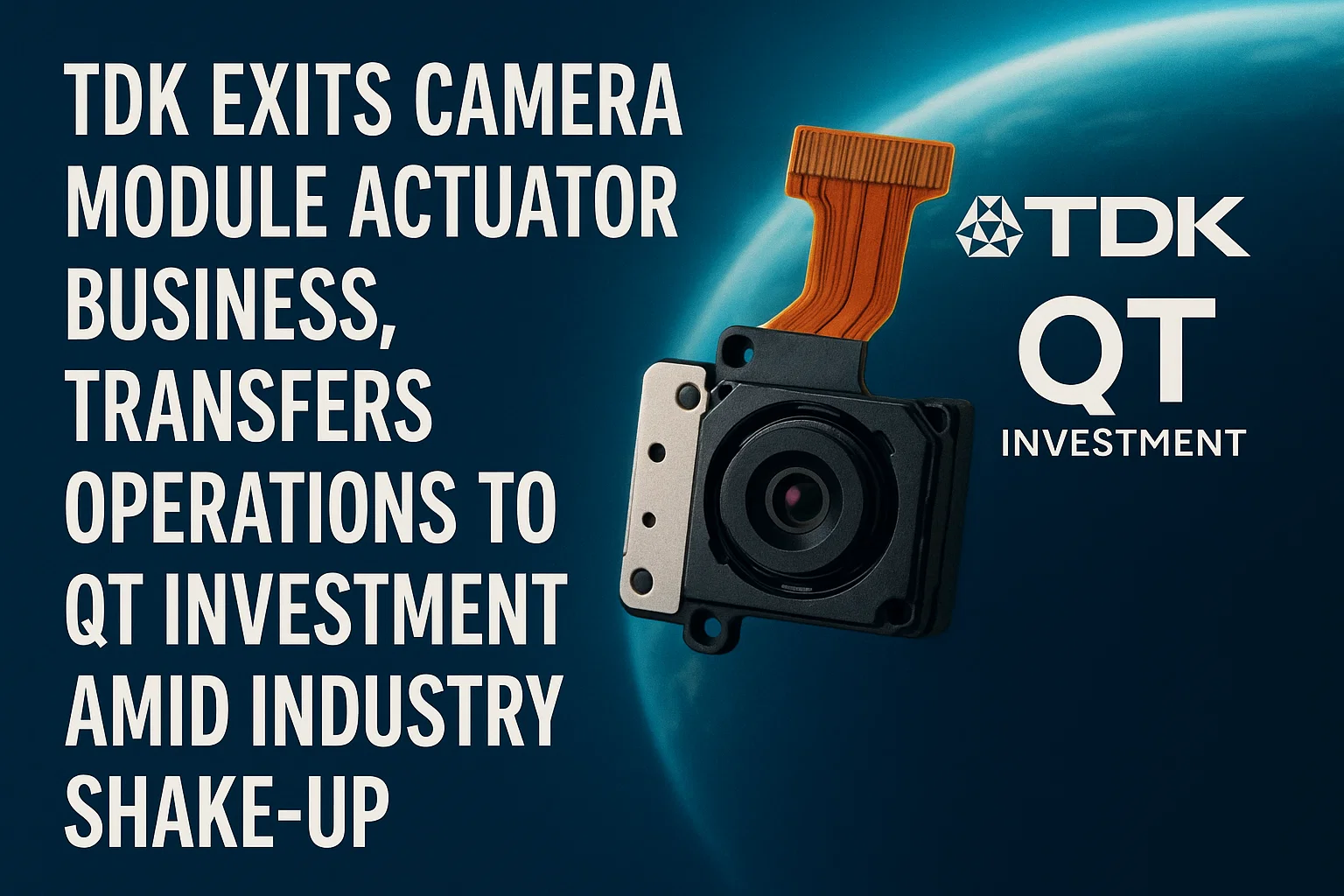
TDK Exits Camera Module Actuator Business, Transfers Operations to QT Investment Amid Industry Shake-Up
The smartphone camera has evolved from a simple feature for capturing everyday memories to a powerful tool rivaling professional photography equipment. At the heart of this technological evolution lies a crucial yet often overlooked component the camera module actuator. This tiny device is responsible for precise lens movements that enable functions such as autofocus (AF), optical image stabilization (OIS), and zoom. With growing demand for high-quality imaging in smartphones, tablets, automotive systems, and even AR/VR devices, the camera module actuator industry is entering a new phase of innovation and market expansion.
According to the latest industry insights, the global camera module actuator market was valued at USD 3,386 million in 2024 and is projected to reach USD 3,997 million by 2032, growing at a compound annual growth rate (CAGR) of 2.5% during the forecast period. This growth reflects steady demand across consumer electronics and emerging applications, particularly as advancements in smartphone camera design continue to drive complexity in actuators.
Access Your Free Sample Report- Camera Module Actuator Market
Understanding Camera Module Actuators and Their Role in Imaging
A camera module actuator is a critical component in modern imaging systems. It controls the precise movement of lens elements to achieve various functions:
- Autofocus (AF) – Adjusts lens position to focus accurately on subjects at different distances.
- Optical Image Stabilization (OIS) – Counteracts hand shake and vibrations for sharper photos and smoother videos.
- Zoom Functions – Moves lens groups to enable optical zoom, maintaining image quality at different focal lengths.
- Advanced Features – Such as ultra-close-up macro photography and 3D sensing in AR/VR.
These actuators must operate with micron-level precision, extreme reliability, and at high speeds, all while fitting into the compact form factor of modern smartphones. As smartphone manufacturers push for innovations like continuous optical zoom and ultra-high-resolution sensors, the demands on actuator performance are increasing dramatically.
Market Overview: Growth and Key Drivers
The camera module actuator market is expanding steadily, supported by the proliferation of multi-camera smartphones and demand for advanced features. Here are the main drivers:
- Rising Demand for High-Resolution Smartphone Cameras
Smartphones with 50MP, 100MP, and even 200MP sensors are now common. These high-resolution sensors require highly precise actuators for autofocus and OIS to prevent image blur and maximize detail. The need for precision is fueling innovation in actuator design and materials.
- Emergence of Continuous Optical Zoom
Unlike conventional cameras that offer fixed zoom steps (e.g., 3x, 5x), continuous optical zoom enables smooth focal length transitions without loss of quality. This feature demands multi-group lens movements, requiring more sophisticated actuator systems.
- AR/VR and Automotive Applications
Beyond smartphones, camera actuators are finding use in augmented reality (AR), virtual reality (VR), and automotive advanced driver assistance systems (ADAS). These applications require ultra-fast, reliable actuators for functions like depth sensing, driver monitoring, and gesture recognition.
- Miniaturization and Cost Efficiency
As smartphone designs get slimmer, actuator suppliers are challenged to reduce size while maintaining performance. Cost optimization is also crucial, especially for mid-range and entry-level devices, driving innovation in MEMS (microelectromechanical systems)-based actuators.
Recent Industry Developments: Shaping the Future of Actuators
-
Samsung Electro-Mechanics Leading the Charge with Continuous Zoom Modules
Samsung Electro-Mechanics (SEM), a global leader in camera module components, is pioneering continuous optical zoom technology.
According to The Elec and Android Authority, Samsung is developing advanced telephoto modules where multiple lens groups move independently to create a seamless zoom range, much like professional DSLR lenses.
Key highlights:
- Targeted at Chinese smartphone manufacturers, not Samsung’s own Galaxy devices initially.
- Lens design divided into more than two moving groups for smoother zoom transitions.
- Expected to deliver superior image quality across all focal lengths compared to digital or stepped optical zoom.
This development signals a major leap forward for smartphone photography. Continuous zoom requires extremely precise and durable actuators, representing a significant revenue opportunity for actuator suppliers.
-
Ultra-Close-Up Camera Module with Advanced Ball-Guide Actuator
Samsung Electro-Mechanics has also introduced a groundbreaking ultra-close-up camera module for flagship smartphones.
Features include:
- 200MP resolution with superior image clarity.
- 14.8× optical zoom, enabling sharp ultra-close-up images at distances as low as 12 cm.
- A ball-guide type actuator for precise movement of large-diameter lenses.
This innovation demonstrates how actuator technology is evolving to meet the demands of high-megapixel sensors and macro photography, where even slight inaccuracies can ruin image quality.
-
TDK’s Strategic Transfer of Its Micro Actuator Business
In a strategic move, TDK Corporation announced on April 28, 2025, that it will transfer its Micro Actuator Solution business which includes design, development, and production of camera actuators to QT Investment Inc.
- The transfer is part of TDK’s medium-term plan to optimize its business portfolio and focus on core growth areas.
- The transition is expected to be completed by March 2026.
- This move reshapes the competitive landscape, potentially leading to new entrants or restructured alliances in the actuator market.
This decision reflects the intense competition and capital requirements of actuator manufacturing, as companies reassess their positions in the rapidly evolving mobile imaging industry.
Download Sample Report PDF- Camera Module Actuator Market
-
Mass Production of Continuous Zoom Modules for Chinese OEMs
Recent reports indicate that continuous zoom camera modules are already entering mass production, but are initially exclusive to Chinese smartphone brands.
Samsung’s strategy to supply these components to external clients before using them in its own Galaxy lineup suggests a dual-track business model:
- Revenue generation through B2B sales to other manufacturers.
- Delayed internal adoption to refine technology and manage risk.
Chinese brands are often early adopters of cutting-edge features, making them ideal partners for initial rollouts.
Technical Innovations in Actuator Design
The evolution of actuators involves advances in both mechanical design and control systems. Some notable trends include:
- MEMS-Based Actuators
MEMS actuators are increasingly favored for their compact size, low power consumption, and fast response times. They are especially valuable for mid-range smartphones where cost and space are critical factors.
- Voice Coil Motors (VCM)
Traditional VCM actuators remain dominant in premium smartphones, offering the precision needed for OIS and high-speed autofocus.
Recent innovations focus on improving:
- Magnetic circuit efficiency.
- Durability under frequent use.
- Power efficiency to extend battery life.
- Multi-Dimensional Actuation
Modern camera modules often combine multiple actuators:
- One for autofocus.
- Another for OIS.
- Additional actuators for zoom control.
This layered approach allows for advanced functions like simultaneous stabilization and zooming, but increases complexity and manufacturing challenges.
Market Segmentation and Growth Opportunities
The camera module actuator market can be segmented by application, technology, and region.
By Application
- Smartphones & Tablets – The largest segment, driven by consumer demand for better photography.
- Automotive – Growing use in ADAS, driver monitoring, and surround-view systems.
- AR/VR Devices – Emerging segment with significant potential as AR glasses and VR headsets gain traction.
- Security & Surveillance – Actuators used in high-end surveillance cameras for precise zoom and stabilization.
By Technology
- Voice Coil Motors (VCM) – Dominant technology in high-end devices.
- MEMS Actuators – Rapidly growing in mid-range products.
- Piezoelectric Actuators – Niche applications requiring ultra-precise control.
Regional Insights
- Asia-Pacific remains the largest market, with China, South Korea, and Japan leading production and consumption.
- North America and Europe are key regions for automotive and AR/VR applications.
- Emerging markets in India and Southeast Asia are driving mid-range smartphone adoption, boosting demand for cost-effective actuators.
Challenges Facing the Industry
Despite its growth, the camera module actuator industry faces several challenges:
- Manufacturing Complexity
As camera modules become more sophisticated, actuator assembly requires extreme precision. Maintaining quality at high volumes is a major hurdle.
- Supply Chain Disruptions
Global semiconductor shortages and geopolitical tensions can impact the availability of key materials and components.
- Cost Pressures
Smartphone OEMs are constantly seeking to reduce bill-of-materials (BOM) costs, squeezing margins for actuator suppliers.
- Intellectual Property (IP) Conflicts
The actuator market is rife with patents, and disputes over proprietary designs can delay innovation or lead to costly legal battles.
Future Outlook: Where the Industry is Headed
The future of the camera module actuator industry will be shaped by several transformative trends:
- AI-Powered Imaging
Integration of AI algorithms with actuator control will enable smarter autofocus, predictive stabilization, and real-time scene analysis.
- Foldable and Rollable Devices
These devices will require innovative actuator designs to fit within unconventional form factors.
- Sustainability Initiatives
Manufacturers are exploring eco-friendly materials and energy-efficient designs to reduce environmental impact.
- Expansion into New Sectors
As AR/VR, autonomous vehicles, and smart home devices grow, actuators will find diversified applications, reducing reliance on smartphones.
Click Here To Download Full Sample Report- Camera Module Actuator Market
Competitive Landscape
The camera module actuator industry is highly competitive, with key players including:
- Samsung Electro-Mechanics – Leader in advanced telephoto and continuous zoom modules.
- Alps Alpine – Known for precision actuator technologies.
- TDK Corporation – Transitioning its micro actuator business to QT Investment.
- Sunny Optical – Major supplier to Chinese smartphone brands.
- LG Innotek – Strong presence in high-end smartphone modules.
These companies compete on innovation, manufacturing scale, and partnerships with smartphone OEMs.
The camera module actuator industry is at the forefront of the smartphone imaging revolution. With the market projected to grow from USD 3,386 million in 2024 to USD 3,997 million by 2032 at a CAGR of 2.5%, it remains a vital component of the broader mobile and imaging ecosystem.

Comments (0)