
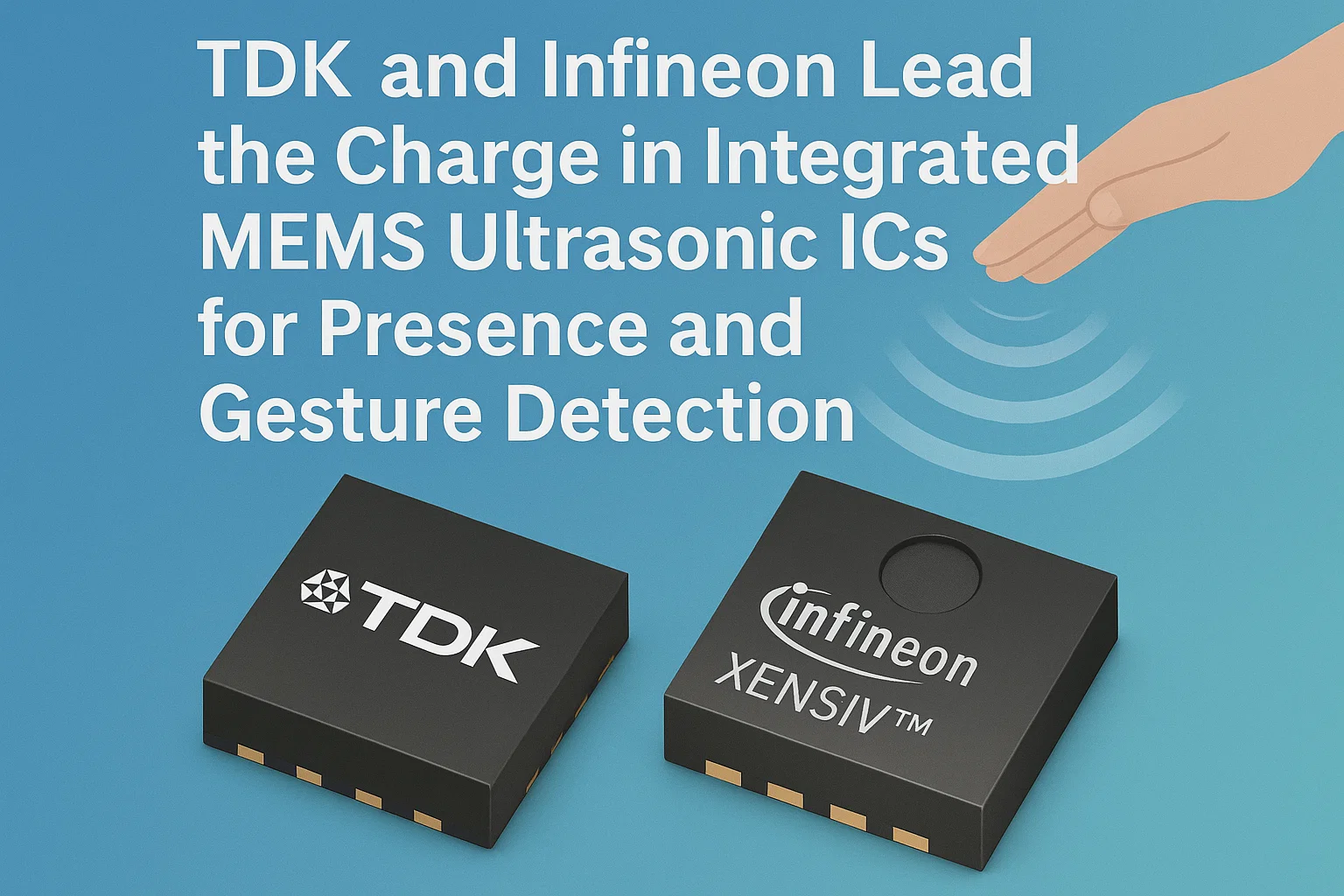
TDK and Infineon Lead the Charge in Integrated MEMS Ultrasonic ICs for Presence and Gesture Detection
Over the past decade, Time-of-Flight (ToF) ultrasonic sensors have quietly evolved from niche industrial components into mainstream enablers of advanced smart systems. From autonomous robots and industrial automation to smart home appliances and automotive safety, ultrasonic ToF technology offers reliable and cost-effective sensing even where optical or LiDAR sensors fail. At the heart of this transformation lies the IC (Integrated Circuit) the “brain” that drives signal generation, reception, processing, and analytics.
In 2024, the IC for ToF Ultrasonic Sensor market was valued at USD 97 million. According to recent projections, it is expected to reach USD 157 million by 2032, growing at a steady CAGR of 7.4% during the forecast period. This expansion is powered by a combination of miniaturization, on-chip intelligence, and new application domains that demand reliable and energy-efficient sensing.
Access Your Free Sample Report- IC for TOF Ultrasonic Sensor Market
Understanding ICs for ToF Ultrasonic Sensors
What Makes Ultrasonic ToF Different
Unlike traditional ultrasonic sensors, ToF technology measures the time it takes for an ultrasonic pulse to travel to a target and back, enabling precise distance and presence detection. When combined with specialized ICs, these sensors deliver:
- High accuracy (millimeter-level precision in near-field distances)
- Low power consumption ideal for battery-powered devices
- Resistance to environmental factors such as dust, low light, and varying surface reflectivity
The IC component in these sensors typically integrates drivers for the transducer, analog front-end (AFE) circuitry, analog-to-digital converters (ADCs), digital signal processing (DSP), and in many cases an embedded microcontroller to handle on-chip computations.
The Shift Toward “Smart” ICs
Traditionally, ultrasonic ToF sensors relied on an external MCU or DSP to process the data. However, as applications have proliferated, sensor makers have started integrating more intelligence directly into the IC, reducing system cost and power draw while enabling plug-and-play modules. This trend mirrors what we’ve seen in MEMS microphones, IMUs, and optical ToF sensors.
Market Overview – 2024 Baseline and 2032 Outlook
The IC for ToF Ultrasonic Sensor market is poised for strong growth. With USD 97 million in revenue in 2024, the industry is on track to reach USD 157 million by 2032. Here’s why:
- Smart homes and appliances are embedding ultrasonic presence and proximity detection.
- Automotive systems demand robust sensor fusion for ADAS (advanced driver-assistance systems).
- Industrial and robotics applications are migrating to low-cost, low-power ToF ultrasonic modules for indoor mapping and safety.
- Wearables and consumer electronics are experimenting with gesture recognition and spatial awareness features.
This breadth of use cases is spreading the demand for ICs that can handle not just simple distance measurement but also multi-echo detection, obstacle classification, and edge AI.
Key Recent Developments from Leading Players
TDK/InvenSense Leads with Production of Smart Ultrasonic ICs
TDK’s InvenSense unit has been at the forefront with its ICU-10201 and ICU-30201 sensors. The ICU-30201, ramped to full production in January 2025, is a landmark device that integrates:
- MEMS PMUT (Piezoelectric Micromachined Ultrasonic Transducer)
- On-chip processing capable of presence detection without a host MCU
- Power consumption below 0.5 mW crucial for battery devices
This development underscores a clear shift toward “sensor-as-a-system” architectures, in which the IC handles both the analog and digital domains.
Infineon Integrates Transducer and Control Electronics
Infineon has announced a single-chip MEMS ultrasonic IC that merges the transducer and control circuitry, reducing footprint and simplifying assembly. By lowering parasitics and improving mechanical coupling, Infineon’s approach may set new standards in performance consistency and cost.
Elmos Expands Into Gesture and Presence Applications
Elmos has demonstrated combining ToF ultrasonic data with other modalities, such as their HALIOS® optical technology, to enable touchless gesture control in automotive interiors and industrial user interfaces. This approach reflects a growing emphasis on sensor fusion, where ultrasonic ICs feed into multi-sensor algorithms.
Drone and Robotics Adoption Gains Ground
Reports in EE Times and other outlets highlight how ultrasonic ToF ICs are being deployed in drones for indoor navigation and obstacle avoidance, areas where optical sensors struggle due to poor lighting or reflective surfaces. These deployments are pushing IC designers to deliver longer range, lower latency, and better signal-to-noise ratios.
Drivers Behind the Market Growth
Miniaturization and Integration
The integration of the ultrasonic transducer with signal processing electronics into a single IC package is reducing overall sensor module size. This enables deployment in space-constrained applications like wearables, IoT sensors, and ultra-thin smart devices.
Power Efficiency
Battery-operated devices demand ultra-low-power solutions. IC designers are therefore focusing on dynamic power modes, event-driven wake-up, and adaptive sampling to extend battery life.
Edge Intelligence
There’s a clear shift toward on-chip machine learning (TinyML) to detect patterns in ultrasonic echoes, enabling classification (human vs. object, or distinguishing different types of movements). This not only reduces bandwidth but also lowers latency for real-time responses.
Broader Application Horizons
Beyond the traditional proximity and distance measurement, ToF ultrasonic ICs are finding new markets in:
- Smart HVAC systems for occupancy detection
- Automated doors and elevators for enhanced safety
- Consumer electronics for gesture-based control
- Robotics for simultaneous localization and mapping (SLAM) in GPS-denied environments
Download Sample Report PDF- IC for TOF Ultrasonic Sensor Market
Technological Innovations in IC Design
Advanced Analog Front-Ends
The analog front-end (AFE) remains a critical differentiator. Innovations include low-noise amplifiers, programmable gain stages, and higher-speed ADCs, all integrated on the same die.
Piezoelectric MEMS Transducers (PMUTs)
ICs are increasingly paired with PMUTs, which offer higher sensitivity and lower drive voltage than traditional bulk piezo elements. PMUTs also integrate more easily with CMOS, paving the way for SoC-style products.
Adaptive Signal Processing
Real-time digital filtering, multi-echo separation, and noise suppression algorithms are becoming standard features in the IC firmware, reducing external processing requirements.
Wireless and Connectivity Options
Some next-generation ICs may embed low-power wireless interfaces (BLE, Zigbee) or standardized I²C/SPI communication with built-in encryption, facilitating secure IoT deployment.
Competitive Landscape
The industry features a mix of large semiconductor companies and niche sensor specialists:
- TDK/InvenSense – Leader in smart MEMS ultrasonic ToF modules.
- Infineon Technologies – Pioneer in integrated transducer + IC designs.
- Elmos Semiconductor – Sensor fusion and automotive applications.
- Murata, STMicroelectronics, Texas Instruments – Potential entrants or partners leveraging their analog/mixed-signal expertise.
This blend of established players and innovative newcomers creates a healthy competitive environment that accelerates the pace of development.
Challenges and Constraints
Despite the promising growth, the IC for ToF Ultrasonic Sensor market faces a few headwinds:
- Manufacturing complexity of combining MEMS structures with CMOS electronics.
- Thermal and mechanical stability issues in harsh environments.
- Price sensitivity in consumer and IoT segments, which demands continued cost reductions.
- Standardization gaps, as interfaces and algorithms vary widely among vendors.
Addressing these challenges will be key to sustaining the projected 7.4% CAGR through 2032.
Regional Insights
North America & Europe
Home to many automotive and industrial innovators, these regions lead in R&D investment and early adoption of ToF ultrasonic ICs. Automotive Tier-1 suppliers in Germany and the U.S. are integrating such sensors into ADAS and in-cabin monitoring systems.
Asia-Pacific
With its large consumer electronics and manufacturing base, Asia-Pacific (especially China, Japan, South Korea, and Taiwan) represents a high-volume market. TDK (Japan) and various Chinese startups are expanding their production capacity to meet demand for IoT and robotics.
Emerging Markets
In regions with fast-growing smart city projects, affordable and low-maintenance sensing solutions such as ultrasonic ToF are being trialed for traffic management, crowd monitoring, and energy optimization.
Future Outlook – Where the Industry Is Heading
Toward Fully Autonomous Modules
The next wave of ICs will likely feature complete sensor systems on a chip integrating PMUTs, AFE, DSP, memory, and wireless connectivity turning each device into a self-contained sensing node.
AI-Enhanced ToF
Expect AI algorithms embedded directly into the IC, enabling not just distance measurements but also classification, behavioral detection, and anomaly recognition.
Ultra-Low Power & Energy Harvesting
Combining ultra-low-power designs with energy harvesting techniques (vibration, light, or thermal) could allow maintenance-free sensors for industrial IoT.
Automotive Safety & Autonomous Vehicles
As automakers push toward higher levels of autonomy, redundant sensing modalities (including ultrasonic ToF) will become critical, opening new demand for robust ICs capable of handling high data throughput and environmental resilience.
Click Here To Download Full Sample Report- IC for TOF Ultrasonic Sensor Market
Strategic Recommendations for Stakeholders
- For Manufacturers: Invest in PMUT-CMOS integration and edge AI capabilities.
- For OEMs: Explore hybrid sensor fusion (ultrasonic + optical + radar) to cover edge cases.
- For Investors: Focus on companies with IP portfolios in low-power analog front-ends and on-chip ML.
- For Researchers: Develop standardized testing frameworks for ultrasonic ToF performance across varied conditions.
The IC for ToF Ultrasonic Sensor industry is undergoing a dynamic phase of innovation and expansion. With revenue projected to grow from USD 97 million in 2024 to USD 157 million by 2032, the sector represents a promising opportunity for chip designers, OEMs, and investors alike.

Comments (0)