

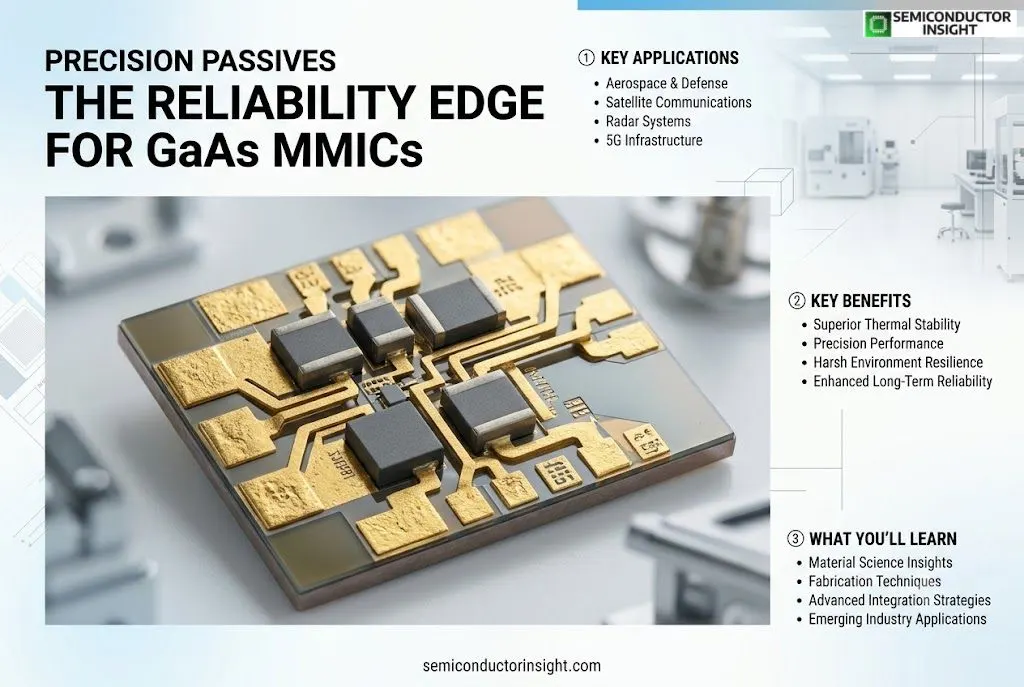
Tantalum Nitride Thin Film Capacitor Integration Advances Reshaping GaAs MMIC Reliability in Defence and Telecom
Tantalum nitride (TaN) thin film capacitors have carved out a specialized yet critical role in gallium arsenide monolithic microwave integrated circuits, or GaAs MMICs. These components deliver the precision, thermal stability, and reliability that modern high-frequency systems demand, from satellite communications to advanced radar arrays. Engineers value TaN for its ability to maintain consistent electrical properties under stress, making it a go-to material when standard options fall short in demanding environments.
The material stands out because of its self-passivating nature. When exposed to moisture or elevated temperatures, TaN forms a thin protective oxide layer that shields the underlying structure. This characteristic proves especially useful in GaAs MMICs, where thin film elements must endure temperature swings, humidity, and long operational lifetimes without drifting in performance. In practice, TaN films as thin as 50 nanometers can deliver reliable capacitance while resisting oxidation and corrosion far better than many alternatives.
Material Science behind the Reliability Edge
ü At the atomic level, tantalum nitride combines high hardness with excellent thermal conductivity reaching up to 1,100 W/mK in certain phases, nearly three times that of copper.
ü This property helps dissipate heat efficiently in compact MMIC layouts where power densities run high. Manufacturers deposit TaN through reactive sputtering or similar physical vapor deposition techniques, allowing precise control over film thickness and stoichiometry.
ü The result is a resistor or capacitor layer with low temperature coefficients of resistance (TCR), often in the range of 10 to 150 ppm/°C, and tight tolerances down to ±0.05% in production settings.
ü In GaAs processes, TaN integrates alongside metal-insulator-metal (MIM) structures and air bridges. Designers use it for bias networks, coupling elements, and decoupling functions where parasitic effects must stay minimal up to tens of GHz.
ü Its chemical inertness also prevents unwanted reactions with gold interconnects or other metals common in GaAs fabrication, supporting longer device lifetimes in space-qualified hardware.
Advanced Technology Applications Transforming Industries
Defense radar and electronic warfare platforms frequently rely on GaAs MMICs equipped with TaN-based passives. For instance, X-band transmit/receive modules in phased-array radars incorporate TaN resistors and capacitors to maintain phase and amplitude stability across temperature variations. One documented process iteration replaced earlier resistor materials with TaN to improve uniformity and contact reliability, resulting in better overall circuit yield for military applications.
Satellite communications benefit similarly. Low Earth orbit constellations operating in Ka-band use compact MMIC amplifiers and low-noise blocks where TaN thin films help manage power distribution and filtering without adding excessive size or weight. Ground-based 5G infrastructure, particularly mmWave base stations, leverages GaAs-derived front-end modules that incorporate these capacitors for signal integrity under varying environmental loads.
In research settings, teams have demonstrated TaN thin film resistors with sheet resistivities around 50 Ω/square paired with MIM capacitors reaching capacitance densities over 200 pF/mm² in GaN-on-SiC processes that share fabrication similarities with GaAs flows. These combinations support broadband performance from sub-6 GHz into millimeter waves.
Fabrication Techniques Driving Performance Improvements
Modern deposition methods allow engineers to fine-tune nitrogen content in TaN films, directly influencing resistivity and stability. Higher nitrogen ratios often yield better oxidation resistance and lower leakage in capacitor configurations. Post-deposition annealing further enhances uniformity across large wafers, critical for cost-effective MMIC production.
Integration with through-wafer vias and thick gold metallization layers creates robust vertical interconnects, reducing inductance in high-frequency paths. This matters for power amplifiers handling pulsed signals in radar, where TaN elements help stabilize bias lines and prevent oscillations.
Emerging Applications and Technology Synergies
As 5G evolves toward denser deployments and satellite mega-constellations expand, the need for reliable, high-frequency passives grows. GaAs MMICs continue serving mobile handsets, automotive radar, and point-to-point links, with TaN capacitors contributing to lower noise figures and higher linearity. Hybrid approaches combining TaN with other dielectrics, such as silicon nitride, offer designers flexibility choosing higher capacitance density where voltage breakdown allows, or superior Q-factor for RF filtering.
Ongoing work in thin-film patterning, including ion beam milling for sub-micron features, pushes boundaries for higher-density integration. This supports smaller form factors without sacrificing power handling or thermal performance.
Why These Capacitors Excel in Harsh Environments?
Military and aerospace specifications often require components to survive thousands of hours at elevated temperatures with minimal parametric drift.
TaN’s proven track record in such conditions demonstrated through biased humidity testing showing shifts under 0.05% makes it preferable over nichrome in long-life systems.
Its pulse-handling capability also aids in circuits exposed to transient events common in radar transmitters.
To Know More about the Report, You Can Freely Browse Our Latest Updated Report: https://semiconductorinsight.com/report/tantalum-nitride-thin-film-capacitor-for-gaas-mmic-market/
o Engineers are exploring stacked thin-film configurations and advanced passivation schemes to further boost volumetric efficiency.
o Compatibility with emerging heterogeneous integration platforms where GaAs MMICs pair with silicon or other compound semiconductors positions TaN-based elements as versatile building blocks.
o Continued refinement in sputtering uniformity and contact metallization will likely expand adoption into even higher millimeter-wave bands.
Tantalum nitride thin film capacitors remain a quiet enabler of progress in GaAs MMIC technology. Their unique combination of stability, precision, and robustness addresses the exacting requirements of today’s RF systems, supporting everything from battlefield awareness to global connectivity infrastructure. As frequencies climb and reliability demands intensify, these specialized components will keep delivering where it matters most.

Comments (0)