
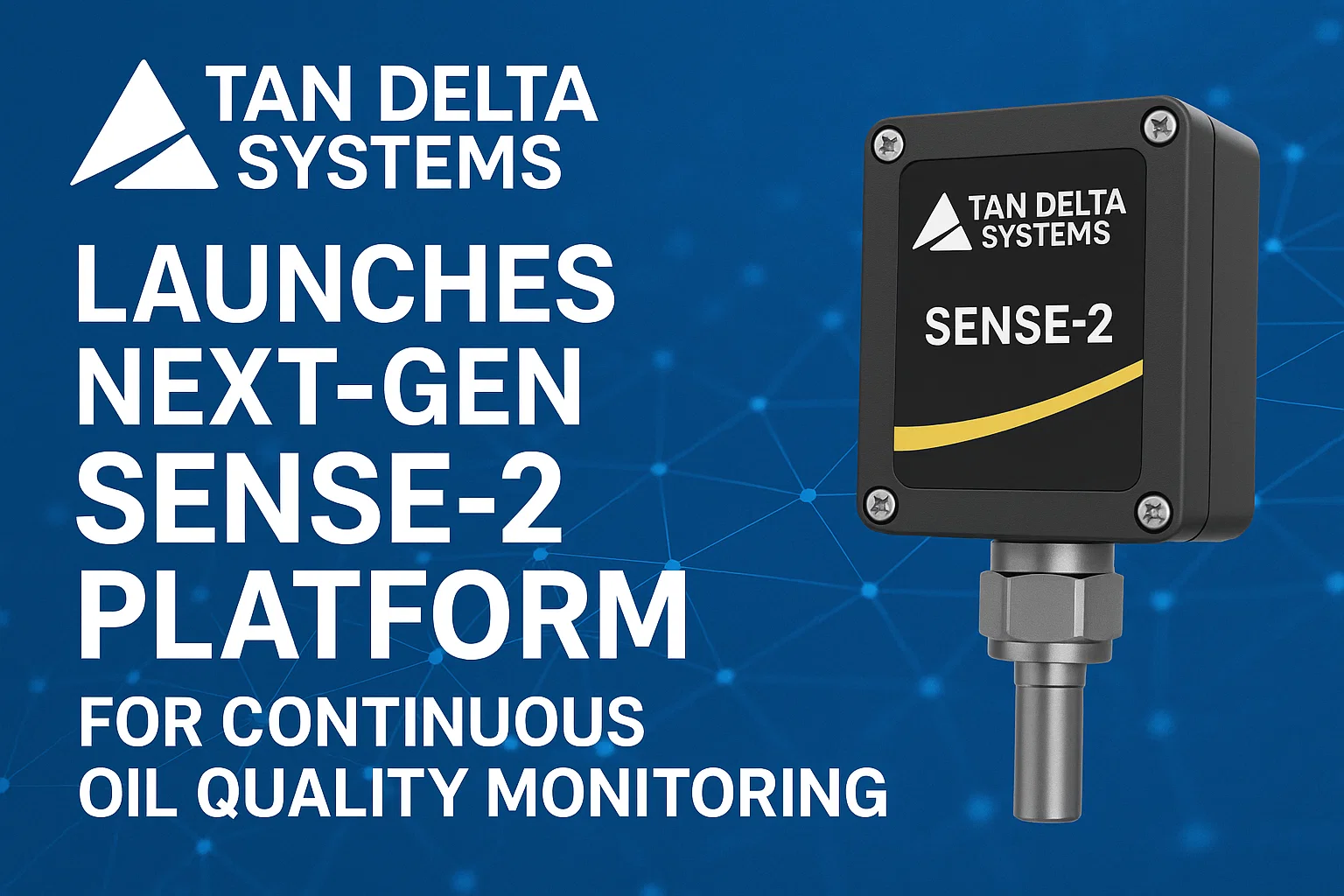
Tan Delta Systems Launches Next-Gen SENSE-2 Platform for Continuous Oil Quality Monitoring
In the world of heavy machinery, marine propulsion, automotive fleets, and industrial manufacturing, oil is more than just a lubricant it’s the lifeblood of operations. From engines and turbines to compressors and gearboxes, oil reduces friction, cools moving parts, and protects equipment from wear. However, oil degrades over time, and contaminants or wear debris can indicate early failures. Traditionally, maintenance teams relied on scheduled oil changes and periodic laboratory testing to monitor lubricant health. While effective, these methods are often reactive, time-consuming, and costly.
Enter real-time oil condition analysis sensors a new generation of smart devices capable of continuously monitoring oil quality, contamination, and wear debris without human intervention. By integrating these sensors with IoT platforms and advanced analytics, organizations can predict problems earlier, extend oil life, and improve equipment reliability.
According to the latest estimates, the global Real-Time Oil Condition Analysis Sensors market was valued at US$ 678 million in 2024 and is projected to reach US$ 1.15 billion by 2032, growing at a CAGR of 6.9% from 2025 to 2032. This impressive trajectory highlights the growing importance of predictive maintenance and digital transformation in industrial operations.
Access Your Free Sample Report- Real Time Oil Condition Analysis Sensors Market
Market Dynamics at a Glance
- Market Size (2024): US$ 678 million
- Projected Market Size (2032): US$ 1.15 billion
- CAGR (2025–2032):9%
Several factors drive this growth:
- Shift from time-based to condition-based maintenance: Companies are realizing the cost savings and operational benefits of knowing exactly when oil needs changing.
- Industrial IoT and predictive maintenance adoption: Real-time data from oil sensors feeds into cloud platforms and machine learning models.
- Environmental and regulatory pressures: Reducing oil waste and emissions by extending lubricant life is both cost-effective and eco-friendly.
- High-profile product launches and field trials: Companies like Gastops and Tan Delta Systems are pioneering new sensor technologies.
Recent Developments and Innovations
1. Gastops and Leeway Marine: Real-World Field Testing of Online Oil Monitoring Systems
One of the most striking recent developments comes from Gastops, a Canadian leader in fluid condition and wear debris monitoring, and Leeway Marine, a marine logistics company. In 2024, they conducted an extensive field trial aboard the hydrographic survey vessel RV Novus. The test ran throughout the sailing season to evaluate a prototype online fluid condition sensor system.
This system continuously measured oil contamination and wear debris in engines and gearboxes under real-world marine conditions arguably one of the harshest environments for rotating machinery. Marine engines are subjected to temperature fluctuations, vibration, saltwater exposure, and varying load cycles, making them ideal test beds for sensor durability.
Why It Matters:
- The system eliminates the need for periodic sampling and laboratory testing.
- It provides real-time alerts for contamination and wear, enabling crews to take immediate corrective action.
- Gastops plans further testing in 2025 with a more mature prototype, suggesting commercial readiness within a few years.
By successfully demonstrating this technology in the marine sector, Gastops and Leeway Marine are paving the way for adoption in offshore energy, shipping, and defense applications.
2. Tan Delta Systems Launches “SENSE-2”
Tan Delta Systems, a UK-based leader in oil condition monitoring technology, launched its new SENSE-2 platform in 2024. This system is designed as a plug-and-play solution for continuous, real-time monitoring of oil quality in industrial and mobile equipment. SENSE-2 detects molecular-level changes in oil, capturing parameters such as:
- Oxidation
- Contamination (water, particulates, fuel dilution)
- Additive depletion
- Overall oil health index
Key Benefits:
- Extended oil life: In some plants, oil change intervals have doubled (e.g., from 400 to 800 hours).
- Cost savings: Reduced oil purchases, less downtime, and fewer maintenance interventions.
- Environmental impact: Significant reduction in oil disposal and associated emissions.
Tan Delta has also targeted biogas plants as a market for SENSE-2, demonstrating its versatility beyond traditional industrial and marine sectors.
3. Integration of IoT and Edge Analytics
Both Gastops’ and Tan Delta’s systems highlight the digital transformation of maintenance. These sensors are not standalone devices; they are gateways to predictive analytics platforms. By integrating with wireless and cloud-based solutions, operators can:
- Monitor multiple assets from a central dashboard.
- Apply AI algorithms to predict future failures based on oil condition trends.
- Correlate oil condition data with vibration, temperature, and load metrics to get a holistic view of equipment health.
This convergence of real-time sensing + IoT + AI is what makes today’s oil condition analysis sensors so transformative.
4. Expansion to Harsh Environments and New Industries
Initially, real-time oil condition sensors were mostly found in stationary industrial settings. But the new wave of products is designed for harsh, mobile, and remote environments:
- Marine: As shown by the Gastops–Leeway Marine trials.
- Renewable energy plants (biogas, wind turbines): Tan Delta’s deployments show oil sensors can improve uptime in critical energy infrastructure.
- Construction and mining equipment: Mobile heavy-duty equipment can benefit enormously from on-the-go oil condition data to prevent catastrophic failures in the field.
This expansion opens up massive new market opportunities and justifies the projected 6.9% CAGR through 2032.
5. Focus on Wear Debris Monitoring
Traditional oil analysis focuses on contamination and viscosity changes. However, wear debris monitoring is emerging as one of the most valuable metrics. Metal particles in oil often precede catastrophic failures especially in gearboxes, bearings, and turbines. Gastops’ MetalSCAN technology, for example, is engineered to detect and quantify wear debris online, providing early warning long before vibration or temperature anomalies appear.
This shift represents a major upgrade in the predictive maintenance toolkit.
Download Sample Report PDF- Real Time Oil Condition Analysis Sensors Market
Deeper Insights: What’s Driving the Market
Predictive Maintenance Becoming Mainstream
The industrial world has been moving steadily from preventive maintenance (fixed intervals) to predictive maintenance (data-driven). Oil condition sensors are at the heart of this movement. By knowing precisely how oil behaves under specific loads and environmental conditions, maintenance can be performed “just in time,” maximizing equipment uptime and minimizing waste.
Environmental Regulations and Sustainability
Governments worldwide are tightening rules on industrial waste and emissions. Extending oil life not only reduces costs but also slashes the environmental footprint. For companies in shipping, aviation, and heavy manufacturing, this represents both a compliance measure and a sustainability win.
Cost Savings and ROI
Although oil condition sensors add upfront cost, they pay for themselves by reducing:
- Unplanned downtime (which can cost millions in lost production).
- Equipment replacement costs due to catastrophic failures.
- Oil purchase and disposal costs.
With the market projected to reach US$ 1.15 billion by 2032, clearly the ROI equation is compelling enough to drive adoption at scale.
Technology Trends Shaping the Future
1. Sensor Miniaturization and Multi-Parameter Monitoring
New sensors are being designed to measure multiple parameters (viscosity, dielectric constant, moisture, particle count) simultaneously. Miniaturized sensors mean they can be embedded directly into engines, gearboxes, and hydraulic systems, reducing installation complexity.
2. Optical and Spectroscopic Techniques
While many sensors rely on electrical or capacitive measurements, emerging designs use infrared spectroscopy, fluorescence, or optical scattering to detect oil degradation at the molecular level. These methods can provide a more detailed chemical fingerprint of oil condition.
3. Wireless Connectivity and Edge Processing
Modern oil condition sensors increasingly feature wireless communication (Bluetooth, Wi-Fi, LTE, or LoRa) and edge computing capabilities, enabling local data processing before transmitting only critical alerts to the cloud. This reduces bandwidth needs and increases responsiveness.
4. AI and Machine Learning for Data Interpretation
The real value of continuous data lies in trend analysis. AI algorithms can learn the “normal” operating profile of an engine or gearbox and spot subtle deviations much earlier than human observers. By fusing oil data with other sensor data, machine learning models can even estimate remaining useful life (RUL) of lubricants and components.
5. Integration with Digital Twins
Digital twins virtual models of physical assets are becoming standard in many industries. Real-time oil condition data is a key input for these digital twins, enabling highly accurate simulations of equipment health and performance.
Competitive Landscape
While market research firms provide broad overviews, recent real-world deployments highlight a few notable companies at the forefront of this technology:
- Gastops Ltd. (Canada): Specializing in wear debris and oil contamination sensors.
- Tan Delta Systems (UK): Advanced oil condition sensors with molecular-level detection.
- Parker Hannifin, Poseidon Systems, and others developing online oil analysis technologies.
The market is also seeing partnerships between sensor makers, OEMs, and fleet operators to integrate sensors into new equipment at the manufacturing stage.
Challenges and Barriers to Adoption
Despite the promising growth, some challenges remain:
- Integration Complexity: Retrofitting older equipment with new sensors may require custom engineering.
- Data Management: Continuous monitoring generates huge volumes of data companies need robust platforms to manage and analyze it.
- Upfront Costs: Smaller companies may hesitate to invest without clear ROI projections.
- Standardization: Lack of standardized data protocols can make it harder to integrate different sensor brands into unified dashboards.
However, as technology matures and costs drop, these barriers are likely to diminish.
Future Outlook (2025–2032)
The next decade will see real-time oil condition analysis sensors move from niche to mainstream, driven by:
- Predictive maintenance as a service (PMaaS): Equipment OEMs may bundle oil condition monitoring with maintenance contracts.
- Green operations and circular economy models: Companies will advertise extended oil life as part of their sustainability credentials.
- More embedded OEM solutions: Engines, gearboxes, and industrial machines will increasingly ship with built-in sensors as standard equipment.
- Artificial intelligence integration: Beyond mere alerts, systems will recommend specific actions (e.g., adjust load, change filter, or drain a portion of oil) to prolong both oil and equipment life.
By 2032, it is likely that most large-scale industrial, marine, and renewable energy operations will treat continuous oil monitoring as essential rather than optional.
Click Here To Download Full Sample Report- Real Time Oil Condition Analysis Sensors Market
Key Takeaways for Industry Stakeholders
- For Equipment Operators: Adopting real-time oil condition sensors can significantly reduce unplanned downtime and maintenance costs.
- For Sensor Manufacturers: Opportunities abound in designing rugged, multi-parameter, IoT-enabled sensors for harsh environments.
- For Investors: With a projected market size of US$ 1.15 billion by 2032, the segment offers attractive long-term growth potential.
- For Regulators: Supporting predictive maintenance technologies can help industries meet environmental targets and improve safety.
The Real-Time Oil Condition Analysis Sensors market is transitioning from an emerging niche to a core component of industrial maintenance strategies. Backed by strong demand for predictive maintenance, sustainability goals, and IoT integration, the market is set to grow from US$ 678 million in 2024 to US$ 1.15 billion by 2032 at a healthy 6.9% CAGR.

Comments (0)