Real Time Oil Condition Analysis Sensors Market, Trends, Business Strategies 2025-2032

Real Time Oil Condition Analysis Sensors Market size was valued at US$ 678 million in 2024 and is projected to reach US$ 1.15 billion by 2032, at a CAGR of 6.9% during the forecast period 2025-2032

PDF Icon Download Sample Report PDF
  • Quick Dispatch

    All Orders

  • Secure Payment

    100% Secure Payment

Price range: $1,500.00 through $4,250.00

Clear

MARKET INSIGHTS

The global Real Time Oil Condition Analysis Sensors Market size was valued at US$ 678 million in 2024 and is projected to reach US$ 1.15 billion by 2032, at a CAGR of 6.9% during the forecast period 2025-2032.

Real-time oil condition analysis sensors are advanced monitoring devices designed to continuously assess oil quality in industrial applications. These sensors employ various technologies including spectroscopy, impedance analysis, and viscosity measurement to detect contaminants, oxidation levels, and overall fluid degradation. The systems provide instant feedback through digital interfaces, enabling proactive maintenance decisions and preventing equipment failures.

The market growth is primarily driven by increasing adoption of predictive maintenance strategies across industries such as oil & gas, automotive, and power generation. Furthermore, integration with Industrial Internet of Things (IIoT) platforms has expanded their functionality through remote monitoring capabilities. Key players like Parker Hannifin and Eaton have recently launched next-generation sensors with enhanced data analytics, contributing to market expansion. The Asia-Pacific region shows particularly strong growth potential due to rapid industrialization and increasing investments in smart manufacturing technologies.
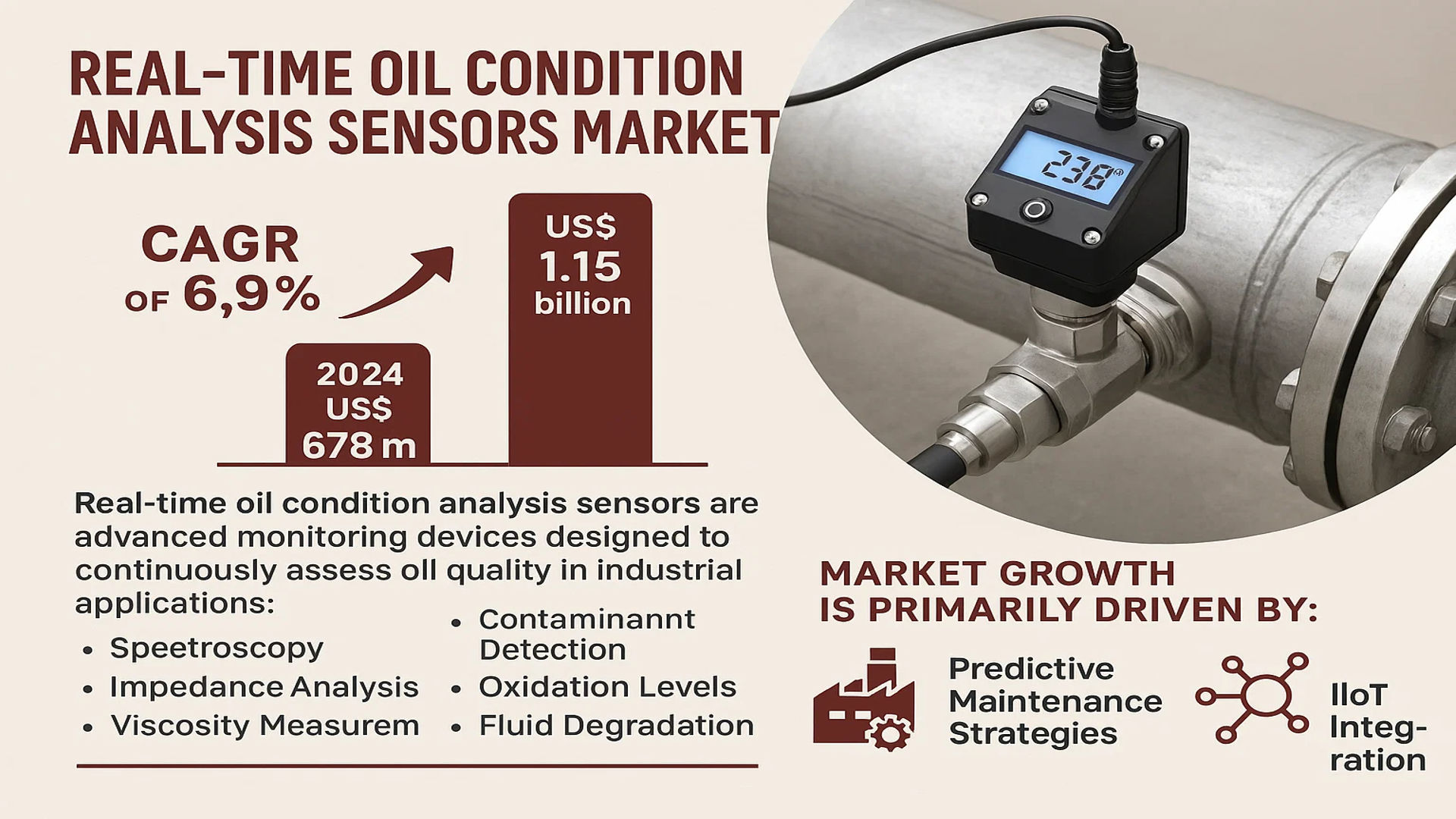
Real Time Oil Condition Analysis Sensors Market

MARKET DYNAMICS

MARKET DRIVERS

Rising Adoption of Predictive Maintenance Strategies to Fuel Market Growth

The global shift toward predictive maintenance in industrial operations is significantly driving demand for real-time oil condition analysis sensors. Industries are increasingly adopting these sensors as part of Industry 4.0 initiatives to monitor equipment health proactively. Machinery failures due to lubricant degradation cost industries billions annually, creating strong incentive for continuous monitoring solutions. Real-time oil condition analysis provides immediate feedback on parameters like viscosity, acidity, and particulate contamination, allowing maintenance teams to intervene before catastrophic failures occur.

Technological Advancements in Sensor Capabilities Expanding Market Potential

Recent breakthroughs in sensor technology are enabling more sophisticated oil condition monitoring capabilities. Modern sensors now combine multiple measurement techniques including dielectric spectroscopy, viscosity measurement, and ferrous particle detection in compact form factors. These technological improvements have increased sensor accuracy to within ±2% for key parameters while extending operational lifespans in harsh industrial environments. The integration of machine learning algorithms further enhances diagnostic capabilities by establishing baseline oil health profiles and detecting subtle degradation patterns.

Growing Industrial IoT Adoption Creating New Implementation Opportunities

The expansion of Industrial IoT infrastructure worldwide is creating significant growth opportunities for oil condition sensors. These devices are increasingly being designed with native IIoT connectivity, allowing seamless integration into digital monitoring platforms. Cloud-based analytics solutions can process data from thousands of sensors simultaneously, enabling centralized fleet monitoring. This capability is particularly valuable for industries with distributed assets like wind farms or pipeline networks where onsite oil sampling was previously impractical.

MARKET RESTRAINTS

High Initial Investment Costs Limit Adoption Among SMEs

While the long-term benefits of real-time oil monitoring are clear, the significant upfront investment required presents a barrier to widespread adoption. Complete monitoring systems including sensors, connectivity hardware, and software platforms often require capital expenditures that smaller operations find prohibitive. For many mid-sized industrial facilities, the return-on-investment period extends beyond typical budgeting horizons, delaying procurement decisions.

Technical Integration Challenges With Legacy Equipment Pose Implementation Hurdles

Retrofitting oil condition sensors to existing industrial equipment often presents technical challenges that restrain market growth. Older machinery may lack suitable mounting points or require significant modifications to accommodate modern sensor packages. In some cases, the integration process necessitates equipment downtime that operators are reluctant to schedule, particularly in continuous process industries where production interruptions are costly.

Lack of Standardized Communication Protocols Creates Integration Complexities

The absence of universal communication standards across industrial equipment manufacturers complicates sensor integration efforts. Many real-time oil condition sensors require custom interface development to communicate with existing plant control systems, adding complexity and cost to deployment projects. This fragmentation in industrial communication protocols discourages some potential adopters from implementing comprehensive monitoring solutions.

MARKET OPPORTUNITIES

Emerging Applications in Renewable Energy Sector Offer Untapped Potential

The rapid expansion of renewable energy infrastructure worldwide presents significant growth opportunities for oil condition monitoring solutions. Wind turbine gearboxes and hydroelectric generators require precise lubrication monitoring to maintain optimal performance in challenging environments. Remote monitoring capabilities are particularly valuable for offshore wind farms where accessibility limitations make traditional oil sampling impractical.

Development of Advanced Machine Learning Analytics Creates Value-Added Services

The integration of advanced artificial intelligence with oil condition monitoring systems is enabling new predictive maintenance service offerings. Machine learning algorithms can now correlate oil condition data with operational parameters to predict remaining useful life of lubricants and components. This capability allows service providers to transition from monitoring to predictive analytics, creating additional revenue streams while delivering greater value to customers.

Increasing Regulatory Focus on Environmental Protection Drives Compliance Needs

Growing environmental regulations regarding oil management and equipment emissions are prompting industries to adopt more rigorous monitoring solutions. Real-time oil condition analysis helps facilities maintain compliance with environmental standards by preventing leaks and optimizing oil change intervals. This regulatory push is particularly strong in Europe and North America, where stringent environmental policies are accelerating adoption of condition monitoring technologies.

MARKET CHALLENGES

Data Interpretation Complexity Requires Specialized Training

The sophisticated data generated by modern oil condition sensors often requires specialized expertise for proper interpretation. Many industrial facilities lack personnel trained in advanced tribology and data analytics, creating a skills gap that challenges effective utilization of monitoring systems. Without proper interpretation, the wealth of sensor data may not translate into actionable maintenance insights.

Long-Term Reliability Concerns in Harsh Operating Environments

While sensor technology has advanced significantly, concerns remain about long-term reliability in extreme operating conditions. High temperatures, vibration, and chemical exposure in industrial settings can compromise sensor performance over time. These reliability challenges are particularly acute in sectors like mining and heavy manufacturing where equipment operates under severe mechanical stress.

Competition From Conventional Oil Analysis Methods

Despite technological advances, traditional laboratory oil analysis continues to offer certain advantages that challenge sensor adoption. Conventional methods provide comprehensive testing for a wider range of contaminants and can detect some failure modes that sensors may miss. Many maintenance professionals maintain trust in established laboratory techniques, creating resistance to full transition toward real-time monitoring solutions.

REAL TIME OIL CONDITION ANALYSIS SENSORS MARKET TRENDS

Industrial Adoption of Predictive Maintenance Drives Sensor Demand

The global real-time oil condition analysis sensors market, valued at approximately $280 million in 2024, is projected to grow at a CAGR of 7.5% through 2032, reaching an estimated $480 million. A key driver is the industrial shift toward predictive maintenance strategies. By continuously monitoring oil quality parameters—including viscosity, contamination levels, and oxidation—these sensors enable early detection of equipment wear, reducing unplanned downtime by up to 45% in sectors like oil & gas and heavy machinery. This transition from reactive to proactive maintenance is particularly evident in regions with high industrial activity, such as North America and Asia-Pacific, where manufacturers prioritize operational efficiency.

Other Trends

Integration with Industrial IoT (IIoT) Platforms

The convergence of real-time oil sensors with IIoT ecosystems is transforming asset management. Modern sensors equipped with wireless connectivity transmit data to cloud-based analytics platforms, enabling remote monitoring across geographically dispersed facilities. For instance, in the power generation sector, IIoT-integrated sensors help predict transformer failures by analyzing dielectric strength trends, reducing maintenance costs by 30-40%. This trend aligns with broader Industry 4.0 adoption, where seamless data interoperability between sensors and enterprise systems enhances decision-making.

Technological Advancements Enhance Sensor Capabilities

Innovations in multi-parameter sensing are expanding market potential. Next-generation sensors now combine spectroscopic analysis, acoustic viscosity measurement, and particle counting in compact form factors. A notable example is the development of MEMS-based sensors that offer lab-grade accuracy for real-time Total Acid Number (TAN) monitoring. Such advancements address longstanding challenges in oil degradation tracking, particularly for wind turbine gearboxes where sensor reliability in harsh environments is critical. Additionally, advancements in machine learning algorithms enable these systems to provide actionable insights, such as optimal oil change intervals, further driving adoption across the automotive and marine sectors.

Regulatory Pressures Accelerate Market Penetration

Stringent environmental regulations are compelling industries to adopt oil condition monitoring solutions. For instance, ISO 4406:2021 standards for particulate contamination control in hydraulic systems have increased demand for inline particle counting sensors. Similarly, maritime operators are deploying these sensors to comply with IMO 2020 sulfur cap regulations by monitoring lubricant compatibility with low-sulfur fuels. This regulatory push, combined with growing emphasis on sustainability, positions real-time oil analysis as a compliance tool while simultaneously reducing lubricant waste by up to 25% through optimized consumption.

COMPETITIVE LANDSCAPE

Key Industry Players

Real-Time Monitoring Drives Innovation Among Oil Condition Sensor Providers

The global real-time oil condition analysis sensors market features a competitive mix of established industrial technology providers and specialized monitoring solution developers. Tan Delta Systems has emerged as a market leader, leveraging its proprietary optical sensor technology that provides continuous oil quality monitoring with high accuracy. The company holds approximately 18% of the market share in 2024, according to industry estimates, thanks to its strong presence in the oil & gas and power generation sectors.

Parker Hannifin and Eaton Corporation both maintain significant positions in the market through their comprehensive industrial sensor portfolios and global distribution networks. Their growth is powered by increasing integration of Oil Condition Monitoring (OCM) solutions into predictive maintenance programs across heavy industries. Parker’s recent acquisition of a smaller sensor technology firm in 2023 strengthened its position in marine applications, while Eaton continues to expand its IIoT-enabled sensor offerings.

Meanwhile, specialized players like Rheonics and SPM Instrument are gaining traction through technological differentiation. Rheonics’ viscosity sensors, which offer industry-leading ±1% accuracy, have become particularly popular in precision manufacturing applications. The company reported a 32% year-over-year revenue growth in 2023, highlighting the rapid adoption of advanced oil monitoring solutions.

Market competition is intensifying as companies invest heavily in sensor miniaturization, wireless connectivity, and machine learning capabilities. Recent developments include Stauff’s launch of a compact, retrofit-ready sensor module in Q1 2024 and Des-Case’s introduction of cloud-based oil analysis predictive algorithms. These innovations reflect the industry’s shift toward comprehensive condition monitoring ecosystems rather than standalone sensor products.

List of Key Real-Time Oil Condition Analysis Sensor Companies

  • Tan Delta Systems (UK)
  • Parker Hannifin Corporation (U.S.)
  • Eaton Corporation (Ireland)
  • Rheonics (Switzerland)
  • SPM Instrument International (Sweden)
  • Stauff Group (Germany)
  • Des-Case Corporation (U.S.)
  • Gill Sensors & Controls (UK)
  • CM Technologies GmbH (Germany)
  • Poseidon Systems, LLC (U.S.)

Segment Analysis:

By Type

Pollution Measurement Sensors Dominate the Market Due to Rising Demand for Contamination Detection

The market is segmented based on type into:

  • Pollution Measurement
    • Subtypes: Metal content sensors, moisture sensors, particulate sensors
  • Viscosity Measurement
  • Density Measurement
  • Others
    • Subtypes: Temperature sensors, dielectric sensors

By Application

Oil & Gas Industry Leads Market Adoption for Equipment Reliability and Maintenance Optimization

The market is segmented based on application into:

  • Oil & Gas
  • Automobile Industry
  • Ship Industry
  • Power Industry
  • Others

By Technology

Spectroscopy-Based Sensors Gain Traction for Comprehensive Oil Analysis Capabilities

The market is segmented based on technology into:

  • Spectroscopy
  • Impedance Analysis
  • Fluid Property Sensing
  • Others

By End-User

Industrial Sector Shows Strong Adoption for Predictive Maintenance Applications

The market is segmented based on end-user into:

  • Industrial Manufacturing
  • Transportation
  • Energy & Utilities
  • Others

Regional Analysis: Real Time Oil Condition Analysis Sensors Market

North America
The North American real-time oil condition analysis sensors market leads globally, driven by stringent regulatory frameworks and advanced industrial infrastructure. The U.S. dominates, accounting for over 65% of the regional market share, fueled by strong adoption in the oil & gas and automotive sectors. The shift toward predictive maintenance in manufacturing, supported by IIoT integration, is accelerating demand. Canada follows closely, with growing applications in mining and power generation, while Mexico’s market is emerging with increasing investments in industrial automation. Key players like Parker, Eaton, and HydraForce are expanding their portfolios to cater to the rising need for real-time monitoring solutions.

Europe
Europe holds a significant share of the market, with Germany, the U.K., and France at the forefront. The region’s emphasis on Industry 4.0 and sustainability is propelling demand for sensors that reduce unplanned downtime and extend equipment life. Strict EU regulations on emissions and machine efficiency further drive adoption. Nordic countries, with their robust maritime and renewable energy sectors, are increasingly deploying these sensors for offshore wind turbines and ship engines. Challenges include high costs of advanced sensors, though companies like SPM Instrument International and CM Technologies GmbH are innovating cost-competitive solutions.

Asia-Pacific
Asia-Pacific is the fastest-growing region, led by China, Japan, and India. China’s expansive manufacturing base and aggressive Industry 4.0 initiatives contribute to over 40% of regional demand. Japan’s automotive industry relies heavily on these sensors for quality control, while India’s expanding power and transportation sectors present new opportunities. Cost sensitivity remains a barrier, but local players like Yateks are gaining traction with affordable alternatives. Southeast Asian markets, particularly Indonesia and Thailand, are also adopting sensors for oil & gas and marine applications, albeit at a slower pace due to fragmented infrastructure.

South America
The South American market is nascent but shows potential, with Brazil and Argentina as primary contributors. Brazil’s oil & gas sector, particularly offshore drilling, is a key adopter of real-time oil condition monitoring. Economic volatility and limited technological penetration hinder widespread adoption, but increasing foreign investments in mining and energy are creating growth avenues. Argentina’s focus on renewable energy projects, such as wind farms, is expected to drive demand for sensor-based predictive maintenance in the coming years.

Middle East & Africa
The Middle East, particularly Saudi Arabia and the UAE, dominates the regional market, leveraging its oil & gas industry’s need for real-time monitoring. Large-scale refinery projects and government initiatives like Saudi Vision 2030 are boosting demand. Africa’s market is in early stages, with South Africa leading due to mining and power generation applications. Infrastructure limitations and budget constraints slow adoption, but partnerships with global players like Stauff and Tan Delta Systems are helping bridge the gap in technology access.

Report Scope

This market research report provides a comprehensive analysis of the global Real Time Oil Condition Analysis Sensors market, covering the forecast period 2024–2032. It offers detailed insights into market dynamics, technological advancements, competitive landscape, and key trends shaping the industry.

Key focus areas of the report include:

  • Market Size & Forecast: Historical data and future projections for revenue, unit shipments, and market value across major regions and segments.
  • Segmentation Analysis: Detailed breakdown by product type (pollution measurement, viscosity measurement, density measurement), application (oil & gas, automobile, ship, power industries), and end-user industries.
  • Regional Outlook: Insights into market performance across North America, Europe, Asia-Pacific, Latin America, and the Middle East & Africa, including country-level analysis.
  • Competitive Landscape: Profiles of leading market participants including Tan Delta Systems, Parker, Eaton, and others, covering product offerings, R&D focus, and strategic developments.
  • Technology Trends & Innovation: Assessment of emerging technologies including spectroscopy, impedance analysis, and IIoT integration in oil condition monitoring.
  • Market Drivers & Restraints: Evaluation of factors driving market growth such as predictive maintenance adoption, along with challenges including high implementation costs.
  • Stakeholder Analysis: Strategic insights for sensor manufacturers, industrial end-users, and investors regarding market opportunities.

The analysis employs primary and secondary research methods, including interviews with industry experts and data from verified sources, to ensure accuracy and reliability.

FREQUENTLY ASKED QUESTIONS:

What is the current market size of Global Real Time Oil Condition Analysis Sensors Market?

-> Real Time Oil Condition Analysis Sensors Market size was valued at US$ 678 million in 2024 and is projected to reach US$ 1.15 billion by 2032, at a CAGR of 6.9% during the forecast period 2025-2032.

Which key companies operate in this market?

-> Key players include Tan Delta Systems, Parker Hannifin, Eaton Corporation, Stauff Corporation, and SPM Instrument International, among others.

What are the key growth drivers?

-> Major growth drivers include rising adoption of predictive maintenance strategies, increasing industrial automation, and stringent regulations regarding equipment efficiency and emissions.

Which region dominates the market?

-> North America currently leads the market share (38% in 2024), while Asia-Pacific is expected to witness the fastest growth (7.9% CAGR) during 2024-2032.

What are the emerging trends?

-> Emerging trends include integration with Industrial IoT platforms, development of multi-parameter sensors, and increasing use of AI for predictive analytics in oil condition monitoring.

Real Time Oil Condition Analysis Sensors Market, Trends, Business Strategies 2025-2032

Get Sample Report PDF for Exclusive Insights

Report Sample Includes

  • Table of Contents
  • List of Tables & Figures
  • Charts, Research Methodology, and more...

PDF Icon Download Sample Report PDF
SKU: 850761ba7312
Category:

Download Sample Report

Table of Content

1 Introduction to Research & Analysis Reports
1.1 Real Time Oil Condition Analysis Sensors Market Definition
1.2 Market Segments
1.2.1 Segment by Type
1.2.2 Segment by Application
1.3 Global Real Time Oil Condition Analysis Sensors Market Overview
1.4 Features & Benefits of This Report
1.5 Methodology & Sources of Information
1.5.1 Research Methodology
1.5.2 Research Process
1.5.3 Base Year
1.5.4 Report Assumptions & Caveats
2 Global Real Time Oil Condition Analysis Sensors Overall Market Size
2.1 Global Real Time Oil Condition Analysis Sensors Market Size: 2024 VS 2032
2.2 Global Real Time Oil Condition Analysis Sensors Market Size, Prospects & Forecasts: 2020-2032
2.3 Global Real Time Oil Condition Analysis Sensors Sales: 2020-2032
3 Company Landscape
3.1 Top Real Time Oil Condition Analysis Sensors Players in Global Market
3.2 Top Global Real Time Oil Condition Analysis Sensors Companies Ranked by Revenue
3.3 Global Real Time Oil Condition Analysis Sensors Revenue by Companies
3.4 Global Real Time Oil Condition Analysis Sensors Sales by Companies
3.5 Global Real Time Oil Condition Analysis Sensors Price by Manufacturer (2020-2025)
3.6 Top 3 and Top 5 Real Time Oil Condition Analysis Sensors Companies in Global Market, by Revenue in 2024
3.7 Global Manufacturers Real Time Oil Condition Analysis Sensors Product Type
3.8 Tier 1, Tier 2, and Tier 3 Real Time Oil Condition Analysis Sensors Players in Global Market
3.8.1 List of Global Tier 1 Real Time Oil Condition Analysis Sensors Companies
3.8.2 List of Global Tier 2 and Tier 3 Real Time Oil Condition Analysis Sensors Companies
4 Sights by Product
4.1 Overview
4.1.1 Segment by Type – Global Real Time Oil Condition Analysis Sensors Market Size Markets, 2024 & 2032
4.1.2 Pollution Measurement
4.1.3 Viscosity Measurement
4.1.4 Density Measurement
4.1.5 Others
4.2 Segment by Type – Global Real Time Oil Condition Analysis Sensors Revenue & Forecasts
4.2.1 Segment by Type – Global Real Time Oil Condition Analysis Sensors Revenue, 2020-2025
4.2.2 Segment by Type – Global Real Time Oil Condition Analysis Sensors Revenue, 2026-2032
4.2.3 Segment by Type – Global Real Time Oil Condition Analysis Sensors Revenue Market Share, 2020-2032
4.3 Segment by Type – Global Real Time Oil Condition Analysis Sensors Sales & Forecasts
4.3.1 Segment by Type – Global Real Time Oil Condition Analysis Sensors Sales, 2020-2025
4.3.2 Segment by Type – Global Real Time Oil Condition Analysis Sensors Sales, 2026-2032
4.3.3 Segment by Type – Global Real Time Oil Condition Analysis Sensors Sales Market Share, 2020-2032
4.4 Segment by Type – Global Real Time Oil Condition Analysis Sensors Price (Manufacturers Selling Prices), 2020-2032
5 Sights by Application
5.1 Overview
5.1.1 Segment by Application – Global Real Time Oil Condition Analysis Sensors Market Size, 2024 & 2032
5.1.2 Oil & Gas
5.1.3 Automobile Industry
5.1.4 Ship Industry
5.1.5 Power Industry
5.1.6 Others
5.2 Segment by Application – Global Real Time Oil Condition Analysis Sensors Revenue & Forecasts
5.2.1 Segment by Application – Global Real Time Oil Condition Analysis Sensors Revenue, 2020-2025
5.2.2 Segment by Application – Global Real Time Oil Condition Analysis Sensors Revenue, 2026-2032
5.2.3 Segment by Application – Global Real Time Oil Condition Analysis Sensors Revenue Market Share, 2020-2032
5.3 Segment by Application – Global Real Time Oil Condition Analysis Sensors Sales & Forecasts
5.3.1 Segment by Application – Global Real Time Oil Condition Analysis Sensors Sales, 2020-2025
5.3.2 Segment by Application – Global Real Time Oil Condition Analysis Sensors Sales, 2026-2032
5.3.3 Segment by Application – Global Real Time Oil Condition Analysis Sensors Sales Market Share, 2020-2032
5.4 Segment by Application – Global Real Time Oil Condition Analysis Sensors Price (Manufacturers Selling Prices), 2020-2032
6 Sights by Region
6.1 By Region – Global Real Time Oil Condition Analysis Sensors Market Size, 2024 & 2032
6.2 By Region – Global Real Time Oil Condition Analysis Sensors Revenue & Forecasts
6.2.1 By Region – Global Real Time Oil Condition Analysis Sensors Revenue, 2020-2025
6.2.2 By Region – Global Real Time Oil Condition Analysis Sensors Revenue, 2026-2032
6.2.3 By Region – Global Real Time Oil Condition Analysis Sensors Revenue Market Share, 2020-2032
6.3 By Region – Global Real Time Oil Condition Analysis Sensors Sales & Forecasts
6.3.1 By Region – Global Real Time Oil Condition Analysis Sensors Sales, 2020-2025
6.3.2 By Region – Global Real Time Oil Condition Analysis Sensors Sales, 2026-2032
6.3.3 By Region – Global Real Time Oil Condition Analysis Sensors Sales Market Share, 2020-2032
6.4 North America
6.4.1 By Country – North America Real Time Oil Condition Analysis Sensors Revenue, 2020-2032
6.4.2 By Country – North America Real Time Oil Condition Analysis Sensors Sales, 2020-2032
6.4.3 United States Real Time Oil Condition Analysis Sensors Market Size, 2020-2032
6.4.4 Canada Real Time Oil Condition Analysis Sensors Market Size, 2020-2032
6.4.5 Mexico Real Time Oil Condition Analysis Sensors Market Size, 2020-2032
6.5 Europe
6.5.1 By Country – Europe Real Time Oil Condition Analysis Sensors Revenue, 2020-2032
6.5.2 By Country – Europe Real Time Oil Condition Analysis Sensors Sales, 2020-2032
6.5.3 Germany Real Time Oil Condition Analysis Sensors Market Size, 2020-2032
6.5.4 France Real Time Oil Condition Analysis Sensors Market Size, 2020-2032
6.5.5 U.K. Real Time Oil Condition Analysis Sensors Market Size, 2020-2032
6.5.6 Italy Real Time Oil Condition Analysis Sensors Market Size, 2020-2032
6.5.7 Russia Real Time Oil Condition Analysis Sensors Market Size, 2020-2032
6.5.8 Nordic Countries Real Time Oil Condition Analysis Sensors Market Size, 2020-2032
6.5.9 Benelux Real Time Oil Condition Analysis Sensors Market Size, 2020-2032
6.6 Asia
6.6.1 By Region – Asia Real Time Oil Condition Analysis Sensors Revenue, 2020-2032
6.6.2 By Region – Asia Real Time Oil Condition Analysis Sensors Sales, 2020-2032
6.6.3 China Real Time Oil Condition Analysis Sensors Market Size, 2020-2032
6.6.4 Japan Real Time Oil Condition Analysis Sensors Market Size, 2020-2032
6.6.5 South Korea Real Time Oil Condition Analysis Sensors Market Size, 2020-2032
6.6.6 Southeast Asia Real Time Oil Condition Analysis Sensors Market Size, 2020-2032
6.6.7 India Real Time Oil Condition Analysis Sensors Market Size, 2020-2032
6.7 South America
6.7.1 By Country – South America Real Time Oil Condition Analysis Sensors Revenue, 2020-2032
6.7.2 By Country – South America Real Time Oil Condition Analysis Sensors Sales, 2020-2032
6.7.3 Brazil Real Time Oil Condition Analysis Sensors Market Size, 2020-2032
6.7.4 Argentina Real Time Oil Condition Analysis Sensors Market Size, 2020-2032
6.8 Middle East & Africa
6.8.1 By Country – Middle East & Africa Real Time Oil Condition Analysis Sensors Revenue, 2020-2032
6.8.2 By Country – Middle East & Africa Real Time Oil Condition Analysis Sensors Sales, 2020-2032
6.8.3 Turkey Real Time Oil Condition Analysis Sensors Market Size, 2020-2032
6.8.4 Israel Real Time Oil Condition Analysis Sensors Market Size, 2020-2032
6.8.5 Saudi Arabia Real Time Oil Condition Analysis Sensors Market Size, 2020-2032
6.8.6 UAE Real Time Oil Condition Analysis Sensors Market Size, 2020-2032
7 Manufacturers & Brands Profiles
7.1 Tan Delta Systems
7.1.1 Tan Delta Systems Company Summary
7.1.2 Tan Delta Systems Business Overview
7.1.3 Tan Delta Systems Real Time Oil Condition Analysis Sensors Major Product Offerings
7.1.4 Tan Delta Systems Real Time Oil Condition Analysis Sensors Sales and Revenue in Global (2020-2025)
7.1.5 Tan Delta Systems Key News & Latest Developments
7.2 Stauff
7.2.1 Stauff Company Summary
7.2.2 Stauff Business Overview
7.2.3 Stauff Real Time Oil Condition Analysis Sensors Major Product Offerings
7.2.4 Stauff Real Time Oil Condition Analysis Sensors Sales and Revenue in Global (2020-2025)
7.2.5 Stauff Key News & Latest Developments
7.3 Des-Case
7.3.1 Des-Case Company Summary
7.3.2 Des-Case Business Overview
7.3.3 Des-Case Real Time Oil Condition Analysis Sensors Major Product Offerings
7.3.4 Des-Case Real Time Oil Condition Analysis Sensors Sales and Revenue in Global (2020-2025)
7.3.5 Des-Case Key News & Latest Developments
7.4 Bartech
7.4.1 Bartech Company Summary
7.4.2 Bartech Business Overview
7.4.3 Bartech Real Time Oil Condition Analysis Sensors Major Product Offerings
7.4.4 Bartech Real Time Oil Condition Analysis Sensors Sales and Revenue in Global (2020-2025)
7.4.5 Bartech Key News & Latest Developments
7.5 Rheonics
7.5.1 Rheonics Company Summary
7.5.2 Rheonics Business Overview
7.5.3 Rheonics Real Time Oil Condition Analysis Sensors Major Product Offerings
7.5.4 Rheonics Real Time Oil Condition Analysis Sensors Sales and Revenue in Global (2020-2025)
7.5.5 Rheonics Key News & Latest Developments
7.6 CM Technologies GmbH
7.6.1 CM Technologies GmbH Company Summary
7.6.2 CM Technologies GmbH Business Overview
7.6.3 CM Technologies GmbH Real Time Oil Condition Analysis Sensors Major Product Offerings
7.6.4 CM Technologies GmbH Real Time Oil Condition Analysis Sensors Sales and Revenue in Global (2020-2025)
7.6.5 CM Technologies GmbH Key News & Latest Developments
7.7 Fraunhofer IMM
7.7.1 Fraunhofer IMM Company Summary
7.7.2 Fraunhofer IMM Business Overview
7.7.3 Fraunhofer IMM Real Time Oil Condition Analysis Sensors Major Product Offerings
7.7.4 Fraunhofer IMM Real Time Oil Condition Analysis Sensors Sales and Revenue in Global (2020-2025)
7.7.5 Fraunhofer IMM Key News & Latest Developments
7.8 Eaton
7.8.1 Eaton Company Summary
7.8.2 Eaton Business Overview
7.8.3 Eaton Real Time Oil Condition Analysis Sensors Major Product Offerings
7.8.4 Eaton Real Time Oil Condition Analysis Sensors Sales and Revenue in Global (2020-2025)
7.8.5 Eaton Key News & Latest Developments
7.9 Poseidon Systems
7.9.1 Poseidon Systems Company Summary
7.9.2 Poseidon Systems Business Overview
7.9.3 Poseidon Systems Real Time Oil Condition Analysis Sensors Major Product Offerings
7.9.4 Poseidon Systems Real Time Oil Condition Analysis Sensors Sales and Revenue in Global (2020-2025)
7.9.5 Poseidon Systems Key News & Latest Developments
7.10 SPM Instrument International
7.10.1 SPM Instrument International Company Summary
7.10.2 SPM Instrument International Business Overview
7.10.3 SPM Instrument International Real Time Oil Condition Analysis Sensors Major Product Offerings
7.10.4 SPM Instrument International Real Time Oil Condition Analysis Sensors Sales and Revenue in Global (2020-2025)
7.10.5 SPM Instrument International Key News & Latest Developments
7.11 WIKA-TECH
7.11.1 WIKA-TECH Company Summary
7.11.2 WIKA-TECH Business Overview
7.11.3 WIKA-TECH Real Time Oil Condition Analysis Sensors Major Product Offerings
7.11.4 WIKA-TECH Real Time Oil Condition Analysis Sensors Sales and Revenue in Global (2020-2025)
7.11.5 WIKA-TECH Key News & Latest Developments
7.12 Parker
7.12.1 Parker Company Summary
7.12.2 Parker Business Overview
7.12.3 Parker Real Time Oil Condition Analysis Sensors Major Product Offerings
7.12.4 Parker Real Time Oil Condition Analysis Sensors Sales and Revenue in Global (2020-2025)
7.12.5 Parker Key News & Latest Developments
7.13 HydraForce
7.13.1 HydraForce Company Summary
7.13.2 HydraForce Business Overview
7.13.3 HydraForce Real Time Oil Condition Analysis Sensors Major Product Offerings
7.13.4 HydraForce Real Time Oil Condition Analysis Sensors Sales and Revenue in Global (2020-2025)
7.13.5 HydraForce Key News & Latest Developments
7.14 Gill Sensors & Controls
7.14.1 Gill Sensors & Controls Company Summary
7.14.2 Gill Sensors & Controls Business Overview
7.14.3 Gill Sensors & Controls Real Time Oil Condition Analysis Sensors Major Product Offerings
7.14.4 Gill Sensors & Controls Real Time Oil Condition Analysis Sensors Sales and Revenue in Global (2020-2025)
7.14.5 Gill Sensors & Controls Key News & Latest Developments
7.15 Yateks
7.15.1 Yateks Company Summary
7.15.2 Yateks Business Overview
7.15.3 Yateks Real Time Oil Condition Analysis Sensors Major Product Offerings
7.15.4 Yateks Real Time Oil Condition Analysis Sensors Sales and Revenue in Global (2020-2025)
7.15.5 Yateks Key News & Latest Developments
8 Global Real Time Oil Condition Analysis Sensors Production Capacity, Analysis
8.1 Global Real Time Oil Condition Analysis Sensors Production Capacity, 2020-2032
8.2 Real Time Oil Condition Analysis Sensors Production Capacity of Key Manufacturers in Global Market
8.3 Global Real Time Oil Condition Analysis Sensors Production by Region
9 Key Market Trends, Opportunity, Drivers and Restraints
9.1 Market Opportunities & Trends
9.2 Market Drivers
9.3 Market Restraints
10 Real Time Oil Condition Analysis Sensors Supply Chain Analysis
10.1 Real Time Oil Condition Analysis Sensors Industry Value Chain
10.2 Real Time Oil Condition Analysis Sensors Upstream Market
10.3 Real Time Oil Condition Analysis Sensors Downstream and Clients
10.4 Marketing Channels Analysis
10.4.1 Marketing Channels
10.4.2 Real Time Oil Condition Analysis Sensors Distributors and Sales Agents in Global
11 Conclusion
12 Appendix
12.1 Note
12.2 Examples of Clients
12.3 DisclaimerList of Tables
Table 1. Key Players of Real Time Oil Condition Analysis Sensors in Global Market
Table 2. Top Real Time Oil Condition Analysis Sensors Players in Global Market, Ranking by Revenue (2024)
Table 3. Global Real Time Oil Condition Analysis Sensors Revenue by Companies, (US$, Mn), 2020-2025
Table 4. Global Real Time Oil Condition Analysis Sensors Revenue Share by Companies, 2020-2025
Table 5. Global Real Time Oil Condition Analysis Sensors Sales by Companies, (K Units), 2020-2025
Table 6. Global Real Time Oil Condition Analysis Sensors Sales Share by Companies, 2020-2025
Table 7. Key Manufacturers Real Time Oil Condition Analysis Sensors Price (2020-2025) & (US$/Unit)
Table 8. Global Manufacturers Real Time Oil Condition Analysis Sensors Product Type
Table 9. List of Global Tier 1 Real Time Oil Condition Analysis Sensors Companies, Revenue (US$, Mn) in 2024 and Market Share
Table 10. List of Global Tier 2 and Tier 3 Real Time Oil Condition Analysis Sensors Companies, Revenue (US$, Mn) in 2024 and Market Share
Table 11. Segment by Type – Global Real Time Oil Condition Analysis Sensors Revenue, (US$, Mn), 2024 & 2032
Table 12. Segment by Type – Global Real Time Oil Condition Analysis Sensors Revenue (US$, Mn), 2020-2025
Table 13. Segment by Type – Global Real Time Oil Condition Analysis Sensors Revenue (US$, Mn), 2026-2032
Table 14. Segment by Type – Global Real Time Oil Condition Analysis Sensors Sales (K Units), 2020-2025
Table 15. Segment by Type – Global Real Time Oil Condition Analysis Sensors Sales (K Units), 2026-2032
Table 16. Segment by Application – Global Real Time Oil Condition Analysis Sensors Revenue, (US$, Mn), 2024 & 2032
Table 17. Segment by Application – Global Real Time Oil Condition Analysis Sensors Revenue, (US$, Mn), 2020-2025
Table 18. Segment by Application – Global Real Time Oil Condition Analysis Sensors Revenue, (US$, Mn), 2026-2032
Table 19. Segment by Application – Global Real Time Oil Condition Analysis Sensors Sales, (K Units), 2020-2025
Table 20. Segment by Application – Global Real Time Oil Condition Analysis Sensors Sales, (K Units), 2026-2032
Table 21. By Region – Global Real Time Oil Condition Analysis Sensors Revenue, (US$, Mn), 2025-2032
Table 22. By Region – Global Real Time Oil Condition Analysis Sensors Revenue, (US$, Mn), 2020-2025
Table 23. By Region – Global Real Time Oil Condition Analysis Sensors Revenue, (US$, Mn), 2026-2032
Table 24. By Region – Global Real Time Oil Condition Analysis Sensors Sales, (K Units), 2020-2025
Table 25. By Region – Global Real Time Oil Condition Analysis Sensors Sales, (K Units), 2026-2032
Table 26. By Country – North America Real Time Oil Condition Analysis Sensors Revenue, (US$, Mn), 2020-2025
Table 27. By Country – North America Real Time Oil Condition Analysis Sensors Revenue, (US$, Mn), 2026-2032
Table 28. By Country – North America Real Time Oil Condition Analysis Sensors Sales, (K Units), 2020-2025
Table 29. By Country – North America Real Time Oil Condition Analysis Sensors Sales, (K Units), 2026-2032
Table 30. By Country – Europe Real Time Oil Condition Analysis Sensors Revenue, (US$, Mn), 2020-2025
Table 31. By Country – Europe Real Time Oil Condition Analysis Sensors Revenue, (US$, Mn), 2026-2032
Table 32. By Country – Europe Real Time Oil Condition Analysis Sensors Sales, (K Units), 2020-2025
Table 33. By Country – Europe Real Time Oil Condition Analysis Sensors Sales, (K Units), 2026-2032
Table 34. By Region – Asia Real Time Oil Condition Analysis Sensors Revenue, (US$, Mn), 2020-2025
Table 35. By Region – Asia Real Time Oil Condition Analysis Sensors Revenue, (US$, Mn), 2026-2032
Table 36. By Region – Asia Real Time Oil Condition Analysis Sensors Sales, (K Units), 2020-2025
Table 37. By Region – Asia Real Time Oil Condition Analysis Sensors Sales, (K Units), 2026-2032
Table 38. By Country – South America Real Time Oil Condition Analysis Sensors Revenue, (US$, Mn), 2020-2025
Table 39. By Country – South America Real Time Oil Condition Analysis Sensors Revenue, (US$, Mn), 2026-2032
Table 40. By Country – South America Real Time Oil Condition Analysis Sensors Sales, (K Units), 2020-2025
Table 41. By Country – South America Real Time Oil Condition Analysis Sensors Sales, (K Units), 2026-2032
Table 42. By Country – Middle East & Africa Real Time Oil Condition Analysis Sensors Revenue, (US$, Mn), 2020-2025
Table 43. By Country – Middle East & Africa Real Time Oil Condition Analysis Sensors Revenue, (US$, Mn), 2026-2032
Table 44. By Country – Middle East & Africa Real Time Oil Condition Analysis Sensors Sales, (K Units), 2020-2025
Table 45. By Country – Middle East & Africa Real Time Oil Condition Analysis Sensors Sales, (K Units), 2026-2032
Table 46. Tan Delta Systems Company Summary
Table 47. Tan Delta Systems Real Time Oil Condition Analysis Sensors Product Offerings
Table 48. Tan Delta Systems Real Time Oil Condition Analysis Sensors Sales (K Units), Revenue (US$, Mn) and Average Price (US$/Unit) & (2020-2025)
Table 49. Tan Delta Systems Key News & Latest Developments
Table 50. Stauff Company Summary
Table 51. Stauff Real Time Oil Condition Analysis Sensors Product Offerings
Table 52. Stauff Real Time Oil Condition Analysis Sensors Sales (K Units), Revenue (US$, Mn) and Average Price (US$/Unit) & (2020-2025)
Table 53. Stauff Key News & Latest Developments
Table 54. Des-Case Company Summary
Table 55. Des-Case Real Time Oil Condition Analysis Sensors Product Offerings
Table 56. Des-Case Real Time Oil Condition Analysis Sensors Sales (K Units), Revenue (US$, Mn) and Average Price (US$/Unit) & (2020-2025)
Table 57. Des-Case Key News & Latest Developments
Table 58. Bartech Company Summary
Table 59. Bartech Real Time Oil Condition Analysis Sensors Product Offerings
Table 60. Bartech Real Time Oil Condition Analysis Sensors Sales (K Units), Revenue (US$, Mn) and Average Price (US$/Unit) & (2020-2025)
Table 61. Bartech Key News & Latest Developments
Table 62. Rheonics Company Summary
Table 63. Rheonics Real Time Oil Condition Analysis Sensors Product Offerings
Table 64. Rheonics Real Time Oil Condition Analysis Sensors Sales (K Units), Revenue (US$, Mn) and Average Price (US$/Unit) & (2020-2025)
Table 65. Rheonics Key News & Latest Developments
Table 66. CM Technologies GmbH Company Summary
Table 67. CM Technologies GmbH Real Time Oil Condition Analysis Sensors Product Offerings
Table 68. CM Technologies GmbH Real Time Oil Condition Analysis Sensors Sales (K Units), Revenue (US$, Mn) and Average Price (US$/Unit) & (2020-2025)
Table 69. CM Technologies GmbH Key News & Latest Developments
Table 70. Fraunhofer IMM Company Summary
Table 71. Fraunhofer IMM Real Time Oil Condition Analysis Sensors Product Offerings
Table 72. Fraunhofer IMM Real Time Oil Condition Analysis Sensors Sales (K Units), Revenue (US$, Mn) and Average Price (US$/Unit) & (2020-2025)
Table 73. Fraunhofer IMM Key News & Latest Developments
Table 74. Eaton Company Summary
Table 75. Eaton Real Time Oil Condition Analysis Sensors Product Offerings
Table 76. Eaton Real Time Oil Condition Analysis Sensors Sales (K Units), Revenue (US$, Mn) and Average Price (US$/Unit) & (2020-2025)
Table 77. Eaton Key News & Latest Developments
Table 78. Poseidon Systems Company Summary
Table 79. Poseidon Systems Real Time Oil Condition Analysis Sensors Product Offerings
Table 80. Poseidon Systems Real Time Oil Condition Analysis Sensors Sales (K Units), Revenue (US$, Mn) and Average Price (US$/Unit) & (2020-2025)
Table 81. Poseidon Systems Key News & Latest Developments
Table 82. SPM Instrument International Company Summary
Table 83. SPM Instrument International Real Time Oil Condition Analysis Sensors Product Offerings
Table 84. SPM Instrument International Real Time Oil Condition Analysis Sensors Sales (K Units), Revenue (US$, Mn) and Average Price (US$/Unit) & (2020-2025)
Table 85. SPM Instrument International Key News & Latest Developments
Table 86. WIKA-TECH Company Summary
Table 87. WIKA-TECH Real Time Oil Condition Analysis Sensors Product Offerings
Table 88. WIKA-TECH Real Time Oil Condition Analysis Sensors Sales (K Units), Revenue (US$, Mn) and Average Price (US$/Unit) & (2020-2025)
Table 89. WIKA-TECH Key News & Latest Developments
Table 90. Parker Company Summary
Table 91. Parker Real Time Oil Condition Analysis Sensors Product Offerings
Table 92. Parker Real Time Oil Condition Analysis Sensors Sales (K Units), Revenue (US$, Mn) and Average Price (US$/Unit) & (2020-2025)
Table 93. Parker Key News & Latest Developments
Table 94. HydraForce Company Summary
Table 95. HydraForce Real Time Oil Condition Analysis Sensors Product Offerings
Table 96. HydraForce Real Time Oil Condition Analysis Sensors Sales (K Units), Revenue (US$, Mn) and Average Price (US$/Unit) & (2020-2025)
Table 97. HydraForce Key News & Latest Developments
Table 98. Gill Sensors & Controls Company Summary
Table 99. Gill Sensors & Controls Real Time Oil Condition Analysis Sensors Product Offerings
Table 100. Gill Sensors & Controls Real Time Oil Condition Analysis Sensors Sales (K Units), Revenue (US$, Mn) and Average Price (US$/Unit) & (2020-2025)
Table 101. Gill Sensors & Controls Key News & Latest Developments
Table 102. Yateks Company Summary
Table 103. Yateks Real Time Oil Condition Analysis Sensors Product Offerings
Table 104. Yateks Real Time Oil Condition Analysis Sensors Sales (K Units), Revenue (US$, Mn) and Average Price (US$/Unit) & (2020-2025)
Table 105. Yateks Key News & Latest Developments
Table 106. Real Time Oil Condition Analysis Sensors Capacity of Key Manufacturers in Global Market, 2023-2025 (K Units)
Table 107. Global Real Time Oil Condition Analysis Sensors Capacity Market Share of Key Manufacturers, 2023-2025
Table 108. Global Real Time Oil Condition Analysis Sensors Production by Region, 2020-2025 (K Units)
Table 109. Global Real Time Oil Condition Analysis Sensors Production by Region, 2026-2032 (K Units)
Table 110. Real Time Oil Condition Analysis Sensors Market Opportunities & Trends in Global Market
Table 111. Real Time Oil Condition Analysis Sensors Market Drivers in Global Market
Table 112. Real Time Oil Condition Analysis Sensors Market Restraints in Global Market
Table 113. Real Time Oil Condition Analysis Sensors Raw Materials
Table 114. Real Time Oil Condition Analysis Sensors Raw Materials Suppliers in Global Market
Table 115. Typical Real Time Oil Condition Analysis Sensors Downstream
Table 116. Real Time Oil Condition Analysis Sensors Downstream Clients in Global Market
Table 117. Real Time Oil Condition Analysis Sensors Distributors and Sales Agents in Global Market

List of Figures
Figure 1. Real Time Oil Condition Analysis Sensors Product Picture
Figure 2. Real Time Oil Condition Analysis Sensors Segment by Type in 2024
Figure 3. Real Time Oil Condition Analysis Sensors Segment by Application in 2024
Figure 4. Global Real Time Oil Condition Analysis Sensors Market Overview: 2024
Figure 5. Key Caveats
Figure 6. Global Real Time Oil Condition Analysis Sensors Market Size: 2024 VS 2032 (US$, Mn)
Figure 7. Global Real Time Oil Condition Analysis Sensors Revenue: 2020-2032 (US$, Mn)
Figure 8. Real Time Oil Condition Analysis Sensors Sales in Global Market: 2020-2032 (K Units)
Figure 9. The Top 3 and 5 Players Market Share by Real Time Oil Condition Analysis Sensors Revenue in 2024
Figure 10. Segment by Type – Global Real Time Oil Condition Analysis Sensors Revenue, (US$, Mn), 2024 & 2032
Figure 11. Segment by Type – Global Real Time Oil Condition Analysis Sensors Revenue Market Share, 2020-2032
Figure 12. Segment by Type – Global Real Time Oil Condition Analysis Sensors Sales Market Share, 2020-2032
Figure 13. Segment by Type – Global Real Time Oil Condition Analysis Sensors Price (US$/Unit), 2020-2032
Figure 14. Segment by Application – Global Real Time Oil Condition Analysis Sensors Revenue, (US$, Mn), 2024 & 2032
Figure 15. Segment by Application – Global Real Time Oil Condition Analysis Sensors Revenue Market Share, 2020-2032
Figure 16. Segment by Application – Global Real Time Oil Condition Analysis Sensors Sales Market Share, 2020-2032
Figure 17. Segment by Application -Global Real Time Oil Condition Analysis Sensors Price (US$/Unit), 2020-2032
Figure 18. By Region – Global Real Time Oil Condition Analysis Sensors Revenue, (US$, Mn), 2025 & 2032
Figure 19. By Region – Global Real Time Oil Condition Analysis Sensors Revenue Market Share, 2020 VS 2024 VS 2032
Figure 20. By Region – Global Real Time Oil Condition Analysis Sensors Revenue Market Share, 2020-2032
Figure 21. By Region – Global Real Time Oil Condition Analysis Sensors Sales Market Share, 2020-2032
Figure 22. By Country – North America Real Time Oil Condition Analysis Sensors Revenue Market Share, 2020-2032
Figure 23. By Country – North America Real Time Oil Condition Analysis Sensors Sales Market Share, 2020-2032
Figure 24. United States Real Time Oil Condition Analysis Sensors Revenue, (US$, Mn), 2020-2032
Figure 25. Canada Real Time Oil Condition Analysis Sensors Revenue, (US$, Mn), 2020-2032
Figure 26. Mexico Real Time Oil Condition Analysis Sensors Revenue, (US$, Mn), 2020-2032
Figure 27. By Country – Europe Real Time Oil Condition Analysis Sensors Revenue Market Share, 2020-2032
Figure 28. By Country – Europe Real Time Oil Condition Analysis Sensors Sales Market Share, 2020-2032
Figure 29. Germany Real Time Oil Condition Analysis Sensors Revenue, (US$, Mn), 2020-2032
Figure 30. France Real Time Oil Condition Analysis Sensors Revenue, (US$, Mn), 2020-2032
Figure 31. U.K. Real Time Oil Condition Analysis Sensors Revenue, (US$, Mn), 2020-2032
Figure 32. Italy Real Time Oil Condition Analysis Sensors Revenue, (US$, Mn), 2020-2032
Figure 33. Russia Real Time Oil Condition Analysis Sensors Revenue, (US$, Mn), 2020-2032
Figure 34. Nordic Countries Real Time Oil Condition Analysis Sensors Revenue, (US$, Mn), 2020-2032
Figure 35. Benelux Real Time Oil Condition Analysis Sensors Revenue, (US$, Mn), 2020-2032
Figure 36. By Region – Asia Real Time Oil Condition Analysis Sensors Revenue Market Share, 2020-2032
Figure 37. By Region – Asia Real Time Oil Condition Analysis Sensors Sales Market Share, 2020-2032
Figure 38. China Real Time Oil Condition Analysis Sensors Revenue, (US$, Mn), 2020-2032
Figure 39. Japan Real Time Oil Condition Analysis Sensors Revenue, (US$, Mn), 2020-2032
Figure 40. South Korea Real Time Oil Condition Analysis Sensors Revenue, (US$, Mn), 2020-2032
Figure 41. Southeast Asia Real Time Oil Condition Analysis Sensors Revenue, (US$, Mn), 2020-2032
Figure 42. India Real Time Oil Condition Analysis Sensors Revenue, (US$, Mn), 2020-2032
Figure 43. By Country – South America Real Time Oil Condition Analysis Sensors Revenue Market Share, 2020-2032
Figure 44. By Country – South America Real Time Oil Condition Analysis Sensors Sales, Market Share, 2020-2032
Figure 45. Brazil Real Time Oil Condition Analysis Sensors Revenue, (US$, Mn), 2020-2032
Figure 46. Argentina Real Time Oil Condition Analysis Sensors Revenue, (US$, Mn), 2020-2032
Figure 47. By Country – Middle East & Africa Real Time Oil Condition Analysis Sensors Revenue, Market Share, 2020-2032
Figure 48. By Country – Middle East & Africa Real Time Oil Condition Analysis Sensors Sales, Market Share, 2020-2032
Figure 49. Turkey Real Time Oil Condition Analysis Sensors Revenue, (US$, Mn), 2020-2032
Figure 50. Israel Real Time Oil Condition Analysis Sensors Revenue, (US$, Mn), 2020-2032
Figure 51. Saudi Arabia Real Time Oil Condition Analysis Sensors Revenue, (US$, Mn), 2020-2032
Figure 52. UAE Real Time Oil Condition Analysis Sensors Revenue, (US$, Mn), 2020-2032
Figure 53. Global Real Time Oil Condition Analysis Sensors Production Capacity (K Units), 2020-2032
Figure 54. The Percentage of Production Real Time Oil Condition Analysis Sensors by Region, 2024 VS 2032
Figure 55. Real Time Oil Condition Analysis Sensors Industry Value Chain
Figure 56. Marketing Channels
