
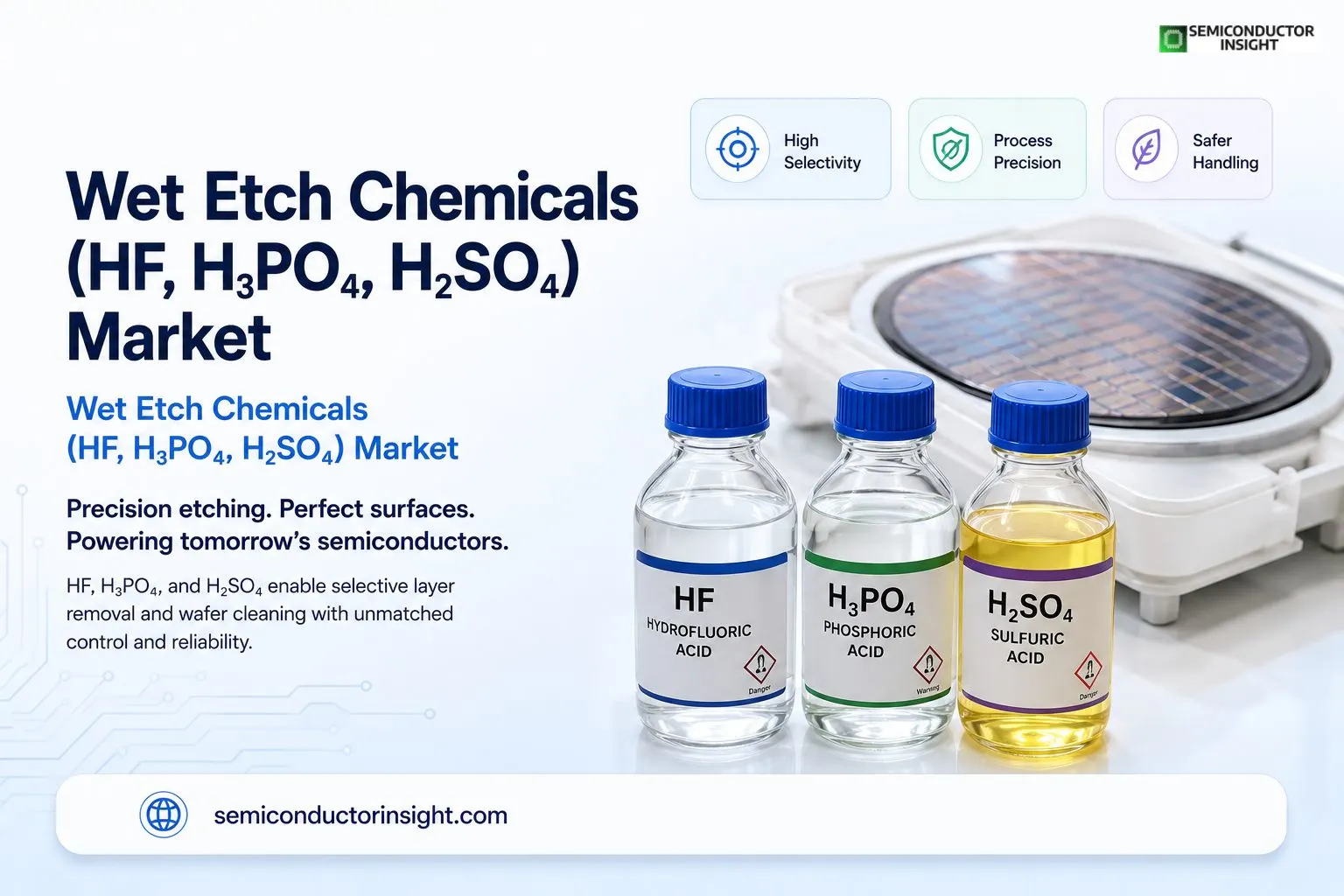
Surface Preparation Excellence Featured in the Wet Etch Chemicals (HF, H3PO4, H2SO4) Market
Wet etching remains a foundational step in semiconductor fabrication where liquid chemicals precisely remove targeted material layers from silicon wafers. Manufacturers immerse or spray wafers with solutions containing hydrofluoric acid (HF), phosphoric acid (H3PO4), and sulfuric acid (H2SO4) to create intricate patterns essential for transistors and interconnects. These processes complement lithography by dissolving unprotected areas while leaving masked regions intact.
Core Chemical Roles in Layer Removal
- Hydrofluoric acid excels at etching silicon dioxide layers. Buffered versions mixed with ammonium fluoride provide controlled removal of oxide films, creating openings for contacts or cleaning surfaces before new depositions. Its high selectivity toward oxide over silicon makes it valuable for delicate structures.
- Phosphoric acid, typically used hot at 150-180°C in concentrations around 85%, selectively removes silicon nitride films. This step proves critical during device isolation or gate formation, as it attacks nitride while largely sparing underlying oxide and silicon. Engineers appreciate its more uniform etch behavior compared to more aggressive alternatives.
- Sulfuric acid often pairs with hydrogen peroxide in Piranha solutions for organic residue removal or combines in mixtures for silicon etching. Its strong dehydrating properties help strip photoresist and clean wafers thoroughly between process steps.
Selectivity Principles Guiding Process Design
Engineers design etchant mixtures to exploit differences in chemical reactivity. For instance, hot phosphoric acid etches silicon nitride at rates far higher than silicon dioxide, enabling precise stop layers. HF-based solutions target oxides with minimal impact on silicon substrates when concentrations and exposure times stay tightly controlled. These properties allow fabrication of complex three-dimensional structures in modern chips.
In compound semiconductor work, such as gallium arsenide or indium phosphide devices, mixtures involving sulfuric acid and hydrogen peroxide help define mesas or remove specific layers with high precision.
Want to learn more about the report? Check out our latest updated version for free: https://semiconductorinsight.com/report/wet-etch-chemicals-hf-hpo-hso-market/
Process Precision and Safety Control in Advanced Wet Etching
Temperature stability and chemical concentration management play a decisive role in modern wet etching performance across semiconductor fabrication facilities. Heated phosphoric acid baths are commonly maintained at elevated temperatures to enable efficient silicon nitride removal while preserving high selectivity against surrounding materials. Uniform thermal distribution throughout the wafer batch is essential for minimizing pattern variation and ensuring consistent etch depth across advanced device architectures. Similarly, hydrofluoric acid solutions are carefully formulated in varying dilution ranges depending on process requirements, from highly dilute mixtures used for sensitive surface cleaning to stronger concentrations designed for rapid oxide removal.
Alongside process optimization, semiconductor fabs enforce rigorous safety and chemical handling protocols due to the highly corrosive and hazardous nature of wet etch materials. Hydrofluoric acid demands especially strict controls because of its ability to penetrate tissue and chemically interact with calcium within the body, requiring specialized emergency response measures including calcium gluconate treatment procedures. To minimize exposure risks and maintain contamination-free manufacturing environments, facilities increasingly rely on automated chemical delivery systems, enclosed wet benches, advanced ventilation infrastructure, and multilayer protective equipment integrated directly into cleanroom operations.
- Integration with Broader Fabrication Flows
Wet etch steps occur at multiple points in the manufacturing sequence. After deposition or implantation, wafers often undergo cleaning or patterning using these acids before moving to dry etch or further lithography. In advanced nodes, wet processes help smooth surfaces or remove damaged layers created during plasma etching. They also support backside thinning and via formation in certain packaging flows.
University cleanroom resources, such as those at Michigan or UCSB, document detailed recipes showing how labs balance etch rates with material compatibility across various substrates.
- Evolving Process Controls and Uniformity
Single-wafer tools now complement traditional batch immersion systems, offering better control over chemical dispensing, rotation, and rinsing. Pre-heated mixtures of phosphoric and sulfuric acid enable faster, more uniform nitride etching in these platforms. Real-time monitoring helps adjust parameters dynamically to reduce defects across increasingly large wafers.
Environmental Considerations in Chemical Management
Semiconductor plants implement advanced treatment systems to handle spent acids and neutralize emissions. Regulations emphasize capture and proper disposal of fluoride-containing wastes and acidic gases. Facilities continuously refine recycling and abatement methods to minimize environmental impact while maintaining process purity.
These wet etch chemicals continue supporting the industry’s push toward smaller, more powerful devices. Their versatility in selective removal, surface preparation, and cleaning ensures they remain integral to both established and cutting-edge semiconductor production lines around the globe.

Comments (0)