
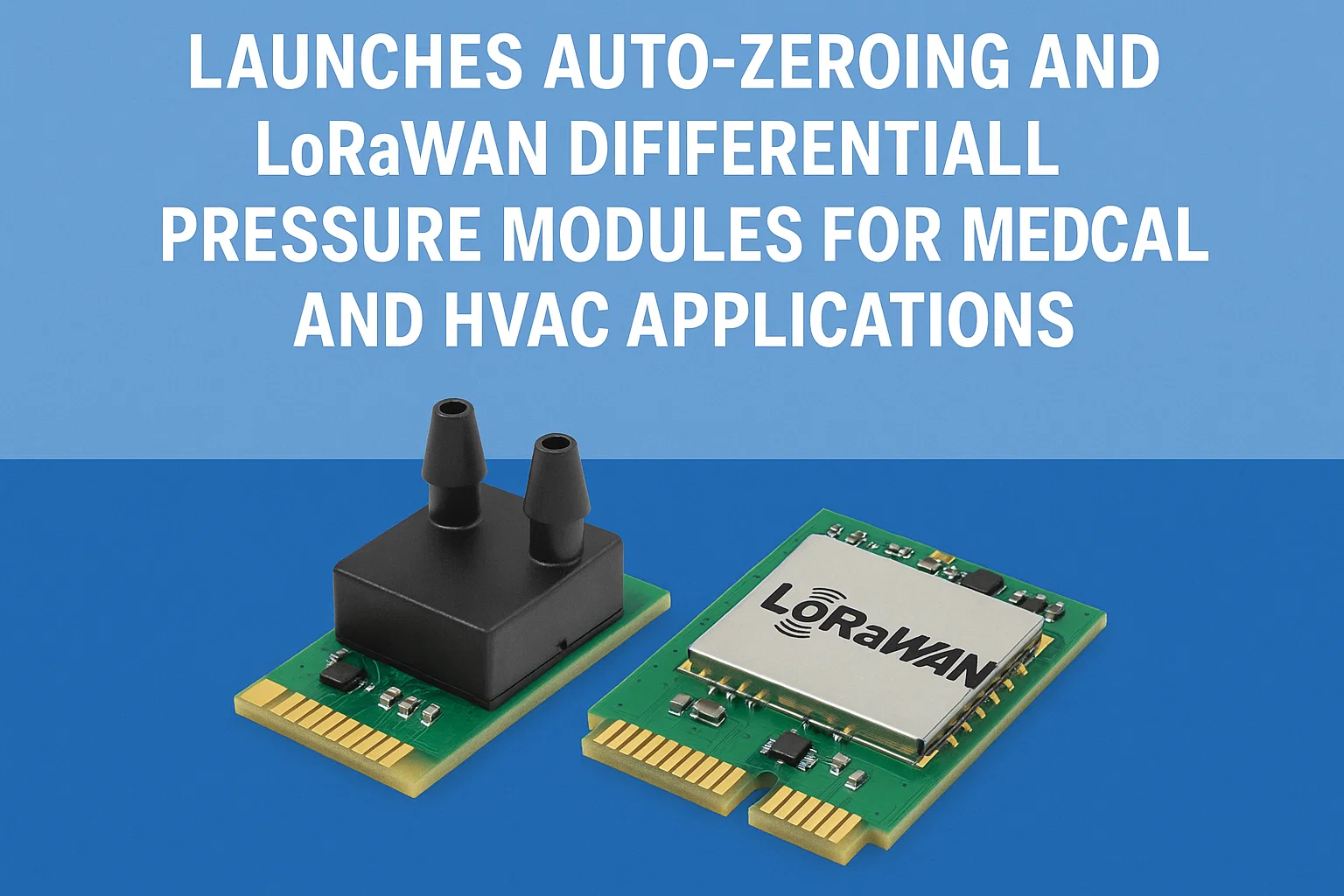
Superior Sensor Technology Launches Auto-Zeroing and LoRaWAN Differential Pressure Modules for Medical and HVAC Applications
In today’s world, where precision sensing underpins everything from life-saving medical devices to next-generation electric vehicles and smart buildings, MEMS (Micro-Electro-Mechanical Systems) micro differential pressure sensors have emerged as a critical technology. These tiny yet powerful devices measure pressure differences across membranes or flow paths, enabling accurate control of processes in healthcare, automotive, HVAC, IoT, and industrial systems.
The global MEMS Micro Differential Pressure Sensor Market was valued at USD 851 million in 2024 and is projected to reach USD 1,334 million by 2032, growing at a CAGR of 6.7% during the forecast period. This growth trajectory reflects the rising demand for miniaturized, low-power, and highly sensitive pressure sensing solutions across industries undergoing rapid digital transformation.
Access Your Free Sample Report- MEMS Micro Differential Pressure Sensor Market
What Are MEMS Micro Differential Pressure Sensors?
Before delving into the latest developments, it’s worth clarifying what makes MEMS micro differential pressure sensors unique.
- MEMS technology: MEMS sensors are fabricated using microfabrication techniques, allowing miniaturization of pressure-sensing elements on silicon chips.
- Differential sensing: Instead of measuring absolute pressure, differential pressure sensors detect the difference between two pressure inputs — an essential function in applications such as airflow monitoring, HVAC duct balancing, respiratory devices, and industrial fluid dynamics.
- Advantages: Small size, low power consumption, scalability for mass production, high sensitivity, and compatibility with digital signal processing make MEMS-based differential sensors highly attractive in modern systems.
Market Outlook: Growth Drivers and Projections
The strong CAGR of 6.7% between 2024 and 2032 is backed by multiple drivers:
- Healthcare applications: MEMS differential pressure sensors are crucial in ventilators, CPAP machines for sleep apnea, anesthesia monitoring, and other medical equipment requiring precise airflow measurement.
- Automotive transformation: EVs and hybrid vehicles demand reliable sensors for battery cooling, HVAC systems, and fluid control, with MEMS sensors fitting the bill due to their robustness and compactness.
- Smart buildings & HVAC: As energy efficiency and indoor air quality gain attention, MEMS differential pressure sensors play a central role in airflow monitoring and filter maintenance systems.
- IoT & wireless integration: The rise of smart devices and wireless networks (e.g., LoRaWAN) creates new demand for connected, ultra-low power differential pressure sensing modules.
- Industrial automation: Precise fluid and gas monitoring in manufacturing and energy systems requires sensors with high sensitivity and stability.
Recent Developments in MEMS Micro Differential Pressure Sensors
1. Melexis Triphibian® Technology
In January 2024, Melexis unveiled the MLX90830, the world’s first MEMS pressure sensor built with its Triphibian® architecture. Unlike traditional designs, this sensor is capable of operating seamlessly in gas, liquid, and even frozen media, covering ranges from 2 bar to 70 bar.
- Innovation impact: This multi-phase compatibility enables robust deployment in EV thermal management systems, where fluids and temperature extremes must be monitored with precision.
- Design features: The suspended cantilever structure improves durability and reduces the impact of environmental stress, while compact packaging allows easy integration into constrained spaces.
- Market relevance: With the automotive industry undergoing electrification, this product positions Melexis at the forefront of MEMS innovation for mobility.
2. Superior Sensor Technology’s Advanced Modules
California-based Superior Sensor Technology has made waves with a series of innovations tailored to medical, HVAC, and IoT applications.
- CP203/CP303 sensors: Designed for sleep apnea and respiratory therapy devices, these differential sensors include built-in snore detection and ultra-low pressure sensing for patient safety.
- AZ100 auto-zeroing sensor: Features an integrated calibration valve, addressing one of the biggest pain points in pressure sensors — drift over time. This breakthrough reduces the need for frequent recalibration, saving costs in medical and industrial settings.
- enLink Status-DP: A LoRaWAN-enabled differential pressure sensor, optimized for remote building automation and industrial monitoring, demonstrates how wireless IoT integration is reshaping sensor deployment.
These developments highlight the trend toward application-specific MEMS differential sensors, tailored for niche markets that demand reliability and precision.
3. Research Innovations in Resonant MEMS Sensors
Academic and industrial research communities are exploring resonant MEMS differential pressure sensors, where sensing relies on detecting changes in resonant frequency rather than resistive or capacitive changes.
- Resonant advantages: Improved accuracy, higher signal-to-noise ratio, and greater long-term stability compared to conventional piezoresistive sensors.
- Recent studies: Papers published in 2024 detail custom packaging methods and “beam-membrane-island” structural approaches to reduce nonlinearity and increase sensitivity in low-pressure ranges, crucial for medical devices and microfluidics.
These breakthroughs promise next-generation MEMS sensors with higher accuracy and lower drift, suitable for critical infrastructure and healthcare.
Download Sample Report PDF- MEMS Micro Differential Pressure Sensor Market
4. Emerging Materials: 2D Material Integration
One of the most exciting research frontiers is the use of 2D materials such as PtSe₂ in MEMS membranes:
- Why it matters: Ultra-thin 2D membranes improve sensitivity, lower power consumption, and can be monolithically integrated with CMOS ASICs.
- Potential applications: Microfluidic analysis, wearable health devices, and next-generation IoT sensors.
- Status: Early research demonstrates feasibility, with prototypes showing enhanced performance in differential pressure sensing.
This material innovation could dramatically transform MEMS differential sensor design over the next decade.
5. China’s Push for Domestic MEMS Innovations
China-based manufacturers, such as WTsensor, are ramping up investments in MEMS pressure sensors, aiming to close the gap with Western and Japanese players.
- Focus areas include digital output MEMS sensors, low-power IoT-ready devices, and sensors designed for harsh environments.
- With the government encouraging domestic semiconductor and MEMS development, local players are positioning themselves to capture growing demand in Asia-Pacific markets.
This regional focus adds competitive pressure and accelerates the pace of global innovation.
Technical Challenges Facing MEMS Differential Pressure Sensors
Despite rapid advancements, challenges remain:
- Temperature compensation and drift: Maintaining long-term stability under fluctuating temperatures is critical, particularly in medical and industrial applications.
- Dynamic response vs. sensitivity: Thinner membranes increase sensitivity but compromise robustness and speed of response.
- Nonlinearity and cross-axis interference: Especially in very low-pressure ranges, parasitic effects can distort readings.
- Packaging and sealing: Ensuring hermeticity and compatibility with diverse media (gas, liquid, frozen) remains a persistent challenge.
- Integration with electronics: Embedding calibration, digital interfaces, and wireless communication without increasing power consumption is a complex balancing act.
Application Insights: Where MEMS Differential Pressure Sensors Are Making an Impact
Medical & Healthcare
- Ventilators, CPAP, anesthesia monitoring, drug delivery pumps.
- COVID-19 accelerated demand for compact, accurate airflow sensors, and this momentum continues in respiratory care.
Automotive & EVs
- Battery cooling, HVAC, engine management, emission controls.
- MEMS sensors are particularly important in EVs, where efficient thermal management extends battery life.
HVAC & Smart Buildings
- Air filter monitoring, airflow measurement, and smart ventilation.
- With growing regulations for indoor air quality, MEMS sensors are becoming standard in building automation systems.
Industrial & Energy
- Process control, fluid monitoring, and oil & gas applications.
- MEMS sensors offer the miniaturization and robustness needed for distributed industrial IoT deployments.
Consumer Electronics & IoT
- Wearables, drones, and connected devices requiring compact sensing modules.
- Wireless-enabled MEMS differential sensors are set to dominate this segment.
Click Here To Download Full Sample Report- MEMS Micro Differential Pressure Sensor Market
Future Trends to Watch (2025–2032)
- Wireless MEMS differential pressure modules will gain adoption in HVAC, industrial monitoring, and smart cities.
- Integration of AI and edge computing: Sensors with built-in analytics (e.g., anomaly detection in airflow) will emerge.
- Bio-compatible MEMS sensors for implantable or wearable healthcare applications.
- Hybrid multi-sensor packages combining pressure, temperature, flow, and humidity sensing in one chip.
- Sustainability and green manufacturing: Development of eco-friendly packaging and energy-efficient designs.
As the market expands from USD 851 million in 2024 to USD 1,334 million by 2032, stakeholders across healthcare, automotive, HVAC, industrial, and IoT sectors will benefit from sensors that are smaller, smarter, and more reliable than ever before.

Comments (0)