
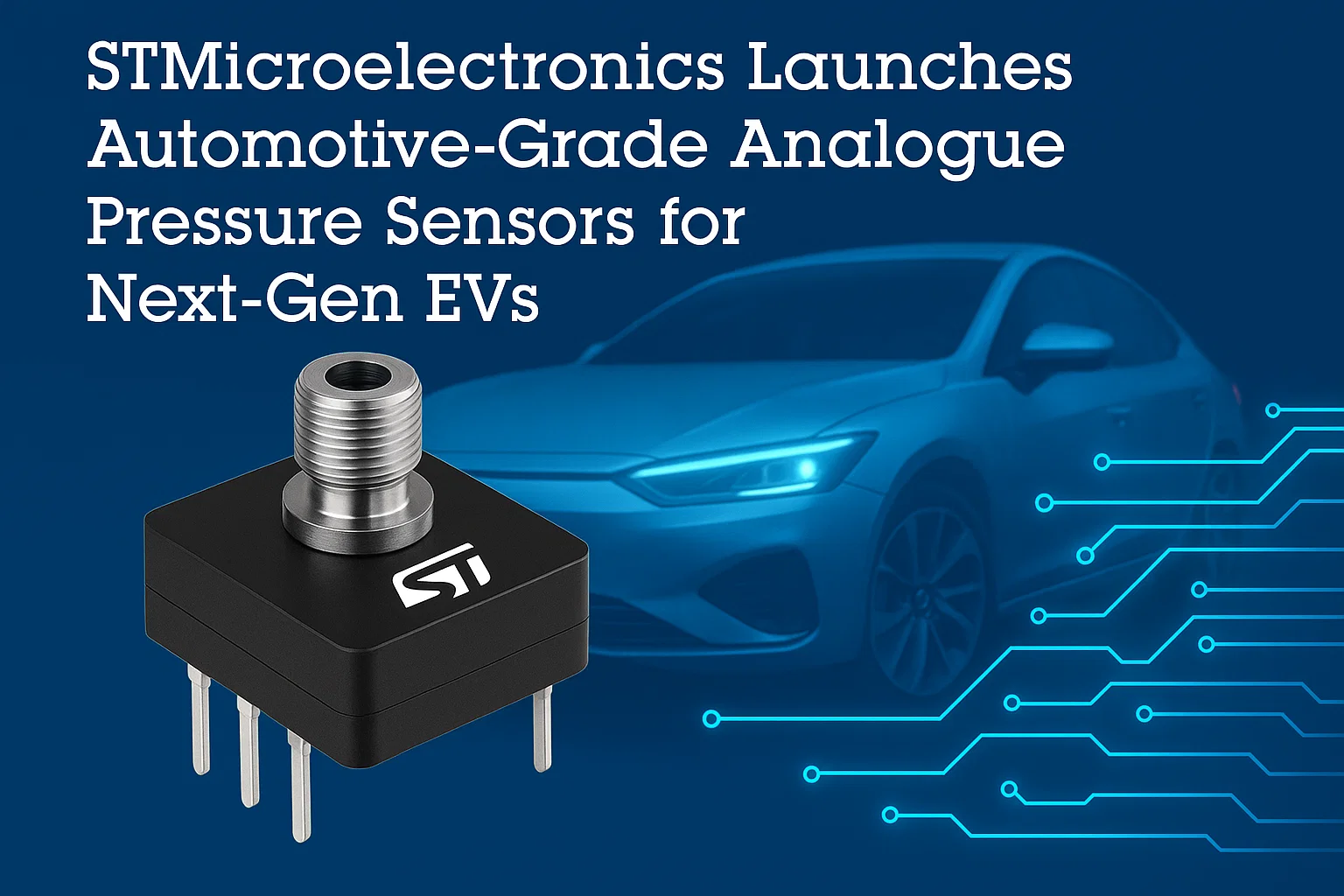
STMicroelectronics Launches Automotive-Grade Analogue Pressure Sensors for Next-Gen EVs
In a world increasingly dominated by digital systems and software-defined solutions, it may come as a surprise that analogue pressure sensors remain indispensable across industries. From ensuring the safety of aircraft engines to monitoring a patient’s blood flow in real time, analogue sensors provide reliability, sensitivity, and precision in environments where accuracy is non-negotiable. Unlike purely digital sensors, analogue variants excel in environments where continuous monitoring is required with minimal latency.
In 2024, the analogue pressure sensor industry reached an estimated market valuation of US$ 3.45 billion, and projections suggest it will climb to US$ 5.67 billion by 2032, achieving a compound annual growth rate (CAGR) of 6.4% during the forecast period (2025–2032). This steady growth trajectory is underpinned by breakthroughs in sensor design, expanding applications in automotive, healthcare, and aerospace, and the green energy transition.
Access Your Free Sample Report- Analogue Pressure Sensors Market
Market Overview: A Growing Need for Precision
The analogue pressure sensor market’s expansion is driven by three core forces:
- Rising demand for smart mobility and automotive safety – With stricter emissions regulations and safety mandates, cars increasingly rely on analogue sensors for tire pressure monitoring systems (TPMS), fuel injection management, and exhaust control.
- Healthcare technology boom – Medical-grade sensors are being miniaturized for use in catheters, infusion pumps, and respiratory monitoring, especially following global lessons from COVID-19.
- Energy and sustainability applications – Clean energy systems such as hydrogen fuel cells and wind power require robust sensors to withstand extreme conditions and prevent catastrophic failures.
The market is further bolstered by advancements in MEMS (Micro-Electro-Mechanical Systems), which combine the sensitivity of analogue sensing with scalable production techniques.
Bosch Sensortec: Redefining MEMS Efficiency
Bosch Sensortec, a pioneer in MEMS technology, has pushed the boundaries of low-power analogue pressure sensors. In 2024, Bosch unveiled its next-generation MEMS sensors designed for wearables, IoT devices, and compact medical electronics.
What makes these sensors groundbreaking is their ability to operate at ultra-low power consumption, extending battery life for devices like smartwatches, fitness trackers, and portable health monitors. Moreover, their compact form factor allows integration into space-constrained devices without compromising performance.
This development highlights the dual priority of efficiency and miniaturization, aligning with global trends where consumers demand both smarter and longer-lasting devices. Bosch’s innovation represents a significant leap in bridging analogue accuracy with the convenience of digital ecosystems.
STMicroelectronics: Driving Automotive Reliability
The automotive industry remains one of the largest consumers of analogue pressure sensors, and STMicroelectronics has seized this opportunity. In 2024, ST introduced a new line of automotive-grade pressure sensors tailored for tire pressure monitoring systems (TPMS) and engine management applications.
Key attributes include:
- Wide operating temperature ranges (-40°C to +150°C), ensuring durability in extreme conditions.
- Compliance with automotive safety standards like ISO 26262.
- High linearity and stability, which are critical for engine efficiency and emissions control.
This innovation aligns with the global push for smarter, greener vehicles. As electric and hybrid vehicles gain traction, the role of precise pressure sensing grows ensuring optimal performance of batteries, cooling systems, and braking technologies.
Honeywell: Enabling the Hydrogen Economy
Honeywell has been at the forefront of applying analogue pressure sensors to the energy transition. In 2024, the company spotlighted sensors tailored for hydrogen storage and distribution systems, addressing a crucial gap in renewable energy infrastructure.
Hydrogen presents unique challenges: storage tanks often operate at pressures exceeding 700 bar, and safety is paramount. Honeywell’s analogue pressure sensors provide continuous, reliable monitoring to prevent leaks, explosions, or system failures.
By expanding into this niche, Honeywell positions itself as a key enabler of the hydrogen economy, which is projected to play a central role in achieving net-zero emissions targets worldwide.
Infineon: Bridging Sensors and Artificial Intelligence
One of the most exciting cross-industry trends is the integration of sensors with AI-powered edge devices, and Infineon Technologies has made notable strides here.
In late 2024, Infineon launched analogue pressure sensors embedded into AI-ready microcontrollers. These devices are designed for industrial IoT and predictive maintenance, where real-time monitoring helps detect anomalies before costly failures occur.
This combination allows factories and infrastructure systems to operate with self-diagnostic capabilities, marking a new era of smart manufacturing. For analogue pressure sensors, it also represents a powerful argument: not only are they reliable, but when paired with AI, they become predictive assets in Industry 4.0.
Download Sample Report PDF- Analogue Pressure Sensors Market
Aerospace and Space Applications: Reliability Beyond Earth
Analogue pressure sensors have long been trusted in aerospace and defense, where failures are not an option. In 2024, both NASA and the European Space Agency (ESA) reported using hybrid analogue-digital pressure sensors for propulsion testing and space vehicle monitoring.
Key reasons for analogue preference in space missions include:
- Radiation resistance compared to purely digital systems.
- Continuous signal outputs with minimal delay.
- High durability under temperature fluctuations and vibration.
Whether monitoring rocket fuel lines or controlling cabin pressurization, analogue pressure sensors continue to be the unsung heroes of space exploration.
Medical Devices: Post-Regulation Expansion
Healthcare is another sector where analogue pressure sensors are thriving. The implementation of stricter medical device regulations in the U.S. (FDA guidelines) and the European Union (MDR framework) has pushed manufacturers to adopt more reliable, miniaturized sensing technologies.
Companies like TE Connectivity and Amphenol have scaled up their production of sensors for:
- Catheters – measuring blood pressure inside arteries.
- Infusion pumps – ensuring accurate delivery of medication.
- Respiratory systems – monitoring airflow in ventilators and sleep apnea devices.
The COVID-19 pandemic underscored the importance of respiratory monitoring devices, accelerating R&D and deployment of pressure sensors in medical settings. The demand in this segment is projected to remain strong throughout the next decade.
Industry-Wide Drivers: What’s Fueling Growth?
Beyond individual company innovations, several macro trends explain why analogue pressure sensors are experiencing renewed momentum:
- Miniaturization – Smaller, thinner sensors are opening doors to wearables and micro-medical devices.
- Energy Transition – Hydrogen, wind, and solar systems depend on robust monitoring technologies.
- AI and Edge Computing – Sensors are no longer passive; they actively contribute to predictive analytics.
- Global Safety Standards – From automotive to aerospace, regulatory compliance fuels demand for highly reliable analogue systems.
Challenges: Where the Road Gets Bumpy
Despite optimistic growth, the analogue pressure sensor industry faces several hurdles:
- Competition from digital sensors – Digital variants often provide easier integration with software systems.
- Calibration requirements – Analogue sensors may need frequent recalibration in sensitive applications.
- Price sensitivity – Industries like consumer electronics demand ultra-low-cost solutions, which can squeeze margins.
Manufacturers are addressing these challenges through hybrid analogue-digital solutions, improved calibration stability, and economies of scale in MEMS production.
Click Here To Download Full Sample Report- Analogue Pressure Sensors Market
Future Outlook (2025–2032): The Path Ahead
Looking forward, analogue pressure sensors are set to play a defining role in industries undergoing transformation. By 2032, the market is forecasted to reach US$ 5.67 billion, thanks to a CAGR of 6.4%.
Key predictions include:
- Automotive: Growing reliance on sensors for EVs, autonomous driving, and safety compliance.
- Healthcare: Rising adoption in wearable health tech, especially for continuous cardiovascular monitoring.
- Energy: Expansion into hydrogen, offshore wind, and carbon capture systems.
- Smart Infrastructure: Pressure sensors will underpin predictive maintenance in factories, pipelines, and transport networks.
The convergence of analogue accuracy with digital intelligence will define the next generation of innovations. Rather than being overshadowed by digital sensors, analogue systems will complement them, ensuring reliability in mission-critical environments.
By 2032, with a market poised to surpass US$ 5.67 billion, analogue pressure sensors will stand as a cornerstone technology quietly but powerfully shaping the way we move, heal, and explore.

Comments (0)