
Analogue Pressure Sensors Market MARKET INSIGHTS
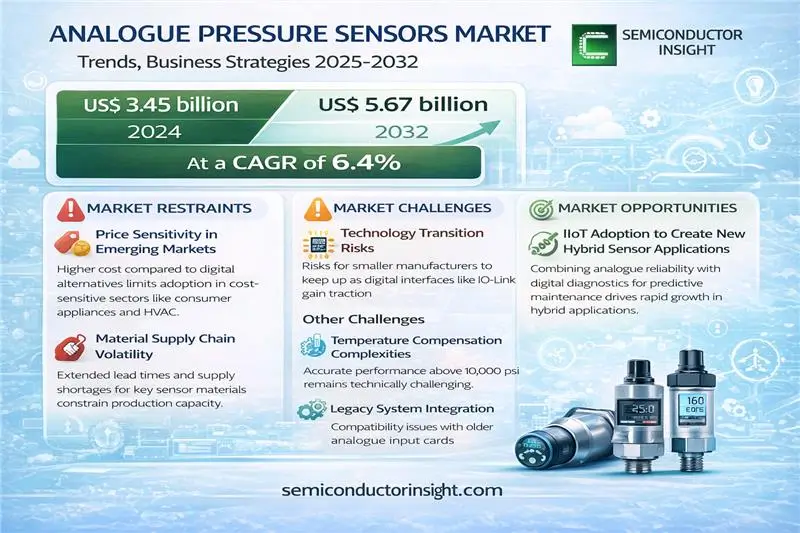
Global Analogue Pressure Sensors Market size was valued at USD 3.45 billion in 2024 and is projected to reach USD 5.67 billion by 2032, at a CAGR of 6.4% during the forecast period 2025-2032.
Analogue pressure sensors, also known as pressure transducers, are devices that convert mechanical pressure into proportional electrical signals. These sensors utilize strain-gauge technology or piezoresistive elements to measure pressure variations with high accuracy, typically outputting signals in 4-20 mA or 0-10 V ranges. They are widely preferred in industrial applications due to their reliability, simplicity, and compatibility with legacy systems.
The market growth is driven by increasing industrial automation, stringent safety regulations in process industries, and rising demand from the automotive sector for tire pressure monitoring and engine management systems. The differential pressure sensor segment accounts for the largest market share due to its extensive use in HVAC, filtration, and flow measurement applications. Key players like WIKA, Honeywell, and TE Connectivity are investing in MEMS-based sensors to enhance performance while reducing costs. Asia-Pacific dominates the market, with China contributing over 35% of global demand, fueled by rapid industrialization and infrastructure development.
Analogue Pressure Sensors Market MARKET DYNAMICS
Analogue Pressure Sensors Market MARKET DRIVERS
Expanding Industrial Automation to Fuel Demand for Accurate Pressure Monitoring Solutions
The proliferation of Industry 4.0 initiatives across manufacturing sectors is creating unprecedented demand for reliable pressure sensing technologies. As factories increasingly adopt smart automation systems, analogue pressure sensors have become critical components for hydraulic systems, pneumatic controls, and process monitoring equipment. Their 4-20mA and 0-10V output signals remain the preferred communication method in industrial environments due to superior noise immunity compared to digital alternatives. The industrial automation market is projected to maintain robust growth, with manufacturing facilities requiring thousands of pressure measurement points per plant for safety and efficiency optimization.
Stringent Safety Regulations in Automotive and Aerospace to Accelerate Market Growth
Transportation industries face increasingly rigorous safety standards, particularly for fluid pressure monitoring in braking, fuel, and HVAC systems. Recent regulatory updates now mandate redundant pressure sensing in commercial aircraft hydraulic systems, while automotive TPMS (Tire Pressure Monitoring Systems) requirements continue expanding globally. Analogue sensors dominate these applications due to their fail-safe characteristics and decades of proven reliability. The aerospace pressure sensor market alone is forecast to grow significantly as next-generation aircraft incorporate more electronic flight control systems requiring precise pressure data.
Furthermore, emerging applications in electric vehicle battery pack pressure monitoring and hydrogen fuel cell systems present additional growth avenues. Major automotive suppliers are collaborating with sensor manufacturers to develop specialized variants for these new propulsion technologies.
Analogue Pressure Sensors Market MARKET RESTRAINTS
Price Sensitivity in Emerging Markets to Limit Adoption Rates
While analogue pressure sensors offer reliability advantages, their electromechanical construction typically carries a 15-25% cost premium over basic digital alternatives. This pricing difference significantly impacts procurement decisions in price-sensitive sectors such as consumer appliances and commercial HVAC systems. Manufacturers in developing regions frequently opt for lower-cost solutions despite potential long-term maintenance implications. The current global economic climate has exacerbated this trend, with many OEMs prioritizing short-term cost reduction over lifecycle value.
Material Supply Chain Volatility to Constrain Production Capacity
The industry faces persistent challenges securing specialized materials required for high-performance sensor construction. Certain stainless steel alloys and ceramic substrates essential for accurate pressure measurement remain subject to allocation from suppliers. Lead times for these raw materials have extended by 30-40% compared to pre-pandemic levels, forcing manufacturers to maintain larger inventories. This situation particularly impacts differential pressure sensor production, where material specifications are most stringent for achieving required accuracy levels.
Analogue Pressure Sensors Market MARKET CHALLENGES
Technology Transition Risks as Digital Interfaces Gain Traction
The industry faces increasing pressure to integrate digital communication capabilities while maintaining analogue output compatibility. Many end-users now demand hybrid solutions supporting both traditional 4-20mA outputs and modern protocols like IO-Link. Developing these dual-interface sensors requires substantial R&D investment and risks cannibalizing existing product lines. Smaller manufacturers without the resources for such development may lose market share as digital transformation accelerates across industrial sectors.
Other Challenges
Temperature Compensation Complexities
Maintaining measurement accuracy across wide temperature ranges remains technically challenging, particularly for high-pressure applications exceeding 10,000 psi. Sensor drift can necessitate frequent recalibration in extreme environments, increasing total cost of ownership for end-users.
Legacy System Integration
Many industrial facilities operate equipment with analog input cards that cannot be easily upgraded. This creates compatibility challenges when modern sensors offer improved performance but different electrical characteristics.
Analogue Pressure Sensors Market MARKET OPPORTUNITIES
IIoT Adoption to Create New Hybrid Sensor Applications
The Industrial Internet of Things is driving demand for sensors that combine traditional analogue outputs with digital diagnostics. Advanced versions now incorporate self-monitoring capabilities that predict maintenance needs while maintaining compatibility with existing control systems. This hybrid approach allows facilities to gradually transition to smart factory architectures without costly infrastructure replacement. Market leaders are reporting 40-50% faster growth for these intelligent analogue sensors compared to conventional versions.
Energy Transition Projects to Generate Specialized Sensor Demand
Renewable energy installations and carbon capture systems require pressure measurement solutions for unique operating conditions. Applications such as hydrogen compression, CO2 sequestration, and biomass processing present demanding environments where traditional sensors may not suffice. Several manufacturers have developed specialized product lines featuring enhanced corrosion resistance and wider temperature ranges to address these emerging applications. The clean energy sector’s rapid expansion is expected to create sustained demand for these purpose-built solutions.
ANALOGUE PRESSURE SENSORS MARKET TRENDS
Industrial Automation and IIoT Integration Driving Market Growth
The growing adoption of Industrial Internet of Things (IIoT) and automation across manufacturing and process industries is significantly boosting the demand for analogue pressure sensors. These sensors play a critical role in real-time monitoring and control systems by providing reliable, continuous pressure data in harsh industrial environments. The market is witnessing a shift toward smart manufacturing, where high-precision, rugged sensors are essential for predictive maintenance and operational efficiency. Analogue outputs such as 4–20 mA and 0–10 V signals remain preferred due to their noise immunity and long-distance transmission capabilities, ensuring seamless integration with legacy systems.
Other Trends
Expansion in Automotive and Aerospace Applications
The automotive and aerospace sectors are witnessing substantial growth in the deployment of analogue pressure sensors, driven by increasing demand for fuel efficiency, emission control, and advanced safety systems. In vehicles, these sensors monitor fuel injection pressure, brake systems, and tire pressure, contributing to enhanced performance and regulatory compliance. Similarly, in aerospace, they are essential for cabin pressure monitoring, hydraulic systems, and engine performance analytics. The need for lightweight, high-durability sensors capable of operating in extreme conditions is fueling R&D investments among key manufacturers.
Advancements in Sensor Accuracy and Miniaturization
Technological advancements in microelectromechanical systems (MEMS) and semiconductor fabrication have significantly improved the accuracy and miniaturization of analogue pressure sensors. Manufacturers are leveraging these innovations to develop compact, energy-efficient sensors with higher sensitivity and reduced hysteresis, catering to medical and consumer electronics applications. For instance, medical-grade pressure sensors are increasingly used in portable diagnostic devices, ventilators, and patient monitoring systems. This trend is expected to accelerate as MEMS-based sensors gain traction in IoT-enabled wearables and smart home devices.
COMPETITIVE LANDSCAPE
Key Industry Players
Market Leaders Focus on Innovation and Strategic Expansion to Gain Competitive Edge
Global Analogue Pressure Sensors Market is characterized by a mix of established industry leaders and emerging players striving to enhance their market presence. WIKA stands as a dominant player, leveraging its extensive product portfolio and strong foothold in industrial applications worldwide. Known for its precision measurement solutions, WIKA continues to lead due to its expertise in high-performance pressure sensors across automotive, aerospace, and heavy industries.
IMI PLC and AVL List GmbH command significant market shares, driven by their robust R&D investments and customized pressure sensing solutions tailored for specialized applications. Their growth is further accelerated by partnerships with key automotive manufacturers and industrial automation providers, reinforcing their position in critical supply chains.
Additionally, companies like STS Sensors and Analog Microelectronics GmbH are gaining traction through niche technological advancements, particularly in miniaturized and IoT-enabled sensor solutions. Their ability to integrate smart sensing technologies with Industry 4.0 applications positions them as key innovators in the evolving market landscape.
Meanwhile, SICK and Turck are strengthening their competitive standing through strategic acquisitions and geographic expansions. These efforts, combined with a focus on sustainability and digital transformation, enable them to cater to the rising demand for energy-efficient and connected pressure sensing systems.
List of Key Analogue Pressure Sensor Companies Profiled
- WIKA (Germany)
- IMI PLC (U.K.)
- AVL List GmbH (Austria)
- STS Sensors (Germany)
- Analog Microelectronics GmbH (Germany)
- Phoenix Sensors (U.S.)
- Wenglor (Germany)
- Turck (U.S.)
- SICK (Germany)
- Heise (U.S.)
- KELLER (Switzerland)
- Infineon (Germany)
- Autonics (South Korea)
Segment Analysis:
By Type
Differential Pressure Sensors Lead Due to Widespread Use in Industrial Automation
The market is segmented based on type into:
- Differential Pressure Sensor
- Absolute Pressure Sensor
By Application
Aerospace Sector Dominates Owing to Critical Pressure Monitoring Requirements
The market is segmented based on application into:
- Aerospace
- Automobile Industry
- Ship Industry
- Others
By Sensing Technology
Strain Gauge Technology Holds Major Share Due to High Accuracy and Reliability
The market is segmented based on sensing technology into:
- Strain Gauge
- Piezoresistive
- Capacitive
- Resonant
By Operation Mode
4-20 mA Output Remains Preferred Standard for Industrial Applications
The market is segmented based on operation mode into:
- 4-20 mA
- 0-10 V
- 0-5 V
- 1-5 V
Regional Analysis: Analogue Pressure Sensors Market
Asia-Pacific
The Asia-Pacific region dominates the global Analogue Pressure Sensors Market, accounting for the largest revenue share, driven by rapid industrialization and increasing automation across key industries. China, Japan, and India lead the adoption, supported by robust manufacturing sectors and government initiatives like China’s “Made in China 2025” policy, which emphasizes smart manufacturing. The automotive and aerospace industries are significant contributors, with Japan’s precision engineering and China’s growing electric vehicle market fueling demand for high-accuracy sensors. While cost-competitive solutions prevail, technological advancements in MEMS-based sensors are gaining traction, particularly in industrial automation and IoT applications.
North America
North America remains a high-growth market for analogue pressure sensors, propelled by stringent industrial safety norms and the presence of key players such as Honeywell and TE Connectivity. The U.S. accounts for over 70% of regional demand, with applications in aerospace, oil & gas, and medical devices driving adoption. Regulatory standards like ASME B40.100 ensure sensor reliability, while investments in Industry 4.0 and smart factories further boost market expansion. However, competition from digital sensor alternatives poses a challenge, particularly in sectors prioritizing connectivity and data integration.
Europe
Europe’s market is characterized by a strong emphasis on innovation and compliance with environmental regulations, including the EU’s RoHS and REACH directives. Germany leads in industrial applications, with automotive giants like BMW and Siemens driving demand for precision sensors in engine management and HVAC systems. The region also sees growing adoption in renewable energy projects, particularly wind turbines requiring robust pressure monitoring. However, slower industrial growth in Southern Europe and high manufacturing costs limit broader market penetration compared to Asia-Pacific.
South America
The South American market is emerging, with Brazil and Argentina accounting for the majority of analogue pressure sensor demand. Applications in oil & gas, food processing, and water management are primary drivers, though economic instability and limited local manufacturing hinder consistent growth. While multinational companies dominate the supply chain, local players are gradually entering the market, focusing on cost-effective solutions for agricultural and automotive sectors. Infrastructure investments, such as Brazil’s offshore oil projects, present long-term opportunities.
Middle East & Africa
The Middle East & Africa region shows steady growth, led by the GCC countries’ oil & gas sector, which relies on analogue pressure sensors for drilling and refining processes. Saudi Arabia’s Vision 2030 initiative is driving industrial diversification, increasing demand for sensors in water desalination and smart city projects. In Africa, South Africa and Nigeria are key markets, though infrastructure gaps and low industrialization restrict overall adoption. Nonetheless, rising FDI in manufacturing and energy sectors signals future potential for sensor manufacturers.
Report Scope
This market research report provides a comprehensive analysis of the Global Analogue Pressure Sensors Market, covering the forecast period 2024–2032. It offers detailed insights into market dynamics, technological advancements, competitive landscape, and key trends shaping the industry.
Key focus areas of the report include:
- Market Size & Forecast: Historical data and future projections for revenue, unit shipments, and market value across major regions and segments. The Global Analogue Pressure Sensors market was valued at USD 3.45 billion in 2024 and is projected to reach USD 5.67 billion by 2032, growing at a CAGR of 6.4 % during the forecast period.
- Segmentation Analysis: Detailed breakdown by product type (Differential Pressure Sensor, Absolute Pressure Sensor), application (Aerospace, Automobile Industry, Ship Industry, Others), and end-user industries to identify high-growth segments and investment opportunities.
- Regional Outlook: Insights into market performance across North America (U.S., Canada, Mexico), Europe (Germany, France, U.K., Italy, Russia), Asia-Pacific (China, Japan, South Korea, India), Latin America, and the Middle East & Africa, including country-level analysis.
- Competitive Landscape: Profiles of leading market participants including WIKA, IMI PLC, AVL List GmbH, STS Sensors, and Analog Microelectronics GmbH, covering their product portfolios, market shares, R&D investments, and strategic developments.
- Technology Trends & Innovation: Assessment of emerging sensor technologies, integration with IoT platforms, advancements in MEMS-based sensors, and evolving industry standards for pressure measurement.
- Market Drivers & Restraints: Evaluation of factors such as industrial automation growth, automotive safety regulations, and process industry demands versus challenges like price sensitivity and digital sensor competition.
- Stakeholder Analysis: Strategic insights for sensor manufacturers, OEMs, system integrators, and investors regarding market entry strategies and growth opportunities.
The research employs both primary and secondary methodologies, including interviews with industry leaders, analysis of financial reports, and validation through multiple data sources to ensure accuracy and reliability.
FREQUENTLY ASKED QUESTIONS:
What is the current market size of Global Analogue Pressure Sensors Market?
->Analogue Pressure Sensors Market size was valued at USD 3.45 billion in 2024 and is projected to reachUSD 5.67 billion by 2032, at a CAGR of 6.4% during the forecast period 2025-2032.
Which key companies operate in Global Analogue Pressure Sensors Market?
-> Key players include WIKA, IMI PLC, AVL List GmbH, STS Sensors, Analog Microelectronics GmbH, Phoenix Sensors, and Wenglor, among others.
What are the key growth drivers?
-> Key growth drivers include increasing industrial automation, stringent safety regulations in automotive sector, and growth in process industries.
Which region dominates the market?
-> Asia-Pacific shows the highest growth potential, while North America currently leads in technological adoption.
What are the emerging trends?
-> Emerging trends include MEMS-based sensor miniaturization, IoT integration, and development of high-temperature resistant sensors for extreme environments.

Get Sample Report PDF for Exclusive Insights
Report Sample Includes
- Table of Contents
- List of Tables & Figures
- Charts, Research Methodology, and more...
 Download Sample Report PDF


