
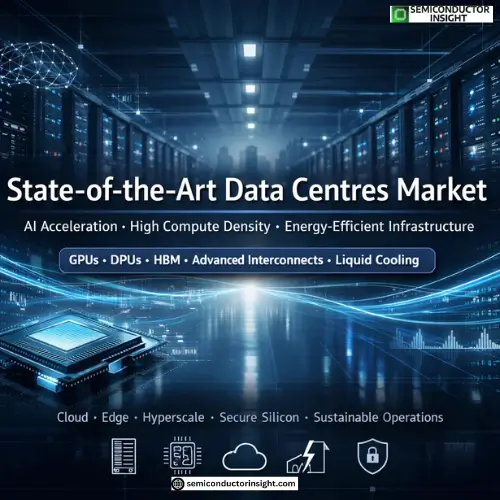
State-of-the-Art Data Centres Market Strategy Balancing Performance, Efficiency, and Growth
Data centres have shifted from centralized warehouses of racks and cables to intelligent hubs of computational power that drive modern digital life. Streaming services, AI training clusters, cloud platforms, autonomous systems, and real-time analytics all place demands on infrastructure that only the latest semiconductor and architectural innovations can meet. This evolution has created a distinct segment the State-of-the-Art Data Centres Market characterized by ultra-efficient design, high compute density, resilient operations, and continuous scaling.
In this context, semiconductors are not just components; they are the heart of performance, power efficiency, and service continuity.
Why Semiconductors Are Core to Modern Data Centres?
Every advanced data centre integrates a layered silicon stack that includes:
- High-Performance CPUs for general compute tasks
- AI Accelerators (GPUs, TPUs, DPUs, ASICs) for machine learning and inference
- Network Processors for high-speed data throughput
- Memory Components (DRAM, HBM, NAND/SSD) for caching and persistent storage
- Power Management ICs and Voltage Regulators to optimize energy conversion
The push toward heterogeneous computing where specialized silicon works alongside general processors enables modern workloads to run faster with lower energy consumption. This is critical when scaling from a few dozen servers to facilities with thousands of interconnected nodes.
Current Market Momentum: AI and Data Explosion
The global data footprint continues to grow exponentially. Recent industry insights indicate that over 90% of the world’s data was generated in the past two years, driven by AI, IoT, video streaming, and enterprise digitization. This explosion demands data centres with massive parallel processing capabilities, which in turn drives demand for semiconductors optimized for:
- Matrix math acceleration
- High-bandwidth memory access
- Low-latency interconnects
- Real-time task orchestration
It is not uncommon for cutting-edge AI training clusters to integrate tens of thousands of GPU or accelerator chips, each supported by sophisticated network fabrics and power distribution systems.
Architectural Trends: Distributed, Edge, and Cloud Convergence
State-of-the-art data centres are no longer monolithic monoliths located only in Silicon Valley or Northern Virginia. Three architectural trends are shaping the market:
- Cloud Metacentres: Centralized campuses owned by Hyperscaler with thousands of racks and custom silicon designs.
- Edge Data Centres: Smaller installations closer to end users to minimize latency for real-time applications like autonomous vehicles and AR/VR.
- Hybrid Distributed Grids: A blend of centralized cloud resources and distributed edge nodes supporting seamless application workloads.
Each architecture stresses semiconductors in different ways. While metacentres focus on high-density silicon and cooling efficiency, edge nodes prioritize power efficiency and compact interconnect solutions.
Thermal and Power Challenges Driving Silicon Innovation
Semiconductor scaling in data centres is closely linked to thermal management and power optimization. Traditional cooling approaches raised floors, chilled water loops, and air circulation are being augmented or replaced by:
- Liquid immersion cooling to dissipate heat from dense compute arrays
- Heat reuse systems that recapture thermal energy at scale
- Dynamic voltage and frequency scaling (DVFS) within chips to manage power draw
These innovations reflect the reality that power costs can exceed 40% of operational expenditure (OPEX) in large facilities. Semiconductor solutions optimized for low thermal output and high performance help contain these costs while sustaining compute throughput.
Network Fabric and Interconnect Semiconductors
Data movement is as important as data processing. Modern data centres rely on high-speed interconnects such as PCIe Gen5/Gen6, Compute Express Link (CXL), and Ethernet fabrics scaling to 400G and beyond. Semiconductors enabling these fabrics are advancing rapidly to facilitate:
- Faster cluster synchronization
- Reduced latency for distributed compute jobs
- Scalable bandwidth across storage, compute, and AI accelerators
These network ICs are specialized chips that bridge silicon islands into cohesive, high-performance computing grids.
Semiconductor Supply Chain and Production Readiness
The complexity and precision required for data centre chips have intensified supply chain focus. Semiconductor manufacturers are investing billions in fab expansions to support node transitions from 7 nm and 5 nm for logic and AI cores, down to advanced packaging processes for 3D integration.
Data centre vendors are also increasingly securing long-term wafer supply agreements and co-developing architectures with major foundries. This reduces risk and aligns production forecasts, which is particularly valuable in a market with expanding compute demand.
AI and Workload Optimization as Market Catalysts
AI workloads are arguably the most important growth vector for semiconductors in data centres. Large language models, computer vision training, and real-time inference require scalable compute platforms with high memory bandwidth and ultra-low latency. This has driven adoption of:
- Tensor cores in GPUs
- Domain-specific accelerators (TPUs, NPUs)
- Memory systems with HBM2/HBM3 stacks
Hardware that once supported general enterprise applications is now being complemented or replaced by silicon optimized for AI performance, shifting the market’s semiconductor mix significantly.
Data Sovereignty, Security, and Hardware Trust
Security concerns in modern infrastructures have never been higher. Data centres are being designed with hardware-based security features that ensure:
- Secure boot and attestation
- Encrypted memory regions
- Isolation of sensitive tasks
- Protection against side-channel attacks
Semiconductors with embedded security such as root-of-trust modules and cryptographic accelerators are becoming integral to meeting regulatory and enterprise data governance standards.
Lastly before we wrap up, don’t forget to look at our most recent exclusive report for in-depth insights:
https://semiconductorinsight.com/report/state-of-the-art-data-centers-market/
The state-of-the-art data centre market anticipates continuous evolution, influenced by:
- Growth in AI/ML compute demand
- Expansion of hybrid and edge architectures
- Continued advances in semiconductor efficiency
- Sustainability mandates around energy usage and carbon footprint
Semiconductor innovations will follow these trends, fostering systems that are not only powerful but also thermally efficient, secure, and modular.
State-of-the-Art Data Centres Market is far more than an infrastructure story it’s a semiconductor-centred narrative of how chips, packaging, power systems, and network fabrics come together to support the digital economy. From the silicon labs to hyperscale campuses and edge nodes, semiconductors drive performance, resilience, and innovation across every layer of this critical ecosystem.

Comments (0)