

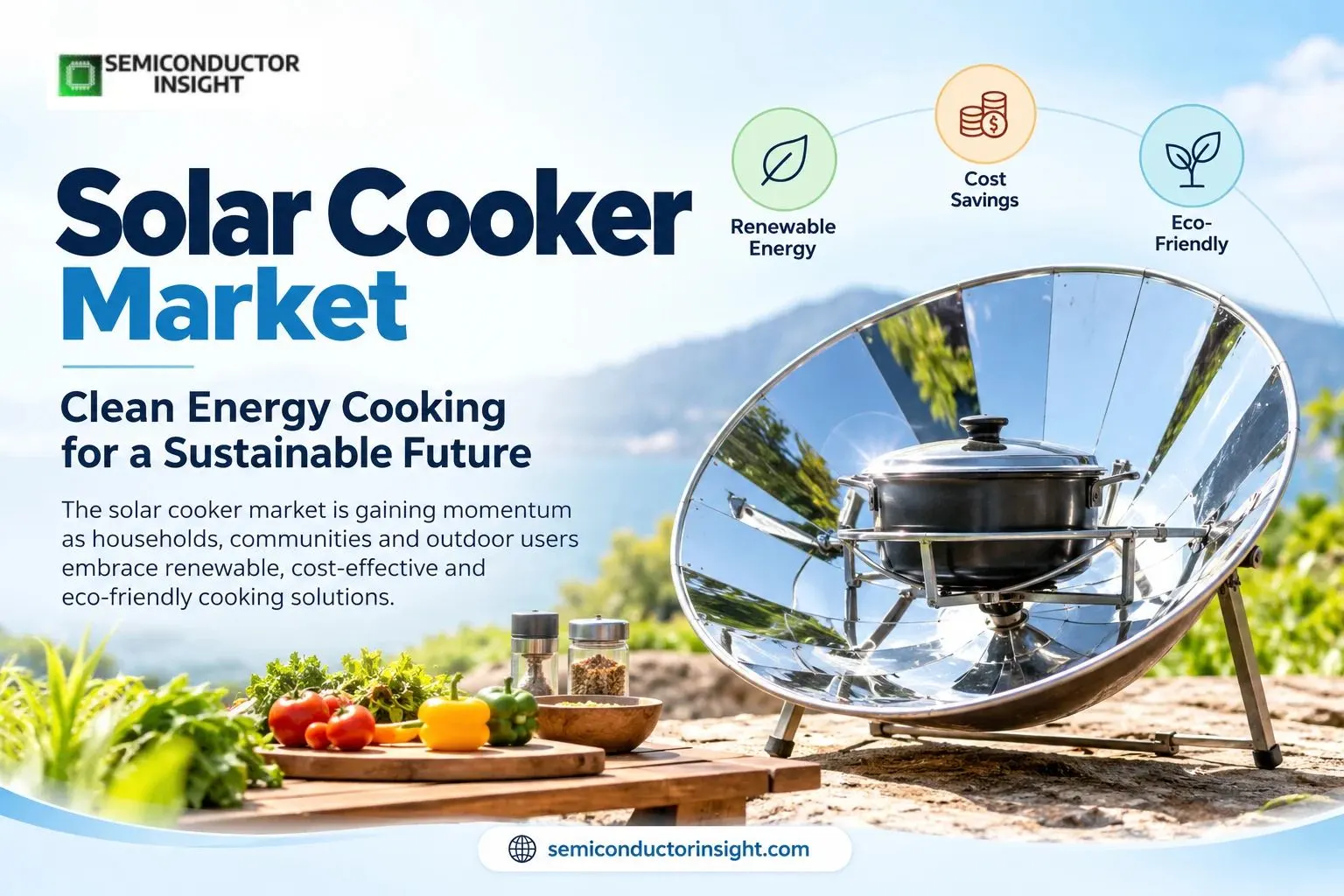
Solar Cooker Market Developments across Household Energy Access, Fuel Savings and Solar Thermal Innovation
Solar cookers are gaining renewed attention as households, community kitchens, and institutions look for alternatives to conventional cooking fuels. What was once associated mainly with simple outdoor cooking devices is expanding into a broader category that includes reflective cookers, concentrated solar heat, thermal storage, and photovoltaic-powered induction systems.
Solar cooker market is increasingly connected to energy affordability, household air quality, and access to dependable cooking solutions. Recent product launches and research initiatives suggest that manufacturers are exploring ways to make solar cooking more practical for everyday meals rather than limiting it to occasional use in favourable weather.
The Technology Split Between Solar Heat and Solar Electricity
- Solar cookers generally operate through two approaches. Solar thermal devices capture and concentrate sunlight to heat cookware directly, while solar photovoltaic systems convert sunlight into electricity that can operate an induction stove or another electric cooking appliance.
- The Indian Ministry of New and Renewable Energy identifies four broad categories, including box cookers, concentrating cookers, advanced indoor systems with thermal storage, and community-scale solar cookers. Its guidance also highlights their potential in institutional kitchens, hospitals, hotels, residential schools, and industrial canteens. MNRE
- This distinction matters commercially because the best solution depends on cooking volume, available space, sunlight conditions, and whether meals must be prepared after sunset.
A 2026 Product Launch Brings Solar Power into the Modern Kitchen
On April 15, 2026, Indian solar company SWELECT Energy Systems announced an off-grid solar cooking solution designed to power standard induction stoves using photovoltaic panels without relying on grid electricity or cooking gas. The company positioned the product as an option for households seeking greater energy independence amid concerns about cooking-fuel availability and costs. The initial launch was offered in limited quantities. pv magazine India
The development illustrates an important shift in product design. Instead of asking consumers to change their cooking habits entirely, manufacturers can connect solar generation with familiar electric appliances. Actual performance and affordability will depend on system sizing, storage requirements, local sunlight, and household cooking patterns.
Why Clean Cooking Access Creates a Larger Opportunity?
The International Energy Agency reported in its World Energy Outlook 2025 that approximately 2 billion people worldwide still lacked access to clean cooking. Its analysis also estimates that universal access requires sustained investment in equipment, infrastructure, and reliable energy services. IEA
Solar cookers will not suit every household or replace every existing fuel. However, they may complement other clean-cooking technologies where sunshine is abundant and conventional fuels are expensive or difficult to obtain. Their potential extends to community kitchens, agricultural settlements, remote institutions, and emergency-response settings.
To Stay Tuned with More meaningful and In-Depth Relevant Insights, Do Visit here: https://semiconductorinsight.com/report/floating-solar-pv-market/
Thermal Storage Could Address the Problem of Intermittent Sunshine
One persistent limitation of solar thermal cooking is that usable heat depends on sunlight availability. Clouds, changing solar angles, and evening meal schedules can make cooking less predictable.
Researchers are therefore investigating thermal storage materials that retain heat for later use. An August 2026 research article in Sustainable Energy Technologies and Assessments examined an improved solar box cooker incorporating volcanic rock as a thermal-storage material. This line of research illustrates how material engineering could help extend the usefulness of collected solar heat beyond periods of strong sunshine. Research article
Progress will depend on verified cooking performance, heat-retention duration, material durability, and the total cost of the finished appliance.
Indian Research Is Extending Solar Cooking Beyond Conventional Designs
- The Government of India’s India Science, Technology and Innovation portal documents a solar-powered smart cooking system developed by RKSP Tech in Tamil Nadu.
- The project reached Technology Readiness Level 7 and underwent user trials at locations in Tiruppur, Salem, and Coimbatore under the BIRAC Innovation Challenge–SoCH programme. Government technology profile
- Such projects demonstrate the importance of testing equipment in real environments rather than evaluating performance exclusively under laboratory conditions.
What Buyers Should Evaluate Before Choosing a Solar Cooker?
The practical value of a solar cooker depends on more than its ability to reach a high temperature. Buyers should consider cooking capacity, preparation time, portability, cleaning requirements, food compatibility, maintenance, and performance during cloudy conditions. For photovoltaic systems, inverter efficiency, battery capacity where applicable, and electrical safety also matter.
For manufacturers, the opportunity lies in combining dependable engineering with simple operation and realistic household economics. Solar cooking is unlikely to become a universal replacement for conventional appliances, but improved designs and hybrid configurations can expand its role in clean-energy kitchens.
The Next Chapter of Everyday Solar Cooking
Solar cooker market is developing through the convergence of solar thermal engineering, photovoltaic electricity, energy storage, and practical appliance design. Recent Indian product announcements and research initiatives indicate that innovation is moving toward more flexible cooking arrangements. Wider adoption will depend on affordability, demonstrated performance, local cooking preferences, and dependable after-sales support. The strongest solutions will be those that turn available sunlight into useful meals without making everyday cooking unnecessarily complicated.

Comments (0)