

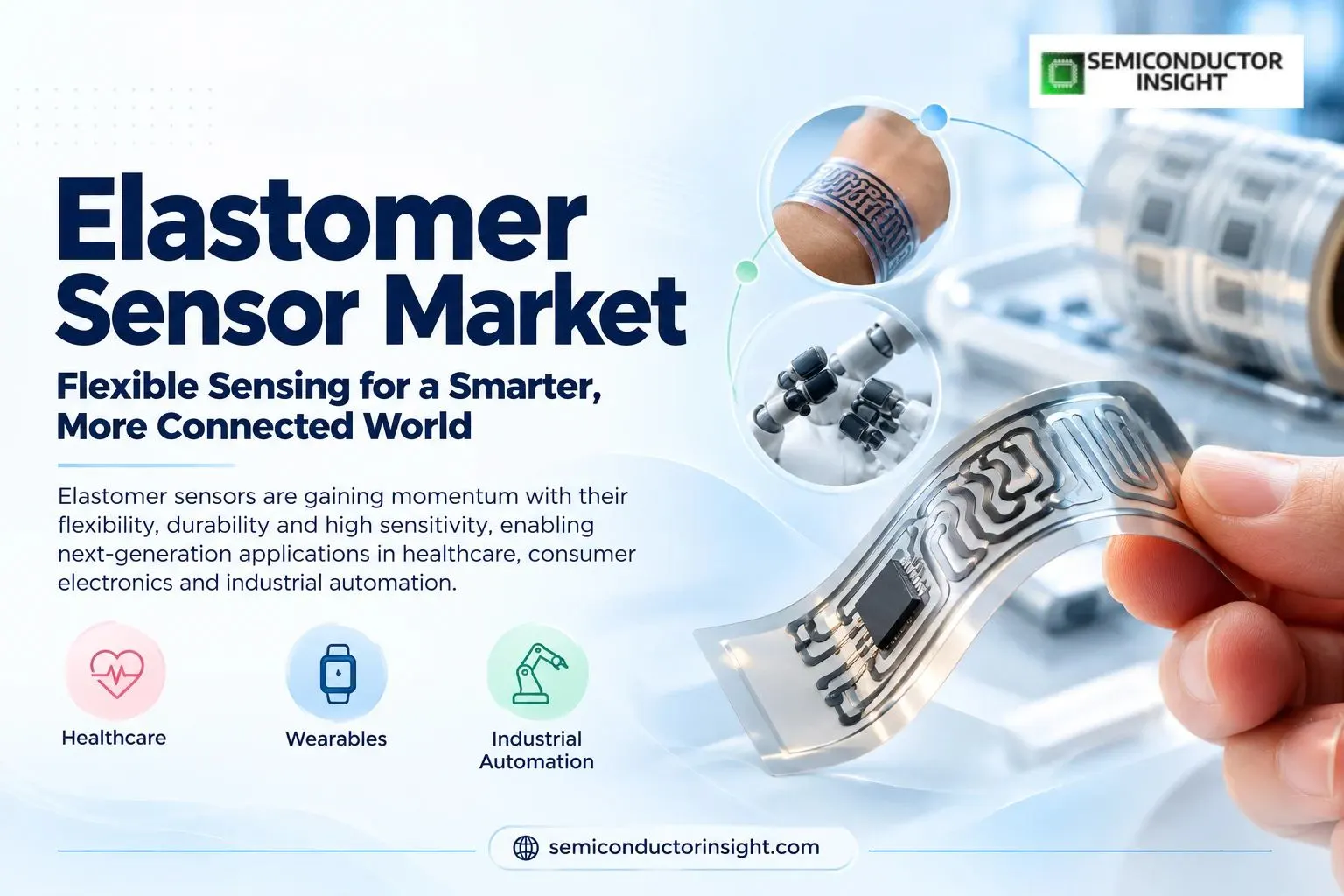
Soft Robotic Grippers Gain Tactile Feedback through Advances in Elastomer Sensor Market
Elastomer matrices such as polydimethylsiloxane, polyurethane, and natural rubber form the backbone of sensors that remain functional while stretched, bent, or compressed. These materials maintain mechanical integrity under large deformation and allow conductive pathways to reconfigure without permanent fracture. Recent laboratory work embeds multiwall carbon nanotubes or graphene flakes inside the polymer so that applied pressure or strain alters the network resistance or capacitance in a repeatable manner.
One freeze-dried natural-rubber composite reaches a sensitivity of 1.145 kPa⁻¹ across a 0-480 kPa window while recovering quickly after each load cycle. The same approach supports glove-mounted arrays that translate finger and wrist motion into remote gesture commands, illustrating how the soft matrix bridges everyday movement and electronic readout.
Conductive Filler Choices That Balance Stretch and Signal Clarity
- Carbon-based fillers dominate current prototypes because they disperse readily and create percolating networks at modest loadings.
- When the elastomer is compressed, particles on micropore walls contact one another and strengthen the conductive path, producing a clear resistance drop.
- Hybrid systems that combine resistive and capacitive responses further reduce unwanted signal drift under simultaneous stretching.
- Devices fabricated by sequential spin-coating and shadow-mask patterning limit capacitance shift to roughly 5 percent even at 100 percent tensile strain, keeping pressure readings stable during complex body motion.
- Response intervals commonly fall between 14 ms and 70 ms, fast enough for real-time feedback in interactive systems.
Multimodal and Self-Healing Architectures Expanding Functional Range
Layered dielectric-elastomer stacks now detect both magnitude and location of touch within a single soft pad. An upper capacitive sheet registers pressure while an underlying array identifies contact coordinates, enabling applications such as adaptive insoles or soft gripper pads. Parallel research introduces dynamic bonds that allow the polymer network to reform after cuts or tears.
Sensors incorporating these bonds regain electrical continuity after mechanical damage, extending usable lifetime in environments where abrasion or repeated flexing is unavoidable. Cycle counts exceeding 10 000 compressions with minimal drift appear routinely in published characterizations, confirming practical durability.
Does Tesla Use Silicon Carbide
Tesla incorporated silicon-carbide power devices into the main traction inverter of the Model 3 beginning with 2017 production vehicles. Each inverter contains 24 dual-die modules, resulting in 48 silicon-carbide MOSFET dies that handle the high-current switching between battery and motor. Independent teardowns and supplier statements confirm that the wide-bandgap devices reduced conduction and switching losses relative to earlier silicon designs, contributing an estimated 10 percent improvement in vehicle range for the same battery capacity.
Tesla later announced plans for a next-generation platform that would cut silicon-carbide content by approximately 75 percent through higher-current-density dies, improved packaging, and refined thermal management while preserving overall efficiency. The original Model 3 and Model Y fleets therefore remain the largest early commercial demonstration of silicon-carbide adoption in passenger electric vehicles, and the material continues to appear in onboard chargers and auxiliary power stages across the lineup.
Printed and Solution-Processed Routes toward Larger Arrays
Screen, stencil, and extrusion printing of carbon-elastomer inks allow sensor arrays to be deposited directly onto stretchable substrates without high-temperature steps that would damage the polymer. Researchers at Imperial College characterized acetylene carbon-black and graphite formulations inside PDMS, mapping conductivity against filler fraction so that designers can select compositions matched to required stretch and signal strength.
The resulting inks support interconnects, heaters, and multi-pixel tactile maps fabricated in a single process flow. Because the matrix remains soft, the finished devices conform to curved surfaces such as robotic fingertips or human skin without delamination.
Don’t Forget to Surf Our Updated Report for More Detailed Analysis: https://semiconductorinsight.com/report/elastomer-sensor-market/
Strain-Insensitive Designs for Unrestricted Motion Tracking
- Conventional stretchable sensors often mix pressure signals with unwanted strain artifacts.
- All-elastomer strain engineering confines deformation outside the active sensing zone, so pressure readings stay accurate even when the entire device is elongated by 100 percent.
- Laboratory prototypes using this principle report detection limits near 1 Pa and maintain linearity across wide pressure spans.
- When mounted on joints or integrated into soft robotic skins, the sensors continue to deliver clean data during walking, grasping, or underwater locomotion.
- A recent Sungkyunkwan University device further converts ultrasonic waves into neural-like signals while stretching like rubber, opening pathways for compliant marine exploration platforms.
Bio-Inspired and Hybrid Material Directions
Natural rubber harvested from Hevea brasiliensis supplies an abundant, renewable elastomer base that already possesses high elasticity and fatigue resistance. In-situ polymerization of conductive polymers such as polyaniline inside the rubber foam creates continuous pathways without sacrificing stretch.
Complementary work with liquid-crystal elastomer foams plated with silver combines piezoresistive sensing and photothermal actuation inside one porous structure, allowing a soft walker to monitor its own locomotion state through resistance changes. These hybrid constructions illustrate how elastomer sensors are evolving beyond single-function devices toward integrated perception-actuation systems that operate safely alongside people and in unstructured environments.

Comments (0)