
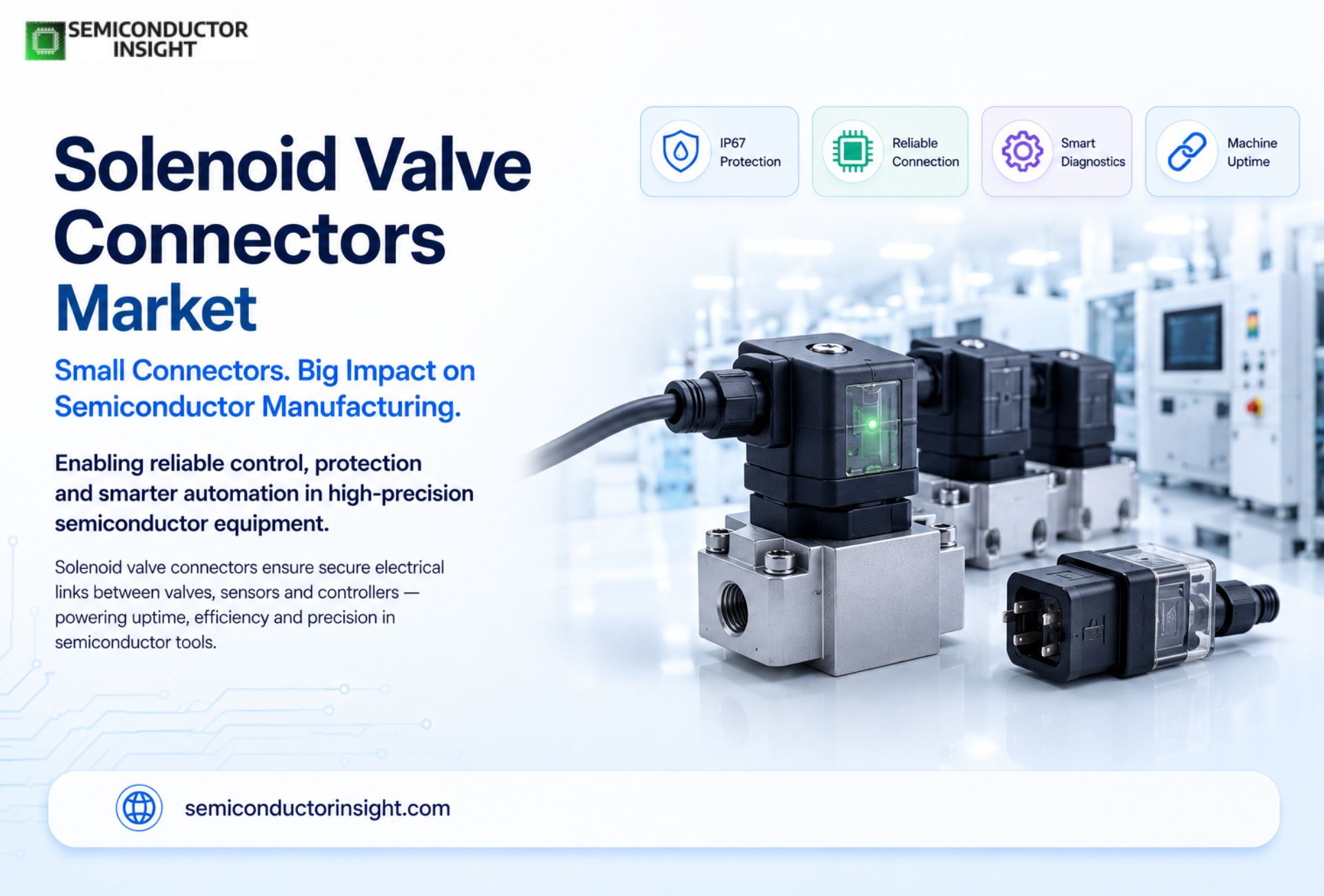
Global Solenoid Valve Connectors Market 2026: DIN 43650, IP67 Protection and Next-Generation Machine Connectivity
Solenoid valve connectors are small components, but their role becomes much more significant inside semiconductor manufacturing equipment. Pneumatic and electromagnetic valves are used to control the movement of gases, fluids and mechanical actuators, while electrical connectivity links those devices to machine controllers. TE Connectivity describes machine wiring in semiconductor equipment as the infrastructure connecting controllers, sensors, actuators, motors and other devices.
This puts the connector directly into the equipment’s reliability chain. A poorly sealed or incorrectly terminated connection can affect a valve’s response, interrupt an automated sequence or increase troubleshooting time.
DIN 43650 remains relevant in a changing automation environment
- One of the interesting aspects of this market is the continued importance of the DIN valve connector architecture.
- The EN 175301-803 standard, formerly DIN 43650, remains widely used for electrical connections to solenoid valves and other electromagnetic or pneumatic devices.
- Molex currently offers DIN valve connectors conforming to this standard, including versions designed for IP67 protection.
- The interface has also evolved beyond simple power delivery.
- Current designs can incorporate LEDs, blocking diodes, voltage-dependent resistors and other circuit-protection features, allowing the connector itself to contribute to equipment diagnostics and electrical protection.
A semiconductor tool has little room for connection failure
Semiconductor manufacturing equipment increasingly combines dense wiring, sensors, actuators, motors and control electronics within constrained machine architectures. TE’s semiconductor-equipment connectivity portfolio includes M8 and M12 interfaces, industrial signal and power connectors, thermocouple connections and connectors for vacuum-chamber applications.
This creates a design equation that is different from ordinary factory equipment:
Compact footprint + reliable sealing + controlled electrical interface + traceability = equipment-ready connectivity
For equipment builders, connector selection therefore becomes part of machine engineering rather than an afterthought during final assembly.
24V control is still a practical reference point
A useful indication of how these components fit into automation comes from current DIN valve connector specifications. Molex lists DIN valve configurations supporting 24V DC and 230V AC, with versions reaching 16A maximum current per contact. Its DIN connectors are available with IP67 protection when properly mated.
The significance is not simply the electrical rating. Semiconductor equipment designers need predictable connection behavior across repeated installation, maintenance and machine-service cycles. Connector geometry, cable retention, sealing and strain relief can therefore influence uptime as much as the nominal voltage rating.
To find out more, feel free to browse our latest updated report: https://semiconductorinsight.com/report/solenoid-valve-connectors-market/
Protection is moving from enclosure-level thinking to connection-level thinking
Modern factory environments expose connectivity to vibration, moisture, chemicals and mechanical stress. Molex’s industrial connector portfolio specifically emphasizes resistance to vibration, temperature, water and chemical exposure.
For solenoid valve connections, sealing is particularly important because the interface is often positioned directly on the valve or actuator. Current DIN designs can reach IP67, while external-thread versions are engineered to improve cable retention and sealing compared with conventional designs.
Design progression
Basic valve wiring → sealed connector → protected circuitry → visual indication → easier maintenance
That progression captures one of the most important changes taking place across industrial connectivity.
The connector is becoming easier to diagnose
- Another emerging direction is visual and service-oriented connectivity.
- Molex’s current DIN valve portfolio includes LED options and circuit-protection configurations, while its wider industrial automation portfolio uses status indication and keyed connections to simplify troubleshooting.
- This matters because semiconductor equipment downtime can require technicians to trace faults through tightly packed machine wiring.
- A connector that immediately indicates electrical status can shorten the path between fault detection and corrective action.
Semiconductor manufacturing is also pushing connectivity into cleaner environments
Clean manufacturing introduces another layer of engineering requirements. TE notes that some semiconductor equipment requires specialized materials for machine wiring to maintain cleanliness or prevent outgassing, alongside specific testing, identification and packaging procedures.
This means future demand is not simply about producing more connectors. It is increasingly about producing connectors and cable assemblies that satisfy the material, cleanliness, traceability and reliability requirements of specific equipment architectures.
The broader shift is toward machine-level connectivity
The direction of the industry can be seen in the wider movement toward decentralized automation. Molex is promoting machine-mounted distribution, pre-terminated connections, status indication and compact M8/M12 and DIN valve interfaces as alternatives to extensive point-to-point hardwiring.
For semiconductor equipment manufacturers, that shift creates an important opportunity. Solenoid valve connectors can increasingly become part of a coordinated connectivity architecture linking pneumatic control, sensors, actuators and machine controllers.
In 2026, the market is therefore less about a simple plug attached to a valve and more about how reliably that small interface performs inside an increasingly dense, automated and precision-driven semiconductor tool.

Comments (0)