

Smartphone and Wearable Design in 2026: The New Role of Coin Vibration Motors in Haptic Feedback
A vibration motor may occupy only a few millimeters of space, but its role in modern electronics is becoming considerably more sophisticated. What began largely as a notification mechanism has evolved into a tactile interface for smartphones, smartwatches, fitness trackers, gaming devices, medical wearables and connected equipment.
Apple’s current iPhone documentation continues to distinguish haptic feedback as a core part of device interaction, while its 2026 iPhone 17e repair documentation specifically includes the Taptic Engine and haptic feedback among the device’s serviceable systems.
This reflects a broader hardware transition: vibration is increasingly being designed as part of the user interface rather than treated as a secondary alert function.
Coin Form Factors Fit the Shrinking Electronics Stack
- The coin configuration has become particularly useful where PCB area and enclosure thickness are tightly constrained. Flat ERM motors use an eccentric rotating mass to create vibration while maintaining a compact profile, making them suitable for slim consumer electronics.
- Technical documentation from electronics manufacturers describes coin-type motors as particularly useful for applications where conventional cylindrical motors would consume excessive vertical space.
- For product designers, this creates an important trade-off. The actuator must fit inside a shrinking mechanical envelope without compromising vibration strength, response characteristics, reliability or battery performance.
ERM Is Giving Way to More Controlled Haptic Architectures
The market is increasingly separating into two distinct design philosophies.
Eccentric rotating mass or ERM motors remain attractive for straightforward vibration functions because of their relatively simple drive requirements and established manufacturing base. Their limitations become more apparent when designers need rapid, repeatable tactile events.
Linear resonant actuators, or LRAs, use a moving mass driven around a resonant frequency. Their mechanical design allows faster response and more controlled haptic effects. Hapticlabs notes that LRAs are commonly used in smartphones and can operate efficiently around their natural resonant frequency.
This distinction is becoming commercially relevant as manufacturers move from simple buzzing alerts toward differentiated haptic patterns.
The Numbers Behind Compact Haptic Engineering
The engineering specifications show why actuator selection matters.
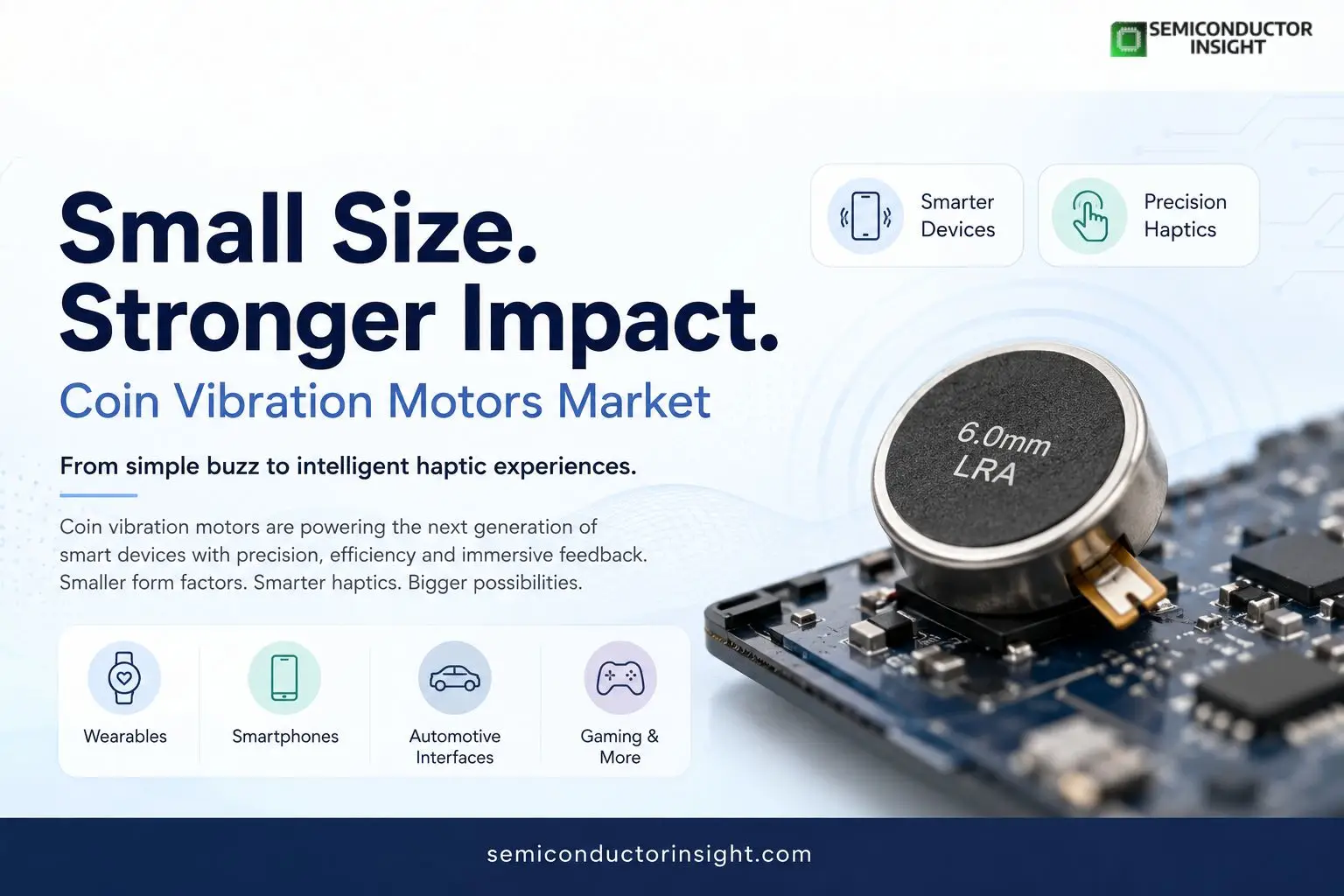
A current Vybronics coin LRA example is available in a 6.0 mm diameter and 2.6 mm thickness configuration, with a listed 260 Hz resonant frequency. The same product family specifies operating voltage around 0.1 to 0.75 VAC and current as low as 12 mA for certain configurations.
These figures illustrate the direction of the industry: small dimensions, controlled resonance and modest electrical requirements are becoming important together rather than independently.
Wearables Are Changing the Definition of Good Vibration
- A smartphone can tolerate a stronger mechanical response because it has a larger enclosure and battery. A smart ring, fitness tracker or compact medical wearable has much less physical and electrical headroom.
- That makes vibration quality more important than raw force. The actuator needs to deliver a noticeable response without creating excessive noise, consuming unnecessary battery power or disturbing adjacent sensors.
- This is one reason LRAs are gaining attention in wearable designs. Their rapid rise and fall characteristics can create sharper tactile events than conventional coin ERM motors.
To find out more, feel free to browse our latest updated report: https://semiconductorinsight.com/report/coin-vibration-motors-market/
Haptics Is Moving Into Automotive Interfaces
The opportunity is also expanding beyond personal electronics.
Research published in the International Journal of Industrial Ergonomics in March 2026 examined vibrotactile feedback as part of takeover-request systems for Level 3 automated driving. The study compared haptic feedback delivered through different locations and technologies, highlighting the growing role of tactile signals in advanced vehicle human-machine interfaces.
For the coin vibration motors ecosystem, automotive adoption presents a different engineering environment, with greater emphasis on durability, temperature tolerance, mechanical integration and consistent feedback.
The Semiconductor Connection Is Getting Stronger
Coin vibration motors are electromechanical components rather than semiconductor devices, but their evolution is closely linked to semiconductor progress.
Modern haptic systems depend on driver ICs, microcontrollers, power-management circuits and increasingly sophisticated control algorithms. The actuator therefore operates as part of a larger semiconductor-controlled feedback loop.
The result is a shift from simply asking whether a motor vibrates to determining how precisely a system can control vibration intensity, frequency, duration and timing.
Why Component Selection Is Becoming a System-Level Decision?
For OEMs, choosing a coin vibration motor increasingly involves more than diameter and voltage. Engineers must consider resonance, current consumption, rise and fall time, mounting orientation, acoustic behavior, driver compatibility and enclosure mechanics.
A 2026 technical reference on LRA and ERM actuator integration notes that changing an actuator can alter electrical impedance, mechanical resonance and back-EMF characteristics, meaning the driver and actuator generally need to be treated as a matched system.
That is an important commercial shift for suppliers. The opportunity is moving toward customized actuator-plus-driver solutions rather than standardized motors sold purely on unit price.
Where the Next Haptic Demand Is Taking Shape
Coin Vibration Motors Market is entering a phase where volume alone is no longer the complete story. Smartphones and wearables remain important application areas, but connected medical devices, gaming hardware, industrial wearables and automotive interfaces are broadening the addressable opportunity.
Manufacturers that can combine thinner form factors with reliable vibration, low electrical demand and application-specific tuning are likely to have an advantage as device designers pursue richer tactile experiences.
The next generation of haptic hardware will therefore be defined less by the size of the motor and more by how effectively that tiny component works with the electronics, software and mechanical architecture surrounding it.

Comments (0)