Coin Vibration Motors Market Insights
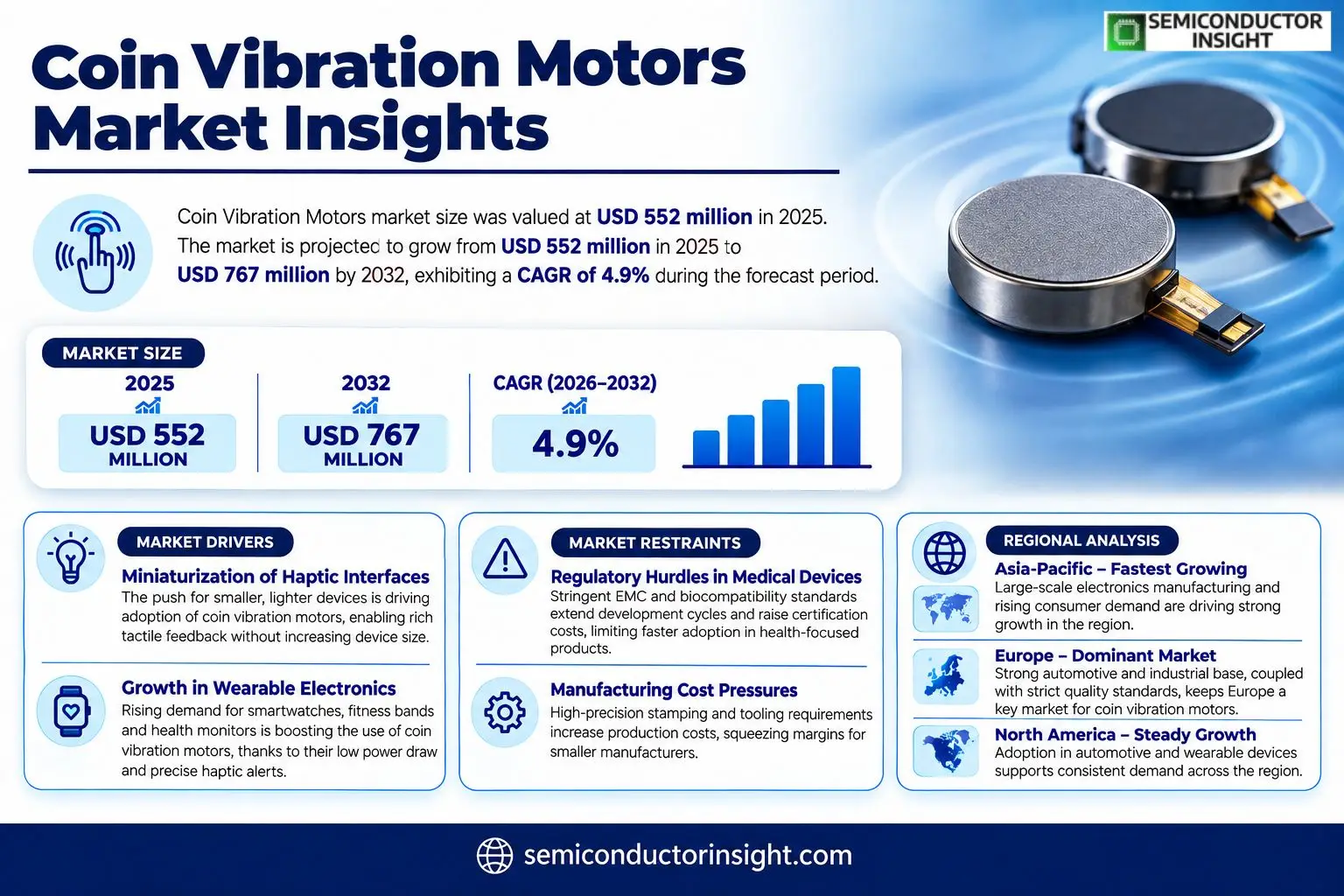
Coin Vibration Motors market size was valued at USD 552 million in 2025. The market is projected to grow from USD 552 million in 2025 to USD 767 million by 2032, exhibiting a CAGR of 4.9% during the forecast period.
Coin vibration motors are compact electromechanical actuators that create tactile feedback by oscillating an eccentric mass mounted on a rotating shaft. Their minimal footprint and low power draw enable seamless integration into smartphones, wearables, gaming controllers, and automotive touch panels where precise haptic cues improve user interaction.The market is experiencing steady expansion because device makers are seeking richer haptic experiences while preserving thin form factors. Advances in magnetic‑circuit design have boosted response speed and durability, prompting adoption in emerging AR/VR headsets. Recent collaborationssuch as Nidec’s partnership with Samsung Electronics announced in March 2024 to co‑develop next‑generation haptic modulesdemonstrate how OEMs are leveraging specialized expertise to differentiate products.
MARKET DRIVERS
Miniaturization of Haptic Interfaces
The relentless push toward smaller, lighter consumer devices has compelled designers to adopt coin‑shaped vibration motors. Their compact footprint enables integration behind slim bezels without compromising tactile feedback. As manufacturers prioritize ergonomics, the demand for these miniature actuators has risen sharply, fueling a steady uptick in component orders.
Growth in Wearable Electronics
Wearables now constitute a sizeable share of the broader electronics market, and haptic alerts remain a core user‑experience element. Coin vibration motors deliver precise, low‑power pulses that extend battery lifean essential attribute for smartwatches, fitness bands, and health monitors. This synergy between power efficiency and tactile quality has made the motor a preferred choice for new product launches.
➤ Manufacturers that secure early access to advanced MEMS‑based motor designs are positioning themselves to capture premium contracts with OEMs seeking differentiated feel.
Overall, the convergence of device thinness and the proliferation of on‑body technology is creating a sustained pull on Coin Vibration Motors Market, encouraging suppliers to expand capacity and invest in reliability testing.
MARKET CHALLENGES
Manufacturing Cost Pressures
Coin motors require tight tolerances and high‑precision stamping processes. The capital outlay for specialized tooling can strain smaller producers, leading to a concentration of supply among a few large firms. This dynamic pushes downstream manufacturers to negotiate tighter pricing, squeezing margins across the value chain.
Other Challenges
Supply Chain Volatility
Flash‑point materials such as rare‑earth magnets and specialty alloys have experienced intermittent shortages in recent years. When lead times elongate, device manufacturers often delay product roll‑outs, which in turn dampens short‑term order volumes for vibration modules.Moreover, the requirement for high reliability in medical‑grade wearables adds an extra layer of testing, increasing time‑to‑market and further tightening cost structures.
MARKET RESTRAINTS
Regulatory Hurdles in Medical Devices
Medical applications subject vibration motors to rigorous electromagnetic compatibility (EMC) and biocompatibility standards. Meeting these specifications often necessitates design revisions and extensive certification, extending development cycles and raising the overall project budget.In addition, the need for device sterilization imposes constraints on motor packaging materials, limiting the range of cost‑effective options available to manufacturers.Because regulatory clearance can take months, companies hesitant to allocate substantial R&D resources may postpone or abandon plans to embed coin motors in health‑focused products.
MARKET OPPORTUNITIES
Integration with Augmented Reality Controllers
AR headsets and handheld controllers rely on subtle haptic cues to guide user interaction without visual overload. The lightweight nature of coin vibration motors makes them ideal for embedding within the thin frames of next‑generation AR devices, where space is at a premium.Manufacturers that can co‑design motor packages with AR ecosystem partners stand to differentiate their offerings, unlocking premium pricing tiers and long‑term supply agreements.Furthermore, the emergence of AI‑driven adaptive feedback loopswhere vibration intensity adjusts in real time based on user behaviorcreates a demand for motors with finely controllable drive circuits, opening a niche for specialized, high‑precision variants within Coin Vibration Motors Market.
Coin Vibration Motors Market Trends
Integration of Miniaturized Haptic Feedback in Wearables
The adoption of ultra‑compact vibration motors has become a decisive factor for wearable manufacturers seeking to enrich user interaction without enlarging device footprints. Engineers are capitalising on the coin‑shaped form factor to embed tactile cues directly beneath flexible substrates, thereby preserving aesthetic thinness while delivering precise feedback. This shift reflects a broader consumer demand for discreet, yet responsive, wearables that can convey notifications, navigation prompts, or health‑monitoring alerts without relying solely on visual or auditory channels. Suppliers that streamline assembly processes and offer tighter tolerance specifications are gaining preference, as OEMs look to shorten time‑to‑market and differentiate their products through refined haptic experiences.
Other Trends
Shift Toward Low‑Power Designs
Battery longevity remains a pivotal concern for devices that operate continuously in the field. Manufacturers are therefore prioritising vibration motors that consume markedly less current while retaining adequate amplitude for discernible feedback. Advances in magnetic circuit optimisation and the use of high‑efficiency coil winding techniques have yielded motor variants that run at voltages as low as 1.5 V, extending operational cycles for portable gadgets. This focus on energy efficiency not only satisfies end‑user expectations but also aligns with regulatory pressures for greener electronics. Companies that can certify their products against stringent power‑draw benchmarks are positioned to secure contracts with large‑scale IoT deployments, where cumulative energy savings translate into significant cost reductions.
Emergence of Customized Form Factors for IoT Devices
Beyond conventional circular designs, OEMs are experimenting with asymmetric and slim profiles to fit irregular cavities in smart appliances, medical implants, and automotive dashboards. By collaborating closely with motor manufacturers, they can request bespoke dimensions that match specific enclosure constraints, thereby eliminating the need for costly redesigns of housing components. This trend is reinforced by the rise of modular platform strategies, where a single product line can be adapted across multiple applications through interchangeable motor modules. Firms that maintain flexible production lines and rapid prototyping capabilities are better equipped to meet these bespoke demands, ultimately fostering stronger partner relationships and opening new revenue streams within niche verticals.
COMPETITIVE LANDSCAPEKey Industry Players
Coin Vibration Motors: Competitive Landscape Overview
Coin Vibration Motors Market is anchored by a handful of multinational manufacturers that control the bulk of volume and technology licensing. Nidec Corporation leads the arena with a comprehensive portfolio that spans miniaturized axial and radial designs, leveraging its deep expertise in precision motor engineering. Johnson Electric follows closely, differentiating through aggressive cost‑optimization and an extensive supply network that serves consumer electronics, automotive and medical segments. Sensata Technologies and CEA have carved out niches by focusing on high‑frequency, low‑torque models tailored for haptic feedback in wearable devices, where form factor and power efficiency are paramount. These dominant players benefit from vertically integrated production lines, enabling rapid iteration of coil winding techniques and magnet material selection, which translates into faster time‑to‑market for OEMs seeking custom solutions.Beyond the primary tier, a diverse set of specialists contributes to market depth. Murata Manufacturing and Alps Alpine supply ultra‑compact modules that integrate vibration drivers with control ASICs, addressing space‑constrained smartphones and gaming controllers. TDK and Bosch bring robust engineering for automotive haptic alerts, emphasizing durability under temperature extremes. Regional firms such as BYD (China) and Samsung Electro‑Mechanics (South Korea) add capacity in high‑volume consumer segments, while emerging innovators like TFE, E‑Spin and Vibration Technologies focus on niche applications such as medical imaging equipment and industrial instrumentation. Their agility in prototyping and willingness to engage in co‑development projects creates opportunities for OEMs to explore differentiated haptic experiences without incurring large upfront tooling costs.
List of Key Coin Vibration Motors Companies Profiled
- Nidec Corporation
- Johnson Electric
- Sensata Technologies
- Murata Manufacturing
- Alps Alpine
- TDK
- Bosch Automotive Aftermarket
- BYD Electronics
- Samsung Electro‑Mechanics
- TFE (Taiwan)
- E‑Spin
- Vibration Technologies
- CEA (France)
- Opendot
- Fong’s Precision
Segment Analysis:
| Segment Category | Sub-Segments | Key Insights |
| By Type |
|
Linear Coin Motors
|
| By Application |
|
Wearable Devices
|
| By End User |
|
Consumer Electronics
|
| By Integration Method |
|
Surface‑Mount Technology
|
| By Functional Requirement |
|
Variable‑Frequency Vibration
|
Regional Analysis: Coin Vibration Motors Market
Automotive interiors, consumer wearables, and industrial handheld tools dominate usage patterns. Engineers prize the motor’s low profile for integrating tactile alerts without compromising ergonomics, prompting design cycles that prioritize haptic nuance over brute force.
Harmonised EU directives on electromagnetic compatibility and product safety compel suppliers to certify each coin motor iteration. This regulatory rigor filters out sub‑standard entrants, elevating the overall quality bar and shaping procurement decisions toward established manufacturers.
Proximity to component foundries and a dense network of contract manufacturers shortens lead times. The ability to source raw materials locally reduces exposure to geopolitical disruptions, granting European firms a logistical edge over distant competitors.
Collaborative research between universities and automotive labs fuels advances in magnetic materials and drive‑control algorithms. These breakthroughs translate into smoother vibration profiles, directly influencing user perception in next‑generation cabin experiences.
North America
North America exhibits a pragmatic adoption curve, where cost efficiency meets functional performance. Leading OEMs in the United States and Canada lean on coin vibration motors to augment driver‑feedback systems in autonomous‑vehicle prototypes, valuing the technology’s rapid response time. Consumer electronics firms, especially those focused on gaming peripherals, exploit the motor’s discreet size to embed nuanced haptic cues without inflating device footprints. The market narrative here is shaped by a blend of venture capital backing for start‑ups and established supply networks that prioritize rapid iteration.
Asia‑Pacific
In Asia‑Pacific, Coin Vibration Motors Market is propelled by a surge in affordable smart‑device production and a burgeoning automotive sector in China and India. Manufacturers capitalize on large‑scale assembly lines to produce cost‑competitive units, while regional design houses experiment with multi‑modal vibration patterns for mobile health wearables. Cultural emphasis on tactile interaction in user interfaces fuels a distinct demand pattern, encouraging suppliers to tailor motor characteristics for region‑specific applications.
South America
South America presents a niche yet growing landscape, where localized automotive assemblers and low‑cost consumer gadget producers drive modest demand. Economic variability encourages manufacturers to adopt coin vibration motors as a means to achieve functional differentiation without significant price penalties. Partnerships between regional universities and component firms are beginning to explore energy‑saving drive circuits, hinting at a future where efficiency becomes a competitive lever.
Middle East & Africa
The Middle East & Africa region reflects a fragmented demand profile, anchored primarily in automotive retrofits and specialized industrial tools. High‑temperature operating environments in parts of the Middle East challenge motor durability, prompting suppliers to innovate with heat‑resistant coatings. In Africa, limited infrastructure pushes firms toward ruggedized designs that can withstand erratic power conditions, shaping a market segment that values reliability above all else.
Report Scope
This market research report provides a comprehensive analysis of Coin Vibration Motors Market, covering the forecast period 2026–2034. It offers detailed insights into market dynamics, technological advancements, competitive landscape, and key trends shaping the industry.
Key focus areas of the report include:
- Market Overview: The report begins with an overview outlining its current market scenario, key growth indicators, and industry transformation drivers. It discusses macroeconomic factors, demand–supply balance, regulatory landscape, and the strategic role of semiconductors in powering advancements across industries such as automotive, telecommunications, consumer electronics, and industrial automation.
- Market Size & Forecast: Historical data and future projections for revenue, unit shipments, and market value across major regions and segments.
- Segmentation Analysis: Detailed breakdown by product type, technology, application, and end-user industry to identify high-growth segments and investment opportunities.
- Regional Insights: Insights into market performance across North America, Europe, Asia-Pacific, Latin America, and the Middle East & Africa, including country-level analysis where relevant.
- Competitive Landscape: Profiles of leading market participants, including their product offerings, R&D focus, manufacturing capacity, pricing strategies, and recent developments such as mergers, acquisitions, and partnerships.
- Technology Trends & Innovation: Assessment of emerging technologies, integration of AI/IoT, semiconductor design trends, fabrication techniques, and evolving industry standards.
- Market Drivers & Restraints: Evaluation of factors driving market growth along with challenges, supply chain constraints, regulatory issues, and market-entry barriers.
- Stakeholder Insights: Insights for component suppliers, OEMs, system integrators, investors, and policymakers regarding the evolving ecosystem and strategic opportunities.
Primary and secondary research methods are employed, including interviews with industry experts, data from verified sources, and real-time market intelligence to ensure the accuracy and reliability of the insights presented.
FREQUENTLY ASKED QUESTIONS:
What is the current market size of Coin Vibration Motors Market?
-> Coin Vibration Motors Market was valued at USD 552 million in 2025 and is expected to reach USD 767 million by 2032, growing at a CAGR of 4.9% during the forecast period.
Which key companies operate in Coin Vibration Motors Market?
-> Key players include Axalta Coating Systems, AkzoNobel, BASF SE, PPG, Sherwin-Williams, and 3M, among others.
What are the key growth drivers?
-> Key growth drivers include railway infrastructure investments, urbanization, and demand for durable coatings.
Which region dominates the market?
-> Asia-Pacific is the fastest-growing region, while Europe remains a dominant market.
What are the emerging trends?
-> Emerging trends include bio-based coatings, smart coatings, and sustainable rail solutions.
Get Sample Report PDF for Exclusive Insights
Report Sample Includes
- Table of Contents
- List of Tables & Figures
- Charts, Research Methodology, and more...