

Smart Wearable Equipment Market Trends Shaping Digital Health, Fitness Tracking, and Semiconductor Integration
Smart wearable equipment market has rapidly transitioned from a niche consumer electronics segment into a strategic intersection of healthcare technology, semiconductor innovation, and connected ecosystems. Devices such as smartwatches, fitness trackers, smart rings, and wearable medical monitors are now embedded with advanced chipsets, biometric sensors, and wireless communication modules that continuously collect real-time physiological data.
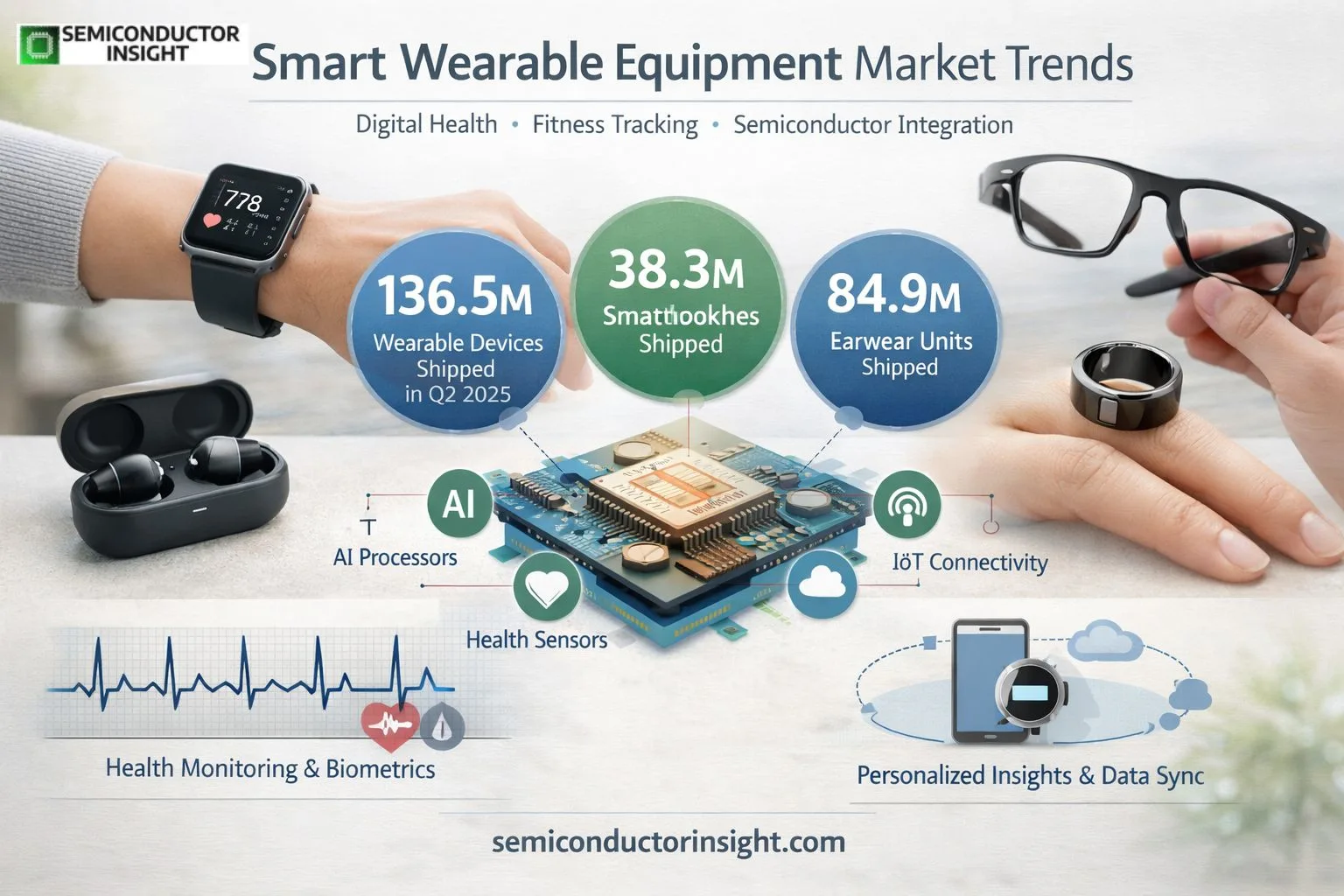
- Global wearable device shipments reached 5 million units in Q2 2025, reflecting a 9.6 million unit year-over-year increase. Audio-focused devices continued to dominate the category, with basic earwear accounting for 84.9 million units, making it the largest segment in the wearable ecosystem.
- Smartwatches followed with 38.3 million units shipped, reinforcing their role as a core consumer device for health tracking and smartphone integration. Wrist bands recorded 10.9 million units, maintaining demand in the affordable fitness tracking segment.
- Meanwhile, smart glasses and smart rings remain an emerging category with a smaller shipment base but growing industry interest as wearable technology expands into augmented reality and advanced health monitoring devices.
Modern wearable devices now integrate multiple semiconductor components including system-on-chips (SoCs), MEMS sensors, power management ICs, Bluetooth chips, and AI accelerators. These integrated technologies are enabling wearables to transition from simple activity trackers into sophisticated digital companions capable of monitoring health conditions, sleep patterns, and cardiovascular signals.
Only a few years ago, wearables were largely associated with step counting. Today, they represent a growing ecosystem supporting telemedicine, remote patient monitoring, and preventive healthcare.
For instance, in March 2026; Qualcomm Technologies Inc. revealed the Snapdragon Wear Elite Platform, a personal AI platform intended to open the door to the next generation of intelligent wearable computers that are genuinely personal and always on. With an NPU for on-device AI and an advanced suite of ultra-low power connectivity solutions, the Snapdragon Wear Elite is the world’s first personal AI wearable platform that works across WearOS by GoogleTM, Android, and Linux. Personal AI devices will be a crucial layer of the intelligent network for the AI era.
Semiconductor Innovation Powering Wearable Intelligence
The progress of wearable technology is closely tied to breakthroughs in semiconductor design. Ultra-low-power processors, advanced sensor arrays, and integrated wireless chips allow devices to perform complex analytics while maintaining minimal energy consumption.
Companies developing wearable chipsets have focused heavily on energy efficiency because wearable devices must operate for extended periods without frequent charging. Advanced fabrication processes such as 5 nm and 7 nm semiconductor nodes have made it possible to integrate multiple computing functions into extremely compact chips.
Miniaturized MEMS sensors also play a critical role. According to research published by the National Institute of Standards and Technology, modern MEMS accelerometers and gyroscopes used in wearables measure motion changes as small as 0.001 g, enabling precise activity and posture tracking.
These innovations allow wearable devices to support sophisticated applications such as ECG monitoring, oxygen saturation measurement, and stress analysis capabilities that were previously limited to clinical environments.
Health Monitoring Becomes the Core Wearable Application
- One of the most important transformations in the wearable equipment market is the shift toward health monitoring. Governments and healthcare organizations increasingly recognize wearable devices as tools that can improve early diagnosis and chronic disease management.
- The S. Centers for Disease Control and Prevention reports that more than 38 million adults in the United States live with diabetes. Continuous glucose monitoring wearables and smart health bands are being developed to help patients track their health metrics more effectively.
- Similarly, wearable heart monitoring technologies are becoming increasingly common. According to the American Heart Association, cardiovascular diseases are responsible for nearly 20 million deaths globally each year, driving demand for consumer devices capable of detecting irregular heart rhythms.
- Wearables equipped with ECG sensors and optical heart rate monitors provide continuous data streams that can help healthcare providers detect abnormalities earlier than traditional check-ups.
- This transition from lifestyle gadgets to digital health platforms is reshaping the value proposition of wearable devices.
You Can Go Through Our Latest Updated Insights Here: https://semiconductorinsight.com/report/global-smart-wearable-equipment-market/
Expanding Consumer Ecosystem and Device Diversity
The wearable ecosystem now includes a wide range of device categories designed for different user groups. Smartwatches remain the largest segment, but new form factors such as smart rings, AR glasses, and connected clothing are gaining traction.
Smartwatch shipments hit 186 million units globally in 2023, accounting for the greatest share of wearable device shipments, according to data from Canalys, a global technology analysis organization. In the meantime, smart bands and fitness trackers are still widely used in developing nations where cost is a major factor.
Another emerging category is wearable medical equipment used in hospitals and remote healthcare monitoring. Hospitals are increasingly adopting wearable sensors that track patient vital signs continuously rather than relying on periodic manual measurements.
These medical wearable can monitor body temperature, respiratory rate, blood oxygen levels, and mobility patterns generating large volumes of healthcare data for clinicians.
Data, Connectivity, and the Rise of Personalized Insights
- Smart wearables generate enormous volumes of health and behavioral data, which are analyzed using AI algorithms embedded within devices or cloud platforms. According to the World Economic Forum, a typical smartwatch can collect more than 250,000 health-related data points per day through its sensors.
- This constant data collection enables highly personalized insights. Wearable devices can detect changes in sleep quality, recommend exercise routines, and alert users about potential health concerns.
- The integration of edge computing chips within wearables also allows many of these analytics functions to run directly on the device rather than relying entirely on cloud processing. This improves both speed and data privacy.
- Wireless connectivity technologies such as Bluetooth Low Energy and ultra-wideband communication are further strengthening the wearable ecosystem by allowing seamless interaction with smartphones, medical platforms, and smart home systems.
Manufacturing Scale and Global Technology Participation
The smart wearable equipment market is supported by a global manufacturing network spanning semiconductor producers, sensor manufacturers, consumer electronics companies, and medical technology firms.
According to data from the Japan Electronics and Information Technology Industries Association, global production of wearable-related electronic components including sensors and microcontrollers exceeded 8.6 billion units in 2023.
This manufacturing scale highlights how wearable devices have evolved into an important segment within the broader semiconductor and electronics supply chain.
As sensor accuracy improves, chip power efficiency increases, and health analytics become more sophisticated, wearable equipment is likely to play an increasingly central role in both consumer technology and digital healthcare systems.

Comments (0)