
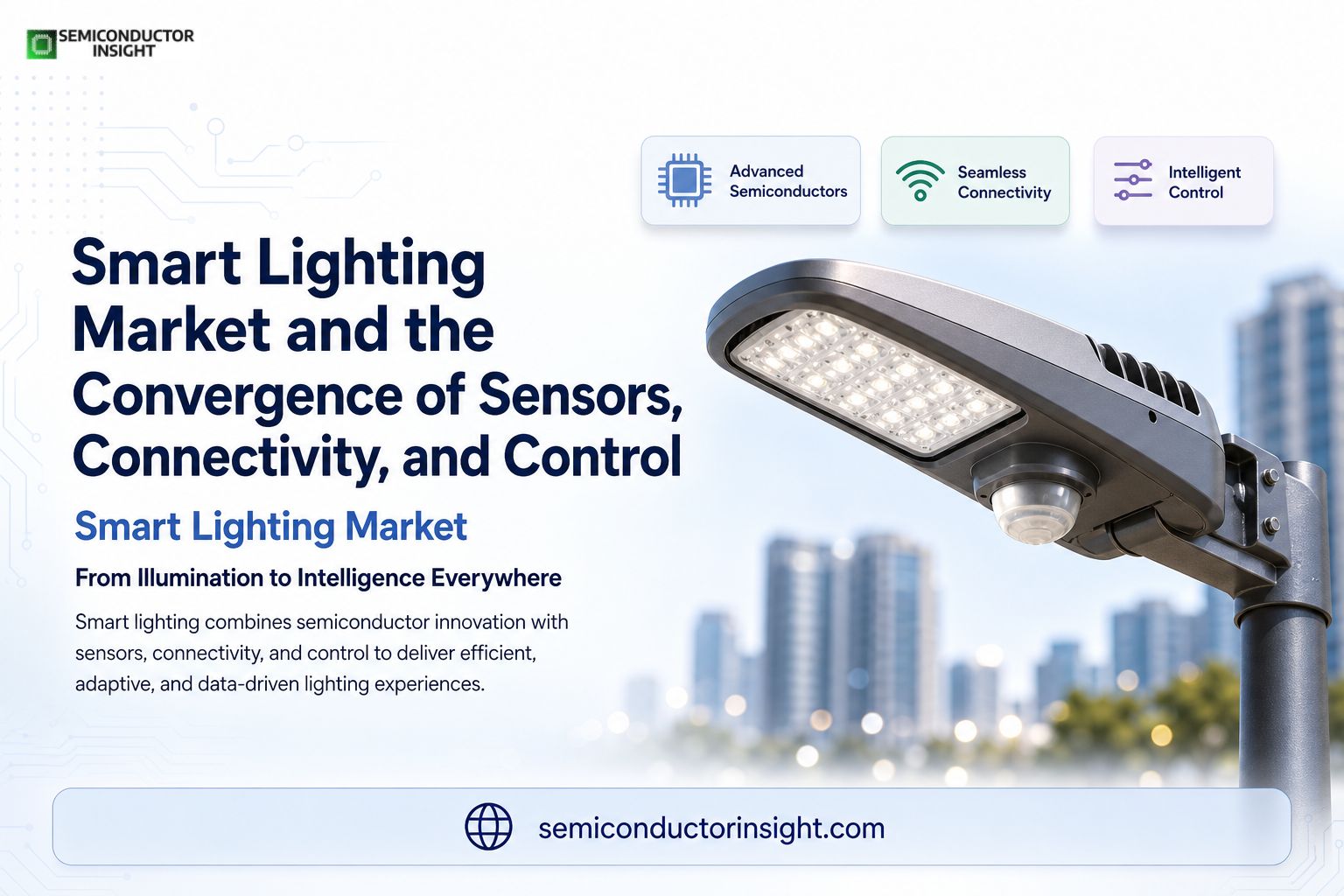
Smart Lighting Market and the Convergence of Sensors, Connectivity, and Control
Smart lighting today sits on a deep semiconductor backbone where LEDs, integrated circuits, sensors, and communication chips work as a unified system rather than standalone components. The shift from incandescent and fluorescent sources to light-emitting diodes has been one of the fastest technology transitions in the energy sector.
According to the International Energy Agency, LEDs now account for more than 50% of global lighting sales, compared to less than 5% in 2013. This transition is not just about efficiency but about controllability, data exchange, and integration with digital ecosystems.
- At the chip level, gallium nitride (GaN) based semiconductors dominate LED production due to their high luminous efficacy and thermal stability. Modern LEDs can achieve efficiencies exceeding 150 lumens per watt in commercial applications, while laboratory prototypes have crossed 300 lumens per watt.
- These gains directly reduce electricity demand. Lighting still accounts for roughly 15% of global electricity consumption, which translates to thousands of terawatt-hours annually, making semiconductor-driven efficiency improvements highly impactful.
Embedded Intelligence inside Lighting Systems
Smart lighting systems rely heavily on microcontrollers, wireless communication modules, and sensor arrays embedded within luminaires. Chips designed for Zigbee, Bluetooth Low Energy, and Wi-Fi enable real-time control and automation. Semiconductor firms are now integrating system-on-chip architectures that combine processing, connectivity, and power management into compact modules, reducing cost and improving scalability.
Sensors play a critical role. Motion sensors, ambient light sensors, and even occupancy analytics systems allow lighting to respond dynamically. For example, occupancy sensors can reduce energy usage by 20-40% in commercial buildings by switching off lights in unused spaces. Advanced daylight harvesting systems adjust brightness based on external light levels, cutting additional consumption without compromising visibility.
Smart Lighting Solutions Providers Shaping the Ecosystem
Smart lighting market is defined by a mix of traditional lighting giants and semiconductor-driven technology companies that bring connectivity and intelligence into the system
- Signify stands out with its Philips Hue ecosystem, integrating app-based control, voice assistants, and IoT platforms. Its connected lighting systems are deployed in homes, offices, and even large-scale smart city projects
- OSRAM has evolved into a semiconductor-focused company, particularly after its opto-semiconductor division expansion, supplying high-performance LED chips used across automotive and industrial lighting
- Cree LED (now operating under Wolfspeed for certain segments) has been instrumental in advancing silicon carbide and GaN technologies, enabling high-efficiency lighting solutions
- Acuity Brands provides intelligent lighting platforms integrated with building management systems, widely used in North American commercial infrastructure
- Zumtobel Group focuses on architectural and human-centric lighting, combining semiconductor efficiency with design precision for high-end applications
- Panasonic integrates smart lighting into broader home automation ecosystems, particularly in Asia, linking lighting with HVAC and security systems
- Samsung Electronics contributes through LED components and IoT platforms, enabling connected lighting experiences in both residential and industrial setups
- LG Electronics leverages its semiconductor and display expertise to develop energy-efficient and connected lighting systems for smart homes
Stay connected for additional in-depth information right here: https://semiconductorinsight.com/report/global-smart-lighting-market/
Data-Driven Illumination and Smart City Deployment
Smart lighting is increasingly integrated into urban infrastructure. Cities are deploying connected street lighting systems equipped with sensors and communication nodes. These systems can reduce energy consumption by 50-70% compared to conventional streetlights.
- For instance, large-scale smart lighting projects in Europe and Asia have replaced hundreds of thousands of streetlights with LED-based connected systems.
- A single smart streetlight can consume 30-60 watts compared to 100-250 watts for traditional sodium vapor lamps.
- When scaled across a city with 100,000 streetlights, this translates into annual energy savings of tens of gigawatt-hours.
These lighting systems serve as data centres in addition to saving electricity. Lighting poles can become multipurpose semiconductor-enabled nodes by hosting traffic monitoring systems, environmental sensors, and even 5G small cell infrastructure.
Manufacturing Scale and Component Economics
The semiconductor supply chain plays a decisive role in smart lighting economics. LED chips are produced in wafer fabs, similar to other semiconductor devices, with wafer sizes typically ranging from 2 to 6 inches for GaN-based LEDs. Advances in epitaxial growth and wafer processing have significantly reduced costs over the past decade.
Today, the cost of LED bulbs has dropped by more than 80% since 2010, making smart lighting more accessible. A standard LED lamp now consumes around 8-12 watts while delivering the same brightness as a 60-watt incandescent bulb. Over a lifespan of 25,000 hours, this results in energy savings of roughly 1,000 kWh per bulb.
Security, Connectivity, and Edge Intelligence in Lighting Networks
- As lighting becomes connected, cyber security and edge computing are gaining importance.
- Smart lighting networks often operate as part of broader IoT ecosystems, requiring secure communication protocols and firmware updates. Semiconductor companies are embedding encryption modules directly into lighting controllers to protect against unauthorized access.
- Edge processing capabilities are also expanding. Instead of sending all data to the cloud, smart lighting systems can now process information locally, enabling faster response times and reducing bandwidth usage.
- This is particularly useful in industrial environments where milliseconds matter for safety and efficiency.
Smart lighting has evolved far beyond illumination. It is now a semiconductor-driven platform where light, data, and intelligence intersect, transforming how spaces are designed, managed, and experienced across residential, commercial, and urban environments.

Comments (0)