
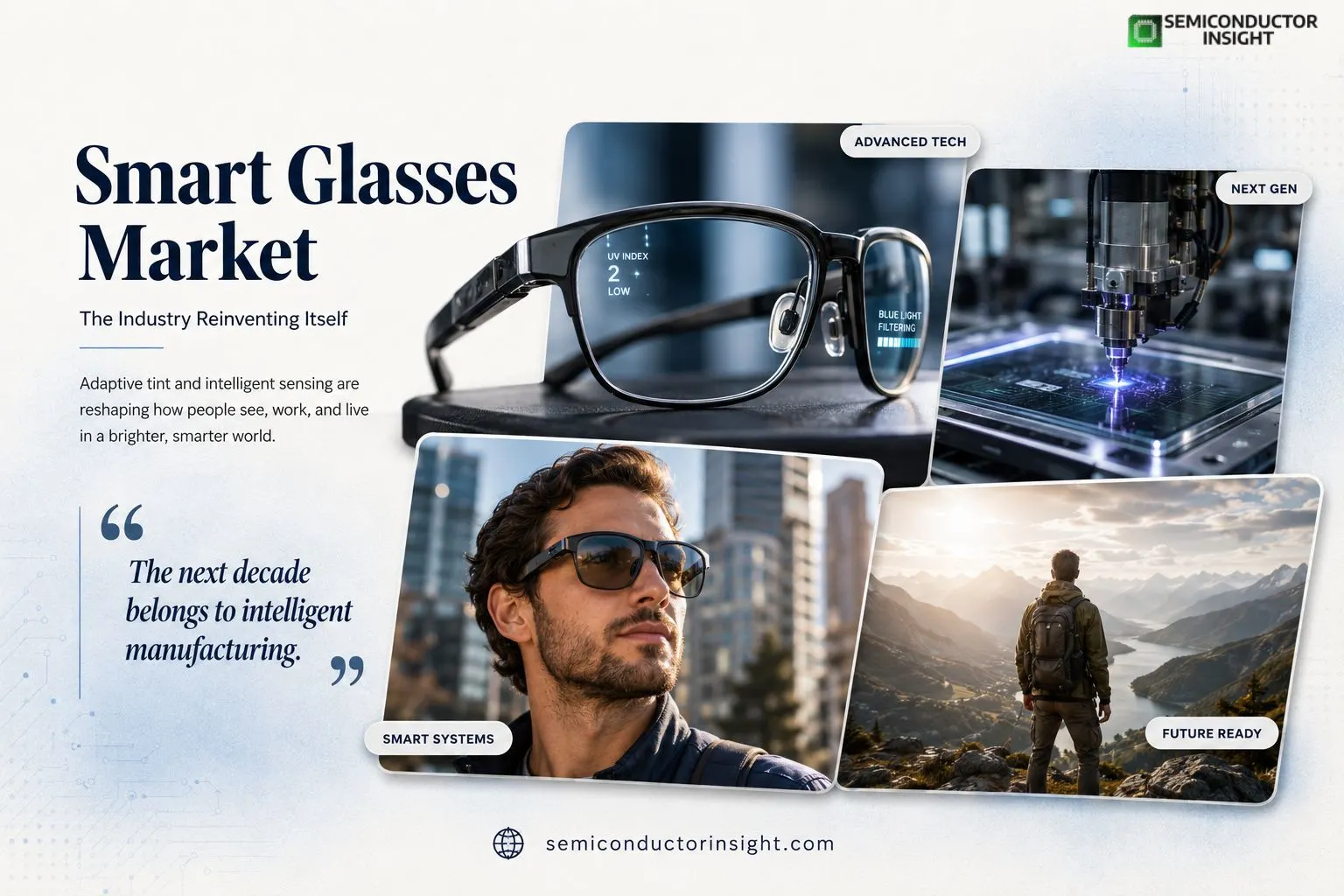
Smart Glasses Adaptive Tint Market 2026 Semiconductor Integration in UV Blue Light Eye Protection Systems
Smart glasses featuring UV index monitoring and adaptive blue light filtering with dynamic tint represent a compelling intersection of semiconductor technology and everyday eye protection. These devices automatically adjust lens darkness based on real-time light conditions while shielding users from harmful rays and digital strain.
Semiconductor Foundations Powering Lens Adaptivity
- At the core of these glasses lie thin-film semiconductor layers, often involving materials like indium tin oxide (ITO) or specialized electrochromic polymers. These enable rapid ion movement when voltage is applied, shifting tint states in fractions of a second.
- Current studies entries on smart glass describe how electrochromic systems use porous semiconductor structures, such as titanium dioxide layers, to host chromogens that alter optical properties under electrical control.
- Patents like US7874666B2 detail laminated structures with electrochromic polymers sandwiched between transparent electrodes and gel electrolytes, allowing precise control over light transmittance.
- This semiconductor-driven approach outperforms traditional photochromic options by responding to both ambient sensors and user input.
Real-World Application Flows in Daily Routines
Consider a typical urban professional starting the day indoors under artificial lights. The lenses stay clear, filtering blue light from screens during video calls or commutes. Stepping outside triggers UV sensors to initiate tinting, providing 100% UVA/UVB blocking as seen in advanced Transitions-style integrations or e-Tint liquid crystal systems that switch in 0.1 seconds.
Outdoor enthusiasts benefit during hikes or cycling, where adaptive tint maintains visibility across varying shade and sunlight while reducing glare. Recent examples include electrochromic models from innovators like Povec, allowing finger-swipe adjustments across multiple tint levels for activities ranging from driving to sports.
Key Performance Metrics in Adaptive Systems
The product offers a tint switch time of 0.1 to 4 seconds, along with 100% UV and blue-violet light filtering, making it well-suited for daily commutes and outdoor use. It also provides light modulation of up to 68%, supporting variable CAT 1 to CAT 3 tint levels for smooth transitions between office and field environments. In addition, its battery can last from several days to a month, thanks to sensor and control integration that supports extended outdoor performance.
Global Adoption Patterns and Volume Indicators
Shipments of smart glasses have shown notable growth, with estimates indicating millions of units moving through markets annually as adoption spreads beyond early prototypes. Historical studies references note projections scaling from tens of thousands in earlier years toward broader consumer and enterprise volumes. China has emerged as a significant production and usage hub, contributing hundreds of thousands of units in recent periods amid rising interest in AI-integrated eyewear.
Installed bases in professional settings, such as logistics and healthcare, demonstrate practical scaling where adaptive lenses support extended wear without frequent adjustments.
You Can Freely Surf Our Latest Updated Report Here: https://semiconductorinsight.com/report/smart-glasses-with-uv-index-and-blue-light-filter-adaptive-tint-market/
Sensor and Display Semiconductor Synergies
UV index detection relies on compact semiconductor photodiodes integrated into frames, feeding data to microcontrollers that command lens tinting. Blue light filtering layers work alongside these, often using organic coatings or nanoparticle semiconductors to selectively block high-energy wavelengths (around 400-500 nm) while preserving color accuracy.
Case examples from technical literature highlight nickel-based phosphate electrochromic films achieving fast coloration (under 3 seconds) and neutral tones for comfortable all-day wear.
Flow of Light Management Technology
- Ambient Detection: Semiconductor sensors measure UV intensity and blue light exposure.
- Signal Processing: Onboard chips analyze data against user preferences or automatic modes.
- Electrochromic Activation: Voltage applied across semiconductor layers triggers ion exchange for tint change.
- Feedback Loop: Continuous monitoring ensures seamless transitions as conditions evolve, such as entering a building or cloud cover.
Integration with Broader Wearable Ecosystems
Modern implementations pair adaptive tint with audio capabilities, as in Meta’s non-prescription lenses that adapt while offering smart functionality. Industrial pilots report efficiency gains when workers use these glasses for hands-free tasks under varying lighting, from warehouses to outdoor maintenance.
Healthcare applications explore reduced eye strain for professionals viewing screens and patients alike, with blue light management supporting circadian rhythm considerations.
Material Science Advances in Lens Construction
Ongoing refinements focus on liquid crystal and electrochromic composites that maintain clarity across states. Patents and research describe multilayer stacks with anti-UV coatings protecting both the user and the device internals from degradation. These advancements support lighter frames suitable for all-day comfort.
User Scenarios across Lifestyles
Remote workers appreciate indoor blue light filtering that transitions effortlessly during breaks. Athletes value rapid response for training sessions spanning indoor gyms to outdoor fields. Travelers benefit from automatic adjustments across time zones and environments, minimizing carry of multiple eyewear options.
Current instances include tactical e-Tint models used in dynamic conditions and consumer versions blending fashion with tech for everyday urban mobility.

Comments (0)